Topics (384k) Articles (398k) Users (410) Discussions (242) Comments (383) Files (13k) New article
Past exam of the biochemistry course of the University of Cambridge 2024 Paper 5 Section 1 p Solution by  Codex 0 2026-10-20
NVNA1 could contribute to cancer by increasing the chance of host chromosome damage and heritable rearrangements. Persistent occupancy of a chromosomal fragile site could obstruct replication or normal chromatin reassembly. Incompletely replicated or damaged DNA can break, mis-segregate and be repaired into deletions, gene fusions or copy-number alterations. Particular surviving rearrangements might remove a tumour suppressor gene or deregulate an oncogene, after which clonal selection could expand that lineage. A viral protein can therefore promote genomic instability without the viral genome having to integrate at every breakpoint.
The tumour-sequencing association is consistent with this mechanism but does not establish causality by itself. tumour type, pre-existing instability, infection detection sensitivity and cellular composition can confound an NV-positive/NV-negative comparison. The induction experiment strengthens the case that NVNA1 can damage the locus, while its high doses limit direct estimation of risk during ordinary viral latency. Very common infection is compatible with rare cancer because susceptible biological cell types, expression fluctuations, time and cooperating alterations all matter. A documented biological analogue links EBNA1 occupancy of a chromosome 11 repeat cluster to chromosome breakage and rearrangement.[ref]
Chromosomal fragile site breakage by EBV-encoded EBNA1 at clustered repeats by Julia Su Zhou Li and others. Figures 3–4 and tumour-genome analysis: locus damage and chromosome 11 structural variants
Past exam of the biochemistry course of the University of Cambridge 2024 Paper 5 Section 1 o Solution by Codex 0 2026-10-20
Codex 0 2026-10-20The evidence supports NVNA1 as a sequence-specific organizer of viral chromatin, with possible additional roles in nuclear retention and episome partitioning. Binding to the origin of replication and DNA bridging explain assembly at separated viral repeat arrays. Access to recognition sites in nucleosomes and weakening of histone–DNA association provide a plausible way to make an origin accessible to cellular replication machinery. The density-labelling result is consistent with a latent genome using a host-coordinated copying programme; it does not establish that NVNA1 is itself a DNA polymerase or DNA helicase.
Association with host chromosomal DNA could also retain episomes in the nucleus and help distribute them during biological cell division. Such tethering is a plausible maintenance function, but the experiments here do not directly visualize a physical bridge between an episome and a host chromosome. Binding at a vulnerable host repeat could instead be an incidental consequence of recognition specificity. The enrichment of host chromosome rearrangements supports a damage connection; it does not show that chromosome breakage is required for viral replication or that integration is part of the normal latent programme. chromatin opening and host-locus interference are mechanistic interpretations of the presented binding data, not proof of one obligatory replication pathway.
Past exam of the biochemistry course of the University of Cambridge 2024 Paper 5 Section 1 n Solution by Codex 0 2026-10-20
Codex 0 2026-10-20The large breakage frequencies occur mainly at supraphysiological NVNA1 levels; the probability at the mean latent level is not measured directly. At 20 ng/ml doxycycline, NVNA1 is already about twice the latent amount, and breakage is about 8%. At 50 ng/ml, the protein is approximately eightfold above latent levels and breakage about 25%; at 100 ng/ml, approximately sixteenfold and about 45–50%. Higher induction reaches roughly 60% while expression rises to about 21–24 times the latent level. The western blot loading control supports a protein-abundance comparison, although quantitative interpretation also requires unsaturated immunoblot detection.
Latent expression, defined as a ratio of one, lies below the lowest nonzero measured dose. Extrapolating a straight line from baseline and the twofold point would suggest a small frequency, but neither linearity nor a threshold is established. The justified conclusion is lower expected short-term breakage than in the strongly induced conditions, with a potentially important effect of modest upward fluctuations. Cell-to-cell variability, duration of expression and repeated divisions could make uncommon events consequential during a persistent infection. A percentage of broken chromosomes in this assay is not a patient's lifetime cancer probability. Doxycycline and tag controls are also needed to attribute the induced-cell phenotype specifically to NVNA1.
Past exam of the biochemistry course of the University of Cambridge 2024 Paper 5 Section 1 m Solution by Codex 0 2026-10-20
Codex 0 2026-10-20aphidicolin increases the abnormal-locus fraction from roughly 40% to about 55–60% in all three lines. Inhibition of replicative DNA polymerases increases replication stress at an intrinsically difficult-to-complete region. Tandem repeats can complicate fork progression or chromosome organization. Slower or incomplete synthesis leaves underreplicated DNA, unresolved replication intermediates or abnormal condensation as biological cells approach mitosis; these can appear as split signals or gaps and can predispose to actual breakage.
This is an increase of approximately 15–20 percentage points, not proof of a 15–20-fold change. The two independent measurements per condition support a reproducible direction, but the graph does not provide enough information for a precise significance calculation or a quantitative model of fork failure. aphidicolin need not bind NVNA1 or the repeat sequence directly. Because these are uninfected biological cells, the result establishes susceptibility of the host locus to replication stress independently of viral protein expression.
Past exam of the biochemistry course of the University of Cambridge 2024 Paper 5 Section 1 l Solution by Codex 0 2026-10-20
Codex 0 2026-10-20The locus frequently appears as an abnormal, fragile-site-like structure rather than a clean replicated pair. A1, B3 and C2 have one dominant signal instead of a clearly resolved sister pair; A2/A4, B1/B4 and C1/C3 show extra, split or irregularly distributed signal components. These patterns are compatible with incomplete replication, abnormal condensation of sister chromatids, or splitting and fragmentation of the repeat-containing region. A single signal can also result from unresolved sisters or inefficient hybridization, so it is not automatically a deletion.
The several small signals should not simply be counted as newly created intact copies: stretching, gaps and fragmentation can divide the fluorescent image of an existing locus. Conversely, amplification would require independent copy-number evidence. The fact that aberrant structures occur in non-infected biological cells indicates intrinsic vulnerability of this host region, rather than a requirement for NVNA1 in their initial appearance. These images alone do not distinguish an undercondensed but continuous DNA region from a genuine DNA double-strand break. Their sensitivity to replication inhibition provides the next mechanistic clue.
Past exam of the biochemistry course of the University of Cambridge 2024 Paper 5 Section 1 k Solution by Codex 0 2026-10-20
Codex 0 2026-10-20The normal patterns are A3, B2 and C4. In each, two principal DNA fluorescence in situ hybridization signals lie at corresponding positions on the two replicated sister chromatids. A single chromosome in mitosis has already replicated its DNA, so a unique locus normally has one copy on each sister, rather than two signals because two homologous chromosomes are being shown.
The other examples show a single unresolved or missing partner signal, extra fragmented signals, or an abnormal distribution. The images are small and relative intensities differ, especially in row C, so the appropriate criterion is the paired principal locus signals at matching positions, not perfect equality of brightness. Counts from many chromosomes, adequate optical resolution and hybridization controls are necessary before classifying borderline examples.
Past exam of the biochemistry course of the University of Cambridge 2024 Paper 5 Section 1 j Solution by Codex 0 2026-10-20
Codex 0 2026-10-20Use fluorescent dCas9 to ask whether NVNA1 foci coincide with a defined host DNA locus. Targeting a candidate repeated region with CRISPR locus labelling would produce a locus marker in a second colour. Reproducible colocalization with full-length NVNA1, but not with a labelled unrelated locus, supports sequence-associated accumulation. A non-targeting guide and biological cells lacking NVNA1 control fluorescence and targeting background; matched expression and nuclear localization control the protein comparison. The inactive Cas9 is important because cleavage itself could create the chromosome damage being investigated.
A complementary causal test would alter the candidate host recognition region and ask whether focal accumulation is reduced while general nuclear NVNA1 remains. Independent edited clones, verification of the host alteration, and an appropriate restored host-site control would distinguish loss of recognition from clone-specific damage or copy-number changes. Colocalization localizes the protein but does not alone prove direct base-specific contact; the biochemical binding evidence supplies that separate argument. Fluorescent CRISPR marking of a repeated host locus has a direct precedent in the EBNA1 study.[ref]
Past exam of the biochemistry course of the University of Cambridge 2024 Paper 5 Section 1 i Solution by Codex 0 2026-10-20
Codex 0 2026-10-20About 80% of full-length-expressing biological cells have two conspicuous nuclear foci, whereas roughly 90% of biological cells expressing the deletion protein have none. Both proteins show nuclear fluorescence, so the result is not explained simply by complete exclusion of the deletion protein from the nucleus. The DNA-binding domain is needed for efficient focal accumulation at a small number of host sites. A plausible explanation is recognition of repeated host DNA sequences resembling the viral binding sites; clustered repeats and homotypic contacts would concentrate the protein enough to create visible foci.
Two spots are compatible with one locus on each homologous chromosome in a diploid biological cell. They do not prove diploidy, identify a chromosome, or exclude unresolved sister loci and cell-cycle effects. An alternative is DNA-dependent recruitment through a host complex. Matching protein abundance and confirming stability of the deletion construct would make the domain comparison stronger. Punctate fluorescence alone does not demonstrate a liquid condensate or show that a focus identifies an origin of replication.
Past exam of the biochemistry course of the University of Cambridge 2024 Paper 5 Section 1 h Solution by Codex 0 2026-10-20
Codex 0 2026-10-20With nucleosomes alone, neither competitor substantially removes the main nucleosome band, although some free labelled DNA is present. With nucleosome–NVNA1 complexes, increasing specific competitor DNA removes the extra shifts and restores the nucleosome band. The starting shifted complexes therefore contained histones as well as NVNA1: competitor recognition sites draw NVNA1 away while leaving labelled DNA associated with histones.
nonspecific competitor DNA gives a different endpoint. The shifted population changes to a band matching the far-right NVNA1–naked-DNA control, rather than returning mainly to the nucleosome position. The labelled DNA remains bound to NVNA1 while histones can transfer to the excess competitor DNA. NVNA1 binding destabilizes the nucleosome against competitor-induced histone displacement. Remaining shifted DNA is not evidence that the histone octamer remained: its mobility must be compared with both controls. The nucleosome-only competition lanes show that competitor DNA alone is insufficient to cause the same conversion. Histone-specific detection would confirm the inferred component loss. A closely analogous ternary-complex and competition analysis was demonstrated for EBNA1; it provides a methodological precedent without establishing the identity of NV.[ref]
Epstein–Barr nuclear antigen 1 binds and destabilizes nucleosomes at the viral origin of latent DNA replication by Tina M. Avolio-Hunter and others. Figures 2–4: ternary complexes, specific competition and histone displacement
Past exam of the biochemistry course of the University of Cambridge 2024 Paper 5 Section 1 g Solution by Codex 0 2026-10-20
Codex 0 2026-10-20The naked labelled DNA runs fastest. Reconstitution creates a slower nucleosome band, with a little residual unassembled DNA. Adding NVNA1 progressively generates several additional, more slowly migrating labelled species and reduces the unbound nucleosome population. These are consistent with ternary protein–DNA complexes containing DNA, histones and NVNA1, with increasing occupancy or altered assembly. The naked-DNA titration also shows several NVNA1–DNA species, reflecting different occupancy states on the repeat-containing fragment.
A mobility shift reports changes in charge, size and shape together. It cannot by itself establish that histones remain in every shifted species, or identify exact protein stoichiometries. In particular, similarity to a band in the naked-DNA lanes could indicate histone loss rather than merely another occupancy state. The specific-competitor experiment in the next part supplies the important compositional test: removal of NVNA1 can regenerate a nucleosome band, demonstrating retention of histones in the starting ternary population.
Past exam of the biochemistry course of the University of Cambridge 2024 Paper 5 Section 1 f Solution by Codex 0 2026-10-20
Codex 0 2026-10-20The cytoplasmic viral signal stays predominantly at high molecular size despite longer nuclease treatment. The viral DNA is protected from digestion, plausibly inside viral capsids or assembled particles. This differs from a nucleosomal ladder: a capsid can shield a whole genome instead of producing repeated small protected units. Release into the cytoplasm during productive infection makes particle-associated DNA a reasonable interpretation.
The virus-negative lane argues against nonspecific hybridization. Protection alone nevertheless does not prove that all detected particles are mature or infectious; an inaccessible compartment or another protective assembly could also shield DNA. Comparing intact material with material whose protective envelope or capsid has been disrupted would distinguish enclosure from intrinsic nuclease resistance of the DNA. Fractionation controls would address nuclear contamination. The result is about physical accessibility of viral DNA, not a quantitative infectivity assay.
Past exam of the biochemistry course of the University of Cambridge 2024 Paper 5 Section 1 e Solution by Codex 0 2026-10-20
Codex 0 2026-10-20Latent viral DNA has regularly spaced nucleosome protection, whereas much of the nuclear viral DNA during productive infection lacks that regular protection. In the latent sample, increasing digestion resolves a ladder of protected fragments, as expected when micrococcal nuclease cuts exposed linker DNA between nucleosomes. In the productive sample, viral signal is lost rapidly into heterogeneous small material rather than accumulating as a comparable ladder. That is consistent with a large pool of newly replicated or otherwise differently packaged viral DNA being more accessible.
The total-DNA ladders show that host chromatin remains nucleosomal and that the assay can recover protected fragments in each cellular condition. The virus-specific Southern blot distinguishes viral DNA from this abundant host background, and the uninfected lane controls probe background. The conclusion concerns the dominant detectable viral population: productive cultures can contain both chromatinized templates in viral latency and accessible replication products. Absence of a ladder does not establish absence of every histone molecule, and differences in DNA recovery or nuclease accessibility should be considered before assigning a precise fraction of chromatinized genomes.
Past exam of the biochemistry course of the University of Cambridge 2024 Paper 5 Section 1 d Solution by Codex 0 2026-10-20
Codex 0 2026-10-20At low concentration, the array with more and higher-affinity binding sites is preferentially occupied, giving one visible protein cluster on an otherwise extended DNA molecule. At higher concentration the weaker origin array also becomes occupied. homotypic protein interactions between proteins at the two arrays can bridge them, trapping the intervening DNA through DNA looping. This explains why the electron-dense protein cluster lies at the loop junction rather than uniformly coating the entire molecule.
The high-affinity array can stabilize weak-site occupancy through tethering: once one partner is anchored, the second site experiences a high effective local concentration and several contacts can contribute avidity. This reconciles stable looped assemblies with the vulnerability of the isolated weak site to nonspecific competitor DNA. The images support intramolecular DNA bridging, but selected micrographs do not measure its frequency or exclude some intermolecular associations. A high local density of protein need not imply biomolecular phase separation. The printed scale-bar unit appears implausible for a kilobase-scale DNA substrate; the mechanistic inference uses topology and site positions rather than that unit.
Past exam of the biochemistry course of the University of Cambridge 2024 Paper 5 Section 1 c Solution by Codex 0 2026-10-20
Codex 0 2026-10-20The DNA-binding domain supports site occupancy, while the region for homotypic protein interaction permits much larger assemblies. With the truncated protein, the faster complex 4 appears at low protein:DNA ratios and gives way to the slower complex 3 as protein increases. A natural assignment is occupancy of one and then both recognition repeats by functional binding units. A binding unit could itself be a protein dimer; a native gel does not determine the number of polypeptide chains from mobility alone. Loss of free probe with increasing protein supports binding, and failure to shift the zero-repeat probe supports sequence preference under these conditions.
Full-length protein instead produces the very slow complex 1 already at relatively low ratios, followed by more of complex 2 at high ratios. homotypic protein interactions can make cooperative higher-order assemblies and can bridge different probe molecules. At protein excess, separate saturation of available sites can reduce productive bridging, explaining why the largest species need not increase monotonically. Complex 2 is compatible with a smaller saturated full-length assembly; assigning its exact stoichiometry requires an independent measurement. protein size also contributes to the difference between full-length and truncated complexes, but size alone does not explain the concentration-dependent redistribution into the exceptionally slow species. The experiment supports assembly dependent on protein oligomerization rather than a unique structure for every numbered band.
Past exam of the biochemistry course of the University of Cambridge 2024 Paper 5 Section 1 b Solution by Codex 0 2026-10-20
Codex 0 2026-10-20Base composition changes both the initial buoyant density and the size of the BUdR-induced density increment. The fraction-number axis runs toward lower density. The unlabelled viral peak lies at a lower fraction number than the corresponding host peak, consistent with viral DNA having a higher GC content. BUdR replaces thymidine in newly synthesized strands, so relatively AT-rich DNA incorporates more brominated nucleoside per unit length and undergoes a larger density increase.
Consequently the more AT-rich host DNA can overtake the viral DNA in the fully substituted class: the host fully heavy peak is slightly farther toward the dense end, although host unlabelled DNA was less dense. The hybrid peaks are intermediate. A useful qualitative model is , and , where is GC fraction, increases with , and decreases as the thymidine fraction decreases. Unequal substitution efficiencies could contribute, but different replication mechanisms are unnecessary. These are equilibrium density positions, not molecular-length measurements.
Past exam of the biochemistry course of the University of Cambridge 2024 Paper 5 Section 1 a Solution by Codex 0 2026-10-20
Codex 0 2026-10-20The viral DNA is copied by semiconservative replication and its labelling kinetics broadly follow those of host DNA during viral latency. At the earliest time the newly labelled material is mainly hybrid: an old light strand has acquired a heavy complementary strand. Fully heavy duplexes accumulate later, after heavy strands themselves serve as templates. Conservative copying would instead produce a separate fully heavy population from the first copying round, while dispersive copying would produce progressively shifting intermediate densities rather than these three discrete classes.
For an ideal synchronous population starting entirely light, one complete round gives only hybrid duplexes; after rounds the hybrid fraction is and the fully heavy fraction is . The actual culture is asynchronous, so these integer-generation proportions cannot simply be imposed at hours. The similar viral and cellular bars support replication coordinated with cell proliferation rather than rapid autonomous amplification. They do not establish that every episome initiates exactly once in every individual biological cell, or prove an initiation time within S phase. Persistent light material also warns against treating the population as a perfectly uniform set of cycling biological cells. The strand-accounting principle is the one tested in [ref]
The replication of DNA in Escherichia coli by Matthew Meselson and Franklin W. Stahl. Figures 3–4: changes in banding over successive copying rounds
. Past exam of the biochemistry course of the University of Cambridge 2024 Paper 4 Section IV 9 Solution by Codex 0 2026-10-20
Codex 0 2026-10-20Bacteria resist turgor through a load-bearing envelope and controlled osmotic balance, then remodel that envelope locally during growth and division without opening an unprotected gap. Rapid mechanosensitive release protects against sudden downshock; sustained wall synthesis and regulation protect during ordinary growth.
Water enters when the intracellular osmotic environment favours uptake, generating turgor pressure. A lipid membrane alone cannot generally sustain the large pressure difference of a normal walled bacterium. The covalent peptidoglycan mesh provides tensile resistance: glycan strands are connected by peptide crosslinks, distributing load over a continuous sacculus. Gram-positive bacteria generally possess a thick wall outside the cytoplasmic membrane. Gram-negative bacteria have a thinner peptidoglycan layer within a multilayer envelope, whose outer membrane and connections can also contribute to mechanical integrity. These architectures should not be treated as identical thin bags.
A simple mechanical model explains the need for reinforcement. For a thin cylindrical wall of radius and thickness under pressure difference , circumferential stress scales aswhile axial stress is about half that value. This idealization neglects the molecular mesh and envelope heterogeneity, but shows why a larger radius or a thinner load-bearing layer increases tensile demand. No pressure, radius or thickness values are supplied, so a numerical stress cannot be inferred from this paper.
Steady growth requires adding wall while preserving connectivity. Cytoplasmic precursor synthesis supplies glycan–peptide building blocks; membrane-associated transport presents them to polymerizing and crosslinking enzymes outside the cytoplasm. Penicillin-binding proteins and associated synthases connect the new material into the sacculus. Controlled cleavage by autolysins permits expansion and insertion, but cutting must be coordinated with synthesis and repair. Unregulated hydrolysis or failure of crosslinking can make turgor destructive. The wall is therefore renewed through spatially and temporally limited reactions, rather than opened wholesale and rebuilt afterward.
In many rod-shaped bacteria, the Rod complex and MreB organize lateral growth. Imaging linked circumferential motion of MreB-associated machinery to ongoing cell-wall synthesis, consistent with coordinated insertion around the cell rather than a static cytoskeletal scaffold alone.[ref]
Coupled, Circumferential Motions of the Cell Wall Synthesis Machinery and MreB Filaments in B. subtilis by Ethan C. Garner and others. Live-cell motion measurements and wall-synthesis perturbations
Species with other shapes use different arrangements; MreB is not a universal component of all bacteria.Division requires a second local remodeling programme. FtsZ polymers help organize the divisome at an appropriate site, where septal synthesis accompanies inward envelope growth. Daughter-cell separation must be delayed until enough new wall protects each daughter. Local hydrolases then cleave selected septal connections. Spatial regulation prevents a division-associated cleavage reaction from becoming a catastrophic breach across the cell sidewall. Membrane constriction, wall synthesis and separation are coupled processes; attributing all division force or protection to one cytoskeletal protein would miss this coordination.
Osmoregulation adjusts the load imposed on this structure. Under high external osmolarity, cells can accumulate ions and compatible solutes to retain water. Upon sudden transfer into dilute medium, the existing solute pool instead drives rapid water entry. MscS and MscL mechanosensitive ion channels open in response to membrane tension and release solutes, reducing the osmotic imbalance before slower transcriptional responses can act. Genetic loss-of-function and downshock experiments demonstrated that these channels protect against extreme turgor.[ref]
Protection against extreme turgor by MscS and MscL by N. Levina and others. Channel-deficient strains challenged by osmotic downshock
Their emergency role differs from routine growth control. A constitutively open large pore would lose valuable metabolites, so gating must be sensitive and reversible. Conversely, emergency release cannot replace a missing wall during sustained growth in an ordinary environment. Envelope-stress sensing, balanced precursor supply, repair and correctly timed hydrolysis remain necessary.
A useful experimental test measures lysis and survival after a defined downshock while independently measuring wall integrity and growth. Rescue with a functional channel distinguishes emergency relief from nonspecific osmotic adaptation, while perturbing a synthase or autolysin reveals the wall-remodeling contribution. Protection is an integrated system: maintain the barrier, regulate its internal pressure, and coordinate the cuts and additions required to grow and divide.
Past exam of the biochemistry course of the University of Cambridge 2024 Paper 4 Section IV 11 Solution by Codex 0 2026-10-20
Codex 0 2026-10-20Losing a parasitic lifestyle requires replacing the benefits supplied by the host while retaining enough performance to survive and reproduce in a new niche. The difficulty depends strongly on how much autonomy the lineage has already lost. Becoming harmless or mutualistic is also distinct from becoming free-living: a nonparasitic association can remain host-dependent.
The first task is to specify the proposed endpoint. A parasite that no longer damages its host might become a commensal, while a mutualist must confer a demonstrable benefit in the relevant setting. Neither transition necessarily restores host-independent growth. The harder transition to free living requires a complete sustainable life cycle without host-provided metabolism, physical shelter or reproductive opportunities. A resistant transmission stage that survives outside a host does not meet that standard if it cannot reproduce there.
Metabolic host dependence is often the strongest barrier. Host-associated lineages can lose biosynthetic pathways when the host reliably supplies their products. Returning to an external niche may therefore require uptake from a new environmental source, restoration of synthesis, or a partnership with another organism. Missing enzymes cannot necessarily be restored by changing one regulator: whole pathways may require transporters, cofactors, compartmentation and coordinated expression. Genome reduction can also remove regulatory and repair functions that were less useful in a protected environment.
The genome of Cryptosporidium parvum illustrates a highly modified parasite, with a reduced complement of metabolic functions relative to many free-living eukaryotes.[ref]
Complete genome sequence of the apicomplexan, Cryptosporidium parvum by Mitchell S. Abrahamsen and others. Genome evidence for a specialized host-associated metabolic repertoire
It is an example of functions that must be accounted for, not proof that every parasite has the same deficiencies. Other parasites retain substantial biosynthetic capacity and may face mainly ecological or regulatory barriers rather than wholesale metabolic reconstruction.Energy metabolism needs a functional replacement as well. An intracellular niche may supply suitable carbon substrates, oxygen conditions or directly useful metabolites. Outside the host, the organism must obtain energy under fluctuating conditions while balancing reducing equivalents and maintaining ion gradients. Reacquiring an ancestral organelle is not the only imaginable solution: an alternative pathway can in principle supply the indispensable function. However, a transporter alone cannot replace an absent energy-generating network unless suitable external substrates and redox partners are available.
Physical and behavioral adaptations create further constraints. A unicellular parasite may need autonomous nutrient capture, motility, osmoregulation and protection from desiccation or oxidative stress. A multicellular parasite with reduced feeding structures, sensory systems or locomotion could require anatomical and developmental changes as well. Structures optimized for host attachment or invasion can be costly or ineffective elsewhere. The organism also encounters predators, competitors and environmental variation that the host previously buffered.
Reproduction and transmission must be reorganized. If a developmental switch depends on a host cue, free-living reproduction requires an alternative trigger. If sexual stages occur only in a specific host, mating and completion of development must become possible elsewhere. New timing and dispersal traits must work with nutrient supply and seasonal conditions. Reducing virulence without solving these life-cycle dependencies does not create an independent lineage.
Evolutionary routes are possible but constrained. Retained ancestral genes can be redeployed, gene duplication can permit new functions, and horizontal gene transfer can sometimes add useful biochemical capacity. These routes require selectable intermediate states: an extensive reconstruction that yields no advantage until complete is difficult to assemble. A facultative association or a nutrient-rich environmental niche can provide stepping stones. Conversely, population bottlenecks, genetic drift and entrenched dependencies can reduce access to viable intermediate phenotypes.
Comparative biology must be interpreted carefully. Chromera velia is a photosynthetic relative of apicomplexan parasites, providing evidence about ancestral capabilities and the evolution of their lineage. Its existence does not show that a modern obligate parasite regained photosynthesis or reversed to free living.[ref]
A photosynthetic alveolate closely related to apicomplexan parasites by Robert B. Moore and others. Phylogenetic and plastid evidence from a photosynthetic relative
A claim of evolutionary reversal needs a well-supported phylogeny and exclusion of contamination or misidentified ancestral free-living relatives.Experimental evidence should be equally demanding. For host independence, demonstrate repeated reproduction and serial passage without host cells or unrecognized host-derived growth factors, then identify the resources and pathways sustaining it. For a transition to mutualism, measure effects on both partners across relevant conditions rather than equating reduced damage with mutual benefit. Nonparasitism is not achieved simply by deleting invasion genes: the lineage must establish a viable resource economy, complete reproduction and persist in the ecological setting that replaces its former relationship with the host.
Past exam of the biochemistry course of the University of Cambridge 2024 Paper 4 Section IV 10 Solution by Codex 0 2026-10-20
Codex 0 2026-10-20Pyocyanin is a diffusible redox-active phenazine whose ecological benefits and damaging effects arise from cycling between electron donors and acceptors. Its production is controlled by a regulatory network linking quorum signals to metabolic state; PqsE promotes the relevant RhlR output through a protein interaction that is distinct from its catalytic activity.
Pyocyanin gives many Pseudomonas aeruginosa cultures their blue coloration. The phenazine ring system accepts reducing equivalents from cellular metabolism and can pass them to oxygen or other accessible acceptors. In oxygenated settings, repeated redox cycling can generate reactive oxygen species and deplete reducing capacity. These effects can harm competing microorganisms and host cells, making pyocyanin a contributor to virulence. Its effects depend on concentration, oxygen availability and the surrounding antioxidant capacity; pigment production alone does not establish the severity of a particular infection.
For the producing bacterium, the same chemistry can help maintain redox balance when local oxidant supply is limited. Experiments comparing a phenazine-deficient strain with pyocyanin supplementation linked the molecule to intracellular redox state and changes in central carbon flux.[ref]
Pyocyanin Alters Redox Homeostasis and Carbon Flux through Central Metabolic Pathways in Pseudomonas aeruginosa PA14 by Alexa Price-Whelan and others. Mutant and supplementation tests of redox balance
In spatially structured biofilms, a redox mediator can connect poorly oxygenated regions with more accessible oxidants. That benefit has costs: synthesis consumes resources and uncontrolled redox cycling can damage the producer, so export and protective responses must be coordinated. The redox-sensitive regulator SoxR contributes to handling endogenous redox-active metabolites in this setting.Biosynthesis also separates pigment amount from regulation alone. The core phenazine biosynthesis loci produce precursors, and modifying enzymes including PhzM and PhzS generate pyocyanin. Cloning and heterologous reconstruction identified contributions of the core loci and the modifying reactions.[ref]
Functional Analysis of Genes for Biosynthesis of Pyocyanin and Phenazine-1-Carboxamide from Pseudomonas aeruginosa PAO1 by Dmitri V. Mavrodi and others. Functional analysis and heterologous phenazine-pathway reconstruction
A mutant can therefore lose blue pigment through a chemical pathway defect even when signal perception is intact. Oxygen-dependent finishing chemistry can likewise decouple transcription from the amount of final pigment.The canonical quorum sensing network contains interconnected Las, Rhl and quinolone systems. In many laboratory strains, the Las quorum-sensing system activates downstream signaling programmes. The Rhl quorum-sensing system uses a butyryl-homoserine-lactone signal with RhlR, while the Pqs quorum-sensing system responds through PqsR to quinolone signals. Positive feedback can amplify expression, but signal concentration reflects diffusion, retention and growth conditions as well as cell number. It is not a simple universal population counter, and the hierarchy can differ between strains.
PqsE is a particularly important connection. Although encoded in the quinolone-pathway locus, its effect on pyocyanin cannot be explained merely by supplying more quinolone. Binding-interface mutants retain catalytic activity yet fail to support the regulatory phenotype, whereas productive interaction promotes RhlR DNA binding. This separates a protein-interaction role from the enzyme's catalytic function.[ref]
The PqsE-RhlR Interaction Regulates RhlR DNA Binding to Control Virulence Factor Production in Pseudomonas aeruginosa by Kayla A. Simanek and others. Binding-interface mutants, DNA-binding and pyocyanin assays
A pathway diagram should therefore include both chemical signal production and the PqsE–RhlR regulatory partnership.Nutrient status, oxygen availability, growth phase and additional global regulators influence this network. These inputs make biological sense: secretion of a costly redox-active product can be useful under one combination of competition and redox stress and wasteful under another. They also explain why a single quorum-signal measurement does not predict pigment yield in every medium or clinical isolate.
To test regulation, measure signal production, relevant transcripts, pyocyanin itself and growth separately. Compare receptor mutants, biosynthetic mutants and PqsE interface mutants, and rescue at controlled expression levels. A catalytic-dead mutant paired with a binding-defective mutant is especially informative. Keep oxygen, pH and biomass matched, because pyocyanin's oxidation state and medium conditions affect its apparent colour. The mechanistic answer joins redox function, biosynthetic chemistry and conditional gene regulation; treating pyocyanin as merely a quorum-controlled toxin omits its metabolic and ecological roles.
Past exam of the biochemistry course of the University of Cambridge 2024 Paper 4 Section III 8 Solution by Codex 0 2026-10-20
Codex 0 2026-10-20Both heterotrophic bacteria and oxygenic phototrophs must connect intracellular reducing power to an external acceptor across insulating cell-envelope layers. The best-characterized heterotrophic systems use dedicated respiratory redox conduits, whereas cyanobacterial export often involves mediators and incompletely resolved routes whose activity competes with photosynthetic metabolism.
In a Gram-negative heterotroph, oxidation of organic substrates supplies electrons to intracellular carriers and the inner-membrane quinone pool. An insoluble iron oxide or an electrode cannot enter the cytoplasm or simply accept an electron through the lipid phase. Extracellular electron transfer must bridge the inner membrane, periplasm and outer membrane before reaching the mineral or electrode surface. This is a sequence of chemically coupled steps, not unrestricted electronic conductivity through the whole cell.
Shewanella oneidensis provides a useful mechanistic example. Quinol oxidation connects through CymA and periplasmic carriers to the outer-membrane MtrCAB assembly. Its cytochromes place redox-active haem groups on the inward and outward sides of a porin-associated structure; surface MtrC can exchange electrons with external acceptors. Reconstitution of oriented MtrCAB in proteoliposomes demonstrated transfer from an internal electron-carrier pool to external Fe(III) oxides, directly testing the membrane-crossing function rather than inferring it from a mutant phenotype alone.[ref]
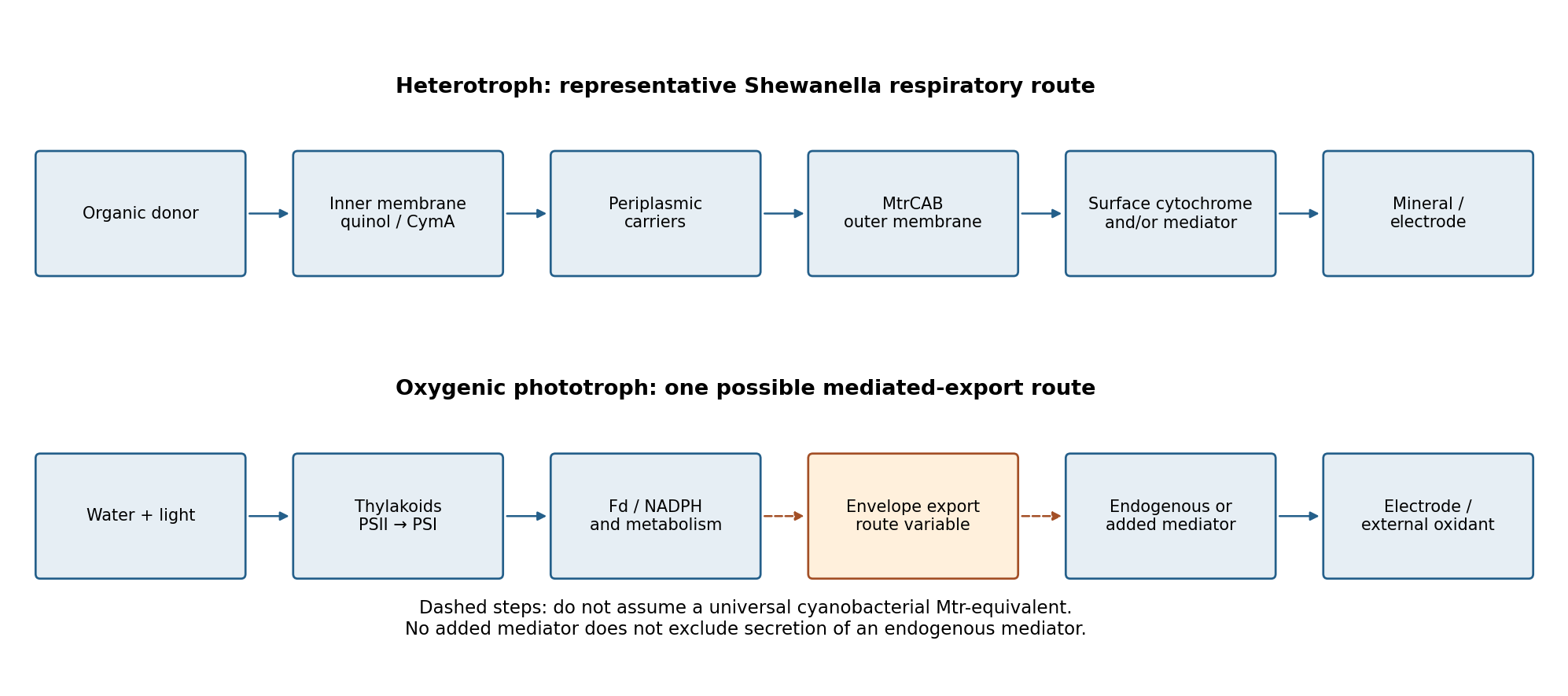
Original comparison of a characterized heterotrophic outer-membrane conduit with alternative phototrophic electron-export routes
. Details. Direct contact is one strategy. Surface cytochromes can reduce a mineral that is close enough, and extracellular conductive structures can extend electron transfer beyond the cell body. Some microbial nanowires are cytochrome-rich filaments or membrane-associated structures; the mechanism should be assigned to the organism and structure actually characterized. Calling every extracellular appendage a conducting pilus is unwarranted. Contact area, attachment and the conductivity of the surrounding biofilm can limit current even when the intracellular respiratory route is functional.
A second strategy uses a redox mediator. The cell reduces a soluble compound, which diffuses to a distant acceptor, transfers its electrons and returns in an oxidized form. Flavin-mediated transfer in Shewanella and phenazine-mediated transfer in some other bacteria illustrate how diffusible chemistry can complement direct contact. Some mediators also associate with proteins rather than remaining entirely free in solution. Mediator availability, diffusion, side reactions and loss into the environment therefore affect efficiency. A poised electrode and an insoluble mineral are not interchangeable acceptors: their accessible potentials, surface chemistry and spatial distribution differ.
For oxygenic phototrophs, light supplies a different upstream route. Photosystem II extracts electrons from water, and photosystem I generates reduced ferredoxin and downstream reducing power. In many cyanobacteria, these reactions occur on internal thylakoid membranes; an electron collected outside must therefore pass through additional metabolic and envelope steps. In eukaryotic algae, the chloroplast envelope and plasma membrane add further compartmental barriers. One should not transplant a Shewanella Mtr diagram into these organisms merely because both produce an electrode current.
The evidence for cyanobacterial export includes mediator-dependent reduction and sensitivity to envelope permeability. In one Synechocystis study, weakening outer-membrane attachment increased photocurrent, while replacing the culture supernatant with fresh medium removed that current under the tested conditions. Ferricyanide reduction provided a complementary readout. These results support a role for extracellular redox-active compounds and an envelope barrier, not identification of one universal cyanobacterial electron-export protein.[ref]
Order-of-magnitude enhancement in photocurrent generation of Synechocystis sp. PCC 6803 by outer membrane deprivation by Shoko Kusama and others. Outer-membrane perturbation, supernatant replacement and ferricyanide-reduction controls
The energetic roles also differ. Mineral-reducing heterotrophs can use an external acceptor in respiratory energy metabolism. A phototroph must retain enough reducing power for carbon fixation, nutrient assimilation and repair; maximal export is not automatically advantageous. Current can persist in darkness through metabolism of stored carbon, and secreted organic material can support heterotrophs that generate part of a measured community current. Oxygen evolution also changes local redox chemistry and can divert electrons away from the electrode.
Mechanistic experiments should separate these possibilities. Compare axenic cultures with mixed communities, light and dark conditions, intact and damaged cells, and cell-free supernatants. Use electrode-potential controls, viability assays, electron-transfer mutants and rescue, together with oxygen and carbon balances. Ferricyanide access must be interpreted relative to its membrane permeability. Most importantly, “no added mediator” does not prove direct transfer: cells can secrete their own mediator. The comparison is therefore between a relatively well-defined family of respiratory conduits and several phototrophic routes requiring organism-specific evidence, with the same general requirements of redox compatibility, envelope crossing and an accessible external sink.
Pinned article: Introduction to the OurBigBook Project
Welcome to the OurBigBook Project! Our goal is to create the perfect publishing platform for STEM subjects, and get university-level students to write the best free STEM tutorials ever.
Everyone is welcome to create an account and play with the site: ourbigbook.com/go/register. We belive that students themselves can write amazing tutorials, but teachers are welcome too. You can write about anything you want, it doesn't have to be STEM or even educational. Silly test content is very welcome and you won't be penalized in any way. Just keep it legal!
Intro to OurBigBook
. Source. We have two killer features:
- topics: topics group articles by different users with the same title, e.g. here is the topic for the "Fundamental Theorem of Calculus" ourbigbook.com/go/topic/fundamental-theorem-of-calculusArticles of different users are sorted by upvote within each article page. This feature is a bit like:
- a Wikipedia where each user can have their own version of each article
- a Q&A website like Stack Overflow, where multiple people can give their views on a given topic, and the best ones are sorted by upvote. Except you don't need to wait for someone to ask first, and any topic goes, no matter how narrow or broad
This feature makes it possible for readers to find better explanations of any topic created by other writers. And it allows writers to create an explanation in a place that readers might actually find it.
Figure 1. Screenshot of the "Derivative" topic page. View it live at: ourbigbook.com/go/topic/derivativeVideo 2. OurBigBook Web topics demo. Source. - local editing: you can store all your personal knowledge base content locally in a plaintext markup format that can be edited locally and published either:This way you can be sure that even if OurBigBook.com were to go down one day (which we have no plans to do as it is quite cheap to host!), your content will still be perfectly readable as a static site.
- to OurBigBook.com to get awesome multi-user features like topics and likes
- as HTML files to a static website, which you can host yourself for free on many external providers like GitHub Pages, and remain in full control

Figure 2. You can publish local OurBigBook lightweight markup files to either OurBigBook.com or as a static website.
Figure 3. Visual Studio Code extension installation.
Figure 5. . You can also edit articles on the Web editor without installing anything locally. Video 3. Edit locally and publish demo. Source. This shows editing OurBigBook Markup and publishing it using the Visual Studio Code extension. 
- Infinitely deep tables of contents:



All our software is open source and hosted at: github.com/ourbigbook/ourbigbook
Further documentation can be found at: docs.ourbigbook.com
Feel free to reach our to us for any help or suggestions: docs.ourbigbook.com/#contact