Topics (384k) Articles (398k) Users (410) Discussions (242) Comments (383) Files (13k) New article

Robin M. Hochstrasser was a physical chemist working on molecular spectroscopy and dynamics. A primary Optica conference record explicitly gives this full-name spelling in the same coupled-vibrator and infrared-echo collaboration whose papers also use the byline R. M. Hochstrasser.[ref]
With M. C. Asplund and Martin T. Zanni, Robin M. Hochstrasser coauthored the2000 phase-controlled peptide experiment in two-dimensional infrared spectroscopy. It used heterodyne detection to recover phase and amplitude of vibrational photon echoes, rather than measuring only an unsigned signal intensity.[ref]
An original field-addition example explains why phase matters. Two contributions of amplitude1 add to total amplitude2 and intensity4 when in phase; opposite-sign contributions cancel to0. Knowing each separate intensity was1 would not determine the combined result. With a known reference field and weak signal field ,For a sufficiently strong reference, the cross term makes the weak field measurable with sensitivity to its relative phase. Changing reference phase samples different field components.
The spectroscopy's scientific power comes from using those controlled relations to constrain molecular interactions. A measured 2D IR cross peak still requires a response model before it establishes a particular coupling or structural assignment. Coherent detection adds information; it does not remove the need for physical interpretation.
David W. McCamant is a physical chemist studying light–matter interactions and fast molecular processes. His Rochester research-group biography describes his Berkeley doctoral work with Richard A. Mathies on femtosecond stimulated Raman spectroscopy. The2003 method paper independently verifies his full byline as David W. McCamant.[ref]
David W. McCamant research-group biography at the University of Rochester. Principal-investigator biography.
[ref]The coauthored apparatus uses a filtered pump near793nm, a continuum probe and spectrally resolved probe/reference detection to measure vibrational gain.[ref]
Femtosecond Broadband Stimulated Raman: A New Approach for High-Performance Vibrational Spectroscopy by David W. McCamant and others. Materials and Methods, Instrumentation and Fig.2.
This makes a molecular vibration accessible through the difference between optical frequencies.For an original conversion example, a793-nm pump and an850-nm Stokes probe correspond to Raman shiftThe factor converts reciprocal nanometres to reciprocal centimetres. Subtracting wavelengths directly would not give the vibrational wavenumber. The850-nm value is stipulated for this example, not attributed as a measured band in the paper.
The method connects pulse design, spectral resolution and quantitative signal processing with questions about molecular dynamics. A rapidly changing signal still needs a molecular assignment and appropriate instrumental controls before it establishes a particular reaction pathway.

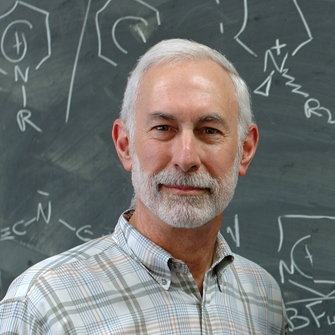
David W. McCamant, portrait identified by his Rochester research-group page
. Philipp Kukura is a chemist developing optical methods for molecular measurements. Oxford's departmental biography records his doctoral work with Richard A. Mathies at Berkeley, while its research description identifies mass photometry and light-scattering-based measurements of individual biomolecules in solution.[ref]
With David W. McCamant and Richard A. Mathies, Philipp Kukura coauthored the broadband femtosecond stimulated Raman spectroscopy method. A narrowband Raman pump and broadband short probe serve complementary spectral and temporal roles in that apparatus.[ref]
A useful motivation for single-particle mass photometry is that a mean can conceal a mixture. For an original illustration, a uniform population of100-kDa objects and a population containing two-thirds120-kDa and one-third60-kDa objects both have mean mass100kDa. Their mass distributions differ. Measurements resolving individual events can test that difference if their resolution, response calibration and selection effects are adequate.
The example is a counting argument, not a reported experiment or an assumption that every event is detected equally. Optical signal must be related to the desired molecular quantity through a validated measurement model. The connection between instrument development and molecular investigation runs through that relation, rather than through signal brightness alone.

Philipp Kukura, portrait identified by his Oxford departmental profile
. Richard A. Mathies is a chemist whose research develops laser-based measurements of molecular reaction dynamics. His Berkeley profile describes work using Raman spectroscopy and femtosecond stimulated Raman spectroscopy to connect changing vibrational spectra with changing molecular structure.[ref]
With David W. McCamant and Philipp Kukura, Richard A. Mathies coauthored the2003 broadband stimulated-Raman method. Its instrumentation combines a spectrally narrow Raman pump with a short broadband probe, so spectral selectivity and rapid probing are assigned different roles in the experiment.[ref]
An original gain example explains what the detector comparison measures. At one probe wavelength, a properly corrected pump-on signal103 and pump-off signal100 give a ratio1.03, or a3% increase. If both readings also contain an unremoved detector offset20, the raw ratio123/120 is only1.025. Background subtraction and normalization belong in the measurement model; a small spectral feature cannot be interpreted independently of them. The primary method uses dark-corrected, reference-normalized gain measurements.[ref]
The scientific contribution is both instrumental and interpretive: obtaining rapid vibrational information requires controlled pulses, detection and a model connecting the optical response to the reacting molecules.

Richard A. Mathies, portrait identified by his Berkeley profile
. Matthias Otto is an analytical chemistry researcher identified in the full title-page byline of the 2004 IUPAC report on multispecies calibration, alongside Klaus Danzer and Lloyd A. Currie. That primary page gives his affiliation as the analytical chemistry department at TU Bergakademie Freiberg. The university's own directory independently lists Matthias Otto among the institute's former staff.[ref]
Guidelines for calibration in analytical chemistry. Part 2: Multicomponent calibration by Klaus Danzer and others. printed p. 1215, full byline and affiliation 2
[ref]Matthias Otto in the TU Bergakademie Freiberg analytical chemistry directory. Former employees, Prof Dr Matthias Otto
The report concerns multivariate calibration: relating several chemical species and their quantities to several measured signals, with uncertainty and model validation treated explicitly. Its sections distinguish classical multivariate calibration, inverse calibration and error diagnosis. This is a coauthored methodological contribution; the byline alone does not assign separate individual roles.[ref]
Guidelines for calibration in analytical chemistry. Part 2: Multicomponent calibration by Klaus Danzer and others. printed p. 1216, Abstract and Contents; §§2–5
An original two-species model illustrates the scientific problem. Let concentration values and two instrument signals be expressed in chosen calibrated units, withThe signals imply and . If the second channel were instead exactly twice the first, giving response matrix , readings would determine only . Merely recording two channels would not make the two species separately identifiable.
This distinction is why calibration mixtures must supply independent information about the species responses and why successful interpolation does not replace validation. Near-dependent response columns can also amplify measurement noise even when a formal inverse exists. Singular value decomposition and the actual calibration design help diagnose such limitations; a regression coefficient is not automatically an independently established chemical effect.
A measurement program can vary mixture composition, collect the same channels under controlled conditions, and test predictions on mixtures not used to fit the response. The example is an ideal calculation, not experimental data from the report. It explains why chemometrics combines chemical knowledge, experimental design and statistical assessment rather than treating a fitted number as a complete analytical result.
Kyungwon Kwak is a chemist working on ultrafast time-resolved spectroscopy of molecular systems. The Institute for Basic Science directory identifies his Korea University chemistry affiliation, Stanford doctorate and research in molecular dynamics. The primary 2007 paper gives the same full byline.[ref]
Kyungwon Kwak profile at the Institute for Basic Science. People search, Kwak, Kyungwon, Information and Research interests
Kyungwon Kwak, Sungnam Park, Ilya J. Finkelstein and Michael D. Fayer coauthored the 2D IR center-line slope method. Their paper defines its slope convention through maxima of frequency-axis slices; that convention matters when converting a plotted geometric slope into a dynamical observable.[ref]
An original bivariate normal distribution gives a transparent geometric example. Let be a centered, scaled horizontal frequency and a centered, scaled vertical frequency. For , take a positive model bandAt each fixed , maximize over . Differentiating the exponent gives . If , the line of maxima has geometric slope , while its inverse is . If , the maxima lie on the vertical line : the geometric slope is unbounded, while the inverse tends to zero. Exchanging axes changes which quantity is called the slope.
This model explains an axis convention; it is not a derivation of the full nonlinear optical response. A measured spectrum can contain homogeneous broadening, overlapping bands, finite-pulse effects and noise. Its fitted line need not be the correlation coefficient of a Gaussian probability distribution. The vibrational frequency-frequency correlation function requires the spectroscopic model that connects molecular fluctuations with the measured band.
The contribution also addresses interferogram apodization: multiplying time-domain data by a window function before the Fourier transform. The paper's stated symmetry and axis restrictions are essential, rather than a guarantee that arbitrary filtering preserves molecular information.[ref]
Frequency-frequency correlation functions and apodization in two-dimensional infrared vibrational echo spectroscopy: A new approach by Kyungwon Kwak and others. Abstract and Introduction, symmetric apodization along the selected axis
Useful processing must retain the observable being interpreted, not merely make the image look smoother.
Kyungwon Kwak, portrait explicitly named on the Institute for Basic Science center's Steering Committee page
. Sungnam Park is a chemist whose research includes time-resolved spectroscopy and the molecular dynamics of complex systems. His laboratory profile identifies him at Korea University and records earlier postdoctoral work with Michael D. Fayer. These primary records connect the named researcher with the ultrafast-spectroscopy collaboration, rather than relying on a surname match.[ref]
Sungnam Park laboratory profile at Korea University. Professor page, identity, Career Summary and Research Areas
With Kyungwon Kwak, Ilya J. Finkelstein and Michael D. Fayer, Sungnam Park coauthored the 2007 method relating a waiting-time-dependent 2D IR center-line slope to molecular frequency correlations under its response approximations.[ref] The byline establishes coauthorship without assigning an individual apparatus or theory role.
An original continuous-time Markov chain illustrates why frequency memory is useful. Let a vibrational probe switch between frequencies and , with the same transition rate in both directions. At equilibrium the two states have equal probability, so the mean frequency is regardless of .
Write the frequency deviation as , where . Over a short interval , a flip of probability reverses its sign. The sign memory therefore obeys , , givingThe vibrational frequency-frequency correlation function distinguishes two systems with the same stationary mean and frequency distribution: gives memory time 1 ps, whereas gives 10 ps. These are ideal model rates, not measurements of a particular solvent.
This loss of molecular frequency memory is an example of spectral diffusion. Experimentally, changing controlled pulse delays tests the temporal relation, while response theory connects the infrared spectroscopy signal to the molecular model. A faster decay need not uniquely identify a microscopic transition mechanism; alternative models and instrumental contributions must be assessed.

Sungnam Park, portrait linked from his named laboratory Professor page
. Ilya J. Finkelstein is a researcher in molecular biophysics whose work includes ultrafast molecular measurements and methods for investigating protein–DNA interactions. His own curriculum vitae identifies him by this full byline, records his Stanford chemistry doctorate and describes later single-molecule and parallel biophysical measurements. The initial J. is not expanded here.[ref]
Ilya J. Finkelstein curriculum vitae and research profile. CV, heading, Education and Five Significant Publications
Ilya J. Finkelstein coauthored the 2007 2D IR center-line slope paper with Kyungwon Kwak, Sungnam Park and Michael D. Fayer.[ref]
Frequency-frequency correlation functions and apodization in two-dimensional infrared vibrational echo spectroscopy: A new approach by Kyungwon Kwak and others. author byline
The paper addresses a practical inverse problem: extracting molecular frequency-memory information from measured spectra, rather than identifying that information with any convenient peak width.His later research profile describes methods that resolve interactions involving individual molecules and many distinct molecular substrates.[ref]
Ilya J. Finkelstein curriculum vitae and research profile. CV, Five Significant Publications; laboratory Members, Ilya Finkelstein research description
An original counting model explains one benefit of resolving separate events. If independent, equally observable sites each bind a probe with probability , the bound count hasConsequently has standard deviation . At stipulated and , that scatter is 0.05. A single observed fraction 0.55 is therefore not by itself evidence for a different binding mechanism.The assumptions are substantive. Sites may interact, molecules may be missed, and a bright object may contain more than one labeled molecule. Background subtraction, detection efficiency and an appropriate measurement model determine whether image counts represent binding events. Averaging more frames does not remove a persistent detection bias.
The common methodological theme is quantitative access to otherwise hidden dynamics: controlled spectroscopy supplies frequency correlations, while molecule-resolved assays can separate populations hidden by an ensemble mean. Neither method replaces controls or a model linking the signal to the molecular quantity of interest.

Ilya J. Finkelstein, photograph linked from his named laboratory curriculum vitae
. Michael D. Fayer is a physical chemist studying molecular dynamics with ultrafast optical methods. His Stanford-hosted curriculum vitae explicitly gives this name; the D. is retained without further expansion. His research description connects two-dimensional infrared spectroscopy with molecular interactions in liquids, confined water and other structured materials.[ref]
Michael D. Fayer profile and curriculum vitae at Stanford. CV, heading and Principal Research Interests; profile, Bio
With Kyungwon Kwak, Sungnam Park and Ilya J. Finkelstein, Michael D. Fayer coauthored the 2007 center-line method for extracting dynamical information from two-dimensional infrared spectroscopy. This is a shared paper contribution, not evidence for separate individual experimental roles.[ref]
The scientific question can be illustrated by an original frequency-fluctuation model. Let be the deviation of a molecular vibrational frequency from its mean, and suppose its vibrational frequency-frequency correlation function isThe normalized memory is . With stipulated , it falls to about 0.368 after 3 ps and 0.0498 after 9 ps. An ordinary mean frequency would not reveal that memory time. These are model calculations, not measurements of confined water.
In the vibrational photon echo approach, controlled optical pulse delays connect an initial frequency label with a later response. The 2D IR center-line slope helps summarize changing spectral geometry. Interpreting that observable as molecular memory requires the response assumptions and axis convention; a slope fitted to arbitrary data is not automatically .
That distinction connects apparatus with theory. Pulse timing, the infrared spectroscopy response and a model of environmental fluctuations all enter the inverse problem. Measurements can constrain how a molecular environment changes while leaving multiple microscopic explanations possible. Michael D. Fayer's Stanford research description explicitly places theoretical analysis alongside the experiments.[ref]
Michael D. Fayer profile and curriculum vitae at Stanford. profile, Bio; CV, Principal Research Interests
Carnitine is a hydroxy-substituted compound with a permanently charged trimethylammonium group and a carboxyl group. Its usual near-neutral aqueous form is a zwitterion. The biological L form has defined stereochemistry; “carnitine” without a stereochemical qualifier does not uniquely specify a pure enantiomer.[ref]
PubChem Compound database by National Center for Biotechnology Information. L-carnitine CID10917 and stereochemically unspecified/DL record CID288
Transfer of a fatty acyl group to its hydroxyl group forms an acylcarnitine. Reversible transfer between carnitine and coenzyme A participates in the movement and use of fatty-acid-derived groups in cellular metabolism. The chemical point is reversible acyl carriage; it does not imply that all stereoisomers have identical biochemical behaviour.
Salicylic acid is 2-hydroxybenzoic acid, : a benzene ring bears adjacent hydroxyl and carboxylic acid groups.[ref]
NIST Chemistry WebBook, SRD 69. Salicylic acid, CAS69-72-7: formula and 2-hydroxybenzoic-acid structure
The two groups supply distinct chemical sites. Acid–base reactions can change their protonation, while derivatization at the phenolic oxygen changes the molecular identity. Their adjacent arrangement also permits intramolecular hydrogen bonding, so moving one group to a different ring position can alter properties despite preserving elemental composition. This makes the compound a useful example of the difference between a formula and a positional isomer.
Adamantane is the saturated cage hydrocarbon . Its carbon framework is a compact three-dimensional network of fused chair-like six-membered rings, with the connectivity recorded by its tricyclic structural name.[ref]
The rigid cage restricts conformational motion. Symmetry can make several carbon or hydrogen positions equivalent in a spectrum, while substitution breaks those equivalences. The molecule therefore provides a useful example of how three-dimensional connectivity and molecular symmetry influence chemical reactivity and spectroscopic counting.
Tropinone is a nitrogen-containing bicyclic ketone in the tropane alkaloid family. Its bridged framework combines a carbonyl group with a ring amine, making it a compact target for studying how several bonds can be constructed in one planned sequence.
Robert Robinson's 1917 synthesis joined small precursors through a coordinated sequence of condensations, building the bridged skeleton instead of constructing each ring independently.[ref]
A Synthesis of Tropinone by Robert Robinson. Original synthesis and its multicomponent construction
The example remains instructive in organic synthesis: choosing mutually compatible reactive fragments can simplify a target more effectively than merely shortening each isolated step.Cephalosporin C is a fungal natural product in the beta-lactam antibiotic family, with formula . Its framework contains a strained four-membered cyclic amide fused to a sulfur-containing six-membered ring.[ref]
PubChem Compound database by National Center for Biotechnology Information. Cephalosporin C, CID65536: formula, connectivity and fungal-metabolite classification
For synthetic chemistry, the challenge is the combination of reactive rings, several functional groups and defined stereochemistry. Making the correct elemental formula is therefore a much weaker test than constructing the complete structure. This compound supplies a concrete example of why total synthesis needs control over connectivity and spatial arrangement together.
Squalene is a thirty-carbon unsaturated hydrocarbon, , with six carbon–carbon double bonds.[ref] Its long chain can be folded and cyclized during the biosynthesis of sterols, making it a useful connection between an acyclic precursor and complex fused-ring structures.
The sequence and geometry of the double bonds matter: they determine which groups can approach during a cyclization. Biological pathways use enzymes to control that geometry and the reaction cascade. Hydrogenation of the double bonds changes the compound's identity, rather than merely purifying the original squalene.
Ketene is the compound , also called ethenone. More generally, ketenes contain the cumulative unit.[ref] Adjacent double bonds make this a different functional group from an ordinary isolated alkene or ketone.
Attack by a suitable nucleophile at the electrophilic carbon can convert a ketene into a carboxylic-acid derivative; addition of water, for example, gives an acid. Substitution around the terminal carbon affects both reaction selectivity and competing pathways. The displayed parent formula should not be confused with every substituted member of the ketene class.
A natural product is a chemical substance produced by a living organism, often discussed in relation to its biosynthesis, structure or biological role. The term commonly highlights specialized metabolites, but its precise breadth depends on context.
Isolating a natural product and making the same molecule by total synthesis are different routes to a chemical identity. A synthetic sample with the same connectivity and stereochemistry is not a different substance merely because its origin differs. Conversely, a matching elemental formula is insufficient: different isomers can have different properties. Source, purity and structural identity should therefore be kept separate.
Phylloquinone, also called vitamin K1, is a Vitamin K compound with formula . Its methyl-substituted quinone ring bears a twenty-carbon phytyl side chain. Sharing the ring framework with menaquinones does not make their complete structures identical: the attached hydrocarbon chains differ.[ref]
Isotope-labelled precursor experiments illustrate why chemical identity matters in metabolism. A labelled product may retain atoms from phylloquinone while having become menaquinone-4. A label traces selected atoms, whereas chromatography and nuclear magnetic resonance help establish the product's identity. The 2010 UBIAD1 study combined labelled Vitamin K derivatives, perturbation of the proposed enzyme and chemical product identification.[ref]
Identification of UBIAD1 as a novel human menaquinone-4 biosynthetic enzyme by Kimie Nakagawa and others. Abstract and Figure 1; conversion of labelled derivatives and identification of labelled menaquinone-4
A menaquinone is a Vitamin K compound with a methyl-substituted quinone ring system and an unsaturated side chain built from isoprene-derived units. The family includes menaquinone-4; the number in MK-4 counts side-chain units, not the number of Vitamin K molecules. The side-chain chemistry distinguishes menaquinones from phylloquinone.[ref]
PubChem Compound database by National Center for Biotechnology Information. Menaquinone entries; compare menaquinone-4 and phylloquinone structures
Menaquinone-4 need not arrive in a tissue as the finished compound. In 2010, reducing UBIAD1 expression in human cells decreased conversion of isotope-labelled Vitamin K derivatives to labelled menaquinone-4; expressing UBIAD1 in insect cells supplied complementary evidence for the biosynthetic enzyme. The product was checked by nuclear magnetic resonance.[ref]
Identification of UBIAD1 as a novel human menaquinone-4 biosynthetic enzyme by Kimie Nakagawa and others. Abstract and Figures 2–3; knockdown, heterologous expression and deuterium NMR
Pyridoxal phosphate is the 5′-phosphate derivative of pyridoxal, a Vitamin B6 form whose ring carries a reactive aldehyde group. It serves as a coenzyme in amino acid chemistry. The phosphate-bearing substituent and the aldehyde have different roles: identifying one does not explain the reactivity of the other.[ref]
Pyridoxal phosphate in ChEBI. CHEBI:18405; definition, structure and classification
An example is 1-aminocyclopropane-1-carboxylate synthase. In a 1990 experiment, chemical reduction with tritium-labelled reagent trapped the coenzyme attached to the enzyme. Subsequent protein digestion and sequencing localized the labelled active-site segment; acid hydrolysis released a modified lysine bearing the pyridoxyl group. This provided chemical evidence for the linkage, beyond observing that adding pyridoxal phosphate improves activity.[ref]
Characterization and sequencing of the active site of 1-aminocyclopropane-1-carboxylate synthase by W. K. Yip and others. PNAS 87, pp. 7930–7934; Abstract, tritiated borohydride labelling and pyridoxyllysine identification
Pinned article: Introduction to the OurBigBook Project
Welcome to the OurBigBook Project! Our goal is to create the perfect publishing platform for STEM subjects, and get university-level students to write the best free STEM tutorials ever.
Everyone is welcome to create an account and play with the site: ourbigbook.com/go/register. We belive that students themselves can write amazing tutorials, but teachers are welcome too. You can write about anything you want, it doesn't have to be STEM or even educational. Silly test content is very welcome and you won't be penalized in any way. Just keep it legal!
Intro to OurBigBook
. Source. We have two killer features:
- topics: topics group articles by different users with the same title, e.g. here is the topic for the "Fundamental Theorem of Calculus" ourbigbook.com/go/topic/fundamental-theorem-of-calculusArticles of different users are sorted by upvote within each article page. This feature is a bit like:
- a Wikipedia where each user can have their own version of each article
- a Q&A website like Stack Overflow, where multiple people can give their views on a given topic, and the best ones are sorted by upvote. Except you don't need to wait for someone to ask first, and any topic goes, no matter how narrow or broad
This feature makes it possible for readers to find better explanations of any topic created by other writers. And it allows writers to create an explanation in a place that readers might actually find it.
Figure 1. Screenshot of the "Derivative" topic page. View it live at: ourbigbook.com/go/topic/derivativeVideo 2. OurBigBook Web topics demo. Source. - local editing: you can store all your personal knowledge base content locally in a plaintext markup format that can be edited locally and published either:This way you can be sure that even if OurBigBook.com were to go down one day (which we have no plans to do as it is quite cheap to host!), your content will still be perfectly readable as a static site.
- to OurBigBook.com to get awesome multi-user features like topics and likes
- as HTML files to a static website, which you can host yourself for free on many external providers like GitHub Pages, and remain in full control

Figure 2. You can publish local OurBigBook lightweight markup files to either OurBigBook.com or as a static website.
Figure 3. Visual Studio Code extension installation.
Figure 5. . You can also edit articles on the Web editor without installing anything locally. Video 3. Edit locally and publish demo. Source. This shows editing OurBigBook Markup and publishing it using the Visual Studio Code extension. 
- Infinitely deep tables of contents:


All our software is open source and hosted at: github.com/ourbigbook/ourbigbook
Further documentation can be found at: docs.ourbigbook.com
Feel free to reach our to us for any help or suggestions: docs.ourbigbook.com/#contact