Topics (384k) Articles (398k) Users (410) Discussions (242) Comments (383) Files (13k) New article

Applied mathematics develops and uses mathematical models, analysis and computation to investigate problems in science, engineering and other fields. Choosing assumptions, deriving consequences and comparing predictions with observations are connected parts of the work. The Society for Industrial and Applied Mathematics describes the field through this cooperation between mathematical methods and practical scientific problems.[ref]
About SIAM by the Society for Industrial and Applied Mathematics. Our Mission and Advance the Application
For a worked example, a uniform-temperature cooling model assumeswhere is a constant ambient temperature. This is Newton's law of cooling. Setting gives , so exponential decay yieldsWith illustrative values , and , the predicted temperature after ten minutes is .
Solving the ordinary differential equation establishes a consequence of the assumptions. Testing the cooling prediction asks whether those assumptions fit the object and conditions. Parameter estimation uses measurements to infer ; disagreement can also reveal missing spatial variation or changing surroundings. This separates a correct mathematical derivation from the empirical adequacy of its mathematical model.
Robotics studies the design, modelling and control of machines that interact with their surroundings through sensing and motion. A robot combines sensors, actuators, computation and a mechanical structure. A robot arm must relate joint motion to the position and orientation of its end effector; a mobile robot must also estimate where it is relative to its environment.[ref]
Modern Robotics: Mechanics, Planning, and Control by Kevin M. Lynch and Frank C. Park. Introductory scope; rigid-body configurations and motion
Kinematics asks which motions a mechanism permits. Dynamics determines the forces and torques needed to produce them, while feedback control corrects deviations using measurements. A desired path is useful only when the mechanism can realize it within constraints such as motor effort, contact and obstacles. These connections make robotics a meeting point of mechanics, geometry, statistical inference and control theory.
Countercurrent flow is an arrangement in which two interacting streams move in opposite directions. In a heat exchanger, a hot stream can transfer heat to a cold stream along the exchanger's length. Each location must have a suitable local temperature difference, although the cold outlet can be warmer than the hot outlet because those outlets are at opposite ends.
For example, with equal constant heat-capacity flow rates and negligible losses, a hot stream cooling from to can heat the opposing stream from to . The end temperature differences are both , and the two energy balances agree. A blast furnace similarly uses opposing solid and gas flows to exchange heat and reactants efficiently.
An actuator turns supplied energy and a control input into a mechanical action, such as a displacement, force or torque. An electric motor produces rotation; a hydraulic cylinder converts fluid pressure into a linear push. The sensor reports a system's state, while the actuator changes it.
In an ideal cylinder with piston area and pressure difference , . Moving at speed requires volume flow , so mechanical power equals hydraulic power before losses. This relation shows why force capacity, speed and supply power must be considered together. In a controlled mechanism, actuator saturation and response time constrain achievable feedback control.
A steam engine is a heat engine that converts part of the energy carried by steam into mechanical work. In a reciprocating design, expanding steam pushes a piston; valves admit and exhaust the working fluid so that the motion can repeat. A crank can convert the reciprocation into rotation. A steam turbine instead extracts work from a continuously flowing stream.
The boiler supplies heat to water, but the engine's useful output depends on pressure changes during expansion and exhaust. For an idealized quasi-static piston, boundary work is . The net work over a cycle is the signed enclosed area on a pressure-volume diagram. Some input heat must be rejected: turning boiler heating into motion does not circumvent the Second law of thermodynamics.
A drop tower is an experimental facility that releases an instrumented package into free fall, providing a short interval of microgravity. The package and its contents accelerate together, greatly reducing the support forces that normally produce apparent weight. Gravity remains present. Evacuating the drop tube reduces air resistance and the resulting disturbance of the falling experiment.[ref]
For release from rest through height with nearly constant gravitational acceleration , , so . A -metre fall gives about seconds in this ideal model, consistent with the facility's reported -second test interval. Such experiments reveal how surface tension, fluid flow and combustion behave when gravity-driven effects are suppressed.[ref]
Zero Gravity Research Facility by NASA. NASA Glenn, 132m drop and 5.18s duration; ideal fall-time calculation derived here
Biomedical engineering applies engineering analysis, measurement and design to problems in biology, medicine and health care. It includes instruments for medical imaging, devices that interact mechanically with the body, biomaterials and tissue engineering. The National Library of Medicine's scope connects experimental and analytical engineering methods with devices, materials, processes and systems for biology and medicine.[ref]
A useful research example combines tensile testing with Raman spectroscopy. A mechanical tester mounted on a Raman microprobe stage held hydrated bone specimens while their mineral spectra were measured during elastic loading. The apparatus connected macroscopic deformation to a molecular-scale observation.[ref]
Bone tissue ultrastructural response to elastic deformation probed by Raman spectroscopy by Michael D. Morris and others. Abstract, coupled tester and Raman microprobe experiment
Neither measurement alone describes every property of the biological system.For an original device-mechanics example, model a uniform elastic test strip of length , area and Young's modulus . Under axial force , the small-extension model givesWith , , and , the predicted extension is . Doubling area halves that extension without changing material stiffness. These stipulated values illustrate a design calculation, not a device recommended for use in a patient.
The model must be tested against relevant biological conditions. Hydration, loading rate, tissue interfaces and biocompatibility can matter alongside stiffness. Bench measurements establish behavior under their test conditions; evidence that a device achieves a clinical benefit requires a separate assessment. A biomedical engineer connects the physical model, the measurement and the intended biological function.
Biomimetics develops engineering principles or designs from the study of biological structures and processes. It asks which mechanism produces a useful function, then tests whether that mechanism transfers to an engineered system. A biological material's appearance alone does not specify the mechanical, chemical or geometric conditions responsible for its performance.
The lotus effect provides a motivating experiment. W. Barthlott and C. Neinhuis contaminated smooth and rough water-repellent plant surfaces with particles, then rinsed them with a sprinkler or fog generator. Droplets rolling from water-repellent surfaces carried contamination away. Their work linked surface microstructure, water repellency and reduced particle adhesion.[ref]
Purity of the sacred lotus, or escape from contamination in biological surfaces by W. Barthlott and C. Neinhuis. Abstract, comparison surfaces and artificial contamination/rinsing experiment
An original idealized Cassie–Baxter state calculation illustrates one possible surface-design principle. Suppose a droplet contacts a solid over projected area fraction and air over the remainder. The apparent contact angle obeysunder the composite-interface assumptions, where is the corresponding smooth-solid angle. Taking and gives . This model shows how geometry can amplify water repellency without replacing the surface chemistry. It does not establish whether a real droplet remains in the assumed state or moves easily.
Transferring the idea therefore requires experiments with contamination, repeated wetting and wear. A large static contact angle alone does not guarantee self-cleaning: pinning and contact-angle hysteresis can prevent a droplet from rolling. The engineering task is to reproduce a useful mechanism under the intended conditions, rather than merely manufacture a rough-looking surface.
An electrical discharge transfers electric charge through a medium or gap. A gas discharge can begin when accelerated charge carriers produce enough further ionization to sustain an electric current. An electron avalanche describes multiplication by successive ionizing collisions; the supply and loss processes determine whether it becomes a sustained conducting state.
A motivating gas-breakdown experiment varies pressure while keeping the gas, electrode separation and electrode geometry specified. The required electric potential difference does not generally decrease monotonically with pressure. At very low density, an electron encounters too few molecules to sustain multiplication; at higher density, collisions can interrupt acceleration before sufficient ionizing energy is acquired. The resulting dependence on pressure and gap is summarized, within its assumptions, by the Paschen law.[ref]
Paschenentladung: Isolation und Plasmaentladung by TU Berlin. A15 experiment description, ionization avalanche and the competing low- and high-pressure limitations
The experimental apparatus therefore needs electrodes with a known separation, pressure control and measurement, and a current-limited electrical source with current and potential measurements. Geometry and electrode surfaces must be recorded along with the gas conditions. A measured onset threshold and the later current–potential characteristic answer different questions; the existence of a glowing plasma is not itself a measurement of its onset threshold.
A data converter translates between an analog quantity and a digital representation. An analog-to-digital converter assigns a code to a measured input; a digital-to-analog converter produces an analog output from a code. The finite code set imposes quantization, while signal sampling determines which times are represented. These are distinct limitations.
For an original ideal model, take an unsigned -bit converter covering with step . Code identifies one interval. Reconstructing at its midpoint gives and . This bounds the error of an ideal uniform quantizer; the probabilistic uniform quantization error model requires further assumptions about the inputs.[ref]
MT-001: Taking the Mystery out of the Infamous Formula by Walt Kester. Pages 1–3, ideal converter levels and quantization error
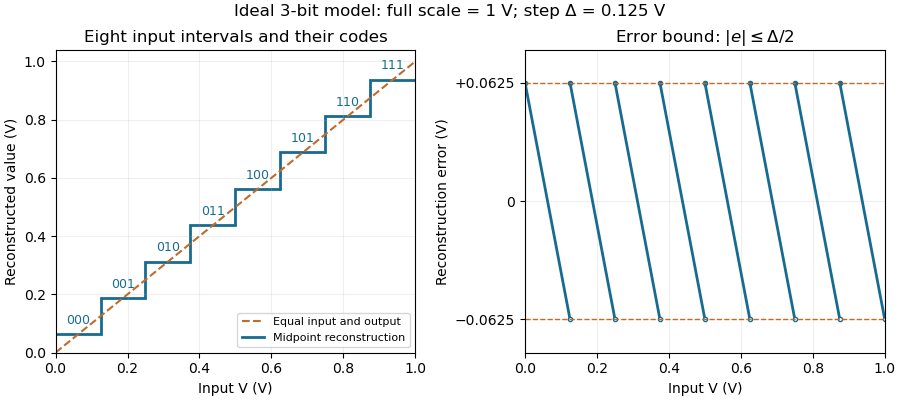
An experiment can slowly sweep a known input and record the transition locations between codes. Unequal step sizes, missing codes and gain or offset errors then become distinguishable from the ideal quantization limit. A changing input adds separate questions about settling and the acquisition time. Quoting only the number of bits therefore does not characterize the complete measurement system.
Telemetry transmits measurements from a remote system to a receiving system. A useful telemetry chain connects a sensor, signal conditioning, a data converter, an encoding and transmission system, and a receiver that reconstructs the reported quantities. Calibration, units and the time of measurement remain part of the scientific meaning of the received data.
Spacecraft illustrate why these stages are distinct. NASA's guide describes science and engineering measurements carried by a modulated downlink, then separated on the ground using their positions in frames or identifying information in packets. Locking a receiver onto the radio carrier is different from recognizing the data frames reliably.[ref]
Basics of Space Flight (2017 edition) by Dave Doody. Chapter 10, Uplink and Downlink; Multiplexing; Telemetry Lock; Channelization
For an original rate calculation, channels sampled at readings per second with transmitted bits per reading require at least bits per second for the raw measurements. Sixteen channels with twelve-bit readings at readings per second require bits per second before framing and other overhead. The receiving display must also distinguish the sample time from arrival time: transport delay and missing records otherwise make a remote process appear to evolve differently from the measured one.
Electroacoustics studies conversion between electrical signals and sound, together with the measurement and control of that conversion. A microphone produces an electrical response to an acoustic input; a loudspeaker performs the reverse conversion. Their frequency responses, loading and directional behavior matter as much as a single sensitivity number.
For a receiving microphone, one can define the complex frequency response in volts per pascal, with the electrical termination and acoustic conditions specified. Equal outputs do not imply equal incident sound pressures if the two microphones have different sensitivities. Calibration supplies the link between the electrical recording and an acoustic measurement.
A motivating primary method is microphone reciprocity calibration. In the NIST system reported by Randall P. Wagner and collaborators, three laboratory microphones are measured in pairs using acoustic coupling cavities. One microphone transmits while another receives; known coupling properties and reciprocity relations allow the individual pressure sensitivities to be determined without starting from a separately calibrated reference microphone. Comparing results with different cavity lengths tests the acoustic corrections and associated measurement uncertainty.[ref]
New Measurement Service for Determining Pressure Sensitivity of Type LS2aP Microphones by the Reciprocity Method by Randall P. Wagner and others. 2011, measurement-system description, reciprocity method and comparison of long and short couplers
Continuum electromechanics couples electromagnetic fields to the motion and deformation of materials modeled as continuous media. The mechanical state changes the fields through geometry and material properties; electric and magnetic stresses act back on the material. A consistent model therefore combines field equations, mechanical balance laws, boundary conditions and constitutive relations.[ref]
Continuum Electromechanics by James R. Melcher. Preface and chapters 2–3, field descriptions and electromagnetic forces
An ideal parallel-plate capacitor gives a simple example. Ignore edge fields and take a vacuum gap , plate area and applied electric potential difference . The electric field magnitude is , and the Maxwell stress tensor gives an attractive electrostatic pressure . Its force magnitude isThe displacement changes the electrical force, so a suspended plate requires a coupled electrical and mechanical equilibrium calculation. A spring supplying the opposing force is not merely an external geometric detail.
The energy bookkeeping also depends on the constraint. At fixed charge, differentiating with the capacitance gives the force. At fixed electric potential difference, the voltage source exchanges energy as the plate moves and must be included. Applying only the field-energy derivative while silently changing this constraint can reverse the inferred force.[ref]
Continuum Electromechanics by James R. Melcher. Chapter 3, electromagnetic forces and thermodynamics of electromechanical coupling
An electrical generator converts mechanical work into electrical energy. In an induction generator, relative motion changes how a conducting circuit interacts with a magnetic field. For an ideal coil with turns and area , rotating at angular velocity in a uniform field of magnitude , the linked magnetic flux is . Faraday's law gives the electromotive forcewith sign determined by the chosen loop orientation. Connecting a load lets this electromotive force drive an electric current; the resulting electromagnetic torque opposes the driving motion, consistent with conservation of energy.
Michael Faraday's rotating-disc apparatus makes the conversion visible without a many-turn coil. A copper disc rotated between magnetic poles, with an external circuit contacting its axle and rim. The motion-dependent Lorentz force separates charge between those contacts. This homopolar generator maintains one output polarity for a fixed field and rotation direction, unlike the alternating output of the rotating-coil example.[ref]
Experimental Researches in Electricity, Volume 1 by Michael Faraday. First Series, §4, paragraphs 85–100: rotating copper disc, conducting contacts, galvanometer and reversal tests
Differential signalling encodes a signal in the electric potential difference between two conductors, . Writing separates this information from the common-mode voltage . A receiver responds primarily to the difference, with finite common-mode rejection ratio in practice.[ref]
Understanding Common-Mode Signals by Analog Devices. Common-Mode Signals Defined and Cables and Noise
For a test, drive one conductor to V and the other to V, giving V. Adding the same 0.3 V disturbance to both preserves . If unequal coupling instead adds 0.30 V and 0.29 V, the receiver sees a 0.01 V differential error. This calculation explains why balanced path impedances matter: common exposure alone does not ensure common coupling. A useful bench measurement compares a shared disturbance with a deliberately unbalanced input path, recording both inputs and the output. Differential transmission also need not mean that either conductor is at zero potential relative to the receiver's reference.
Pinned article: Introduction to the OurBigBook Project
Welcome to the OurBigBook Project! Our goal is to create the perfect publishing platform for STEM subjects, and get university-level students to write the best free STEM tutorials ever.
Everyone is welcome to create an account and play with the site: ourbigbook.com/go/register. We belive that students themselves can write amazing tutorials, but teachers are welcome too. You can write about anything you want, it doesn't have to be STEM or even educational. Silly test content is very welcome and you won't be penalized in any way. Just keep it legal!
Intro to OurBigBook
. Source. We have two killer features:
- topics: topics group articles by different users with the same title, e.g. here is the topic for the "Fundamental Theorem of Calculus" ourbigbook.com/go/topic/fundamental-theorem-of-calculusArticles of different users are sorted by upvote within each article page. This feature is a bit like:
- a Wikipedia where each user can have their own version of each article
- a Q&A website like Stack Overflow, where multiple people can give their views on a given topic, and the best ones are sorted by upvote. Except you don't need to wait for someone to ask first, and any topic goes, no matter how narrow or broad
This feature makes it possible for readers to find better explanations of any topic created by other writers. And it allows writers to create an explanation in a place that readers might actually find it.
Figure 1. Screenshot of the "Derivative" topic page. View it live at: ourbigbook.com/go/topic/derivativeVideo 2. OurBigBook Web topics demo. Source. - local editing: you can store all your personal knowledge base content locally in a plaintext markup format that can be edited locally and published either:This way you can be sure that even if OurBigBook.com were to go down one day (which we have no plans to do as it is quite cheap to host!), your content will still be perfectly readable as a static site.
- to OurBigBook.com to get awesome multi-user features like topics and likes
- as HTML files to a static website, which you can host yourself for free on many external providers like GitHub Pages, and remain in full control

Figure 2. You can publish local OurBigBook lightweight markup files to either OurBigBook.com or as a static website.
Figure 3. Visual Studio Code extension installation.
Figure 5. . You can also edit articles on the Web editor without installing anything locally. Video 3. Edit locally and publish demo. Source. This shows editing OurBigBook Markup and publishing it using the Visual Studio Code extension. 
- Infinitely deep tables of contents:



All our software is open source and hosted at: github.com/ourbigbook/ourbigbook
Further documentation can be found at: docs.ourbigbook.com
Feel free to reach our to us for any help or suggestions: docs.ourbigbook.com/#contact