Topics (384k) Articles (398k) Users (410) Discussions (242) Comments (383) Files (13k) New article

A biological membrane is a thin, organized boundary built from lipids and associated proteins that separates cellular compartments while controlling exchange and communication. The cell membrane bounds the whole biological cell; internal biological membranes surround structures such as the endoplasmic reticulum and mitochondrion. A biological membrane is therefore more general than the outer boundary of a cell.
The basic lipid bilayer puts water-compatible groups toward the surrounding water and hydrophobic portions toward its interior. Its barrier properties make transport selective: crossing a biological membrane through the lipid interior differs from moving through an ion channel or a transporter protein. Such selectivity allows different chemical conditions on the two sides, including an electrochemical gradient that can store usable energy. Membrane proteins also provide receptors, enzymes and attachment sites.
A biological membrane is organized but can remain fluid. In the mouse-human heterokaryon membrane-mixing experiment, Larry Frye and Michael Edidin fused cells whose surface antigens could be distinguished by different fluorescent antibody labels. Initially separate patterns became intermixed, providing evidence for lateral mobility of membrane proteins. This helped motivate the fluid mosaic model: many components can move within a shared membrane rather than occupying a completely rigid shell.[ref]
The rapid intermixing of cell surface antigens after formation of mouse-human heterokaryons by Larry Frye and Michael Edidin. Journal of Cell Science 7 (1970), 319–335: distinguishable parental surface antigens redistribute after cell fusion.
The experiment tests lateral redistribution, not unrestricted movement across the lipid bilayer or unlimited motion of every membrane protein. The distinction is useful: a boundary can preserve different environments across its thickness while permitting substantial rearrangement within its plane.
A phagocyte is a biological cell that takes up particles, such as bacteria or cell debris, by phagocytosis: the cell membrane encloses the material in an intracellular phagosome. Macrophages and neutrophils are important examples. The term describes an uptake capability, rather than a single developmental lineage. Contact with a particle, internalization and destruction of the ingested material are distinct events.
A useful experimental distinction is between phagocytosis and production of reactive oxygen compounds. S. D. Wright and S. C. Silverstein measured hydrogen peroxide released by human granulocytes, monocytes and macrophages spreading on surfaces coated with defined recognition molecules. Surfaces carrying IgG stimulated peroxide release, whereas surfaces carrying C3b or iC3b did not appreciably do so. Even when fibronectin supported a strong complement-receptor-associated phagocytic response in cultured monocytes, measurable peroxide release did not follow.[ref]
Receptors for C3b and C3bi promote phagocytosis but not the release of toxic oxygen from human phagocytes by S. D. Wright and S. C. Silverstein. Abstract and Figure1: ligand-coated surfaces, cultured monocytes and separate uptake/oxidant endpoints.
For example, counting ten particle-containing phagosomes would establish uptake in the observed phagocyte; it would not count ten killed bacteria. A killing assay needs a further endpoint, such as recovery of viable organisms. Likewise, a low extracellular peroxide measurement alone does not establish absence of phagocytosis. Choosing an endpoint that matches the biological question is essential when comparing phagocytes.
RELION is software for statistically regularized reconstruction and classification of macromolecular structures from single-particle cryo-electron microscopy images. A particle image is a noisy projection with initially uncertain orientation and displacement. The reconstruction must infer those hidden quantities while estimating the three-dimensional structure. [ref]
RELION: implementation of a Bayesian approach to cryo-EM structure determination by Sjors H. W. Scheres. 2012, Bayesian formulation, regularization, hidden orientations and iterative refinement
The Bayesian framework combines an image likelihood with prior information that limits unsupported high-resolution detail. Iterative classification can separate subsets consistent with different structures rather than averaging every particle into one object. Regularization does not guarantee a correct result: starting models, image quality, heterogeneity and validation still matter. A sharp-looking reconstruction is a model inferred from measurements, not a direct three-dimensional photograph.
Protein purification separates a selected protein from other components of a sample while recovering material useful for a subsequent measurement or application. Different procedures exploit different properties. In affinity chromatography, a matrix-bound ligand selectively retains the target through a reversible interaction.[ref]
Agarose Derivatives for Purification of Protein by Affinity Chromatography by Pedro Cuatrecasas. opening text, selective interaction with an immobilized ligand
An enzyme example separates recovery from enrichment. Suppose a starting fraction contains total protein and measured activity units, while a collected fraction contains and units. The specific activity rises from to units per milligram: a threefold increase. Recovery of activity is , or . These are constructed assay values, not reported experimental data.
The preparation can therefore be enriched even while some target activity is lost. That inference assumes the assay reports the same catalytic property under comparable conditions; activation or inhibition can change activity without an equivalent change in protein amount. Protein purification consequently needs a stated target, an identity or activity measurement, and a recovery criterion. A visually clean fraction alone does not establish that its protein remains functional.
Molecular recognition is selective association between molecules through noncovalent interactions, often involving complementary shape and charge. A binding partner can distinguish chemically similar molecules without permanently joining them by a new covalent bond.[ref]
IUPAC Compendium of Chemical Terminology, fifth edition (Gold Book). entry 08187, molecular recognition; DOI 10.1351/goldbook.08187
A simple one-site chemical equilibrium model makes selectivity quantitative. Let a free ligand concentration be , and let the dissociation constant of its complex with a binding partner be . With independent sites and negligible depletion of free ligand, the bound fraction is . For two partners with illustrative values of and , supplying gives fractions and .
Thus association can favor one partner strongly at a stated concentration. At very high ligand concentration, both fractions approach one, so selectivity in a practical measurement depends on conditions as well as binding constants. Affinity chromatography exploits this principle by attaching a ligand to a support and retaining selected proteins.[ref]
Agarose Derivatives for Purification of Protein by Affinity Chromatography by Pedro Cuatrecasas. opening text, reversible selective interactions
Recognition alone does not imply catalytic conversion or a downstream cellular response.Relative biological potency compares the biological activity of a test preparation with a reference in a specified bioassay. In a common-shape concentration-response model it is the concentration multiplier satisfyingConsequently equal-effect concentrations obey : a more potent preparation requires less material for the same response. The ratio is dimensionless when both concentrations use the same basis. It depends on the biological system, endpoint and measurement conditions, rather than being a universal measure of chemical purity.
An original dose-response relationship uses and . Solving for a response givesTheir ratio is at every response. If the reference needs 10 concentration units and the test needs 5 for the same response, relative potency is two. If the curves do not have the common shape required by bioassay parallelism, that ratio can change with response level and a single potency parameter may be unsuitable.
State the preparation basis before interpreting the ratio. In an illustrative dilution example, a test stock has twice the activity per unit volume of a reference stock. Preparing the test at tenfold dilution and the reference at fivefold dilution makes their assayed solutions equally potent: . The original stock ratio is recovered by multiplying that result by . A fitted ratio for the diluted solutions is not automatically the ratio of the original stocks.
If a reference has calibrated activity on the same basis, the test estimate is . For independent inputs, first-order uncertainty propagation givesFor stipulated activity units per millilitre with standard uncertainty 5, and with standard uncertainty 0.04, the result is 80 units per millilitre with standard uncertainty about 5.66. These assigned calibration uncertainties are illustrative, not a definition of an International Unit. Reference-standard uncertainty in relative potency can be shared between many test results; covariance must be retained when those results are combined.[ref]
A primary USP application note uses a potency standard, test preparation and assay control with L929 cells to assess etanercept-dependent TNF-alpha neutralization through cell viability.[ref]
Etanercept for Bioassays reference-standard application note by United States Pharmacopeia. Figure 2 and How and when to use the etanercept bioassays reference standard
Its assay-control role differs from assigning the reference's activity scale. Report the reference identity, concentration basis, response model, suitability assessment and confidence interval alongside a potency estimate. A chemically precise concentration measurement does not by itself replace the biological activity comparison.Bioassay parallelism is the common-shape relationship in which test and reference dose-response relationships differ only by a constant horizontal shift on a logarithmic concentration axis. Under that relationship, relative biological potency is independent of which response level is used for an equal-effect comparison. “Parallel” refers to a specified response model; it need not mean two straight lines on the original concentration scale.
For an original sigmoid model, write andCommon lower response , upper response and slope parameter give parallel curves; different midpoints give relative potency . Only the horizontal location changes. The logistic function provides the common mathematical shape, while experimental suitability determines whether it describes the biological observations.
An original equal-effect example uses and . Their concentration ratio at every response strictly between zero and one is . By contrast, replace the test curve with . The reference and test now have the same half-response concentration, 10, but their equal-effect ratios are 0.5 at response 0.2 and 2 at response 0.8. A single midpoint ratio would conceal nonparallelism.
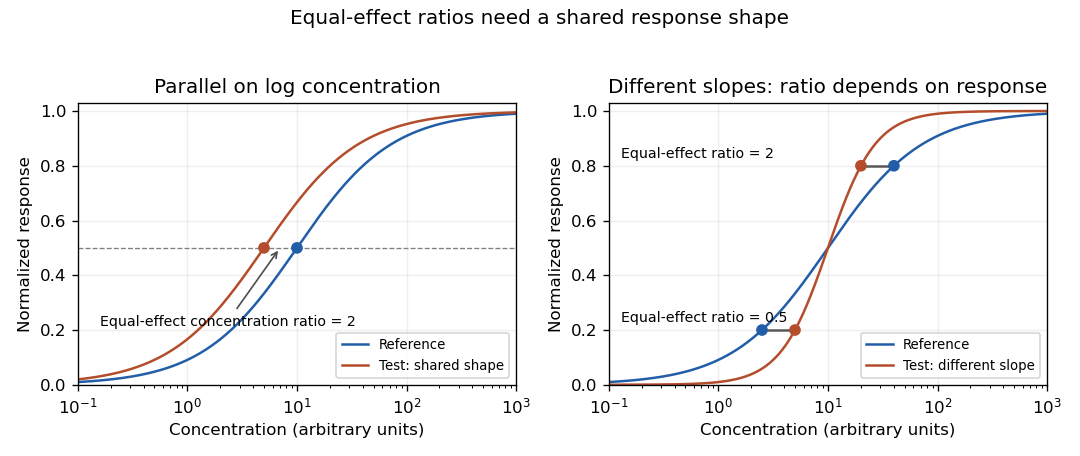
Original stipulated response curves: a common log-concentration shape gives constant equal-effect potency, while different slopes give response-dependent ratios
. Details. Practical evidence for similarity requires more than a nonsignificant difference test. A bioassay parallelism equivalence margin specifies how much departure is acceptable for the intended assay. An equivalence test can then ask whether the uncertainty interval lies within that prespecified range. For an illustrative acceptable slope-ratio range 0.8–1.25, an interval 0.9–1.1 supports that slope criterion; an interval 0.6–1.4 does not. These numbers are hypothetical design choices, not universal pharmaceutical limits. For nonlinear curves, agreement of the upper and lower responses matters as well as slope.
A primary USP application note describes etanercept activity through neutralization of TNF-alpha in L929 cells, using a multiwell cell viability readout, and identifies establishment of equivalence limits for parallelism as one use of its reference standard.[ref]
Etanercept for Bioassays reference-standard application note by United States Pharmacopeia. How and when to use the etanercept bioassays reference standard; Figure 2
This illustrates an experimental response chain rather than merely fitting arbitrary curves.Test and reference should be distributed across the relevant concentration range, with procedural controls, biological replication and recorded dilution preparation. Plate position, cell condition and serial dilution errors can generate structured differences. A common-shape fit imposed from the start cannot independently demonstrate that the shapes were sufficiently similar. Distinguish a useful potency model from evidence that its assumptions hold.
An atomic transition changes an atom between quantum states. For states with energies , a single-photon resonant transition obeys . Absorption raises the atomic energy; spontaneous or stimulated emission lowers it.
Energy matching is necessary but not sufficient: the interaction matrix element and selection rules determine whether a transition is allowed and how strong it is. For an electric-dipole transition between angular-momentum states, polarization determines which magnetic sublevels can be coupled. Transitions therefore provide information about both level energies and state symmetry.
Surface ionization forms ions when atoms interact with a surface and leave after exchanging electrons. For positive ion production at a hot surface, the equilibrium Saha-Langmuir ratio has the form , where is the surface work function, the atomic ionization energy, and a statistical-weight ratio.
A high work function favors leaving an electron behind. Alkali atoms, with relatively low ionization energies, can therefore be detected efficiently by converting neutral arrivals into countable ionic signals. Surface condition and temperature matter, so the equilibrium expression is a model to check rather than a universal detector calibration.[ref]
An atom laser produces a coherent output of matter waves, often by extracting atoms from a Bose-Einstein condensate. Unlike an optical laser, its output consists of massive atoms and responds strongly to gravity and atomic interactions.
In the demonstrated radio-frequency output-coupling method, a pulse transfers part of a trapped condensate into an untrapped magnetic substate. The released atoms leave the trap while retaining coherence associated with the condensate. Varying the pulse controls the extracted fraction. The experiment makes the analogy with a laser concrete, while an output coupler alone does not imply that the reservoir is continuously replenished.[ref]
Magnetic resonance is a resonantly driven transition between states whose energy separation depends on a magnetic field. A static field splits magnetic substates through the Zeeman effect, while an oscillating transverse field supplies energy near the transition frequency. For a simple spin with gyromagnetic ratio , the angular resonance frequency is .
In the Rabi molecular beam magnetic resonance experiment, inhomogeneous magnets selected and refocused molecular trajectories. A radio-frequency field changed magnetic substates at resonance, altering the transmitted beam intensity. Scanning the frequency therefore measured magnetic moments through a frequency-dependent signal.[ref]
The Molecular Beam Resonance Method for Measuring Nuclear Magnetic Moments by Isidor Isaac Rabi and others. Experimental method and resonance apparatus
Optical magnetometry infers a magnetic field from the response of optically prepared and observed atomic spins. In a typical vapor-cell apparatus, resonant pump light polarizes alkali atoms; a field makes that polarization precess at a Larmor frequency . Probe-light absorption or rotation converts the spin evolution into an optical signal.[ref]
Optical Magnetometry by Dmitry Budker and Michael Romalis. Principles of optical magnetometry and atomic-vapor implementations
A motivating experiment uses a sealed vapor cell, pump and probe beams, photodetection, magnetic shielding and coils producing a known test field. Applying an oscillating field and sweeping its frequency reveals a resonance near . Its shift when the coil current changes calibrates the field response, while its width reflects spin relaxation. If a sensor has a calibrated gyromagnetic ratio , a 70 Hz resonance corresponds to 10 nT in this simple model. This numerical example illustrates conversion of frequency to field; actual calibration must control light shifts, field gradients and relaxation. Optical readout detects the spin response, not a direct image of the magnetic field.
A fermionic atom is an atom whose total quantum state has half-integer angular momentum and obeys Fermi-Dirac statistics as a composite particle. Counting the parity of its fermionic constituents distinguishes fermionic and bosonic isotopes when the atom remains intact.
For example, neutral lithium-6 is fermionic, while lithium-7 is bosonic. Identical fermionic atoms in the same internal state have antisymmetric exchange symmetry, constraining their allowed low-energy collision states. The label concerns the complete atom's exchange behavior, not whether each of its constituent particles is a fermion.
An epicycle is a circle whose centre moves along another path, traditionally a larger circle called the deferent. Combining these motions can reproduce loops and changes of apparent speed in a planet's position on the celestial sphere. In Ptolemy's geocentric model, such constructions supplied quantitative planetary predictions.[ref]
A simple planar example isThe second term is the epicycle relative to its moving centre. Suitable radii and angular rates can produce locally backward motion, illustrating apparent retrograde motion. The construction is a geometric representation; fitting an observed track does not by itself establish what force governs the actual orbit.
Candidate generation produces a manageable set of possible answers before a more expensive scoring or verification stage. In a recommender system, retrieving a few hundred items from millions lets a detailed ranking model examine each candidate. Candidates may come from several retrieval rules; their union can combine recent, popular and personally relevant items.[ref]
One mechanism represents a query by a vector and each item by a vector , then retrieves large inner products using nearest neighbor search. If the vectors have unit Euclidean norm, maximizing also minimizes . Without normalization those rankings need not agree. A candidate omitted here cannot be restored by a later stage that only reorders the retrieved set, so retrieval coverage and computational cost must be assessed together.
Automated deduction uses an algorithm to construct or check a mathematical proof from explicit assumptions and inference rules. The representation might use propositional logic, first-order logic or a specialized theory such as linear arithmetic. Soundness means the rules preserve truth; finding a proof additionally requires a search strategy.
For a small resolution example, the clauses , and yield and then the empty clause. This is a contradiction, so the original clauses cannot all hold. To prove a conclusion from assumptions, a refutation method adds its negation and searches for such a contradiction. In first-order logic, unification determines which terms can instantiate matching predicates. A procedure that eventually finds every valid proof need not terminate on every invalid claim: this distinction explains why proof search and proof checking have different computational costs.
Computer vision infers information about a scene from digital images or video. Tasks include recognizing objects, image segmentation and estimating three-dimensional geometry. A digital image records pixel measurements after image formation; lighting, viewpoint and occlusion therefore affect what can be inferred. A dark pixel can indicate a dark surface, a shadow or a surface facing away from the light.
For example, in rectified stereo vision with parallel cameras, horizontal disparity is related to depth by , where is focal length in pixel units and is camera separation. similar triangles give the relation; a smaller disparity means greater distance. The relation requires corresponding scene points and calibrated geometry. Since , a fixed disparity error produces much greater depth error for distant points. Camera calibration, correspondence and uncertainty are thus part of the computation, rather than details that can be ignored after acquiring a picture.
A recommender system selects or ranks items for a particular user or context, such as choosing books from a large catalogue. Its prediction target may be a rating, a click or a purchase; these targets need not coincide with what a user ultimately values. A common architecture first retrieves a manageable candidate set, then scores and reranks it.
Content-based filtering uses similarities between items; collaborative filtering uses patterns of interactions between users and items. If two readers overlap strongly in their previous choices, a book enjoyed by one can become a candidate for the other even without matching its description. Learned vectors make this retrieval a nearest neighbor search or related similarity search. A dot product also depends on vector length, so normalizing the vectors can change rankings.[ref]
Candidate generation overview by Google. candidate-generation table, Embedding space, Comparing similarity measures
Natural language processing studies computational methods for analyzing, transforming and generating human language. Tasks include translation, extracting information from text, and predicting a missing or subsequent word. A system must resolve ambiguity from context: “bank” in a sentence about a river and in a sentence about a loan has different meanings.
A neural language model tackles one precise part of the problem by assigning probabilities to word sequences. For example, after “the cat sat on the”, its distribution can rank “mat” above “democracy”, without thereby proving that it understands the scene. Evaluating a specific task and its errors is more informative than treating fluent text as a universal test of language competence.[ref]
Optical character recognition converts pictures of written or printed text into encoded text. The input is an image of marks; the output is a sequence of characters that can be searched, copied or processed as text. Merely storing a scanned page as a raster image does not perform this recognition.
A typical system must locate text regions and lines, separate or jointly interpret their marks, and decide which character sequence they represent. Image processing can correct skew or improve contrast; image segmentation can identify regions and candidate boundaries. Recognition can use visual evidence together with constraints from surrounding text. These stages can fail separately: a correct symbol classifier cannot read a line that the layout analysis omitted.[ref]
An Overview of the Tesseract OCR Engine by Ray Smith. §2, printed p. 629, architecture: binary input, connected components and organization into lines and words; §§3–5, line finding and word recognition
For a concrete ambiguity, the final
rn of modern can resemble m in a degraded scan, producing modem. That single visual merge requires two ordinary character edits to repair: substitute the final m with r, then insert n. With six reference characters, the character error rate in this synthetic example isThe edit distance makes the scoring rule explicit; one visual mistake need not count as one character edit.[ref]Quality Assurance in OCR-D by OCR-D. Evaluation Metrics, Levenshtein Distance and Character Error Rate sections
A historical implementation illustrates the engineering choices: the 2007 description of Tesseract starts from a binary image and organizes connected outlines into text lines and words before recognition passes. That is evidence about a particular engine architecture, not a requirement that every recognizer use separate character segmentation. Accuracy depends on the images, writing system, layout and evaluation convention; fluent-looking output can still contain consequential transcription errors.
Pinned article: Introduction to the OurBigBook Project
Welcome to the OurBigBook Project! Our goal is to create the perfect publishing platform for STEM subjects, and get university-level students to write the best free STEM tutorials ever.
Everyone is welcome to create an account and play with the site: ourbigbook.com/go/register. We belive that students themselves can write amazing tutorials, but teachers are welcome too. You can write about anything you want, it doesn't have to be STEM or even educational. Silly test content is very welcome and you won't be penalized in any way. Just keep it legal!
Intro to OurBigBook
. Source. We have two killer features:
- topics: topics group articles by different users with the same title, e.g. here is the topic for the "Fundamental Theorem of Calculus" ourbigbook.com/go/topic/fundamental-theorem-of-calculusArticles of different users are sorted by upvote within each article page. This feature is a bit like:
- a Wikipedia where each user can have their own version of each article
- a Q&A website like Stack Overflow, where multiple people can give their views on a given topic, and the best ones are sorted by upvote. Except you don't need to wait for someone to ask first, and any topic goes, no matter how narrow or broad
This feature makes it possible for readers to find better explanations of any topic created by other writers. And it allows writers to create an explanation in a place that readers might actually find it.
Figure 1. Screenshot of the "Derivative" topic page. View it live at: ourbigbook.com/go/topic/derivativeVideo 2. OurBigBook Web topics demo. Source. - local editing: you can store all your personal knowledge base content locally in a plaintext markup format that can be edited locally and published either:This way you can be sure that even if OurBigBook.com were to go down one day (which we have no plans to do as it is quite cheap to host!), your content will still be perfectly readable as a static site.
- to OurBigBook.com to get awesome multi-user features like topics and likes
- as HTML files to a static website, which you can host yourself for free on many external providers like GitHub Pages, and remain in full control

Figure 2. You can publish local OurBigBook lightweight markup files to either OurBigBook.com or as a static website.
Figure 3. Visual Studio Code extension installation.
Figure 5. . You can also edit articles on the Web editor without installing anything locally. Video 3. Edit locally and publish demo. Source. This shows editing OurBigBook Markup and publishing it using the Visual Studio Code extension. 
- Infinitely deep tables of contents:



All our software is open source and hosted at: github.com/ourbigbook/ourbigbook
Further documentation can be found at: docs.ourbigbook.com
Feel free to reach our to us for any help or suggestions: docs.ourbigbook.com/#contact