Topics (384k) Articles (398k) Users (410) Discussions (242) Comments (383) Files (13k) New article
The product Riemannian metric of two round unit spheres has Ricci curvature equal to its metric, since the factor Ricci tensors equal their metrics and the product connection splits. Its directional Ricci curvatures are all one. A two-plane tangent to a single sphere has sectional curvature one, while a mixed plane has sectional curvature zero. This four-dimensional Einstein manifold therefore need not have constant sectional curvature.
A Riemannian or pseudo-Riemannian metric is Einstein when its Ricci tensor is a constant scalar multiple of the metric. Constant-sectional-curvature metrics satisfy this condition with . The Killing-form metric on a real semisimple Lie group is another example, with for in the curvature convention .
A motivating laboratory realization is The Hall Effect and Conductivity in Germanium by Rex Tayloe. The handout specifies a germanium sample holder with temperature and magnetic field control, a low-voltage supply, digital meters, and a current-reversing switch. Measure the sample dimensions, map the contacts, and establish the directions of electric current, magnetic field, and transverse voltage. At fixed temperature and zero magnetic field, sweep positive and negative electric currents and record longitudinal electric potential differences. A straight voltage-versus-electric current relation tests Ohm's law; sample geometry converts its slope to electrical resistivity. For the Hall effect, minimize the zero-field transverse offset and measure transverse voltage at all four combinations of and , repeating for several electric currents. The readouts test longitudinal proportionality, transverse polarity, and transverse proportionality to electric current. These are protocol instructions, not reported measurement outcomes.[ref]
The Hall Effect and Conductivity in Germanium by Rex Tayloe. pp. 1–3, Equipment, Fig. 1, and At room temperature: conductivity sweep and four polarity combinations
For interpreting such measurements, an ideal uniform bar of wire cross-sectional area with longitudinal sensing contacts separated by gives . Four-terminal sensing suppresses voltage drops in current contacts when the voltage meter draws negligible electric current; it does not fix uncertain dimensions or a nonuniform current density. Reverse electric current and use to reject a constant voltage offset. Keep temperature stable, allow the current density to settle, and reduce electric current to test for Joule heating. Those are controls for interpreting the material coefficient, rather than reasons to assume every measured curve is linear.
For the transverse measurement define , , width along , and thickness along . Define , so givesExtract the part odd in both electric current and magnetic field usingThis combination rejects a constant offset and longitudinal pickup even in magnetic field. It cannot reject another signal with the same two reversal symmetries. Check field polarity and magnitude independently; a sign error in the contact map changes the inferred Hall coefficient.
For one Drude model species in transverse open circuit, the steady Lorentz force balance is with . Its component gives . ConsequentlyLongitudinal electrical conductivity and the Hall coefficient therefore separate number density from charge carrier mobility in this single-species model. Inferring a momentum relaxation time additionally requires an appropriate mass. A constant-field longitudinal measurement alone cannot supply all three.
A Hall coefficient is not universally the reciprocal of signed number density. For example, adding independent electron and electron hole contributions with densities and positive charge carrier mobilities in the weak-magnetic field limit givesThe Hall coefficient can vanish even while electrical conductivity is positive, and its sign weights charge carrier mobility as well as number density. The germanium handout explicitly asks students to track possible transverse sign changes with temperature; it does not establish a universal single-carrier interpretation. Real electronic band structure and unequal scattering also limit that interpretation.[ref]
The Hall Effect and Conductivity in Germanium by Rex Tayloe. p. 1, Experiment, and p. 3, As a function of temperature: tracking carrier sign and Hall-voltage sign changes
Use physical electric fields and current densities , with peak complex amplitudes. After the initial transient has decayed, substitution into the Drude model equation gives the complex conductivityHere the mobile species is electrons. With the alternative convention, the denominator is and the imaginary part changes sign; the physical response is identical.[ref]
For with , the real-time current density isThus a positive argument of complex conductivity in the convention means that current density lags the electric field. At , its real part and imaginary part are both , its modulus is , and the lag is .
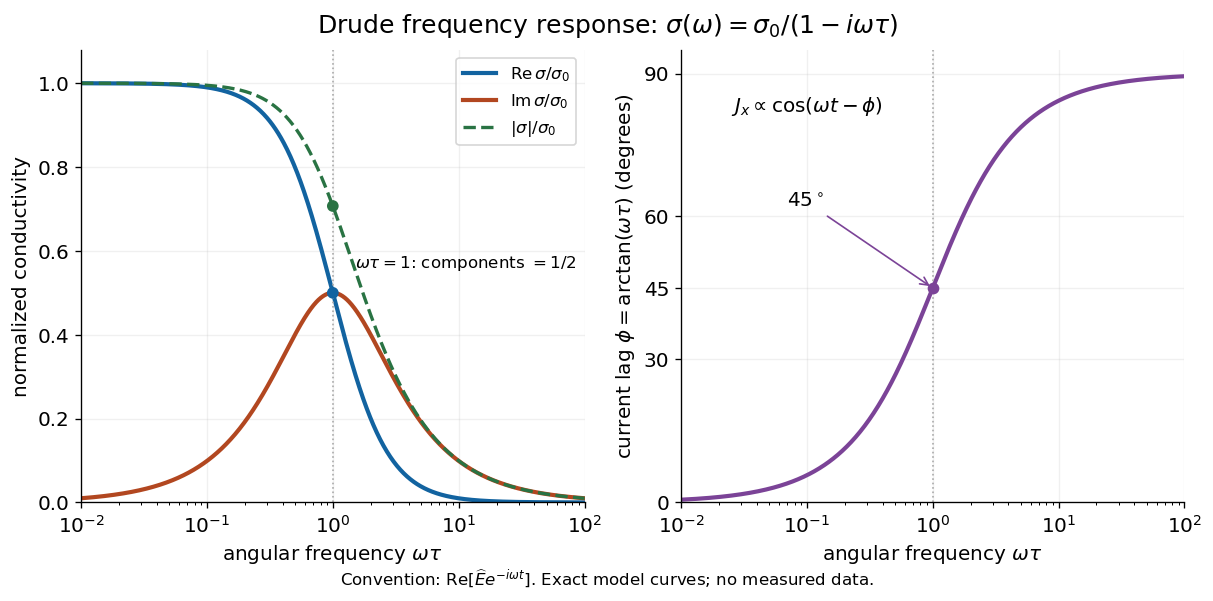
For , complex conductivity tends to the positive constant : current density nearly follows the electric field. For within this model,The current density amplitude decreases and its response becomes predominantly inertial. Average power absorbed per volume is . These limits describe the material response to a specified local electric field, not the complete electromagnetic response of a finite specimen with contacts. The Drude response has its pole at , consistent with the decaying causal response of a first-order relaxation equation.
The simple Drude model does not predict the microscopic momentum relaxation time. It neglects electronic band structure and Fermi-Dirac statistics; a useful semiclassical extension replaces by an appropriate band effective mass, but neither a single scalar mass nor one constant momentum relaxation time describes every material. Several charge carriers, energy-dependent scattering, and transitions between electronic bands can spoil the simple Drude frequency response. A successful low-angular frequency fit does not justify extrapolation to arbitrarily large angular frequencies.
Switch on a constant electric field at . For prescribed initial current density , the exact Drude model solution is the displayed formula. For electrons, the corresponding drift velocity isStarting from zero drift velocity, the current density reaches of its limiting value after one momentum relaxation time. Switching the electric field off at instead gives for . A finite step of electric field changes the acceleration immediately but leaves drift velocity and current density continuous.
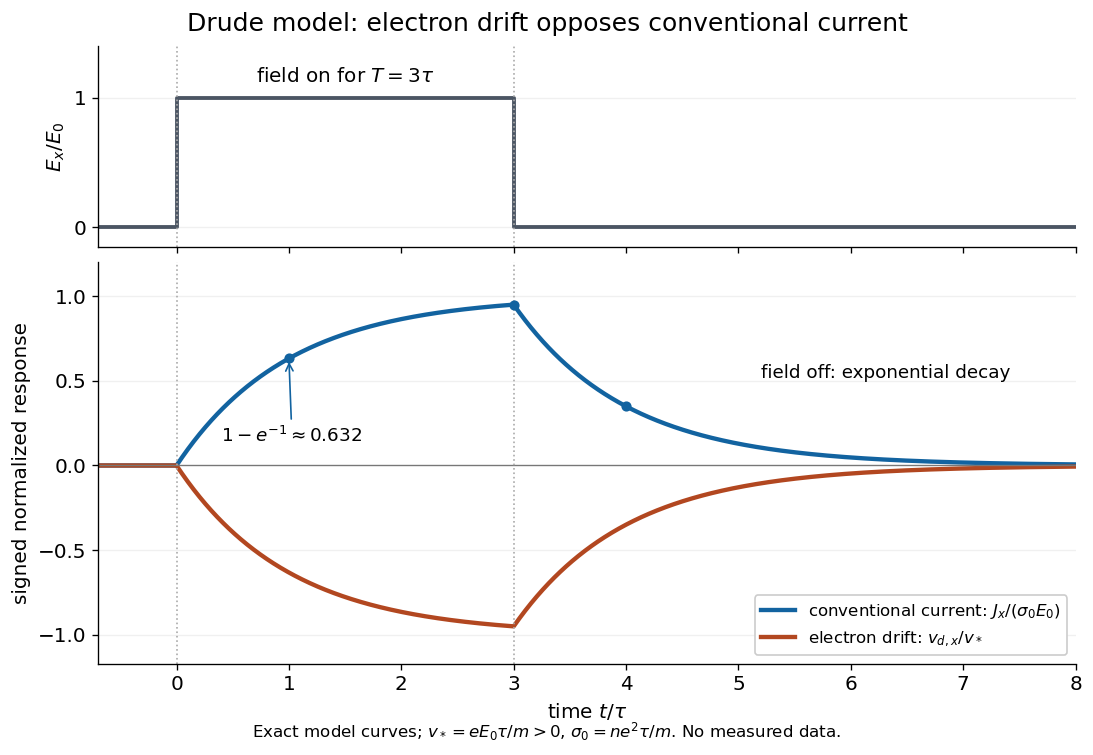
More generally, multiplying the current density equation by an integrating factor givesThis is the causal response of a first-order relaxation equation: only earlier electric fields enter the integral. It also shows why instantaneous Ohm's law is an approximation when the electric field changes appreciably during a momentum relaxation time.
The momentum relaxation time is the exponential relaxation time of mean directed momentum after the driving electric field is removed. In the simplest Drude model, independent collisions occur with probability during a short time interval and reset the mean velocity of the collided population to zero. The remaining fraction preserves its previous mean momentum. To first order in , averaging gives . This is a population equation: it does not assert that every particle stops at equally spaced instants.[ref]
For real materials, a collision that changes a particle's direction only slightly need not erase its directed momentum, so the momentum relaxation time need not equal the time between all scattering events. This transport time is also distinct from the bulk charge relaxation time : one describes loss of directed motion, the other redistribution of charge density.
Linear-boundary Brownian first-passage distribution by  Codex 0 Created 2026-10-14 Updated 2026-11-05
For , real and standard Brownian motion, the first-passage time to a linear boundary hasHere is the standard normal distribution function. Differentiation gives , the drifted Brownian first-passage density. Its Laplace transform is for . There is mass at infinity when ; for the hitting time is finite almost surely.
Consider a site indexed by natural-number objects with arrows only downwards, the cancellation condition for equally typed , and the separation condition that arrows , admit with but . Its dense-sieve sheaf topos is a Boolean topos and a two-valued topos. The representables are separated. No nonempty partial map exists, by the separation condition and naturality. The associated sheaves consequently admit no maps . Each has nonzero support and maps epimorphically to one, but their product has an empty value at every stage , because its factor does.
A fast escaping Jeans-mode mass loss wind can drive an evolving donor into Roche-lobe overflow even while widening the orbit. This mechanism uses the star's changing radius; it is distinct from gravitational capture of a slow Wind Roche-lobe overflow stream.
Assume a slowly evolving circular orbit, no wind retention by the companion, , and the approximate Roche lobe radius . The accretor mass is fixed. With ,If the donor sequence obeys locally, subtracting the two logarithmic responses givesSince , the overfill grows exactly when .
For , this is . For , every positive satisfies the growth condition; dividing by would either be undefined or reverse the inequality. For , no positive satisfies it. Equality is a marginal local response, not growth.
The criterion concerns increasing relative radius along the assumed mass-losing sequence. Reaching actual contact also depends on the initial underfill and how long the same sequence and wind prescription remain valid. Extra angular-momentum losses, wind capture or a changing radius-response exponent require a revised evolution calculation.
For a -closed positive-antiholomorphic-degree differential form of type (p, q) on a polydisc, write with no in . Apply the Cauchy-Green operator in coordinate to the coefficients of . Subtracting its Dolbeault operator derivative removes every term. Closedness then makes the remaining coefficients holomorphic in . Eliminating successive coordinates preserves holomorphicity in earlier coordinates and produces a local primitive after finitely many steps.
For a smooth -form on the complex projective line, solve its Dolbeault operator equation on a disc about zero and a disc about infinity. The difference of the primitives is a holomorphic function on their annular overlap. Split its Laurent series into a nonnegative-power part extending to the finite disc and a negative-power part extending holomorphically across infinity. Subtract the first part from the finite primitive and add the second to the infinite primitive. The results agree and define a global primitive, without Hodge theory.
The Dolbeault theorem identifies this group with first Čech cohomology of the trivial holomorphic line bundle. On the two standard affine charts, a holomorphic overlap function has a Laurent series. Its nonnegative powers extend to the chart at zero, and its negative powers extend to the chart at infinity. Every overlap cocycle is therefore a coboundary. Consequently the Dolbeault operator from functions to -forms is surjective.
Matrix root basis of the even orthogonal Lie algebra by Codex 0 Created 2026-10-14 Updated 2026-11-05
Codex 0 Created 2026-10-14 Updated 2026-11-05For the antidiagonal symmetric matrix in dimension , put and . The diagonal Cartan subalgebra has coordinates . The root spaces of weights are spanned by ; those of weights by , with negative-root spaces given by transposes. The condition gives these generators directly and excludes roots .
With simple roots for and , the fundamental weights are for , followed by and . All roots have squared length two, so their pairings with coroots verify the dual-basis identities. The last two weights are the half-spin highest weights; for , the defining highest weight is .
The Weyl group of the Dn root system consists of coordinate permutations together with an even number of sign changes. Reflection in swaps coordinates ; reflection in swaps them and negates both. These generate all even signed permutations, giving order .
A delivery has value , where are the mean and variance of under the stock-numeraire measure in the Black-Scholes model, and . Split the normal integral at and complete the square in times its normal probability density.
On , let be the graph of the th coordinate and . Successive restriction exact sequences giveWhen and , the determinant of evaluation vanishes at tuples where is nonzero. On distinct points it is the ordinary evaluation determinant; the diagonal factors remove its forced zero when two points coincide. This explains why the formula remains valid at repeated points, using jets instead of repeated evaluations.
Suppose a line bundle of degree on a smooth projective curve has . Choose distinct points where evaluation is invertible for both and . Such choices exist simultaneously: each determinant defines a nonempty open subset of , since independent sections cannot vanish at every point. Let be a sum of nonzero weighted evaluation functionals at these points. The Serre duality matrix of factors as the product of the two invertible evaluation matrices and an invertible diagonal matrix. Its determinant is nonzero. This gives the nonzero leading determinant needed for the Riemann singularity theorem.
At a multiplicity- point, choose a local parameter and elementary symmetric coordinates for the nearby roots. The tangent principal part is . Newton's identities give . Expanding the primitive of a holomorphic one-form proves the residue formula, including its sign. The dual map is restriction to the length- scheme, so it sees all jets through order .
An environment interaction preserving the computational populations multiplies a qubit's upper off-diagonal density entry by . A real phase-flip channel representation exists for every input precisely when is real, with probability . For , the channel is a phase-flip channel of probability followed by the diagonal unitary operator . The coherent phase cannot be discarded just because the populations are unchanged.
Pinned article: Introduction to the OurBigBook Project
Welcome to the OurBigBook Project! Our goal is to create the perfect publishing platform for STEM subjects, and get university-level students to write the best free STEM tutorials ever.
Everyone is welcome to create an account and play with the site: ourbigbook.com/go/register. We belive that students themselves can write amazing tutorials, but teachers are welcome too. You can write about anything you want, it doesn't have to be STEM or even educational. Silly test content is very welcome and you won't be penalized in any way. Just keep it legal!
Intro to OurBigBook
. Source. We have two killer features:
- topics: topics group articles by different users with the same title, e.g. here is the topic for the "Fundamental Theorem of Calculus" ourbigbook.com/go/topic/fundamental-theorem-of-calculusArticles of different users are sorted by upvote within each article page. This feature is a bit like:
- a Wikipedia where each user can have their own version of each article
- a Q&A website like Stack Overflow, where multiple people can give their views on a given topic, and the best ones are sorted by upvote. Except you don't need to wait for someone to ask first, and any topic goes, no matter how narrow or broad
This feature makes it possible for readers to find better explanations of any topic created by other writers. And it allows writers to create an explanation in a place that readers might actually find it.
Figure 1. Screenshot of the "Derivative" topic page. View it live at: ourbigbook.com/go/topic/derivativeVideo 2. OurBigBook Web topics demo. Source. - local editing: you can store all your personal knowledge base content locally in a plaintext markup format that can be edited locally and published either:This way you can be sure that even if OurBigBook.com were to go down one day (which we have no plans to do as it is quite cheap to host!), your content will still be perfectly readable as a static site.
- to OurBigBook.com to get awesome multi-user features like topics and likes
- as HTML files to a static website, which you can host yourself for free on many external providers like GitHub Pages, and remain in full control

Figure 2. You can publish local OurBigBook lightweight markup files to either OurBigBook.com or as a static website.
Figure 3. Visual Studio Code extension installation.
Figure 5. . You can also edit articles on the Web editor without installing anything locally. Video 3. Edit locally and publish demo. Source. This shows editing OurBigBook Markup and publishing it using the Visual Studio Code extension. 
- Infinitely deep tables of contents:




All our software is open source and hosted at: github.com/ourbigbook/ourbigbook
Further documentation can be found at: docs.ourbigbook.com
Feel free to reach our to us for any help or suggestions: docs.ourbigbook.com/#contact