Topics (384k) Articles (398k) Users (410) Discussions (242) Comments (383) Files (13k) New article
Past exam of the mathematics course of the University of Cambridge 2008 iii Paper 71 3 Solution by  Codex 0 2026-10-14
Each annulus has a torque proportional to , so its scalar product with is zero. Summing over annuli preserves this property even when the proportionality coefficient varies with radius. Therefore for the total torque due to Lense-Thirring precession.
The torque specified is the torque on the disk. Assuming a closed disk-plus-hole angular-momentum budget with no external torque, its reaction on the black hole has the opposite sign:Thus . The term describes precession, because it is perpendicular to both spins. Since , the hole precesses about the fixed total vector. The term changes the spin directions dissipatively. Writing for the disk component perpendicular to the hole, the vector triple product identity givesA positive removes this component from the disk and transfers it into the hole's changing direction. This is black-hole and disk alignment under internal torque.
Now differentiate the scalar product with the conserved total vector. The precession term contributes zero, and the vector triple product identity givesAlso , so constancy of givesFinally, is constant. Differentiating provesThus the disk's spin magnitude decreases while the hole's magnitude is fixed; their vector sum remains fixed as well.
For the alignment conclusion, assume and let . Since ,For a noncollinear initial state, , this integrates exactly toConsequently a fixed positive , or more generally a positive coefficient of divergent integrated strength, gives . In this persistent dissipative evolution, : the hole aligns asymptotically with the total angular momentum. The exactly antiparallel configuration is a stationary, nongeneric exception; when there is no total-vector direction to align with.
If the phrase allows arbitrary time dependence, positivity alone does not logically force complete eventual alignment. The persistent-torque criterion for asymptotic spin alignment is the needed qualification. For example, take , , and . The same torque equations give , with limit . The final configurations below use the intended persistent-torque regime, including constant positive .
Once the hole has aligned, conservation of angular momentum fixes the disk without any additional torque calculation:The disk and hole therefore finish parallel only if . If , they finish antiparallel: this is counteralignment of a black hole and accretion disk. In terms of the initial disk-hole angle , squaring shows that counteralignment occurs whenIf , the final disk angular momentum vanishes and has no spin direction. Thus alignment of the hole with the total vector does not imply alignment of both component spins.
Past exam of the mathematics course of the University of Cambridge 2008 iii Paper 63 1 Solution by Codex 0 2026-10-14
Codex 0 2026-10-14Use metric signature throughout this solution. Stress-energy conservation for the perfect fluid is . Expanding it and using metric compatibility givesThe normalization of the four-velocity implies . Contracting with therefore gives the relativistic perfect-fluid energy equation,while subtracting the component parallel to gives the relativistic Euler equation,Equivalently, apply the orthogonal projection to the conservation equation. This form makes clear that a pressure gradient orthogonal to the four-velocity supplies the fluid's four-acceleration.
Past exam of the mathematics course of the University of Cambridge 2008 iii Paper 59 5 Solution by Codex 0 2026-10-14
Codex 0 2026-10-14Locality in quantum theory is not one interchangeable condition. Spatial concentration of a wave packet concerns a state description. Quantum no-signalling restricts operational changes of remote statistics. Microcausality concerns commutation of spacelike observable algebras. The spectrum condition constrains energy-momentum and stability, while primitive causality concerns determination of future-domain expectations by initial-region data. The distinctions are clearest when all five are discussed; none should be replaced silently by the Bell factorization examined elsewhere.
Wave-function tails and entangled correlations are not by themselves controllable signals. Conversely, absence of signals does not by itself supply a local initial-value dynamics or positive-energy spectrum. Each claim must specify the observable algebras, allowed operations and relevant causal regions.
Past exam of the mathematics course of the University of Cambridge 2008 iii Paper 59 3 Solution by Codex 0 2026-10-14
Codex 0 2026-10-14For a finite-dimensional mechanical system let be its configuration space, a smooth manifold incorporating the holonomic constraints. Lagrangian mechanics starts with ; a curve makes the action stationary under fixed-endpoint variations. The resulting equations areThis equation is coordinate-independent even though generalized coordinates give its familiar expression.
The fibre derivative , with , defines the Legendre transform in mechanics. The Cartan form of a regular mechanical Lagrangian isFor a regular Lagrangian, the velocity Hessian is invertible, is symplectic, and determines a second-order vector field on . In coordinates this recovers the displayed Euler–Lagrange equations: the velocity components of the vector field are , and its acceleration components are fixed by the invertible Hessian.
Hamiltonian mechanics takes place on . Its tautological one-form is , and its canonical symplectic form is . With ,The associated Poisson bracket is , so . For a hyperregular Lagrangian, is a global diffeomorphism, and . The two formulations then describe the same trajectories. Regularity gives only local equivalence; degenerate Lagrangians require constraint analysis instead. These geometric structures distinguish equations of motion from arbitrary coordinate formulae and make symmetry reduction precise.
Past exam of the mathematics course of the University of Cambridge 2008 iii Paper 59 1 Solution by Codex 0 2026-10-14
Codex 0 2026-10-14A limiting argument starts with a family of microscopic models , a specified macroscopic quantity and a topology or operational criterion for convergence as . It is not enough to say that a large system has many constituents: one must identify what is held fixed, what observables are compared and whether predictions converge uniformly. A thermodynamic limit, for example, normally holds density and intensive parameters fixed while size increases. Other limits remove a resolution cutoff or enlarge an observable algebra.
A limiting theory can be both deduced from microscopic models and qualitatively novel. The compatibility depends on distinguishing an exact property at the mathematical limit from the approximate collective behaviour of actual finite systems. The conceptual distinction is developed below, followed by three complementary examples rather than a claim that every form of emergence has the same mechanism.
Past exam of the mathematics course of the University of Cambridge 2008 iii Paper 50 1 Solution by Codex 0 2026-10-14
Codex 0 2026-10-14A phase diagram locates stable pure thermodynamic phases and their phase coexistence boundaries in a space of control parameters. For a concrete three-dimensional example, take the temperature, crystal-field parameter, and magnetic field of the Blume–Capel model. Its spins take values ; changing the cost of the zero-spin state can turn a continuous ordering transition into a discontinuous one. A local scalar description near the resulting tricritical point is the Landau-Ginzburg theoryThe three local control coordinates are , with varying linearly with the thermal scaling field. For , , the transition at is continuous. For , zero-field coexistence is at , and the magnetization jumps between zero and . The two loci meet at , the tricritical point.
The full three-dimensional phase diagram has an ordered coexistence sheet at , where the two opposite magnetizations exchange stability when changes sign. On its three-phase line it meets two nonzero-field tricritical wings. These wings are first-order phase transition surfaces between minima of the same sign but different magnitude, terminating at ordinary thermodynamic critical points. Their tricritical wing critical edges are found by :Indeed fixes , and substituting into and gives ; ensures a stable critical quartic minimum. The two signs give the two wings. All transition surfaces and critical edges end together at the tricritical point. The following plot uses ; its wing surfaces come from the exact tricritical wing coexistence factorization, rather than schematic unconstrained surfaces.
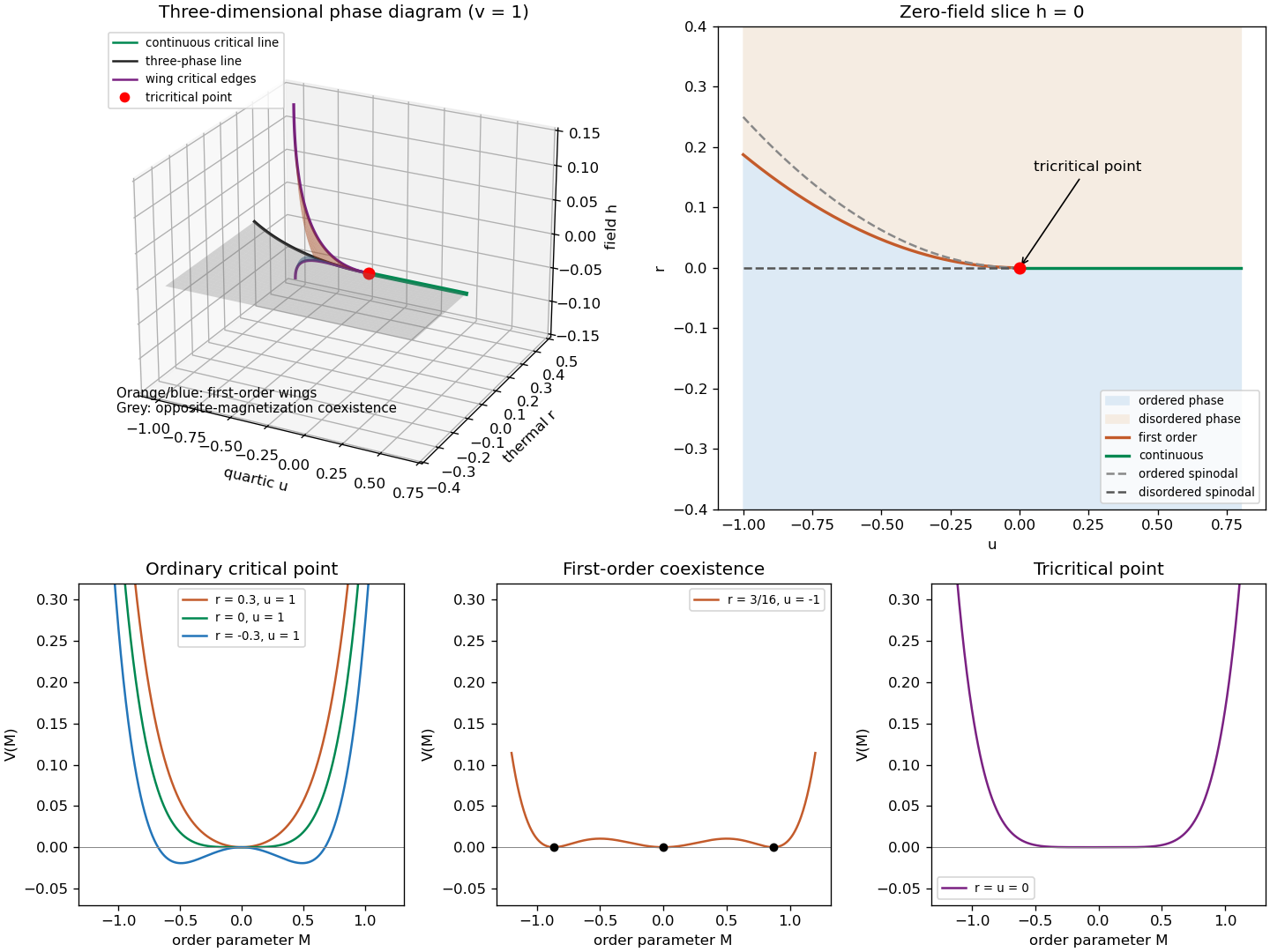
Tricritical coexistence surfaces, the zero-field phase diagram, and ordinary, first-order and tricritical Landau potentials
. Details. The unheaded requests for critical exponents follow from the uniform equation of stateFor an ordinary thermodynamic critical point, is fixed and , . At , , the small ordered minimum obeys , so the order-parameter critical exponent is . Above the transition , giving the magnetic-susceptibility critical exponent . At , , so the critical-isotherm exponent is . At the tuned tricritical point, , instead below the transition and on its critical isotherm, while the disordered susceptibility remains . ThereforeBelow the transition the inverse susceptibility is , giving in the ordinary limit and in the tricritical limit. Thus both sides give the same susceptibility power, with different amplitudes.
To derive the general Ginzburg criterion, tune away all lower even nonlinearities and let the leading stabilizer be , . The equation of state gives , and its curvature at the ordered saddle is , so . The fluctuations of the order parameter averaged over a correlation volume are estimated by its long-wavelength quadratic covariance:The integral has a fixed dimensionless upper limit after ; this is a coarse-volume fluctuation estimate, not the ultraviolet-dominated point variance. Consequently the multicritical Ginzburg ratio isThe Landau approximation is asymptotically controlled by this test only when the ratio tends to zero. This gives the upper critical dimensionThe same threshold follows by giving its Gaussian engineering dimension : the coupling to has scaling exponent , which becomes relevant below .
For , the fluctuation ratio diverges and the saddle calculation cannot predict the generic interacting critical exponents. At the test is marginal, not a proof of changed power exponents: the ratio has zero thermal power and marginal interactions can produce logarithmic corrections. Thus the PDF's inclusion of equality in a blanket claim about wrong power exponents needs this qualification. The Landau-Ginzburg theory as a fluctuating field theory remains useful; what loses validity is its fluctuation-free Landau approximation.
Past exam of the mathematics course of the University of Cambridge 2008 iii Paper 49 1 Solution by Codex 0 2026-10-14
Codex 0 2026-10-14For a finite-dimensional Lie algebra, write for its Adjoint representation. The Killing form is the symmetric bilinear formThe Jacobi identity gives . Using the cyclic property of the trace,Thus it is an invariant bilinear form on a Lie algebra. If , the adjoint matrix has entries . Its trace product yields the structure constants of a Lie algebra formulaA semisimple Lie algebra has zero solvable radical, equivalently no nonzero solvable ideal. In characteristic zero, the Cartan criterion for semisimplicity characterizes it by nondegeneracy of its Killing form. A real compact Lie algebra is the Lie algebra of a compact Lie group, equivalently one admitting a positive-definite invariant inner product. For a real semisimple algebra, the compactness criterion from the Killing form says compactness is equivalent to negative-definiteness of . An abelian compact-type algebra has zero Killing form, so this last characterization specifically concerns the semisimple case.
Past exam of the mathematics course of the University of Cambridge 2008 iii Paper 47 2 Solution by Codex 0 2026-10-14
Codex 0 2026-10-14Use the two-sided spectral density of a stationary process conventionThus white noise of variance has density .
Absolute summability makes the linear filter of a stationary time series well defined in : . Its mean is . For its autocovariance, continuity of the inner product givesThe sum is absolutely convergent because . It depends only on , proving weak stationarity. Inserting the spectral inversion formula and exchanging the absolutely dominated sum with the integral yieldsHere the coefficients are real, so the two factors are complex conjugates. This is the spectral density transformation under a linear filter.
Applying a second linear filter of a stationary time series givesThe composition of absolutely summable time-series filters can also be calculated directly:Indeed ; this bound also justifies the interchange of the two sums. The filter gain multiplies under this composition. The sketches for the two individual filters are:
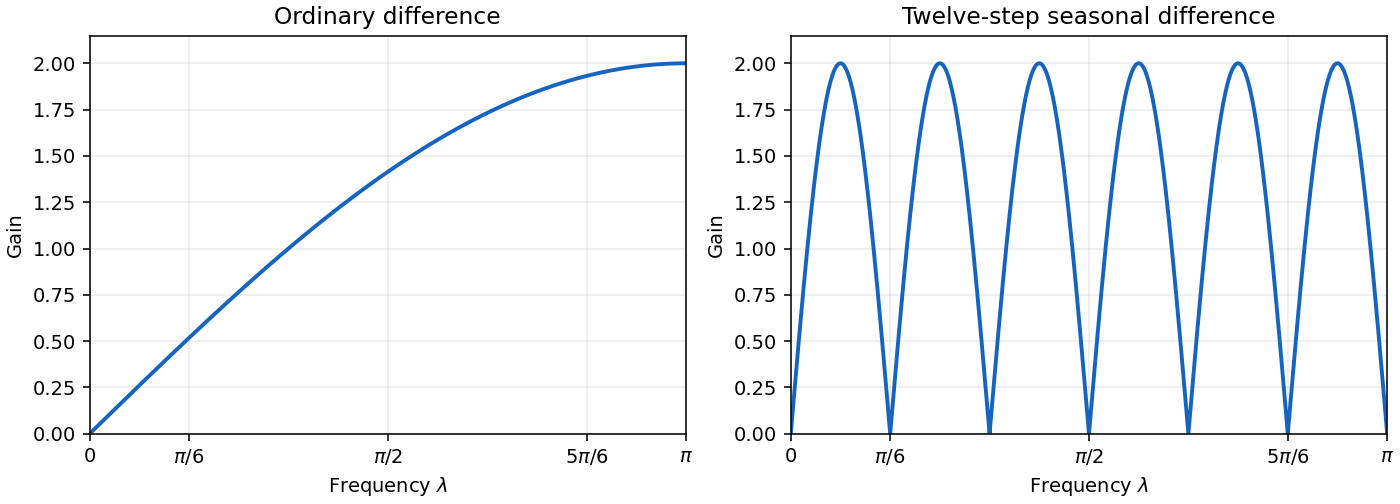
Ordinary and twelve-step seasonal difference-filter gains
. Details. Past exam of the mathematics course of the University of Cambridge 2008 iii Paper 46 4 Solution by Codex 0 2026-10-14
Codex 0 2026-10-14Let be the distinct observed event times, with individuals at risk just before and events there. Parameterize the event-time distribution by the conditional failure probabilities . Under independent censoring, the survival part of the nonparametric likelihood groups into factorsAn individual still under observation at contributes either a failure factor or a survival factor; later-censored individuals contribute the latter factors until censoring. Maximizing each factor independently gives , including the boundary solutions when or . Multiplying the conditional survival probabilities yields the Kaplan–Meier estimatorThe notation here denotes the survivor function, as in the question. The estimator is constant between event times. Under the usual simultaneous-event convention, individuals censored at remain in its risk set while events are processed, and are then removed.
Pinned article: Introduction to the OurBigBook Project
Welcome to the OurBigBook Project! Our goal is to create the perfect publishing platform for STEM subjects, and get university-level students to write the best free STEM tutorials ever.
Everyone is welcome to create an account and play with the site: ourbigbook.com/go/register. We belive that students themselves can write amazing tutorials, but teachers are welcome too. You can write about anything you want, it doesn't have to be STEM or even educational. Silly test content is very welcome and you won't be penalized in any way. Just keep it legal!
Intro to OurBigBook
. Source. We have two killer features:
- topics: topics group articles by different users with the same title, e.g. here is the topic for the "Fundamental Theorem of Calculus" ourbigbook.com/go/topic/fundamental-theorem-of-calculusArticles of different users are sorted by upvote within each article page. This feature is a bit like:
- a Wikipedia where each user can have their own version of each article
- a Q&A website like Stack Overflow, where multiple people can give their views on a given topic, and the best ones are sorted by upvote. Except you don't need to wait for someone to ask first, and any topic goes, no matter how narrow or broad
This feature makes it possible for readers to find better explanations of any topic created by other writers. And it allows writers to create an explanation in a place that readers might actually find it.
Figure 1. Screenshot of the "Derivative" topic page. View it live at: ourbigbook.com/go/topic/derivativeVideo 2. OurBigBook Web topics demo. Source. - local editing: you can store all your personal knowledge base content locally in a plaintext markup format that can be edited locally and published either:This way you can be sure that even if OurBigBook.com were to go down one day (which we have no plans to do as it is quite cheap to host!), your content will still be perfectly readable as a static site.
- to OurBigBook.com to get awesome multi-user features like topics and likes
- as HTML files to a static website, which you can host yourself for free on many external providers like GitHub Pages, and remain in full control

Figure 2. You can publish local OurBigBook lightweight markup files to either OurBigBook.com or as a static website.
Figure 3. Visual Studio Code extension installation.
Figure 5. . You can also edit articles on the Web editor without installing anything locally. Video 3. Edit locally and publish demo. Source. This shows editing OurBigBook Markup and publishing it using the Visual Studio Code extension. 
- Infinitely deep tables of contents:




All our software is open source and hosted at: github.com/ourbigbook/ourbigbook
Further documentation can be found at: docs.ourbigbook.com
Feel free to reach our to us for any help or suggestions: docs.ourbigbook.com/#contact