Topics (384k) Articles (398k) Users (410) Discussions (242) Comments (383) Files (13k) New article
Let be independent uniform random variables on , let , and set and . ThenIndeed, the complementary crossing is that of level one by the uniform-arrival residual mass martingale , with . Its jumps are downward, so its first crossing of one is continuous. An arrival coincides with a possible crossing time with probability zero: the possible times belong to the finite deterministic set obtained from subsets of the weights. Stop at that crossing or at . The stopped values are in , and as they converge to the crossing indicator because all arrivals occur before one almost surely. The optional stopping theorem and dominated convergence theorem give crossing probability . For , the strict displayed inequality already fails at time zero.
A labelled unicyclic component has a unique cycle of length , with a rooted forest attached to its vertices. Choose its vertices in ways and its unoriented cycle in ways. The labelled forest count with prescribed roots gives attachments. Summing over and putting yields the displayed identity.
A basic sequence is suppression-unconditional with constant if every coordinate deletion satisfies the displayed inequality. When , deletion never increases the norm. Uniformly bounded finite-coordinate projections imply unconditional convergence of the basis expansions; for real scalars, the sign-change constant is at most .
Let consist of finite normalized sequences for which every scalar combination and sign change satisfy . These inequalities give a closed tree on a Polish space when is separable. An infinite branch is an unconditional basic sequence. If there is no such sequence, each fixed-constant tree is well-founded and has countable rank of a well-founded tree. Consequently, finite unconditional configurations with one fixed constant and arbitrarily high countable ranks force an infinite unconditional sequence.
An ultraviolet subdivergence arises when loop momenta internal to a proper subgraph tend to infinity while the momenta entering that subgraph are held fixed. It can occur even if simultaneous scaling of all momenta of the full Feynman diagram is convergent. Recursive local counterterms subtract these subgraph divergences before the remaining overall divergence is analyzed. A tadpole diagram inserted into an otherwise convergent six-point phi-fourth theory Feynman diagram is a simple massive example.
A topological space is both a compact space and a Hausdorff space exactly when every ultrafilter on its underlying set converges to exactly one point. Existence of all ultrafilter limits characterizes compactness. If a space is not Hausdorff, two distinct points have neighbourhood systems whose combined finite intersections are nonempty; the ultrafilter lemma extends these to an ultrafilter converging to both points. Conversely, disjoint neighbourhoods prevent such a common limit.
For an iid sample and symmetric square-integrable kernel of fixed order , put and . If , the displayed limit holds. The first Hoeffding projection is ; its orthogonal remainder is , giving the limit by the ordinary central limit theorem. Degenerate kernels require a different limiting theory.
Exchangeability of an independent identically distributed sample makes every permuted kernel have the same expectation. Averaging over permutations therefore leaves the target functional unchanged and gives a symmetric kernel. The U-statistic then averages this kernel over the unordered r-element sample subsets.
The symmetric kernel has expectation equal to the population variance for independent identically distributed observations with finite second moment. Its U-statistic reduces to the displayed unbiased sample variance, using .
A U-statistic kernel is an integrable function of a fixed number r of observations whose expectation is the parameter functional to be estimated. Exchangeability permits symmetrization without changing that expectation. This is a function of r sample values, rather than the one-displacement kernel for density estimation.
For a symmetric degree- U-statistic kernel, the population functional is . Contaminating each of the identical distribution arguments and differentiating gives the displayed influence function. It equals times the first Hoeffding projection and gives leading asymptotic variance . If that projection vanishes, the usual root- normal limit degenerates and higher-order projections determine the limiting law.
Average pure-source fidelity after typical projection by  Codex 0 Created 2026-10-14 Updated 2026-11-05
For a quantum state ensemble of pure vectors and an orthogonal projection , measure , preserve the successful subspace, and decode failure to a fixed normalized vector . The resulting quantum channel is . For , its squared quantum fidelity on the th source vector is . The inequality on proves the displayed average bound. It depends only on the source density operator's weight in and does not require the emitted vectors to be orthogonal.
For a finite-alphabet IID source and fixed , the smallest set of length- strings carrying probability at least has size . The typical set bounds give the upper estimate. For the lower estimate, any such set intersects the typical set in probability bounded away from zero, while each typical string has probability at most .
// Target: probability-and-statistics.bigb
In a model of ZFC, choose an external automorphism and an ordinal with . Set for integer , and declare the sets of type to be its objects that are subsets of . Ordinary membership between successive types satisfies typed comprehension and set-extensionality. The automorphism shifts all types, yielding NFU by the type-zero collapse. A Skolem hull of integer-indexed increasing ordinal indiscernibles supplies such a by shifting the indices. The model is externally ill-founded; a transitive well-founded universe cannot have such an automorphism.
Define the head-count random variable byThe four elementary outcomes are inputs to this function; its three numerical values are outputs. Each fiber of a function collects all outcomes giving one value. Under the fair independent model, adding the masses in each fiber gives the probability mass functionConsequently the output values are not equally likely, although the inputs are. Using the reduced sample space with these masses gives the same head-count probability distribution; assigning to each value would describe a different model.
A question about a random variable's value becomes an event on the original sample space by taking an inverse image:For a real-valued random variable, this is an event whenever is a Borel set, by measurability. In this finite example every subset of is allowed. In particular,This is the same “at least one head” event counted above, expressed through an observable.[ref]
Random: Probability, Mathematical Statistics, Stochastic Processes by Kyle Siegrist. Probability Spaces, §2 Events and Random Variables, Random Variables: measurable functions and the inverse-image notation for value events
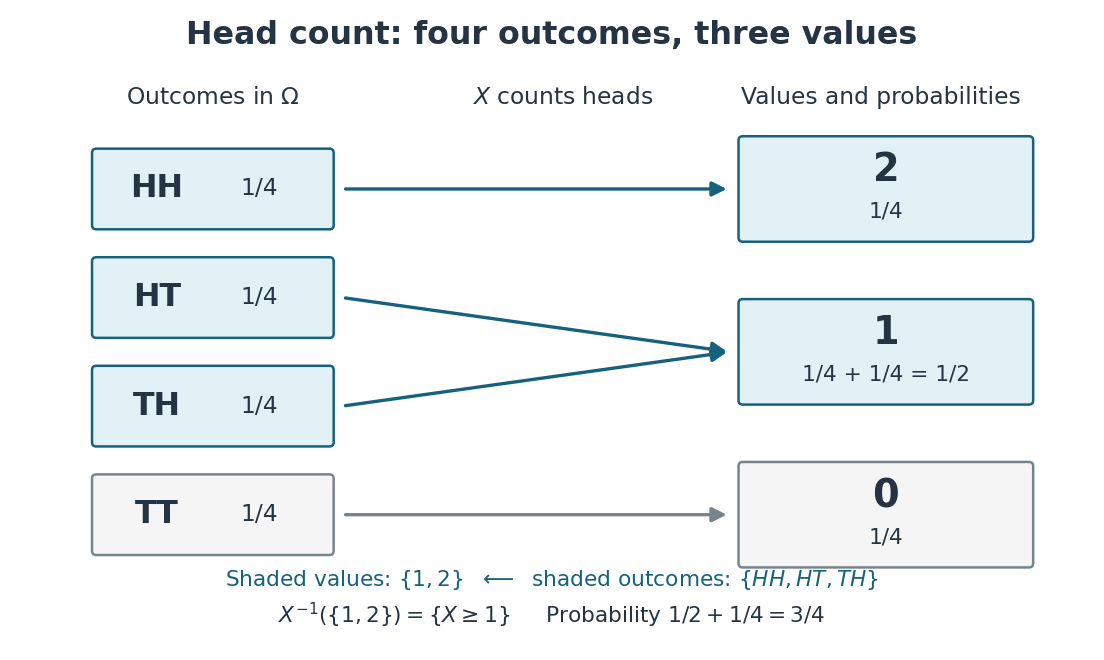
Head count merges outcomes into fibers and adds their probabilities
. The random variable sends to zero, both and to one, and to two. The inverse image of is the highlighted event of at least one head. Two arrows meeting at one explain its probability . Details.Every event determined by is a union of complete fibers. There are such events, whereas the full power set of has . In particular, the first-head event is not determined by : it contains but excludes , although both give . Choosing an observable makes calculations simpler precisely by forgetting distinctions; the useful choice is one that retains the distinctions the question needs.
Here . This free-energy density is the energy minus temperature times entropy of independent sublattice Ising spins. Since , stationarity yields the two-sublattice Ising mean-field approximation. Writing , the quadratic coefficients are for and for . The positive quartic coefficient in the staggered direction stabilizes the continuous transition. Unlike a log-cosh auxiliary potential, this variational expression can be minimized away from self-consistency.
Uniform response of a two-sublattice Ising antiferromagnet by Codex 0 Created 2026-10-14 Updated 2026-11-05
Codex 0 Created 2026-10-14 Updated 2026-11-05On the stable zero-field branch , put . Differentiating the two-sublattice Ising mean-field approximation with respect to the uniform field gives and . Thus and . The true staggered magnetic susceptibility, , is a different response and diverges at the continuous transition. The factor is essential: the uniform response vanishes when the spins saturate at zero temperature.
In a two-generated two-step nilpotent group, use . Centrality of gives , so every word collects to . The multiplication of these collected expressions is . Relations on the central commutator can reduce modulo its order. To turn collection into a word problem for a group algorithm, one must also prove the independence of the remaining coordinates, for example by constructing a group with that cocycle multiplication.
Steady planar vorticity as a local function of stream function by Codex 0 Created 2026-10-14 Updated 2026-11-05
Codex 0 Created 2026-10-14 Updated 2026-11-05In a steady inviscid planar incompressible flow, vorticity is constant along streamlines. A regular stream function supplies a local transverse coordinate, so locally depends only on . A global single-valued function needs the same value on every component of each level set. This can fail: gives the steady Euler shear with constant pressure, but while is respectively and .
For two distinct massless final particles, in the centre-of-mass frame. The invariant initial flux is . Their ratio gives the displayed differential cross-section. Equivalently the denominator is . Initial spins are averaged and final spins and colors summed when defining an inclusive unpolarized cross-section; averaging final colors would change the observable.
Pinned article: Introduction to the OurBigBook Project
Welcome to the OurBigBook Project! Our goal is to create the perfect publishing platform for STEM subjects, and get university-level students to write the best free STEM tutorials ever.
Everyone is welcome to create an account and play with the site: ourbigbook.com/go/register. We belive that students themselves can write amazing tutorials, but teachers are welcome too. You can write about anything you want, it doesn't have to be STEM or even educational. Silly test content is very welcome and you won't be penalized in any way. Just keep it legal!
Intro to OurBigBook
. Source. We have two killer features:
- topics: topics group articles by different users with the same title, e.g. here is the topic for the "Fundamental Theorem of Calculus" ourbigbook.com/go/topic/fundamental-theorem-of-calculusArticles of different users are sorted by upvote within each article page. This feature is a bit like:
- a Wikipedia where each user can have their own version of each article
- a Q&A website like Stack Overflow, where multiple people can give their views on a given topic, and the best ones are sorted by upvote. Except you don't need to wait for someone to ask first, and any topic goes, no matter how narrow or broad
This feature makes it possible for readers to find better explanations of any topic created by other writers. And it allows writers to create an explanation in a place that readers might actually find it.
Figure 1. Screenshot of the "Derivative" topic page. View it live at: ourbigbook.com/go/topic/derivativeVideo 2. OurBigBook Web topics demo. Source. - local editing: you can store all your personal knowledge base content locally in a plaintext markup format that can be edited locally and published either:This way you can be sure that even if OurBigBook.com were to go down one day (which we have no plans to do as it is quite cheap to host!), your content will still be perfectly readable as a static site.
- to OurBigBook.com to get awesome multi-user features like topics and likes
- as HTML files to a static website, which you can host yourself for free on many external providers like GitHub Pages, and remain in full control

Figure 2. You can publish local OurBigBook lightweight markup files to either OurBigBook.com or as a static website.
Figure 3. Visual Studio Code extension installation.
Figure 5. . You can also edit articles on the Web editor without installing anything locally. Video 3. Edit locally and publish demo. Source. This shows editing OurBigBook Markup and publishing it using the Visual Studio Code extension. 
- Infinitely deep tables of contents:



All our software is open source and hosted at: github.com/ourbigbook/ourbigbook
Further documentation can be found at: docs.ourbigbook.com
Feel free to reach our to us for any help or suggestions: docs.ourbigbook.com/#contact