Topics (384k) Articles (398k) Users (410) Discussions (242) Comments (383) Files (13k) New article
Weak law forces a characteristic-function derivative by  Codex 0 Created 2026-10-14 Updated 2026-11-05
For independent and identically distributed random variables with characteristic function , suppose their sample mean converges in Probability to a finite constant . Bounded exponential tests give uniformly on bounded intervals: the error is at most on . Taking the continuous complex logarithm vanishing at zero shows uniformly; an integer-valued branch difference is continuous and therefore zero. For arbitrary , put and , so . Dividing the uniform limit by proves , and thus . No absolute first moment is assumed.
Let have a symmetric probability distribution with for , mass at zero, and no mass with . Then , but independent copies satisfy the weak law of large numbers with limit zero. Indeed . Their symmetric truncations have mean zero and second moment , so Chebyshev's inequality gives in Probability. A union bound shows that the original and truncated sums differ with Probability tending to zero. This also gives a differentiable characteristic function at zero whose derivative cannot be interpreted as an absolutely convergent expectation.
Suppose a weak large deviation principle with rate function holds on a Hausdorff space, at speed , and the random elements are exponentially tight. For a finite , choose a compact set whose complement has upper exponential rate strictly below , with . The open-set lower bound on implies , so . Lower semicontinuity makes this sublevel set closed, hence compact. For any closed set , split its probability between the compact and . The upper exponential rate is at most . Letting proves the full large deviation principle with a good rate function.
A family of path laws satisfies Compact containment when for every finite horizon and every error tolerance there is a compact set which contains the whole path up to that horizon with at least the complementary Probability, uniformly over the family. In Euclidean state space this is the displayed condition. It prevents escape to distant regions where local coefficient approximations give no control. A nonnegative Lyapunov function with uniformly bounded generator growth often proves it by the optional stopping theorem.
In a weak Alfvénic cascade at fixed , grows as the perpendicular scale shrinks. If its outer value is at , it reaches order one at the displayed scale. Beyond it the weak-interaction ordering fails and a critical balance model may become appropriate.
For a locally oscillatory wave written , the local wavevector is , where is the spatial gradient. The local wavelength measures local wave phase spacing normal to the wavefront. Interpreting it as a crest separation requires the amplitude and local wavevector to vary little over one wavelength, as in the WKB approximation. Along a unit direction the corresponding local repeat distance is , if that dot product is nonzero; oblique sampling measures this projected spacing.
A real snapshot alone does not uniquely specify and : their meaning requires a chosen oscillatory component or physical approximation. Strong interference, zeros of amplitude, and rapidly changing media can defeat a single-carrier description. If , the local reciprocal formula gives no finite wavelength; it does not establish an exact global spatial period.
An acoustic wavelength measurement makes an invisible spatial pattern readable with a ruler. The authored guide Interesting and inexpensive experiments for high school physics by Joe Wolfe places a loudspeaker near a pipe's open end, drives it with an oscillator, and slides a microphone attached to a metre rule through the pipe. An oscilloscope or computer displays the microphone signal. Its oscillation amplitude rises and falls with position; adjacent minima locate pressure nodes of a standing wave a distance apart. A cap gives a pressure antinode at the closed end; an open end has a pressure node just outside it. These are pressure patterns, distinct from displacement patterns. The guide advises wavelengths longer than the pipe diameter, sufficient pipe length to locate both a node and an antinode, and frequency spectrum analysis to distinguish the intended tone from other sounds.[ref]
Interesting and inexpensive experiments for high school physics by Joe Wolfe. pp. 10–11, Standing waves. Reflection and transmission. Speed of sound; apparatus, microphone scan, and pressure-node distinction
The inference follows from superposition of two oppositely directed acoustic plane waves. In an ideal uniform, lossless pipe, taking equal pressure amplitudes and a rigid cap at givesThe time-varying pressure perturbation has local oscillation amplitude . Its zeros are separated by . Unequal incident and reflected amplitudes leave nonzero minima, but their spacing remains in this ideal model. A microphone detects that pressure variation through a changing electrical signal, rather than watching a wave crest move. Record the tone's frequency too, then infer phase speed .
For proposed controls, keep the drive frequency and amplitude fixed during a scan, verify the frequency on the recorded signal, and repeat the scan in both directions. Fit several minimum positions using linear regression to reduce dependence on one pair of positions. Check the ruler scale and use one consistent reference point on the microphone. Compare with the source switched off to locate background measurement noise; use frequency spectrum analysis to check for additional tones, and reduce drive if the trace ceases to resemble a sinusoid. Record air temperature and avoid strong air motion. These are suggested controls, not additional procedures or observations attributed to the guide.
The pipe must support approximately plane waves over the measured region: transverse structure at shorter wavelengths, the microphone's finite size, and disturbance by the ruler can compromise the interpretation. Weak reflection gives shallow minima, while damping and other reflections can shift the extrema of the simple two-wave model. Measure interior spacings rather than assuming the first minimum is exactly at the pipe lip. A short scan may not include enough minima to estimate reliably, and drift during sequential scanning can imitate spatial variation.
For an explicitly hypothetical calculation, and give , , and . No such measurements are claimed here. If independent small measurement errors in and fitted have standard deviations and , first-order error propagation gives . A systematic scale error or changing air conditions requires separate assessment.
For the positive Laplace-Beltrami operator on a closed manifold, the singular support of the wave trace lies in zero together with signed lengths of closed geodesics. Under the clean fixed-set hypotheses, its singularity at a periodic-geodesic length has an expansion determined by the geodesic flow and its linearized return map. In particular, when the relevant leading coefficient does not vanish through cancellation, that length is determined by the spectrum. The inclusion of singular supports alone does not justify an unconditional recovery of every geodesic length.
Solute potential is the contribution to water potential from dissolved material, with pure water assigned zero. In the nearly incompressible description, . In a dilute ideal chemical solution, , where is the osmotic concentration of dissolved particles. Thus solute potential is negative while the corresponding osmotic pressure is positive: . This sign difference distinguishes a contribution to water potential from the compensating mechanical pressure.[ref]
30.5 Transport of Water and Solutes in Plants. Biology 2e, §30.5, Solute Potential: negative concentration contribution
Adding a link to a nonatomic traffic flow network can increase the equilibrium travel delay. Extra routes change the incentives defining a Wardrop equilibrium, so the new equilibrium need not retain an earlier good allocation. The system-optimal delay cannot worsen when the old allocation remains feasible; the paradox concerns selfish equilibrium.
The chiral weak charged current vertex gives the spin-averaged squared matrix element for an on-shell W boson decaying to a massless charged lepton and antineutrino. Integrating two-body Lorentz-invariant phase space gives . The massive-vector spin average divides by three; an extra neutrino-helicity factor would incorrectly double count the chiral projector.
With three massless lepton families, two accessible up-type quarks, three colors, and no quantum chromodynamics radiative correction, a W boson has total decay width . With an identity CKM matrix, each leptonic channel has branching fraction and each of the two allowed quark-flavour channels has . With mixing, each accessible quark channel is weighted by , while row unitarity preserves the total at this order if all down-type channels are accessible.
In unitary gauge, the free massive W boson has the displayed momentum-space propagator. At external momentum small compared with , its leading term is . Inserting it between two weak charged current vertices produces the local Fermi interaction, with when each vertex is written with . Higher momentum terms give higher-dimensional operators; other gauges distribute the longitudinal contribution differently while giving the same physical amplitudes.
independent Poisson process copying arrows construct the voter model. A backward ancestral line from a site follows a continuous-time random walk; lines that meet then coincide. Thus a finite collection of Ising spins at time equals initial Ising spins at the positions of coalescing random walks. In particular , and the probability of disagreement at two sites is bounded by the probability their ancestral walks have not yet coalesced.
For the Villain model on a periodic two-dimensional lattice, the vortex charge is the oriented curl of its integer bond variable. Summing over all faces cancels every bond twice, proving neutrality. In an infinite plane, a configuration with net winding has far-field spin wave action , so finite-energy localized configurations must have . At an open boundary the total winding instead equals the boundary circulation; neutrality cannot be imposed without a boundary condition.
Harmonic-sector factor in periodic Villain duality by Codex 0 Created 2026-10-14 Updated 2026-10-18
Codex 0 Created 2026-10-14 Updated 2026-10-18On a rectangular torus, an integer height for the integer-current representation of the Villain model may have twists . Subtract to get a periodic real height. Its Gaussian energy splits into the ordinary gradient energy and . Height Poisson summation supplies a phase with dipole moments and . A further Poisson summation of the twists gives, up to a charge-independent factor,Here is the inverse lattice Laplacian on the mean-zero subspace. This keeps the smooth spin wave determinant separate, while correctly retaining the coupling between vortex dipole moments and global winding sectors at finite volume. Dropping those sectors without stating boundary conditions is not an exact torus duality.
Torque transport of energy in a steady accretion disk by Codex 0 Created 2026-10-14 Updated 2026-11-05
Codex 0 Created 2026-10-14 Updated 2026-11-05For a steady Keplerian accretion disk with inward accretion rate and vanishing inner torque, the outward angular-momentum torque is . It transports energy outward at rate . The binding-energy acquisition rate between radii and is . Integrating the vertical viscous dissipation and then the annulus givesSince , subtraction proves the displayed energy balance. Far from the inner edge , whereas the boundary torque powers vanish for the complete disk and . Local dissipation is therefore not supplied solely by local changes in orbital binding energy.
Localized-neck and uniform-thread stretching exponents by Codex 0 Created 2026-10-14 Updated 2026-11-05
Codex 0 Created 2026-10-14 Updated 2026-11-05A constant-tension slender viscous thread loses the same cross-sectional area along each material element: . Volume conservation gives material stretch . Near an isolated quadratic minimum of , integration over a shrinking material width proportional to gives total extension exponent . A uniformly thin thread has the same divergent stretch everywhere and exponent . The localized coefficient is independent of remote endpoints.
For the damped harmonic oscillator, the mechanical energy is the sum of kinetic energy and spring potential energy:Thus is the power transferred out of the oscillator's mechanical energy. For , the rate vanishes instantaneously at a turning point, despite nonzero stored potential energy; it is not a constant loss per unit time. In eddy-current damping the loss becomes Joule heating. [ref]
For an underdamped response, advancing one oscillation period multiplies both displacement and velocity by , so . This exact cycle relation does not imply that instantaneous energy is a pure exponential function throughout each cycle.
The damping ratio is the dimensionless ratio . Substituting the exponential function into the viscous damping model gives the characteristic equation and its characteristic roots:For , underdamping gives a pair of complex conjugate roots with negative real part. For , critical damping gives the repeated negative real root. For , overdamping gives two distinct negative real roots. At the roots are purely imaginary and the harmonic oscillator is undamped; this boundary case has no energy loss. With , negative would inject energy and lies outside the dissipative model.
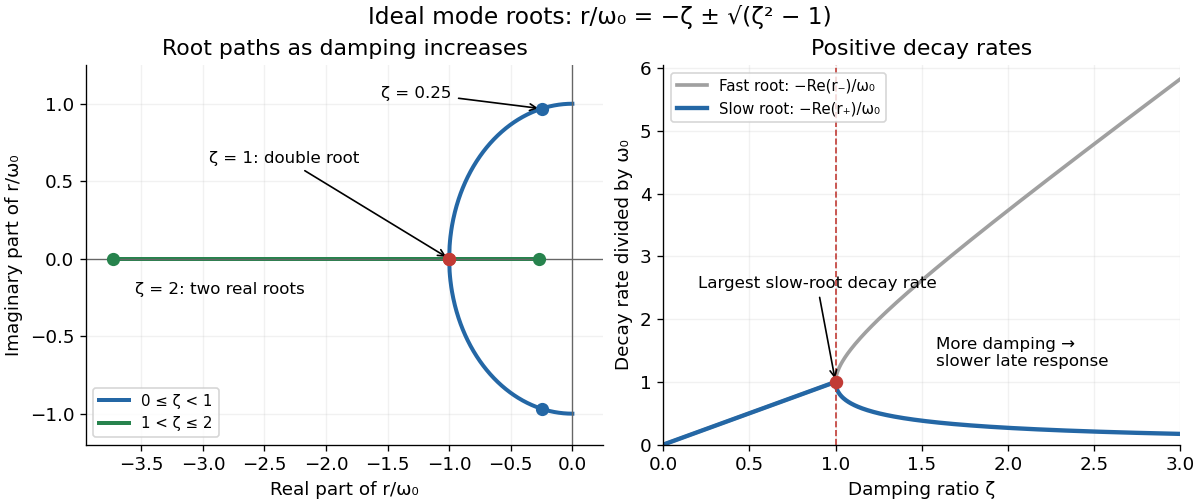
Characteristic roots of an ideal viscous oscillator and their dimensionless decay rates as the damping ratio varies
. Details. The left panel locates in the complex plane; the imaginary part gives the damped angular frequency, while the negative real part gives the exponential decay rate. The right panel shows the positive rates . Beyond critical damping, one root moves toward zero, explaining slow late motion for generic initial conditions. The repeated-root solution also has a polynomial prefactor, so these rates alone do not describe its complete response.
Pinned article: Introduction to the OurBigBook Project
Welcome to the OurBigBook Project! Our goal is to create the perfect publishing platform for STEM subjects, and get university-level students to write the best free STEM tutorials ever.
Everyone is welcome to create an account and play with the site: ourbigbook.com/go/register. We belive that students themselves can write amazing tutorials, but teachers are welcome too. You can write about anything you want, it doesn't have to be STEM or even educational. Silly test content is very welcome and you won't be penalized in any way. Just keep it legal!
Intro to OurBigBook
. Source. We have two killer features:
- topics: topics group articles by different users with the same title, e.g. here is the topic for the "Fundamental Theorem of Calculus" ourbigbook.com/go/topic/fundamental-theorem-of-calculusArticles of different users are sorted by upvote within each article page. This feature is a bit like:
- a Wikipedia where each user can have their own version of each article
- a Q&A website like Stack Overflow, where multiple people can give their views on a given topic, and the best ones are sorted by upvote. Except you don't need to wait for someone to ask first, and any topic goes, no matter how narrow or broad
This feature makes it possible for readers to find better explanations of any topic created by other writers. And it allows writers to create an explanation in a place that readers might actually find it.
Figure 1. Screenshot of the "Derivative" topic page. View it live at: ourbigbook.com/go/topic/derivativeVideo 2. OurBigBook Web topics demo. Source. - local editing: you can store all your personal knowledge base content locally in a plaintext markup format that can be edited locally and published either:This way you can be sure that even if OurBigBook.com were to go down one day (which we have no plans to do as it is quite cheap to host!), your content will still be perfectly readable as a static site.
- to OurBigBook.com to get awesome multi-user features like topics and likes
- as HTML files to a static website, which you can host yourself for free on many external providers like GitHub Pages, and remain in full control

Figure 2. You can publish local OurBigBook lightweight markup files to either OurBigBook.com or as a static website.
Figure 3. Visual Studio Code extension installation.
Figure 5. . You can also edit articles on the Web editor without installing anything locally. Video 3. Edit locally and publish demo. Source. This shows editing OurBigBook Markup and publishing it using the Visual Studio Code extension. 
- Infinitely deep tables of contents:



All our software is open source and hosted at: github.com/ourbigbook/ourbigbook
Further documentation can be found at: docs.ourbigbook.com
Feel free to reach our to us for any help or suggestions: docs.ourbigbook.com/#contact