Topics (384k) Articles (398k) Users (410) Discussions (242) Comments (383) Files (13k) New article
In group theory, order can mean the cardinality of a group or the least positive for which a group element satisfies . If no such exists, the element has infinite order. For a finite group, Lagrange's theorem implies that each element order divides the group order.
A group has the maximal condition on subgroups when every ascending sequence of subgroups eventually stabilizes. Equivalently, every subgroup is a finitely generated group. If a subgroup were not finitely generated, repeatedly adjoining an element outside the previously generated subgroup would give a strictly ascending sequence. Conversely, generators of the union of an ascending sequence all lie in one term, making that term the whole union. This condition is preserved by group extensions because each subgroup is an extension of its intersection with the kernel by its image in the quotient.
The Prüfer rank bounds the number of generators of a group needed for each finitely generated subgroup, without requiring the ambient group to be finitely generated. The additive group has Prüfer rank one: any finitely generated subgroup has a common denominator and is cyclic, but no finite collection generates all rational numbers. Prüfer rank cannot increase under taking subgroups or quotients; for quotients, lift a finite generating set and apply the rank bound to the subgroup generated by its lifts.
For a subgroup of finite index, choose representatives of right cosets . Write with . The transfer is . Replacing by multiplies each factor by on the left and on the right; these cancel in the abelianization because is a permutation. The identity proves the group homomorphism property after multiplying all factors.
The impulse response records the response to a unit impulse, with specified initial or boundary conditions. In continuous time the impulse is a Dirac delta function; in discrete time it is the Kronecker delta . For a linear time-invariant system with zero initial state, the response to a general input is its convolution with the impulse response. The impulse response of a causal filter is zero before the impulse.
For the five-sample moving average, a discrete impulse produces at and zero otherwise. The response lasts five samples, so this is a finite impulse response system. Its frequency response is the finite sum of the five delayed phase contributions: one short input experiment determines how every sustained sinusoid is filtered.
With the positive logarithmic convention, a Green function with pole on a noncompact Riemann surface is positive and harmonic away from , has local form plus a harmonic function in a coordinate , and is minimal among positive functions with these properties. It is obtained, when finite, as the increasing limit of zero-boundary Green functions on an exhaustion by compact bordered subdomains. On the unit disk it isIts sign convention is in a conformal coordinate, with the opposite overall sign from conventions using as the singular part.
For a monic second-order operator, choose a homogeneous solution satisfying the left Robin boundary condition and a solution satisfying the right decay condition. With , the displayed kernel is continuous and its first derivative has jump one. It therefore satisfies and the two boundary conditions. The operator's first derivative term generally makes nonconstant and the resulting Green function nonsymmetric in the unweighted variables.
For the three-dimensional reference Green function , the distributional mixed Hessian has the displayed contact and principal-value parts. Since the spherical mean of is , its ordinary dipole part has zero angular integral. Radial weighting therefore isolates the contact term, provided boundary truncation is absent or negligible in the bulk limit.
For on , impose finiteness at zero and zero value at one. Set ; then with ordinary zero-endpoint conditions. The displayed Green function follows from the left/right sine solutions, where and . Its derivative jumps by one. It exists for ; at zero take the removable limit . At nonzero integer multiples of pi the radial problem has a nonzero homogeneous solution and a Fredholm solvability condition. Integrating against the constant forcing gives , with at .
Boundary-decaying Green kernel for an inverse-square differential operator by  Codex 0 Created 2026-10-14 Updated 2026-10-18
For on , the homogeneous solutions satisfy respectively the zero and infinity boundary conditions. Their Wronskian is . The displayed Green's function is continuous at and its first derivative has jump one, so in the distribution sense. Integration against a compactly supported forcing gives the unique solution decaying at both boundaries.
An internal wave is an oscillation within a stably stratified fluid, where a displaced parcel experiences restoring buoyancy. Such waves can propagate through the interior of an ocean or atmosphere, unlike waves confined to a free surface. The local buoyancy frequency measures the stratification's restoring strength.
For an inviscid nonrotating fluid in the Boussinesq approximation with constant , write horizontal and vertical velocities as , pressure divided by reference density as , and the buoyancy perturbation as . The linear two-dimensional equations areA plane wave proportional to therefore obeysThis is the nonrotating internal-gravity-wave dispersion relation. It gives and depends on the direction of the wavevector, rather than its magnitude. Consequently group velocity and phase velocity need not point together; in this uniform idealization the group velocity is perpendicular to the wavevector. Rotation, compressibility and varying stratification modify the relation. Internal waves can transport energy away from their source without transporting each oscillating parcel along the entire propagation path.
Averaged stress-energy of transverse gravitational waves by Codex 0 Created 2026-10-14 Updated 2026-10-18
Codex 0 Created 2026-10-14 Updated 2026-10-18In the weak-field, short-wavelength averaging regime, a transverse-traceless tensor strain carries the displayed effective stress-energy tensor in units . The average spans several wave periods while remaining small compared with the background curvature scale. The stress is second order in amplitude, so it is absent from a first-order vacuum Linearized Einstein equations calculation. For a plane wave, summing the two equal transverse diagonal contributions gives flux . This effective averaged stress is not an arbitrary pointwise gravitational energy tensor.
The Pound-Rebka experiment measured gravitational redshift using the 14.4-keV gamma ray transition of the isotope iron-57. The Mössbauer effect supplies recoil-free emission and resonant absorption in solids. Robert Vivian Pound and Glen Rebka separated a source and an iron absorber vertically by 74 feet, about 22.6 metres. A helium-filled path reduced absorption by air; detectors behind the absorber counted transmitted gamma rays.[ref]
Apparent Weight of Photons by Robert Vivian Pound and Glen Rebka. 1960, pp. 337–338 and figure 1
Moving the source supplied a calibrated Doppler shift. Interchanging source and absorber reversed the gravitational contribution while exposing fixed source–absorber offsets; monitoring temperature controlled a separate shift from thermal motion. The measured reversal agreed with the prediction to about 10 percent.[ref]
Apparent Weight of Photons by Robert Vivian Pound and Glen Rebka. 1960, pp. 339–341, temperature correction and final ratio 1.05 ± 0.10
For an upward ray through height in a weak gravitational field, . At this height its magnitude is about . The leading gravitational redshift also follows from Nordstrom theory of gravitation; this experiment alone does not distinguish that prediction from general relativity.
A radial infalling geodesic in Schwarzschild spacetime has and , where . An outward radial null geodesic has fixed retarded time with . Consequently . This factor stretches a short emitted pulse's duration, and its reciprocal multiplies the received frequency at infinity. Near horizon crossing , it becomes , including both gravitational redshift and the emitter's Doppler shift. The local short-pulse approximation requires its emitted duration to be much smaller than .
// Target: general-relativity.bigb
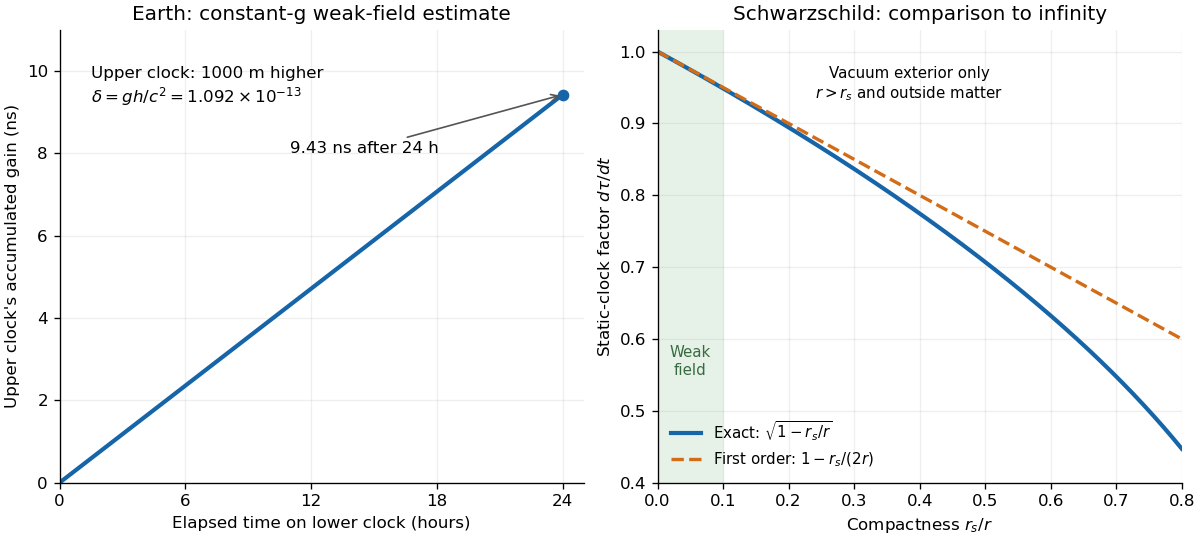
In a static spacetime, a clock held at a fixed position records proper time for metric time component . Two clocks compared over the same coordinate interval have rate ratio . Each clock ticks normally in its own laboratory; the difference appears when their readings or transmitted frequencies are compared. For a weak Newtonian gravitational potential, , so the fractional excess of the upper rate is .
Take two clocks maintained at rest above Earth, separated vertically by . Approximate the local gravitational acceleration as constant, , neglect rotation, and use the exact speed of light from NIST's constants database. Then andThe upper clock gains about nanoseconds during one -second interval on the lower clock. This is a leading weak-field estimate with , not a precision prediction for a particular mountain: Earth's rotation and actual gravitational potential matter in accurate comparisons. The effect is experimentally accessible. Chou, Hume, Rosenband and Wineland raised an optical clock by and measured a fractional rate change ; the same formula with predicts . See their [ref]
https://tsapps.nist.gov/publication/get_pdf.cfm?pub_id=905055. 2010 paper, Optical Clocks and Relativity, equation (2) and figure 3
. Such comparisons make clocks probes of gravitational potential as well as instruments for timekeeping.For the ideal spherical, nonrotating Schwarzschild spacetime, the exact static-clock factor relative to time at infinity is , where is the Schwarzschild radius. Its weak-field expansion is . The figure compares these factors only in a vacuum exterior with ; for a material body, the radius must also exceed its surface radius. It does not extend the exterior formula through the body's interior. See Tong's lecture notes, section 6.1 on Schwarzschild exterior geometry.
For a point lens of mass at observer distance and source distance in a nearby Euclidean geometry, the Einstein radius in the lens plane is . Its angular version is . This is the ring radius for perfect alignment and the characteristic transverse scale of a gravitational microlensing event. A crossing timescale is , proportional to the square root of lens mass at fixed geometry and speed.
The signed magnification is the reciprocal determinant of the Jacobian matrix of the thin gravitational lens equation. Its absolute value gives the flux and solid-angle amplification; its sign gives image parity. Gravitational lensing preserves surface brightness in the geometric-optics approximation.
A gravitational lens is a foreground distribution of matter whose gravitational field deflects light from a background source. Its projected surface mass density determines the mapping in the thin-lens approximation. The lens is the deflecting object; gravitational lensing is the resulting optical process.
For a single source plane, adding a uniform sheet and rescaling the original projected lens mass as shown leaves the reduced shear unchanged. Rescaling source coordinates by also preserves the image positions and shapes. Thus image geometry alone need not determine absolute lens mass normalization. Absolute magnification, independently known source sizes, time-delay information with a fixed distance scale, or additional geometric/dynamical constraints can break or restrict this mass-sheet degeneracy.
Pinned article: Introduction to the OurBigBook Project
Welcome to the OurBigBook Project! Our goal is to create the perfect publishing platform for STEM subjects, and get university-level students to write the best free STEM tutorials ever.
Everyone is welcome to create an account and play with the site: ourbigbook.com/go/register. We belive that students themselves can write amazing tutorials, but teachers are welcome too. You can write about anything you want, it doesn't have to be STEM or even educational. Silly test content is very welcome and you won't be penalized in any way. Just keep it legal!
Intro to OurBigBook
. Source. We have two killer features:
- topics: topics group articles by different users with the same title, e.g. here is the topic for the "Fundamental Theorem of Calculus" ourbigbook.com/go/topic/fundamental-theorem-of-calculusArticles of different users are sorted by upvote within each article page. This feature is a bit like:
- a Wikipedia where each user can have their own version of each article
- a Q&A website like Stack Overflow, where multiple people can give their views on a given topic, and the best ones are sorted by upvote. Except you don't need to wait for someone to ask first, and any topic goes, no matter how narrow or broad
This feature makes it possible for readers to find better explanations of any topic created by other writers. And it allows writers to create an explanation in a place that readers might actually find it.
Figure 1. Screenshot of the "Derivative" topic page. View it live at: ourbigbook.com/go/topic/derivativeVideo 2. OurBigBook Web topics demo. Source. - local editing: you can store all your personal knowledge base content locally in a plaintext markup format that can be edited locally and published either:This way you can be sure that even if OurBigBook.com were to go down one day (which we have no plans to do as it is quite cheap to host!), your content will still be perfectly readable as a static site.
- to OurBigBook.com to get awesome multi-user features like topics and likes
- as HTML files to a static website, which you can host yourself for free on many external providers like GitHub Pages, and remain in full control

Figure 2. You can publish local OurBigBook lightweight markup files to either OurBigBook.com or as a static website.
Figure 3. Visual Studio Code extension installation.
Figure 5. . You can also edit articles on the Web editor without installing anything locally. Video 3. Edit locally and publish demo. Source. This shows editing OurBigBook Markup and publishing it using the Visual Studio Code extension. 
- Infinitely deep tables of contents:



All our software is open source and hosted at: github.com/ourbigbook/ourbigbook
Further documentation can be found at: docs.ourbigbook.com
Feel free to reach our to us for any help or suggestions: docs.ourbigbook.com/#contact