Topics (384k) Articles (398k) Users (410) Discussions (242) Comments (383) Files (13k) New article

The shortest path problem asks for a graph path from a source vertex to a destination vertex minimizing its total edge weight. Here is the cost of traversing edge , and costs add along the graph path. If no route exists, its shortest-path distance is . With nonnegative edge weights, deleting cycles in a graph from a walk never increases its cost, so repetitions cannot improve the optimum.
Consider the undirected graph with vertex set and the six edge weightsEach edge can be traversed in either direction at the same cost. The direct graph path costs ; costs ; costs . The cheapest graph path is , costing . The remaining graph path costs , exhausting the possibilities without repeated vertices.
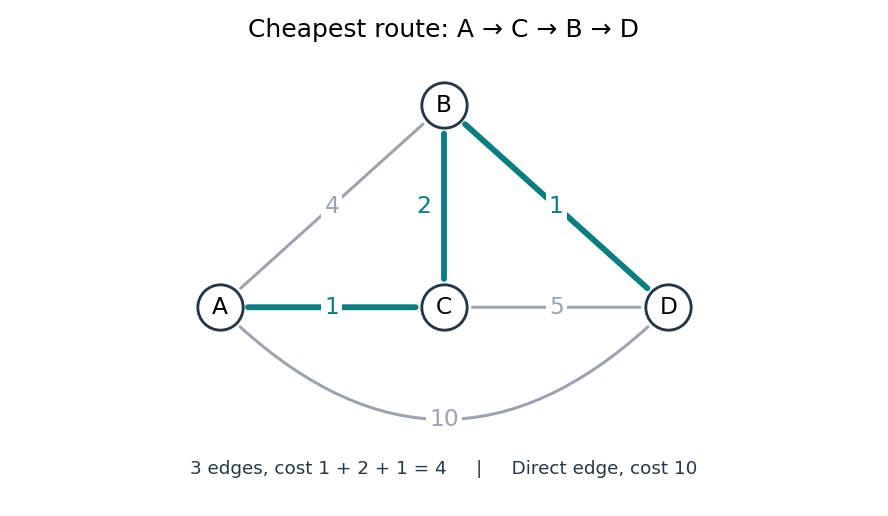
The shortest path problem: three highlighted edges cost less than the direct connection
. Details. Thus fewest edges and least total cost are different objectives. Breadth-first search minimizes the number of edges, which suffices when every edge has the same positive cost. Unequal nonnegative costs call for the Dijkstra algorithm. On a map, weights might be minutes rather than kilometres: a longer-looking route can arrive sooner. This is why a weighted graph separates the network's connections from what a particular journey costs.
For a simple graph, let count the common neighbours of vertices . Choosing two such neighbours makes a four-cycle, and each cycle is counted twice through its opposite pairs. The displayed identity follows even when extra edges are present, since cycles are counted as subgraphs rather than induced subgraphs. Also . Applying Cauchy-Schwarz inequality to degrees and Jensen inequality to common-neighbour counts gives extremal edge and cycle bounds.
The Johnson graph has the -element subsets of an -element set as vertices, with two vertices adjacent exactly when their intersection has elements. Relabelling the ground set gives graph automorphisms. The maximal cliques of a Johnson graph allow reconstruction of those ground-set labels when the two clique sizes are different.
A chordal graph is a finite simple graph with no induced cycle of length at least four. Equivalently, every cycle in a graph with at least four vertices has a chord: an edge joining two nonconsecutive vertices of that graph cycle. The word "induced" matters: the induced subgraph on the chosen vertices must contain exactly the cycle's edges, with no chords. Triangles are allowed. This definition concerns adjacency, independently of how the graph is drawn.
For the square cycle graph , take vertex set and set of edges , where abbreviates . Its graph neighbourhoods are and . The square is an induced cycle, so is not a chordal graph. Add the single edge : now , , , and . The only possible four-vertex graph cycle has chord , so this new graph is a chordal graph. Its maximal cliques are exactly and .
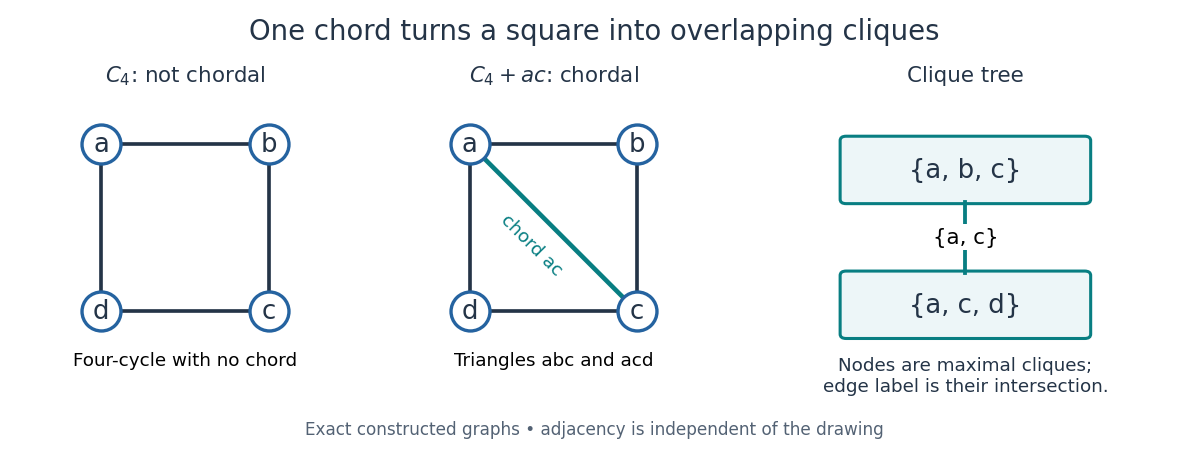
An induced cycle loses its obstruction when one diagonal is added; the resulting maximal cliques form a junction tree
. Details. Connect these two maximal cliques by a single edge labelled with their intersection . The result is a junction tree, also called a clique tree: its nodes are maximal cliques, and the nodes containing any fixed original vertex induce a connected graph inside the tree. Here occur in both nodes, while each occur in just one. This is the running intersection property. More generally, a nonempty connected graph is a chordal graph exactly when its maximal cliques admit such a tree; a disconnected chordal graph can be represented by one such tree per connected component of a graph.[ref]
A chordal graph need not be a planar graph: the complete graph is a chordal graph, since every pair of distinct vertices is adjacent, but its ten edges violate the planar graph edge bound . Conversely, even a plane drawing whose bounded faces are triangles can hide an induced cycle: a wheel graph with a four-vertex rim and a central vertex joined to the whole rim still has the rim as an induced cycle. Adding chords to obtain a chordal graph is called triangulation of an undirected graph; this is an adjacency condition, rather than a requirement about planar faces.
Why is this structure useful? The maximal cliques collect local interactions, and the running intersection property makes their overlaps sufficient for consistent communication. For random variables with finite state sets, a probabilistic graphical model of the square-plus-diagonal form can havewhere the two nonnegative clique potentials have a positive normalizing constant . Eliminating produces the two-variable junction-tree sum-product messageThe shared clique carries everything needed from the eliminated side. For possible states per random variable, this example uses two sums over configurations after reusing the message, rather than directly summing over configurations. The example's message is an exact finite sum, with no simulated data. Large maximal cliques still make exact inference expensive; chordal graphs provide a decomposition, not a universal guarantee of cheap inference.[ref]
The 2-core is what remains of a finite simple graph after repeatedly removing every vertex with fewer than two surviving graph neighbours. It strips away dangling trees while keeping the part that can support itself under this local rule. Precisely, for an undirected graph , its 2-core is the unique maximum by set inclusion induced subgraph such thatThe empty vertex set is allowed: the condition is then vacuous, without needing to define the minimum degree of the empty graph. "Maximum by inclusion" means that contains every other vertex set satisfying the condition. It is stronger than merely saying that one chosen set cannot be enlarged: the 2-core simultaneously contains all possible qualifying induced subgraphs. In this particular family, every inclusion-maximal qualifying set does equal that unique maximum; the union argument in why the 2-core is unique explains why. [ref]
An O(m) Algorithm for Cores Decomposition of Networks by Vladimir Batagelj and Matjaž Zaveršnik. Batagelj and Zaveršnik, An O(m) Algorithm for Cores Decomposition of Networks, §2, definition of a core
For a complete worked example, let denote the edge and takeThe triangle in a graph has a branching tail attached at , and is an isolated vertex. In alphabetical order the initial degrees of vertices are . Deleting turns into a leaf of a graph; deleting leaves with degree of a vertex two; deleting changes no other degree of a vertex. Now delete , which makes a leaf of a graph, and finally delete . Exactly the three edges of remain: .
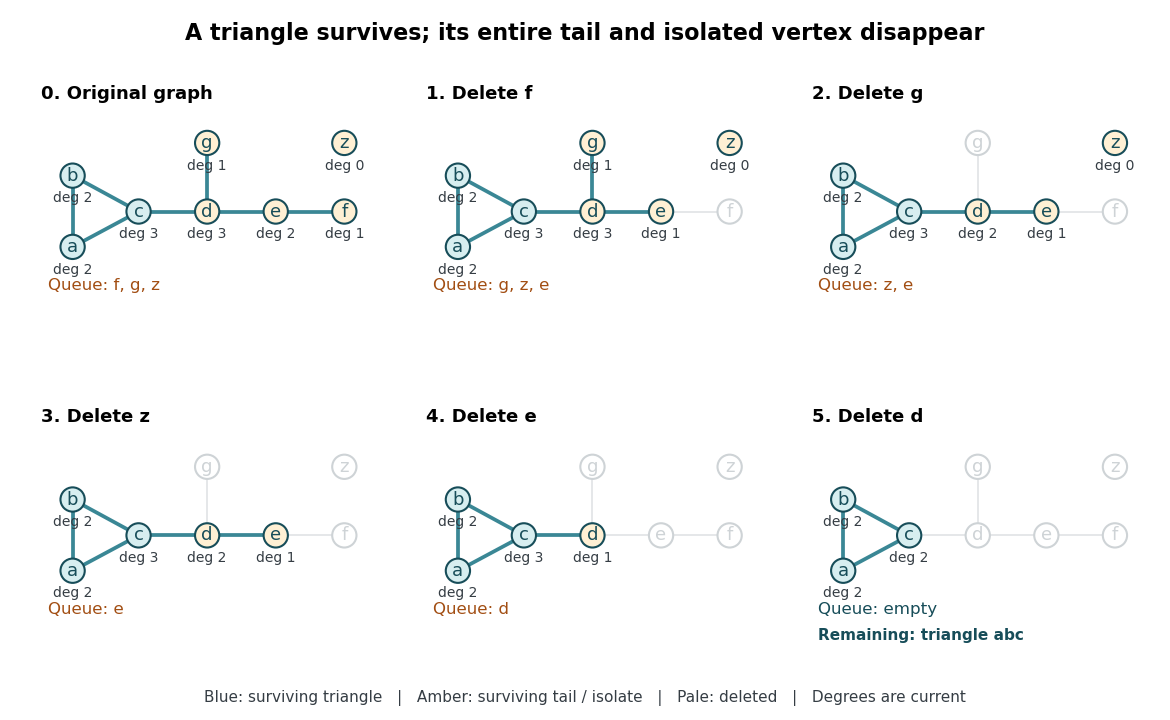
The complete leaf pruning for the 2-core trace: each panel recomputes the displayed degrees of vertices from the surviving induced subgraph, while the FIFO queue determines the next deletion
. Details. A forest has empty 2-core: every nonempty finite forest has an isolated vertex or a leaf of a graph, so deletion cannot stop at a nonempty remainder. In particular, an isolated edge, an isolated vertex, a path graph, and the empty graph all have empty 2-core. Every cycle graph is its own 2-core. Two disjoint triangles in a graph also form their own 2-core, so a 2-core need not be a connected graph; attaching a tree to either triangle changes neither surviving triangle.
Here excess means edges minus vertices. For a connected graph it is one less than the number of independent cycles. Deleting a leaf and its incident edge, or suppressing a degree-two vertex, preserves excess. This convention differs by one from the cyclomatic number for connected graphs.
A geometric spanner is a weighted graph on points in Euclidean space, with edge weights equal to their Euclidean distances, in which every pair has a graph path of length at most times its direct distance. Its stretch factor is the largest ratio , where is shortest-path distance. A square's four perimeter edges, without diagonals, give stretch factor : adjacent points have ratio one, and diagonal pairs have route length instead of . The aim is to retain short routes with fewer edges than a complete graph. [ref]
https://people.scs.carleton.ca/~michiel/encyc_geometric_spanners.pdf. Gudmundsson, Narasimhan and Smid, Geometric Spanners, §1
.For smooth -periodic , the equation is the negative gradient flow of . Periodic integration by parts gives . Its unique equilibrium has Fourier coefficients , and every transient coefficient decays as . Thus the flow converges to the unique minimizer of the energy.
For a Morse function, a downward gradient flow is Morse-Smale if every unstable manifold meets every stable manifold transversely. An intersection between points whose indices differ by one has dimension one; quotienting by time translation gives isolated connecting trajectories. Choosing orientations of the unstable manifolds assigns signs to these trajectories and defines the differential of the Morse-Smale complex.
Intraislet glucagon signaling is critical for maintaining glucose homeostasis by Lu Zhu and others tested whether local glucagon supports insulin release. For human pancreatic islets, a computer-controlled flow system delivered a buffer solution at through a chamber holding 500 pancreatic islets on a nylon filter at . A fraction collector sampled the outgoing fluid. With an amino acid mixture present, the experiment changed glucose from to and compared GLP-1 receptor blockade with fluid lacking the blocker. The readout was released insulin and glucagon: blockade reduced glucose-stimulated insulin release without significantly changing glucagon release. [ref]
Complementary mouse experiments suppressed alpha cell activity using an engineered G protein-coupled receptor. ELISA assays of minute-by-minute effluent samples measured insulin and glucagon concentrations, providing the hormone release readout. Drug-treated control pancreatic islets lacking that engineered receptor checked for drug effects; adding glucagon restored insulin release in the suppressed preparation. Together, blockade and rescue support local signal transduction from alpha cells to beta cells. Isolated pancreatic islets omit intact circulation and nervous input; the human preparation came from five donors, and blocker specificity and donor variation limit generalization. A chamber response does not directly measure whole-body blood glucose control. [ref]
Order the positive integers by odd numbers from upward, then twice the odds, then four times the odds, and so on, followed by descending powers of two and finally . If a continuous interval map has a cycle of one period, it has cycles of every period later in this order. In particular, period three forces every positive period.
An ice sheet is a large body of glacier ice covering land. Its mass budget combines accumulation, surface ablation, basal melting and discharge. Changes of floating ice shelves can influence discharge of grounded ice through changes in restraint, even though shelf melt itself has only a small direct sea-level contribution.
Seal leak current bypasses the membrane patch through an imperfect seal. For an ideal ohmic seal to a zero-voltage bath, , positive from pipette to bath. At and its magnitude is , far larger than the synthetic single-channel step. A stable baseline can be subtracted, but changing leakage can mimic a biological response. Intrinsic membrane leak through ion channels is distinct from this bypass: interpreting both as the same electrical conductance obscures whether the biological cell or the seal changed.
A zonal-mean meridional overturning circulation associated with Southern Ocean wind forcing. In a southern-hemisphere channel with eastward wind stress, the mean circulation has northward surface transport and a southward deep return. Its Eulerian strength need not equal the residual water-mass transport because eddy-induced overturning can oppose it.
The ratio of viscous force to Coriolis force in a rotating fluid at length scale . This convention uses rotation frequency ; conventions omitting the factor two are also common. For small , bulk viscosity is weak but no-slip boundaries can form Ekman layers of thickness of order , with relatively larger boundary shear stress.
A wave caustic is a locus where the projection of a family of rays or wavefronts becomes singular. Several ray paths may coalesce there, and the geometrical approximation can predict divergent intensity. Finite-wavelength diffraction replaces that ideal divergence by a resolved wave pattern. The construction applies to acoustic as well as optical waves.
For positive real numbers and nonnegative weights with , the weighted geometric mean isIt takes a weighted mean of logarithms. A zero weight excludes that input; equal weights give the ordinary geometric mean. If occurs times in a list of total length , its correct weight is . For the list ,and replacing all four entries by preserves the product .
There is also an optimization interpretation. A logarithmic transformation turns multiplicative discrepancies into additive ones. For a positive representative , the weighted mean minimizes squared deviations identity givesThus uniquely minimizes weighted quadratic loss in logarithmic coordinates. The weighted arithmetic mean minimizes squared discrepancies in the original coordinates. These two objectives explain why different choices of what constitutes an error select different summaries.
The strictly concave function and the reversed Jensen's inequality give , where is the weighted arithmetic mean. Apply the same reasoning to the multiplicative inverses to get for the weighted harmonic mean. Thus ; equality holds exactly when all positive-weight inputs agree. For this list, , , and . The weights specify which inputs are represented and must stay the same across the comparison.
A group length function satisfies , and . Word length for a chosen generating set is an example; Coxeter length uses the simple reflections.
A cube complex, in the cubical CW complex convention used here, is built from standard hypercubes by identifying their faces of a cube using isometries. The restriction of each characteristic map to a face of a cube agrees with the characteristic map of a lower-dimensional cell, after an isometry of that face. The cubes carry their Euclidean metrics, giving an induced length distance on each connected component.[ref]
Face identifications may identify different boundary points of the same cube. For example, one interval with its endpoints identified is a circle, and one square with opposite sides identified is a torus. The latter has one vertex, two edges and one square; it is the Salvetti complex for two commuting generators.
A stricter polyhedral convention requires every closed cube to embed and every pair of cubes to meet in one common face. That convention needs a finer cell decomposition of these examples. The cubical-CW convention allows the one-vertex quotient models used in geometric group theory. Being a nonpositively curved cube complex is an additional condition, detected by the link of a vertex in a cube complex.
Pinned article: Introduction to the OurBigBook Project
Welcome to the OurBigBook Project! Our goal is to create the perfect publishing platform for STEM subjects, and get university-level students to write the best free STEM tutorials ever.
Everyone is welcome to create an account and play with the site: ourbigbook.com/go/register. We belive that students themselves can write amazing tutorials, but teachers are welcome too. You can write about anything you want, it doesn't have to be STEM or even educational. Silly test content is very welcome and you won't be penalized in any way. Just keep it legal!
Intro to OurBigBook
. Source. We have two killer features:
- topics: topics group articles by different users with the same title, e.g. here is the topic for the "Fundamental Theorem of Calculus" ourbigbook.com/go/topic/fundamental-theorem-of-calculusArticles of different users are sorted by upvote within each article page. This feature is a bit like:
- a Wikipedia where each user can have their own version of each article
- a Q&A website like Stack Overflow, where multiple people can give their views on a given topic, and the best ones are sorted by upvote. Except you don't need to wait for someone to ask first, and any topic goes, no matter how narrow or broad
This feature makes it possible for readers to find better explanations of any topic created by other writers. And it allows writers to create an explanation in a place that readers might actually find it.
Figure 1. Screenshot of the "Derivative" topic page. View it live at: ourbigbook.com/go/topic/derivativeVideo 2. OurBigBook Web topics demo. Source. - local editing: you can store all your personal knowledge base content locally in a plaintext markup format that can be edited locally and published either:This way you can be sure that even if OurBigBook.com were to go down one day (which we have no plans to do as it is quite cheap to host!), your content will still be perfectly readable as a static site.
- to OurBigBook.com to get awesome multi-user features like topics and likes
- as HTML files to a static website, which you can host yourself for free on many external providers like GitHub Pages, and remain in full control

Figure 2. You can publish local OurBigBook lightweight markup files to either OurBigBook.com or as a static website.
Figure 3. Visual Studio Code extension installation.
Figure 5. . You can also edit articles on the Web editor without installing anything locally. Video 3. Edit locally and publish demo. Source. This shows editing OurBigBook Markup and publishing it using the Visual Studio Code extension. 
- Infinitely deep tables of contents:




All our software is open source and hosted at: github.com/ourbigbook/ourbigbook
Further documentation can be found at: docs.ourbigbook.com
Feel free to reach our to us for any help or suggestions: docs.ourbigbook.com/#contact