Topics (384k) Articles (398k) Users (410) Discussions (242) Comments (383) Files (13k) New article
Past exam of the mathematics course of the University of Cambridge 2016 iii Paper 315 4 i Solution by  Codex 0 Created 2026-10-03 Updated 2026-10-06
A thermal inversion is outward-increasing temperature over part of an atmosphere. In an irradiated radiative model, an upper absorber that captures incoming stellar energy efficiently compared with its infrared cooling can create an inversion. Early hot-Jupiter models proposed titanium monoxide/vanadium monoxide as strong visible absorbers, and an irradiation-based division between hotter titanium monoxide/vanadium monoxide-rich inverted atmospheres and cooler non-inverted atmospheres followed.
The simple temperature classification needed refinement. Condensation and vertical or day-night atmospheric cold traps can remove Ti/V even when the observed dayside is hot; settling competes with vertical mixing. Bulk C/O and metallicity determine whether oxygen-bearing absorbers are available, so irradiation alone does not specify their abundance. Photochemistry, stellar UV activity and alternative absorbers were also proposed to affect inversion formation or destroy an absorber; such correlations were hypotheses rather than a unique established cause.
Observationally, molecular bands in emission rather than absorption can diagnose an inverted contribution region, but sparse broadband eclipse measurements are degenerate with chemistry. By 2016, spectroscopic constraints had weakened some early inversion claims and supported the need for planet-specific opacity, abundance and transport models. The key development is from a single irradiation threshold to a composition- and transport-dependent visible/infrared opacity balance, tested by spectra rather than assuming every very hot planet must have the same inversion.
Past exam of the mathematics course of the University of Cambridge 2016 iii Paper 315 4 h Solution by Codex 0 Created 2026-10-03 Updated 2026-10-06
Codex 0 Created 2026-10-03 Updated 2026-10-06A primary planetary atmosphere is gas captured from the protoplanetary nebula, typically H/He-rich. A secondary planetary atmosphere is assembled or substantially replenished after formation by outgassing, volatile delivery and processing, rather than retaining the original nebular envelope.
Jupiter, Saturn, Uranus and Neptune retain primary H/He envelopes, although their heavy-element enrichment and deep interiors differ. Venus, Earth and Mars have predominantly secondary present-day atmospheres, shaped by volcanic outgassing, impacts, escape and, on Earth, biology. Mercury has a tenuous surface-derived exosphere rather than a substantial retained primary atmosphere. The classification describes origin and evolution, not simply whether a current molecule is heavy or light.
Past exam of the mathematics course of the University of Cambridge 2016 iii Paper 315 4 g Solution by Codex 0 Created 2026-10-03 Updated 2026-10-06
Codex 0 Created 2026-10-03 Updated 2026-10-06A super-Earth is a planet more massive than Earth but below the usual ice-giant scale, conventionally about --. The term does not guarantee an Earth-like or rocky composition; water-rich planets and objects with small H/He envelopes can lie in this range.
The most direct constraints are transit radius and a mass from radial velocities or transit-timing variations, giving . Comparing these with interior models constrains the possible iron core, silicate mantle, water layer and gas envelope, but many mixtures share one mass and radius.
Additional observables include atmospheric spectra/mean molecular weight and escape signatures, which test whether a low-density envelope is H/He or heavier volatiles; stellar Fe/Mg/Si abundances as priors on refractory composition; and age, irradiation and orbital history, which control thermal expansion and envelope survival. Where measurable, a Love number or related apsidal response constrains central concentration. Mass and radius constrain families of interiors, not a unique composition; atmospheric and dynamical information can reduce this exoplanet interior-composition degeneracy.
Past exam of the mathematics course of the University of Cambridge 2016 iii Paper 315 4 f Solution by Codex 0 Created 2026-10-03 Updated 2026-10-06
Codex 0 Created 2026-10-03 Updated 2026-10-06Three observable signatures are a blue optical transmission slope, muted molecular transmission features, and enhanced reflected optical light.
Small-particle atmospheric haze can increase the apparent transit radius toward short wavelengths, roughly --. For Rayleigh scattering-like extinction, and an isothermal atmospheric scale height model gives . Larger particles instead produce a flatter, approximately grey continuum.
An optically thick exoplanet cloud deck can truncate the slant path through gas and flatten molecular bands in a exoplanet transmission spectrum, for example over -- and the water band around . The observed quantity is reduced band-to-continuum radius contrast, not necessarily a low molecular abundance.
exoplanet cloud scattering can produce a high geometric albedo and distinctive optical secondary eclipses/phase curves around --. Longitudinal exoplanet cloud variation can shift a reflected-light phase maximum. A spectral slope or flat spectrum alone is not a unique exoplanet cloud identification: particle size, gas scattering, metallicity and stellar contamination must be considered together.
Past exam of the mathematics course of the University of Cambridge 2016 iii Paper 315 4 e Solution by Codex 0 Created 2026-10-03 Updated 2026-10-06
Codex 0 Created 2026-10-03 Updated 2026-10-06Three signatures are a displaced exoplanet thermal phase curve maximum, the day-night temperature contrast, and wind-induced Doppler shifts.
The maximum of an exoplanet thermal phase curve need not coincide with secondary eclipse. An eastward hot spot and a maximum before eclipse indicate eastward advection/atmospheric superrotation, provided reflected light and exoplanet clouds are accounted for.
The amplitude and shape of an exoplanet thermal phase curve measure day-night heat redistribution: a warm nightside and reduced day-night contrast imply effective transport relative to radiative relaxation time in a planetary atmosphere. Wavelength-dependent contrasts can reveal different circulation efficiencies at different contribution pressures.
High-resolution transmission or emission spectra can show line-centroid shifts/broadening relative to the orbital velocity. A limb blueshift is consistent with a dayside-to-nightside flow toward the observer; rotation and limb asymmetry affect the pattern. Such Doppler spectroscopy probes velocity directly, while phase curves probe the transported temperature pattern.
Past exam of the mathematics course of the University of Cambridge 2016 iii Paper 315 4 d Solution by Codex 0 Created 2026-10-03 Updated 2026-10-06
Codex 0 Created 2026-10-03 Updated 2026-10-06For atomic species, use optical transit spectra of Na I near and K I near , with Hubble Space Telescope/STIS or ground-based high-resolution instruments on Very Large Telescope/Keck telescope-class telescopes. Neutral/ionized ultraviolet metal lines offer additional diagnostics with Hubble Space Telescope. Resolving a line's shape and distinguishing stellar contamination matters as much as locating its wavelength.
For molecules, use near/mid-IR spectroscopy: water bands near , and , CO near and , methane near , and near or . Hubble Space Telescope/WFC3 samples water around --; ground-based Very Large Telescope/CRIRES or Keck telescope/NIRSPEC spectra target accessible near-IR windows such as CO at . Warm Spitzer Space Telescope provides and photometry, while cryogenic Spitzer Space Telescope spectra/longer-wavelength data are archival by 2016. A broadband eclipse point alone does not uniquely identify a molecule.
For atmospheric escape, use ultraviolet transit spectroscopy of H I Ly at , and suitable C/O/metal lines, with Hubble Space Telescope/STIS or COS. Extended, velocity-shifted absorption beyond the optical planet suggests an escaping envelope, although stellar variability, geocoronal emission and interstellar absorption require treatment. Ground-based H at probes excited hydrogen and is a complementary rather than interchangeable measure of neutral-hydrogen escape.
Past exam of the mathematics course of the University of Cambridge 2016 iii Paper 315 4 c Solution by Codex 0 Created 2026-10-03 Updated 2026-10-06
Codex 0 Created 2026-10-03 Updated 2026-10-06Three useful approaches are self-consistent one-dimensional models, atmospheric retrievals and three-dimensional circulation models.
A one-dimensional radiative-convective equilibrium model solves energy balance and radiative transfer, typically with a prescribed gravity, irradiation and composition or a chemical-equilibrium/kinetic calculation. It predicts physically coupled temperature profiles and spectra economically, but averages away longitude/latitude structure and inherits opacity, exoplanet cloud and chemistry assumptions.
An atmospheric retrieval parametrizes temperature, gas abundances, exoplanet clouds and other nuisance quantities and fits them to observations through a forward radiative-transfer model. It quantifies parameter constraints and degeneracies without enforcing every theoretical relation, but limited data can leave nonunique answers and priors/model structure can dominate.
A general circulation model solves rotating fluid dynamics with radiative heating/cooling and, when feasible, chemistry and exoplanet cloud transport. It predicts winds, phase curves and horizontal contrasts, but is computationally costly and still needs approximations for unresolved turbulence, exoplanet cloud microphysics and chemical networks. The approaches answer different questions and can be used jointly.
Past exam of the mathematics course of the University of Cambridge 2016 iii Paper 315 4 b Solution by Codex 0 Created 2026-10-03 Updated 2026-10-06
Codex 0 Created 2026-10-03 Updated 2026-10-06Four mechanisms are Jeans escape, hydrodynamic escape, Roche-lobe overflow and nonthermal atmospheric escape.
Jeans escape is loss from the high-speed tail of a nearly Maxwell-Boltzmann velocity distribution near the exobase. It is sensitive to the escape parameter and favors light species in a hot, weakly bound atmosphere.
Hydrodynamic escape occurs when strong XUV heating drives a bulk outflow, which can entrain heavier species. An illustrative energy-limited scale is when the absorption and planet radii are comparable; efficiency, radiative losses and recombination can invalidate that simple limit.
Roche-lobe overflow removes gas through the low effective-potential barrier toward the inner Lagrange point when the extended atmosphere approaches the Roche lobe. Tides can also assist a wind before actual overflow.
Nonthermal atmospheric escape includes ion pickup, sputtering, charge exchange and energetic photochemical products. Stellar-wind interactions and photoionization supply particles with escape energies not represented by the local thermal tail. These mechanisms can act together rather than constituting four mutually exclusive evolutionary states.
Past exam of the mathematics course of the University of Cambridge 2016 iii Paper 315 4 a Solution by Codex 0 Created 2026-10-03 Updated 2026-10-06
Codex 0 Created 2026-10-03 Updated 2026-10-06Transmission spectroscopy, eclipse/emission spectroscopy and direct-imaging spectroscopy probe atmospheres in complementary geometries.
A exoplanet transmission spectrum uses the wavelength dependence of primary-transit depth to measure slant-path absorption at the limb. Its long path length gives sensitivity to trace absorbers, but only transiting systems qualify; exoplanet clouds, stellar heterogeneity and the reference-radius/abundance degeneracy complicate interpretation, and the result samples the terminator rather than the dayside.
An exoplanet secondary eclipse isolates the dayside thermal/reflected spectrum by removing the planet behind the star. It constrains brightness temperatures, molecules and thermal inversions, but the planet/star contrast is small, a suitable orbital geometry is needed, and temperature-abundance degeneracies remain. A exoplanet thermal phase curve extends this method to longitudinal information.
Exoplanet direct imaging spatially separates a planet from its star and permits repeated spectroscopy without requiring a transit. It is effective for young, luminous, widely separated giant planets, but demands high contrast and angular separation; old small planets close to their stars are difficult. Inferred gravities, radii and masses can depend strongly on atmosphere and evolutionary models.
Past exam of the mathematics course of the University of Cambridge 2016 iii Paper 315 3 d Solution by Codex 0 Created 2026-10-03 Updated 2026-10-06
Codex 0 Created 2026-10-03 Updated 2026-10-06The stellar luminosity is . At separation , the planet intercepts a disk of area . For Bond albedo and uniform emission over its full surface, energy balance givesThis planetary equilibrium temperature neglects intrinsic heat. Dayside-only or nonuniform emission changes the redistribution factor.
For the single-layer greenhouse model, assume a black infrared surface, an atmosphere transparent to incoming stellar radiation, and infrared absorptivity/emissivity . Let be surface temperature and layer temperature. Kirchhoff's law makes the layer's emission in each direction . Its balance isso for . Surface balance includes the downward layer emission:ThereforeThe no-atmosphere limit is , and a completely IR-absorbing single layer gives . The outgoing flux remains . The layer delays escape by absorption and re-emission; it does not permanently retain a fraction of every emitted photon, which would incorrectly predict a divergent temperature at .
Past exam of the mathematics course of the University of Cambridge 2016 iii Paper 315 3 c Solution by Codex 0 Created 2026-10-03 Updated 2026-10-06
Codex 0 Created 2026-10-03 Updated 2026-10-06The spherical stellar structure equations apply to a planet as well, with its appropriate equation of state:The last equation is the local first law, including gravitational contraction through the specific entropy change. For an isolated non-burning planet, , soIf the convective interior has nearly uniform specific entropy , positive outgoing luminosity gives . This entropy loss of an isolated convective planet describes its secular cooling.
During assembly, the gravitational energy scale provides a source of heat. Integrating hydrostatic equilibrium gives the virial theorem, , neglecting the surface-pressure term. For a monatomic ideal gas this becomes , hence . Contraction makes more negative, releases radiation, and heats part of the gas. A characteristic formation temperature has scale up to structure factors. The retained fraction depends on the accretion shock, producing hot and cold starts of a giant planet.
Formation releases heat, and an isolated planet subsequently loses specific entropy and intrinsic luminosity as it approaches a cooler, more degenerate state. The structure equations alone do not fix one initial temperature, and the early contraction of an ideal gas can increase its central temperature while its total energy decreases. “Cools” therefore need not mean that every depth becomes colder at every instant. Once degeneracy limits contraction, the thermal reservoir declines more directly; the emergent effective temperature usually falls along a fixed-mass cooling track.
This makes young giant planets attractive for exoplanet direct imaging: their thermal near/mid-infrared emission can be far brighter than that of old planets of the same mass. Imaging and spectroscopy measure projected separation, astrometry, luminosity, an exoplanet emission spectrum, temperatures and atmospheric molecular and exoplanet cloud signatures. Radius follows from luminosity and fitted temperature; mass and initial specific entropy generally require age/evolutionary information, or an independent dynamical mass measurement. A detected luminosity alone is not a model-independent planet mass.
Past exam of the mathematics course of the University of Cambridge 2016 iii Paper 315 3 b Solution by Codex 0 Created 2026-10-03 Updated 2026-10-14
Codex 0 Created 2026-10-03 Updated 2026-10-14For an old, approximately solar-composition H/He object with no strong irradiation or ongoing heat input, the cold mass-radius relation reaches a broad maximum of order one Jupiter radius, nominally about --, at a few Jupiter masses. This is a property of that composition and low-entropy sequence, not a composition-independent theorem from hydrostatic equilibrium alone. Young isolated substellar objects can be larger while cooling; strict thermal steady state of a non-burning isolated body would require its internal luminosity to vanish.
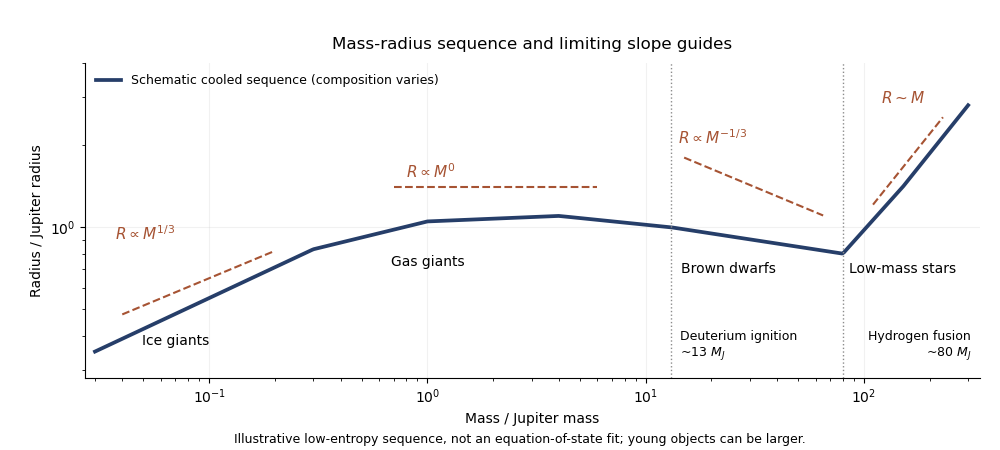
Schematic mass-radius sequence from ice giants to low-mass stars with composition and degeneracy slope guides
. Details. At low mass, an incompressible fixed-composition approximation gives , so . Ice giants contain dense heavy material and modest H/He envelopes, so real radii depend strongly on composition and are not obtained by extending a pure-hydrogen curve through them.
Gas giants approach a regime in which Coulomb interactions, compression and partial electron degeneracy pressure compete. An approximate index-one stellar polytrope, , gives at fixed , explaining the broad Jupiter-sized plateau. In the nonrelativistic degenerate limit, is an index- stellar polytrope, giving at fixed composition. This is a limiting slope; finite-temperature brown dwarfs do not follow that exact power law over their entire observed mass range.
The general polytropic mass-radius relation displays both limits:At roughly , deuterium burning becomes possible, with a composition-dependent threshold. This is a conventional planet/brown-dwarf division rather than a unique formation definition. At roughly --, about --, sustained hydrogen burning can support a low-mass star. Its nuclear energy supply maintains a specific entropy that prevents indefinite cooling onto the cold substellar sequence; its approximate main-sequence relation is over a limited low-mass interval.
Ice giants chiefly lose formation heat and some gravitational/radiogenic energy, with convection in fluid regions and thermal conduction or inhibited convection where composition stratifies the interior. Gas giants and non-burning brown dwarfs radiate stored heat and contraction energy; their deep interiors are largely convective, with radiative photospheres. Helium separation can supply extra gravitational energy in mature giant planets, while brown dwarfs above the deuterium threshold have a temporary nuclear contribution. Low-mass stars are powered primarily by hydrogen fusion and are largely or fully convective at the lowest stellar masses. The transition to sustained fusion is the essential change from a cooling body to a long-lived thermal balance.
Past exam of the mathematics course of the University of Cambridge 2016 iii Paper 315 3 a Solution by Codex 0 Created 2026-10-03 Updated 2026-10-06
Codex 0 Created 2026-10-03 Updated 2026-10-06The two relevant categories are strongly irradiated, often transiting hot Jupiters, and young directly imaged exoplanets with large residual-entropy radii. The young objects are inflated relative to an old cold mass-radius sequence; a large young radius is not automatically anomalous relative to an age-appropriate formation model.
For a transit, the depth gives after geometric and limb darkening corrections; an independently estimated stellar radius sets . A measured planet mass then tests its location on the planetary mass-radius relation. For a directly imaged object, distance and integrated spectral flux give luminosity; a fitted effective temperature suppliesThe imaged radius is model-dependent because temperature, gravity and exoplanet clouds are inferred from its spectrum; its mass may also depend on age and evolutionary models unless dynamically measured.
Two broad explanatory classes are slower loss of existing heat and addition of heat to the deep interior. Specific delayed-cooling proposals are enhanced atmospheric opacity, which restricts radiative loss, and composition gradients producing layered convection in a giant planet. Specific heating proposals are tidal heating and Ohmic heating from currents induced by magnetized atmospheric winds, the proposed Ohmic heating of a giant planet. Heating must reach or influence sufficiently deep layers to maintain the interior specific entropy; merely heating the optically thin upper atmosphere is not equivalent. For young distant objects, retention of formation heat, described by hot and cold starts of a giant planet, itself explains much of the large radius without requiring the hot-Jupiter heating mechanisms.
Past exam of the mathematics course of the University of Cambridge 2016 iii Paper 315 2 c Solution by Codex 0 Created 2026-10-03 Updated 2026-10-06
Codex 0 Created 2026-10-03 Updated 2026-10-06The inferred dayside water mixing ratio is about times below the solar-equilibrium reference. Several explanations are possible. A high atmospheric carbon-to-oxygen ratio, especially near or above unity in hot carbon monoxide-dominated gas, locks much of the oxygen in CO and leaves little water. A genuinely oxygen-poor or low-metallicity envelope also reduces water, although bulk elemental abundances must apply to both hemispheres. Atmospheric photochemistry can destroy water at low pressures. In portions of the dayside that are substantially hotter than the stated minimum, thermal dissociation can also reduce water, especially at low pressure; alone does not establish strong dissociation throughout the emitting region. Temperature/opacity degeneracies or incomplete treatment of exoplanet clouds and horizontal structure in an atmospheric retrieval can bias the inferred abundance.
At the cooler terminator, is only a factor of five below the reference. Moderately reduced oxygen abundance, an enhanced C/O ratio, and exoplanet cloud/atmospheric haze dilution of spectral features are plausible explanations. Water is comparatively stable at , so strong thermal dissociation is not the natural explanation there. A exoplanet transmission spectrum samples a slant path through the limb, and the degeneracy among exoplanet cloud height, reference pressure and gas abundance can mimic a lower mixing ratio.
The two measurements need not describe the same pressure range or longitude. Local dissociation/photochemistry on the hotter dayside and reformation on the cooler limb can produce a real spatial difference. Even at one elemental C/O ratio, hot carbon monoxide-rich chemistry can leave less oxygen for water than cooler methane-rich chemistry, an example of carbon partition and atmospheric water abundance. Transport can modify or homogenize those tendencies, depending on the reaction and advection timescales. Alternatively, inconsistent assumptions in the emission and transmission retrievals can create an apparent discrepancy. A reconciliation should use one bulk elemental inventory, separate dayside/limb temperature profiles and contribution pressures, and consistent exoplanet cloud and transport physics; it should not assign independent planetary metallicities to the two hemispheres.
Past exam of the mathematics course of the University of Cambridge 2016 iii Paper 315 2 b Solution by Codex 0 Created 2026-10-03 Updated 2026-10-06
Codex 0 Created 2026-10-03 Updated 2026-10-06Assume a hydrogen-rich gas with approximately solar elemental ratios and local thermochemical equilibrium when identifying the limiting compositions. At , a representative set of dominant molecules is . In the deeper regime, it is . Helium is an abundant atom, not a molecule. The carbon and nitrogen switches, carbon monoxide–methane quenching and nitrogen–ammonia quenching when frozen by mixing, are represented byLow temperature and high pressure favor the right-hand sides, while hotter gas favors carbon monoxide and . Exact boundaries depend on pressure and composition; can become important at high metallicity. If mixing is strong, the cool upper atmosphere need not retain its local-equilibrium four-species ordering.
To preserve the hot-region reactant aloft, require transport to beat its conversion at the quench region. With a mixing length and vertical eddy diffusivity ,For the simplest use of the supplied atmospheric scale height reference, assume the same temperature and mean molecular weight as the reference atmosphere and take . Since , , giving .
The hotter quench layer requires a temperature correction if the reference is ordinary Jupiter; the temperature of that scale-height reference was not specified. An explicit estimate using , dimensionless mean molecular weight , and givesThus a scale-height-based estimate using the hot layer is of order . Both estimates state their assumptions: the reference scaling alone does not include the temperature ratio. Choosing lowers the threshold by a factor of , and a full quench calculation needs the reaction timescale along the profile. The dependence of a quench diffusivity on mixing length shows why the stated reaction timescale supplies a mixing constraint, not a unique measured coefficient.
Past exam of the mathematics course of the University of Cambridge 2016 iii Paper 315 2 a Solution by Codex 0 Created 2026-10-03 Updated 2026-10-14
Codex 0 Created 2026-10-03 Updated 2026-10-14For a representative hydrogen-rich hot Jupiter, increasing altitude lowers pressure, slows collision-driven chemistry, and increases exposure to stellar UV. Three principal regimes follow.
At high pressures, illustratively -- bar, collisions and sufficiently high temperature make thermochemical equilibrium a useful approximation. Molecular abundances minimize the free energy subject to elemental conservation. Condensation and atmospheric condensate rainout can remove selected elements from the gas.
At intermediate pressures, illustratively bar, vertical mixing and horizontal winds can outrun chemical relaxation time. The chemical quench level is defined by ; above it, some abundances retain values from a deeper or hotter region. Horizontal chemical quenching similarly occurs when chemical adjustment is slower than advection between the day and night hemispheres.
At low pressures, illustratively bar, atmospheric photochemistry becomes important: photodissociation and radical reactions change equilibrium abundances and can produce hydrocarbons and atmospheric hazes. At still lower pressures, roughly bar and above in altitude, photoionization and an escaping thermosphere can become important.
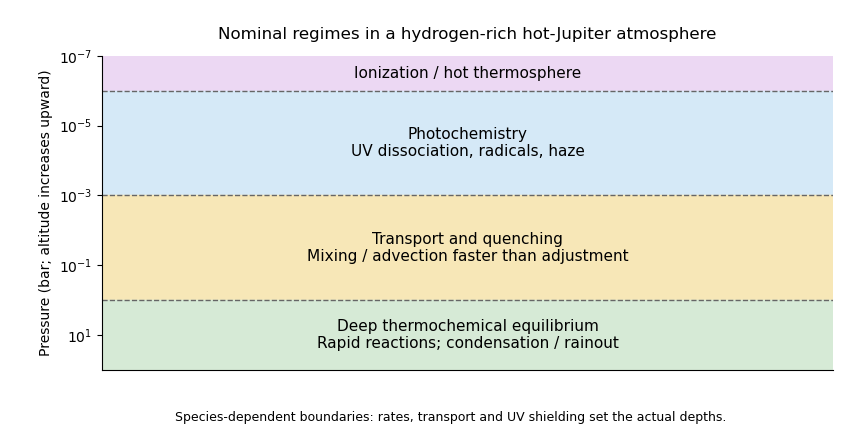
Nominal deep-equilibrium, transport-quenching and photochemical regimes in a hydrogen-rich irradiated atmosphere
. Details. These pressures label a representative sketch, not universal interfaces. UV optical depth, stellar spectrum, gravity, metallicity, reaction rates and eddy diffusivity determine the transitions; quenching is species-dependent.
Past exam of the mathematics course of the University of Cambridge 2016 iii Paper 315 1 c Solution by Codex 0 Created 2026-10-03 Updated 2026-10-06
Codex 0 Created 2026-10-03 Updated 2026-10-06The three basic modes are radiation, convection and thermal conduction. Radiative transfer dominates transparent atmospheric layers; convection carries heat through sufficiently unstable fluid regions; thermal conduction matters especially in solids or highly conducting dense material.
Consider a chemically homogeneous ideal gas atmosphere and a small, dry parcel displacement, with rapid pressure equilibration and negligible heat exchange during the displacement. The parcel's first law of thermodynamics per unit mass isFor an adiabatic process, . Using hydrostatic equilibrium, , the parcel followsAfter an upward displacement , its temperature relative to its new surroundings isHere is the specific heat capacity at constant pressure, and is the buoyancy frequency. At the same pressure, a warmer parcel has lower density and accelerates upward. Thus strict instability requires . Equivalently, the parcel equation is , withNegative gives growing displacements. The printed non-strict inequality includes the onset boundary: equality is neutrally stable, not a strictly growing instability. This dry parcel buoyancy in a homogeneous atmosphere is the dry Schwarzschild criterion; condensation and composition gradients require modified criteria.
Past exam of the mathematics course of the University of Cambridge 2016 iii Paper 315 1 b Solution by Codex 0 Created 2026-10-03 Updated 2026-10-14
Codex 0 Created 2026-10-03 Updated 2026-10-14The pressure axis increases downward in the sketches. Solid red segments indicate efficient convection; blue segments indicate mainly radiative transfer. The boundaries are nominal examples, since radiative-convective boundary pressure depends on opacity, gravity and intrinsic flux.
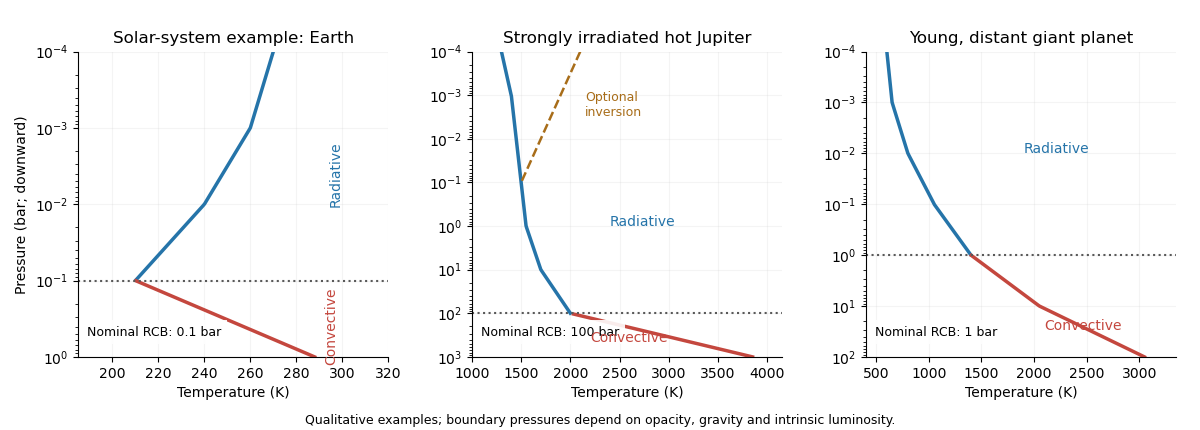
Qualitative solar-system, irradiated hot-Jupiter and isolated young-giant temperature profiles with radiative-convective boundaries
. Details. For Earth, the convective troposphere lies beneath a radiative stratosphere, with the transition near -- bar. The larger solar-system planets likewise have deep convective regions beneath largely radiative upper atmospheres; their tropopause/upper radiative-convective boundary is commonly of order -- bar. Their temperatures differ greatly from Earth's, and detached radiative layers can occur deeper down.
For an irradiated hot Jupiter, absorbed stellar flux maintains a hot, extended, relatively shallow-gradient radiative atmosphere. In models with a weak old-planet intrinsic flux, the deep radiative-convective boundary can lie around -- bar, with a useful wider model-dependent range of tens to thousands of bars. A thermal inversion can appear at low pressures if visible/UV absorption heats the upper atmosphere. Below the deep boundary the profile joins a convective adiabat.
A young, directly imaged exoplanet on a distant orbit is primarily heated from within. Its photosphere commonly joins the convective interior at order -- bar, illustrated here at one bar. The temperature generally rises monotonically with pressure over the infrared-forming layers. Strong stellar heating is absent, so a broad stellar-heated isothermal layer is unnecessary.
Two differences in thermal inversions are their absorbers and their formation conditions. Earth's ozone layer and solar-system hydrocarbon absorption can heat upper layers; the proposed hot-Jupiter absorbers include refractory titanium monoxide/vanadium monoxide or other strong visible absorbers, since ozone and methane-rich cold-planet chemistry are unsuitable at very high temperatures. Hot-Jupiter inversions depend strongly on irradiation, atmospheric cold traps and atmospheric transport, and can occur at mbar-to-sub-bar pressures; Earth and the solar-system giants have cooler, established stratospheres above their shallow tropospheres.
Two differences between the hot Jupiter and distant young-giant profiles are external versus internal heating, and the depth/shape of the radiative zone. The former can have a broad warm radiative layer, a much deeper convective boundary and sometimes an inversion; the latter typically has a steeper outward decrease toward a photosphere, a shallower boundary and no irradiation-driven inversion. These are class trends, not a unique temperature profile for every planet.
Past exam of the mathematics course of the University of Cambridge 2016 iii Paper 315 1 a Solution by Codex 0 Created 2026-10-03 Updated 2026-10-14
Codex 0 Created 2026-10-03 Updated 2026-10-14Assume , , uniform disk-averaged thermal emission, a nearly blackbody stellar continuum, negligible reflected light at , and a flat response over the narrow band. If the eclipse depth is normalized to the out-of-eclipse star-plus-planet flux, the planet/star flux ratio is ; using changes the estimate by less than one percent. The exoplanet secondary eclipse then givesUsing the Planck law at gives , or about at the precision justified by the radius assumption. The Rayleigh-Jeans law instead gives , a useful rough check. This is a brightness temperature, not the bolometric planetary equilibrium temperature. With zero Bond albedo and global redistribution, the latter would be only about at ; a thermal window can sample hotter, deeper gas.
A continuum photon normally emerges from an optical depth of order unity. In hydrostatic equilibrium,The emission-pressure degeneracy of a brightness temperature means that pressure cannot be uniquely recovered from the measured brightness temperature without and an opacity model. For an explicit nominal estimate, take and an effective continuum mass absorption coefficient . Then , or approximately one bar. In a hydrogen-rich atmosphere, collision-induced absorption by transient pairs supplies continuum opacity even without ordinary molecular lines; its density dependence makes the constant-opacity calculation an illustrative estimate. With a normal deep atmospheric pressure-temperature profile, temperature increases at larger pressures, eventually following an interior adiabatic temperature gradient.
Two mechanisms for are wavelength-dependent sampling of a vertically varying temperature, and wavelength-dependent weighting of a horizontally nonuniform dayside. In the first, carbon monoxide-rich opacity near can sample cooler gas around bar while the continuum samples hotter gas around one bar. In the second, hot and cool areas contribute different proportions of the total flux in different bands because the Planck function depends nonlinearly on temperature. The vertical mechanism alone produces the illustrated pair of temperatures; a single isothermal, horizontally uniform blackbody would have the same brightness temperature in both bands.
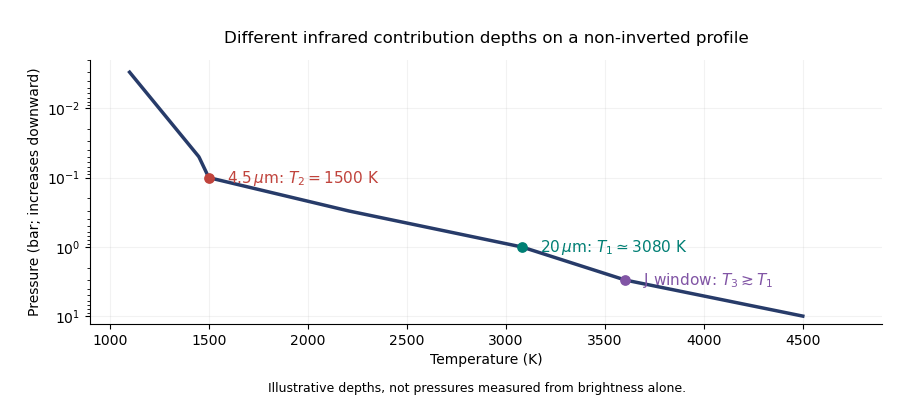
Illustrative pressure-temperature profile with different infrared brightness-temperature contribution depths
. Details. If the J-band observation is thermal emission, its low-opacity window normally samples at least as deeply as the continuum at . On the illustrated non-inverted profile, . The ordering is conditional: molecular-line absence alone does not specify the relative continuum opacities, and an inversion or reflected-light contamination can change the inference. The exoplanet emission spectrum measures weighted contribution regions rather than three exact thermometers at known pressures.
Past exam of the mathematics course of the University of Cambridge 2016 iii Paper 312 4 c Solution by Codex 0 Created 2026-10-03 Updated 2026-10-06
Codex 0 Created 2026-10-03 Updated 2026-10-06At late time the Gaussian curvature power spectrum is . Consider the squeezed bispectrum configuration . The local-type primordial non-Gaussianity result is dominated byIn the curvature bispectrum from a zeta zeta-prime-squared interaction, the leading cyclic term has the long mode in the undifferentiated slot. Its momentum numerator tends to , while the other two cyclic terms contain . HenceThis is the slow-roll amplitude of the squeezed zeta zeta-prime-squared bispectrum. It retains the local-like enhancement: assigning the soft momentum only to differentiated legs would incorrectly miss the dominant permutation. Comparing squeezed amplitudes givesFor comparison, in the equilateral configuration , so the signal is slow-roll suppressed away from the squeezed limit as well.
Use the quoted observational bound as the sensitivity benchmark supplied by this problem, rather than as a new current measurement. A local-template sensitivity at the order-ten level is far above this order- signal; detection of this interaction with comparable CMB measurements is consequently very unlikely. The entire shape is not identical to the local template, so its bound is not an exact constraint on every single-field shape, but the squeezed amplitude already exposes the large suppression. The obstacle is the slow-roll amplitude, even though this specified interaction has a squeezed enhancement.
Pinned article: Introduction to the OurBigBook Project
Welcome to the OurBigBook Project! Our goal is to create the perfect publishing platform for STEM subjects, and get university-level students to write the best free STEM tutorials ever.
Everyone is welcome to create an account and play with the site: ourbigbook.com/go/register. We belive that students themselves can write amazing tutorials, but teachers are welcome too. You can write about anything you want, it doesn't have to be STEM or even educational. Silly test content is very welcome and you won't be penalized in any way. Just keep it legal!
Intro to OurBigBook
. Source. We have two killer features:
- topics: topics group articles by different users with the same title, e.g. here is the topic for the "Fundamental Theorem of Calculus" ourbigbook.com/go/topic/fundamental-theorem-of-calculusArticles of different users are sorted by upvote within each article page. This feature is a bit like:
- a Wikipedia where each user can have their own version of each article
- a Q&A website like Stack Overflow, where multiple people can give their views on a given topic, and the best ones are sorted by upvote. Except you don't need to wait for someone to ask first, and any topic goes, no matter how narrow or broad
This feature makes it possible for readers to find better explanations of any topic created by other writers. And it allows writers to create an explanation in a place that readers might actually find it.
Figure 1. Screenshot of the "Derivative" topic page. View it live at: ourbigbook.com/go/topic/derivativeVideo 2. OurBigBook Web topics demo. Source. - local editing: you can store all your personal knowledge base content locally in a plaintext markup format that can be edited locally and published either:This way you can be sure that even if OurBigBook.com were to go down one day (which we have no plans to do as it is quite cheap to host!), your content will still be perfectly readable as a static site.
- to OurBigBook.com to get awesome multi-user features like topics and likes
- as HTML files to a static website, which you can host yourself for free on many external providers like GitHub Pages, and remain in full control

Figure 2. You can publish local OurBigBook lightweight markup files to either OurBigBook.com or as a static website.
Figure 3. Visual Studio Code extension installation.
Figure 5. . You can also edit articles on the Web editor without installing anything locally. Video 3. Edit locally and publish demo. Source. This shows editing OurBigBook Markup and publishing it using the Visual Studio Code extension. 
- Infinitely deep tables of contents:




All our software is open source and hosted at: github.com/ourbigbook/ourbigbook
Further documentation can be found at: docs.ourbigbook.com
Feel free to reach our to us for any help or suggestions: docs.ourbigbook.com/#contact