Topics (384k) Articles (398k) Users (410) Discussions (242) Comments (383) Files (13k) New article
Past exam of the mathematics course of the University of Cambridge 2016 iii Paper 309 1 ii Solution by  Codex 0 Created 2026-10-03 Updated 2026-10-06
Take the orientation induced by the future-directed unit normal and positive lapse function . In coordinates adapted to the 3+1 decomposition of spacetime, any component with all four indices spatial vanishes: only three distinct spatial indices are available. The shift vector therefore contributes nothing, andHere is the Levi-Civita symbol, and the last equality uses the metric determinant in a 3+1 decomposition, . The right side is precisely the spatial metric volume tensor, with component at , the appropriate permutation sign, and zero for repeated indices. HenceMore invariantly, the spatial volume form is the restriction to the hypersurface of the contraction of the spacetime volume form with .
Past exam of the mathematics course of the University of Cambridge 2016 iii Paper 309 1 i Solution by Codex 0 Created 2026-10-03 Updated 2026-10-06
Codex 0 Created 2026-10-03 Updated 2026-10-06Use signature , so the future-directed unit normal obeys . The spatial projection tensor and the induced metric areIndeed and : this is an idempotent linear map onto the tangent space of the spatial hypersurface. For a covariant tensor both slots must be projected:Contracting either slot with supplies the vanishing factor . Thus both normal contractions vanish, without requiring symmetry of .
Past exam of the mathematics course of the University of Cambridge 2016 iii Paper 308 2 ii Solution by Codex 0 Created 2026-10-03 Updated 2026-10-06
Codex 0 Created 2026-10-03 Updated 2026-10-06Use the coefficients in the authoritative PDF, including their factor . Write andThe numerator and denominator are coprime: a common zero would, by subtraction, require , where both equal one. Therefore the degree of a rational map of the Riemann sphere is four. Direct algebra givesThe domain transformations and are sphere rotations as special-unitary Möbius transformations: respectively a quarter-turn about the third axis and a one-third turn cycling the three coordinate axes. In particular the latter sends , the north, first-axis and second-axis directions. They generate the order-24 rotational symmetry group of a cube, isomorphic to the symmetric group . Their target transformations are rotations: is a half-turn about the first target axis and is a one-third turn about the third target axis. This proves whole-map combined equivariance, not just symmetry of selected roots.
The target rotation image is the order-six dihedral group . The spatial half-turns about all three coordinate axes act trivially on the map: and generate a Klein four-group kernel. Thus the full Skyrmion symmetry combines the spatial cubic rotations with compensating isospin rotations, while its angular energy and Skyrme baryon density have pure spatial cubic symmetry.
The critical directions make the geometry explicit. Its Wronskian of a rational map isThe five finite ramification points are ; infinity supplies the sixth, since in the local coordinate the map starts with . These are the six coordinate-axis directions, or face centres of a cube. The angular Jacobian of a rational map vanishes there, consistent with a cube-shaped shell whose density is concentrated away from its face centres. Any further rotational equivariance would have to preserve this set, so the spatial proper rotation group is exactly the cubic group already generated above.
There is also a reflection relation . Together with the proper rotations, it makes the angular density invariant under the full order-48 symmetry group of a cube, usually denoted . The target operation in this reflection relation is orientation reversing; it should not be mistaken for a proper isospin rotation. In the full Skyrme model, reflections are expressed using the field parity operation together with a compensating isospin rotation.
This is the cubic charge-four rational-map ansatz:The cubic rational-map ansatz for four Skyrmions is a useful approximation and starting point for the cubic four-Skyrmion, whose lowest spin-zero, isospin-zero quantized state models an alpha particle. A radial minimization and, for precision, unrestricted field relaxation are still required. The TeX's missing changes this map; the six critical directions alone would not detect the error, because the same Wronskian zero set persists when is real. The actual rotational equivariance identities are the stronger check.
Past exam of the mathematics course of the University of Cambridge 2016 iii Paper 308 2 i Solution by Codex 0 Created 2026-10-03 Updated 2026-10-06
Codex 0 Created 2026-10-03 Updated 2026-10-06For every real , direct substitution gives the axially equivariant monomial rational map identityThe first is a spatial rotation through about the third axis compensated by a target rotation through , hence by an isospin rotation of the Skyrmion. The second pairs the spatial half-turn about the first axis with a target half-turn about that axis. For , these generate the continuous axial rotation group together with perpendicular half-turns, often written ; it is the group of rotations preserving an axis in the three-dimensional special orthogonal group. Under rotations about the axis, the pure spatial stabilizer of the map itself includes the cyclic group , whereas the larger symmetry just described is combined spatial-target equivariance. Also gives a paired reflection symmetry of its angular density.
The angular Jacobian of a rational map isIt depends only on latitude. Put ; then . Since for , the maximum is at , the equator. For it vanishes at the two poles, producing an axially symmetric ring of angular Skyrme baryon density. For , is the identity: every spatial rotation is compensated by the same target rotation, and the rational map approximation for Skyrmions becomes the fully spherically symmetric Skyrmion hedgehog ansatz. The charge and uses areThe degree-one construction captures the symmetry of the unit Skyrmion exactly; its radial profile still has to be solved. The degree-two map supplies the appropriate toroidal two-Skyrmion symmetry and useful initial data. Higher monomials give axial charge- competitors, but axial symmetry need not minimize the energy: the usual lowest-charge examples already include the tetrahedral three-Skyrmion and the cubic four-Skyrmion. Topological charge determines neither shape nor energy optimality by itself.
Past exam of the mathematics course of the University of Cambridge 2016 iii Paper 307 1 v Solution by Codex 0 Created 2026-10-03 Updated 2026-10-06
Codex 0 Created 2026-10-03 Updated 2026-10-06Use left Grassmann derivatives and place the odd constant transformation parameters on the left. A scalar superfield transformation can be writtenEquivalently, pull back the scalar function under the infinitesimal superspace translationThe term involving has the displayed sign because interchanging it with reverses the sign in the Grassmann algebra. Overall factors of in the definition of the supercharges can be changed together without changing this coordinate transformation.
For two even scalar superfields , the odd generators obey the graded Leibniz rule, while the full parameter-weighted variation is even. ThusThis is precisely the transformation of a product of scalar superfields. The finite version is even clearer: if and for the same transformed superspace point, then . No new representation law is required.
The expression needs a distinction between a configuration and a closed field content. As a function on superspace, it is a valid special configuration of an unconstrained superfield. But its variation isFor nonconstant , this generates nonzero components depending on Grassmann variables. Therefore the pure-scalar truncation is not a supersymmetric multiplet: an isolated spacetime scalar field with all its partners permanently set to zero is not closed under supersymmetry. This is the pure-scalar truncation of a superfield. A constant gauge-singlet is the trivial invariant exception. Calling a special superfield configuration is consistent; claiming that its restricted field content remains a superfield representation is not.
Past exam of the mathematics course of the University of Cambridge 2016 iii Paper 307 1 iv Solution by Codex 0 Created 2026-10-03 Updated 2026-10-06
Codex 0 Created 2026-10-03 Updated 2026-10-06In the conventions , the trace over the two spinor components of the Super-Poincaré algebra givesHence, on a normalized state in the domain of the supercharges,This proves energy positivity in global supersymmetry. The zero of energy is fixed by the algebra; adding an arbitrary constant to while keeping that algebra unchanged is not allowed.
For a finite-dimensional supermultiplet at fixed positive energy and four-momentum, choose a nonzero component with , , and . The Hermitian odd operatorIt is therefore an invertible map from the even fermion parity subspace to the odd subspace and conversely. This proves boson-fermion degeneracy in a supermultiplet, , for every positive-energy physical particle supermultiplet. Equivalently, the supertrace of the supercharge anticommutator vanishes because odd operators interchange these two subspaces. A zero-energy vacuum is an exception to the literal claim about every possible representation: it can be a one-dimensional bosonic singlet with all supercharges acting trivially.
For a vacuum , the sum-of-squares formula gives exactly when all supercharges and their adjoints annihilate it. If global supersymmetry is spontaneously broken and a vacuum exists, at least one such norm is nonzero, so the vacuum energy is positive. In infinite volume this is the statement about the vacuum energy density, understood with a finite-volume regulator. Explicit supersymmetry breaking need not preserve the algebra used in the proof. The conclusion also does not extend to the supergravity F-term potential, whose negative term permits, for example, the zero-energy broken vacua of no-scale supergravity.
Past exam of the mathematics course of the University of Cambridge 2016 iii Paper 307 1 iii Solution by Codex 0 Created 2026-10-03 Updated 2026-10-06
Codex 0 Created 2026-10-03 Updated 2026-10-06Take a canonical Kähler potential and the Wess–Zumino model superpotentialThe F-term component givesEliminating the auxiliary field by gives the F-term scalar potential . ConsequentlyThis is the supersymmetric relation between quartic and Yukawa couplings: there is one holomorphic parameter , with the quartic coefficient and the Yukawa coupling in the displayed normalization. For real the quartic coefficient is the of the question. They cannot be varied independently while retaining this canonical supersymmetry.
The relation produces the supersymmetric cancellation of quadratic divergences. Bosonic and fermionic Feynman diagrams correcting a scalar mass have equal ultraviolet quadratic coefficients and opposite signs, so the mass is not driven directly to the ultraviolet cutoff scale. In a theory with soft supersymmetry breaking, residual corrections instead have the schematic sizewith coefficients and logarithms depending on the spectrum. Thus superpartner masses near the electroweak scale can stabilize the Higgs boson mass against a much larger cutoff, addressing the radiative part of the hierarchy problem. Heavy sparticles leave a corresponding residual sensitivity; the cancellation does not by itself explain every mass scale.
Past exam of the mathematics course of the University of Cambridge 2016 iii Paper 307 1 ii Solution by Codex 0 Created 2026-10-03 Updated 2026-10-06
Codex 0 Created 2026-10-03 Updated 2026-10-06On shell, a massless vector multiplet contains a gauge boson with two transverse polarizations and a gaugino with two fermionic states. A chiral superfield contains a complex scalar field, hence two real bosonic states, and a Weyl spinor with two fermionic states. Their total is bosonic and fermionic states.
Suppose charged scalar fields acquire vacuum expectation values at a supersymmetric vacuum, where F-flatness and D-flatness hold. For each broken generator of the gauge symmetry, the supersymmetric Higgs mechanism combines one massless vector multiplet and one chiral superfield into a massive N=1 vector multiplet. The gauge boson absorbs one real Goldstone boson, acquiring its third polarization. The other real scalar field remains physical. The gaugino and the relevant higgsino mix into the four fermionic states. Thus the spin content isUnbroken supersymmetry gives all these states the same mass through supersymmetric mass degeneracy. Remaining massive chiral superfields instead have spin content , with two fermionic and two bosonic states of a common mass. The auxiliary fields ensure matching off shell but are not additional propagating particles in these counts.
The super-Higgs mechanism occurs when local supersymmetry is spontaneously broken in supergravity. Its spin- gauge field, the gravitino, absorbs the spin- goldstino:The extra states have helicities , supplementing . The ordinary supersymmetric Higgs mechanism can preserve supersymmetry while breaking the internal gauge symmetry; the super-Higgs mechanism breaks the local supersymmetry itself. Spontaneously broken global supersymmetry leaves a physical massless goldstino, because there is no dynamical gravitino to absorb it.
Past exam of the mathematics course of the University of Cambridge 2016 iii Paper 307 1 i Solution by Codex 0 Created 2026-10-03 Updated 2026-10-06
Codex 0 Created 2026-10-03 Updated 2026-10-06Choose a null four-momentum with and orient the third axis so that . The Super-Poincaré algebra givesFor every state in a unitary representation, the second anticommutator is the sum . Thus both operators act trivially. A central charge in supersymmetry also vanishes in this massless supermultiplet: its mixed-spinor anticommutator contains the now-trivial . The remaining pairs, normalized by , satisfy the canonical anticommutation relationsLabel a Clifford vacuum by its highest helicity and choose the lowering convention . Acting with distinct fermionic creation operators produces the fermionic Fock spaceThis proves the helicity spectrum of a massless supermultiplet and the state count. If the internal charges or helicities do not already make the spectrum invariant under the CPT theorem, add its conjugate using the CPT completion of a supermultiplet.
The spin bound for massless supermultiplets follows directly from the width of this helicity interval. Requiring gives , achieved by the four-dimensional N=4 super Yang-Mills theory vector multiplet with multiplicities at helicities . These helicity bounds are necessary spin restrictions for the usual interacting renormalizable quantum field theory; they do not by themselves establish renormalizability for an arbitrary action. Requiring gives . The four-dimensional N=8 supergravity supergravity multiplet attains this bound with highest helicity and multiplicities . There is one state and one state, the two polarizations of a single graviton.
The stronger restriction relevant to matter is the chirality constraint on extended supersymmetry. An chiral superfield can contain a left-handed Weyl spinor in a complex gauge group representation . By contrast, a full hypermultiplet consists of matter in , and the gauginos of a vector multiplet are in the real adjoint group representation. Higher unbroken extended supersymmetry retains this pairing. A pseudoreal representation may allow a half-hypermultiplet, but it does not yield net chirality in a genuinely complex gauge group representation. Consequently the chiral gauge spectrum of the Standard Model permits at most unbroken supersymmetry in its four-dimensional low-energy matter sector.
Past exam of the mathematics course of the University of Cambridge 2016 iii Paper 306 4 ii Solution by Codex 0 Created 2026-10-03 Updated 2026-10-06
Codex 0 Created 2026-10-03 Updated 2026-10-06The PDF's displayed zero-mode term has no derivative. Read literally, vanishes for classical Grassmann variables and supplies no zero-mode symplectic structure. The subsequent canonical-algebra requests therefore require the standard kinetic term . We use that intended correction explicitly; the rest of the displayed action fixes the nonzero-mode normalization.
The Ramond level operator, with vacuum-annihilating normal ordering, isThe canonical oscillator relations, for transverse indices , areThe hermiticity convention is and . The commuting bosonic zero mode is supplied by the center-of-mass momentum. For , define and . Their bosonic occupation numbers are and their fermionic occupation numbers are . Therefore, on the Fock space generated from an oscillator vacuum,Equivalently, creation operators raise the level by , since and . The zero modes commute with and do not change the level. The multiplier imposesso the states are massless. In the Ramond sector the bosonic and fermionic oscillator zero-point contributions cancel, consistently with the stated zero intercept. The massless ground states are spacetime spinors, as the Ramond zero-mode Clifford algebra now shows.
Normalize . ThenLet . Each positive-frequency bosonic annihilator commutes with , while each fermionic annihilator anticommutes with it. Applying either annihilator to therefore gives zero. Thus all eight are oscillator vacua. For real , the hermitian operator satisfies , soThis proves the real independence of Clifford-generated vectors, and hence their linear independence over .
The same argument applies to the nonzero vacuum , because . It gives eight real-linearly independent oscillator vacua . They include itself, at . Products of two zero modes preserve vacuum annihilation just as products of one do.
For the chirality matrix , reversing eight anticommuting factors introduces . HenceMoving any through the other seven factors also gives . If , thenThe first collection has negative chirality; the second has positive chirality. If and have these respective chiralities, hermiticity gives , so they are orthogonal. Combining the two real-independent collections therefore gives at least sixteen real-linearly independent oscillator vacua, eight in each chirality.
The real qualification in the question matters: the particular eight vectors generated from an arbitrary complex need not be independent over . Nevertheless the dimension bound from paired Clifford involutions also follows from the full Clifford algebra. Define four commuting hermitian involutions , . Their joint spectral projections preserve the vacuum space, so it contains a nonzero common eigenvector . Multiplication by flips the eigenvalue of and leaves the other three eigenvalues unchanged. The sixteen products obtained by independently choosing whether to apply these four odd-indexed Gamma matrices to consequently have distinct joint eigenvalue quadruples. They are nonzero, mutually orthogonal oscillator vacua. Thus the unprojected vacuum space also has complex dimension at least sixteen, with eight states of each chirality in the minimal representation. A further chiral projection is an additional physical restriction, not part of the oscillator-vacuum conditions here.
Past exam of the mathematics course of the University of Cambridge 2016 iii Paper 306 4 i Solution by Codex 0 Created 2026-10-03 Updated 2026-10-06
Codex 0 Created 2026-10-03 Updated 2026-10-06The first-order fermionic kinetic term produces second-class momentum constraints. After eliminating them, the canonical graded Dirac brackets arewith other mixed brackets zero. The bracket of two odd variables is symmetric, consistently with the graded Poisson bracket. The constraint algebra isIt is the worldline supersymmetry algebra: the square of the fermionic constraint generates the Hamiltonian constraint.
With , quantization converts these toRepresent the fermions by Gamma matrices, , where , and . The wavefunction is a Dirac spinor. Its physical-state constraint iswhich is exactly the massless Dirac equation. Moreover , so this equation implies the remaining mass-shell constraint. Conversely, a solution of the massless Dirac equation satisfies both constraints. The Klein-Gordon constraint alone would not impose the spinorial first-order equation.
Past exam of the mathematics course of the University of Cambridge 2016 iii Paper 306 3 ii Solution by Codex 0 Created 2026-10-03 Updated 2026-10-06
Codex 0 Created 2026-10-03 Updated 2026-10-06In a point-particle description of quantum gravity, interactions of a massless spin-two field occur at localized vertices of Feynman diagrams. The gravitational coupling has negative mass dimension for spacetime dimension greater than two, so short-distance loop integrations generate higher-derivative counterterms that cannot all be absorbed into the Einstein action. A string worldsheet instead joins incoming and outgoing strings by a smooth surface. In particular, a closed string splits or joins through a smooth pair-of-pants surface. There is no invariantly distinguished point at which every part of an extended string interacts. The choice of a time slicing can draw a joining point, but it is not a physical pointlike vertex. This removes the point-interaction geometry responsible for arbitrarily localized interactions and introduces the string length .
This geometric explanation is supported by the organization of the Polyakov path integral. Introducing a worldsheet metric makes the Nambu–Goto action amenable to gauge fixing. In the Euclidean integral, metrics on a fixed oriented surface are divided by worldsheet diffeomorphisms and Weyl transformations. What remains is a Riemann surface with a conformal structure, together with finitely many worldsheet moduli and the positions of external string vertex operators. The determinants from fixing the metric are represented by Faddeev-Popov ghosts. Schematically, for closed-string external states,Here is the moduli space of genus- punctured surfaces. The dilaton weights a surface by its Euler characteristic , giving before the normalization of external states. Every additional handle multiplies the contribution by . The string genus expansion therefore plays the role of the ordinary loop expansion, with the sphere giving tree level and the torus giving one loop. The critical dimension cancels the worldsheet Weyl anomaly, making this reduction to conformal geometry consistent.
The massless symmetric traceless closed-string state is a graviton, and its long-wavelength interactions reproduce gravity. At distances comparable with , however, an infinite tower of excited states contributes. This is more than a single particle form factor: the same amplitude contains graviton exchange, massive higher-spin exchange and string-scale softness.
The dimensionless variables in the given Virasoro–Shapiro amplitude correspond to , , , where capital letters denote the usual dimensionful Mandelstam invariants. Its constraint identifies the external particles as the closed bosonic tachyons, not four gravitons. Nevertheless its intermediate massless pole directly exhibits graviton exchange. The overall normalization will be suppressed below; no additional copy of the amplitude formula is needed.
First, the amplitude is symmetric under permutations of , expressing crossing symmetry. The poles in any channel areFor generic , the residue can be calculated with the Gamma function pole at and its recurrence:The product is when . Indeed, the pole factor contributes , while the two remaining Gamma ratios contribute . A residue polynomial of degree shows exchange of spins up to , with leading Regge trajectory . At , the massless residue is , containing the spin-two exchange. By crossing, the massless -channel pole isfor generic . Thus at large the pole behaves as , the characteristic energy dependence of graviton exchange. Its massless propagator produces the long-range gravitational interaction. At low energies the massive poles can instead be expanded into local higher-derivative corrections to the effective gravitational action.
At the string scale one must retain the whole tower. The Gamma reflection formula rewrites the amplitude exactly asAt large and fixed , away from the resonance poles or with a specified complex continuation, the Gamma ratio scales as . Hence the Regge limit scales as , up to the signature factor and the displayed -dependent coefficient. In particular, a fixed nonzero momentum transfer changes the point-graviton power law by a factor : the graviton belongs to an entire trajectory rather than remaining an isolated spin-two exchange at arbitrarily high energy.
There is stronger suppression when the scattering angle is fixed. Put , with . Applying Stirling formula to the Gamma functions, after the same treatment of real-axis poles, gives the leading smooth envelopeThe leading terms cancel and the remaining entropy-like combination is negative. In physical units the exponent is . This fixed-angle softness of the closed-string amplitude is absent for an elementary pointlike gravitational vertex. Equivalently, short-distance gravitational scattering probes additional string degrees of freedom. In a four-dimensional long-distance effective setting, a massive exchanged mode contributes a Yukawa-type correction proportional to , with couplings and tensor factors depending on the external states. Such terms are suppressed for and become relevant for . The amplitude establishes the spectrum and short-distance change; it does not by itself give a universal static potential for arbitrary sources. Its bosonic tachyon also signals an unstable vacuum, so it must not be treated as a complete stable model of a gravitational force.
Finally, the modular group prevents overcounting equivalent surfaces and reorganizes the loop ultraviolet region. A torus is with . A change of lattice basis identifiesThus the one-loop integral uses a fundamental domain for , for exampleThe measure is invariant, and the physical integrand, including matter, ghosts and external insertions, must respect torus modular invariance. In this domain . The region of arbitrarily small proper time that causes ultraviolet divergences in a particle loop is therefore not an independent part of the string integral; a modular transformation relates it to another description already represented in the domain.
This does not remove every possible divergence. The cusp is a long tube, and factorization through it can produce infrared divergences, massless tadpoles or the bosonic tachyon divergence. At higher genus, degenerating cycles similarly factorize into propagating intermediate string states. The essential improvement is the relation between worldsheet geometry, the full spectrum and the quotient by large diffeomorphisms; infrared and unstable-background problems remain separate questions. A short-distance expansion that keeps only the graviton discards precisely this structure.
Past exam of the mathematics course of the University of Cambridge 2016 iii Paper 306 3 i Solution by Codex 0 Created 2026-10-03 Updated 2026-10-06
Codex 0 Created 2026-10-03 Updated 2026-10-06Set and take the closed-string spatial coordinate periodic with period . One convenient Lorentzian convention for the conformal gauge action isThe two anticommuting bc ghost systems are the Faddeev-Popov ghosts of the worldsheet metric gauge fixing. Their fields have conformal weights and . Ghost normalizations can be rescaled without changing the algebra. After a Wick rotation the two terms become the familiar holomorphic and antiholomorphic and actions.
Let and include both matter and ghost contributions. With the conventional plane normalization of the zero mode, their Virasoro algebra isEach free coordinate boson contributes central charge , including the timelike coordinate after the usual analytic continuation. The weight- bc ghost system contributes in each chiral sector. Thus the total central charge is .
The Virasoro constraints originate in a gauge symmetry. A nonzero central term is a quantum obstruction to realizing that gauge symmetry without an anomaly; equivalently, the BRST charge fails to be nilpotent. Cancellation of the worldsheet Weyl anomaly therefore requiresThis is the critical dimension of the bosonic string. The accompanying physical-state normal-ordering condition gives the usual matter intercept in each sector. A shift of the zero-mode convention changes the linear term in the central polynomial, but cannot change the required cancellation of its cubic coefficient.
Past exam of the mathematics course of the University of Cambridge 2016 iii Paper 306 2 ii Solution by Codex 0 Created 2026-10-03 Updated 2026-10-14
Codex 0 Created 2026-10-03 Updated 2026-10-14For the Monge-gauge Hamiltonian of a three-dimensional string, in Monge gauge, and . The momentum constraint gives . The other Virasoro constraint then readsChoosing the positive-energy branch,Substituting into the phase-space action leaves , soFor an infinite string this is an energy-density expression; even the undeformed string has infinite total energy. One may regulate the length or subtract its constant reference energy when a finite total energy is needed. The positive branch is unambiguous at the density level.
The canonical Hamiltonian field equations areConsequently impliesThe second equation also becomes , consistent with differentiating the first. These are one-direction traveling profiles along the string.
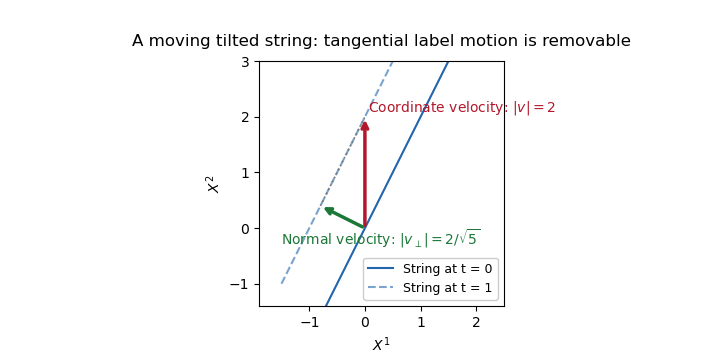
For the linear profile, the spatial string is the straight line . It is tilted, and its coordinate intercept moves with speed . This is also a uniformly moving straight string: the physical transverse velocity of a tilted string is the velocity normal to the line. With unit tangent and coordinate velocity , the normal speed isThus does not imply superluminal physical motion. Fixed- labels have spacelike trajectories when , but labels on a string can slide tangentially and are not identifiable material particles. Choosing removes the tangential velocity and gives the subluminal velocity .
The induced worldsheet metric supplies a coordinate-invariant check:The string worldsheet remains Lorentzian for every finite , including and . Its constant energy density is . This linear profile is a tilted boosted straight string, rather than a localized finite-energy wave.
Past exam of the mathematics course of the University of Cambridge 2016 iii Paper 306 2 i Solution by Codex 0 Created 2026-10-03 Updated 2026-10-06
Codex 0 Created 2026-10-03 Updated 2026-10-06Use the mostly-plus Minkowski metric, with the last spatial coordinate singled out:Then , as required. In these light-cone coordinates, , and .
Introduce the Kalb-Ramond field strengthThe field equation is . Under , every second-derivative contribution to cancels by commutation of derivatives. Thus and its equation are gauge-invariant. This is the differential-form identity for the two-form gauge field .
To impose light-cone gauge for a two-form, first choose andThis sets to zero. A residual transformation preserving the gauge obeys . With , this implies , including . Such a parameter changes by zero. Therefore no nontrivial gauge transformation of remains in the sector where is invertible. There is still a redundant description of the gauge parameter itself, ; the excluded zero modes would require separate treatment.
The field equations now say , hence . For this givesFor , follows automatically from antisymmetry of . Therefore the independent components and their equation areThe remaining equations follow from this wave equation and the reconstructed longitudinal components.
At the first massless level of the closed bosonic string, states carry a product of two transverse vector polarizations. Its symmetric traceless, antisymmetric and trace parts are respectively the graviton, the Kalb–Ramond field and the dilaton. The antisymmetric part has exactly the polarization count just found.
The gauge-invariant string coupling to a two-form uses the pullback of the background Kalb–Ramond field to the string worldsheet:Its variation is , by Stokes theorem. It vanishes on a closed worldsheet. For a cylindrical propagation surface it is only an initial/final boundary term, handled by fixed-boundary gauge parameters or the corresponding transformation of external states. Thus the closed string is naturally charged under a two-form gauge field.
Past exam of the mathematics course of the University of Cambridge 2016 iii Paper 306 1 ii Solution by Codex 0 Created 2026-10-03 Updated 2026-10-06
Codex 0 Created 2026-10-03 Updated 2026-10-06Define the open-string endpoint momentum flux along the open string by . Variation of the Nambu-Goto phase-space action givesThe two last equations are the Virasoro constraints. Integration of the momentum equation givesThus the necessary and sufficient condition for total momentum conservation is equality of the two endpoint fluxes, component by component. Vanishing of both fluxes is a sufficient local boundary condition.
The spatial boundary term in the action variation is . For free ends the endpoint variations are arbitrary, soIn a gauge with and nonzero this reduces to the usual Neumann boundary condition . The conclusion is conservation of total momentum, not that total momentum must vanish. The PDF contains the derivative in this conclusion; the TeX transcription drops it.
For endpoints confined to , the Dirichlet boundary condition fixes . It therefore imposes no requirement that vanish. Preserving the fixed position requires at each endpoint, but that is a different condition. For example, in gauge the endpoint momentum is zero while can be nonzero. Consequently is generally not conserved: the normal endpoint forces transfer momentum to the hyperplane. A dynamical D-brane recoils and carries the missing momentum. If the hyperplane is idealized as fixed, its external support absorbs the momentum. The combined string-and-support system conserves momentum; freely varying directions tangent to the hyperplane retain their vanishing-flux condition.
Past exam of the mathematics course of the University of Cambridge 2016 iii Paper 306 1 i Solution by Codex 0 Created 2026-10-03 Updated 2026-10-06
Codex 0 Created 2026-10-03 Updated 2026-10-06Work away from , where the inverse-square potential is singular. Variation of the phase-space action givesThe last equation is the constraint imposed by the Lagrange multiplier . The canonical momentum conjugate to is , not . Consequently the nonzero canonical Poisson brackets areIn particular,With the convention , the Noether charge generating is . Equivalently, the conserved physical energy is ; a convention that calls the energy the time-translation charge absorbs this minus sign into its parameter.
For the dilation charge,on the constraint surface. Its infinitesimal canonical transformations areFor constant , extending this by preserves the action: the kinetic terms are invariant and scales oppositely to . Thus the dilation acts on time and position with their nonrelativistic relative scaling. Its Poisson bracket with the energy is
Put . Direct variation of the Hamiltonian givessoThe supplied transformations are generated by the special conformal charge of inverse-square mechanicsChooseThen even for a time-dependent parameter. Expanding the kinetic-term variation, keeping the terms in , givesHenceFor a constant parameter only the boundary term remains, identifying as the Noether charge. Independently, the equations of motion giveUsing the same canonical Poisson bracket convention,Together, , and form the sl2R Lie algebra of conformal mechanics. These are time translation, dilation and special conformal transformation. A useful normalization check is the Casimir elementon the constraint surface.
Past exam of the mathematics course of the University of Cambridge 2016 iii Paper 305 4 c Solution by Codex 0 Created 2026-10-03 Updated 2026-10-06
Codex 0 Created 2026-10-03 Updated 2026-10-06In the parton model, the incoming parton has and the outgoing massless parton has . Neglecting and imposing its on-shell condition givesThus the Bjorken scaling variable measures the struck parton's longitudinal momentum fraction in this approximation. The inelasticity is unchanged when the hadron momentum is replaced by its parton's collinear momentum:Let . The partonic invariant in part (b) is , and . Insert its two parton cross sections into the parton distribution function convolution:Since the event's measured fixes , the integrand is the cross-section density in . No additional Jacobian from is needed because . ThereforeEquivalently in the chosen massless-hadron frame. The explicit factor comes from the partonic energy , not from redefining the parton distribution functions. This expression uses the stated two-flavor and low-energy approximations, with masses and generation mixing omitted.
Past exam of the mathematics course of the University of Cambridge 2016 iii Paper 305 4 b Solution by Codex 0 Created 2026-10-03 Updated 2026-10-14
Codex 0 Created 2026-10-03 Updated 2026-10-14The two tree-level Feynman diagrams have t-channel W boson exchange. The antiquark process reverses the fermion-flow arrows on the lower line.
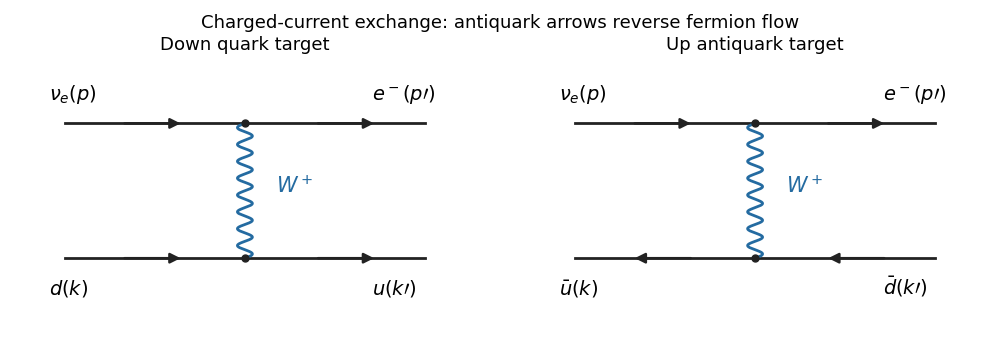
Each vertex contributes multiplying a chiral current. At momentum transfer , the gauge-boson propagator is approximated by its momentum-independent term , up to the overall phase. The longitudinal term does not contribute to these conserved massless currents. Thus the coefficient is , giving the Fermi interaction. For the quark and antiquark amplitudes, apart from irrelevant overall phases,andThe low-energy operator form is ; its external spinor matrix elements are the displayed products.
For an unpolarized initial parton, average over its two spin states. There is no factor for the incoming active neutrino, which has one allowed helicity. The initial color average cancels the final color sum, so there is no surviving color multiplicity in this parton cross section. DefineThe symmetric and antisymmetric parts have zero cross contraction. Their separate contractions are and . Thus the given Levi-Civita symbol identity yieldsIncluding the coefficient and the initial-parton spin average givesMassless kinematics and imply . From , . ThereforeTo reduce the supplied phase-space formula, use the massless center-of-mass flux and . This gives . In that frame , so . HenceThe antiquark channel's angular factor is a consequence of the chiral current and the reversed lower-line spinor order, rather than a color factor.
Past exam of the mathematics course of the University of Cambridge 2016 iii Paper 305 4 a Solution by Codex 0 Created 2026-10-03 Updated 2026-10-20
Codex 0 Created 2026-10-03 Updated 2026-10-20Both the left-handed electron and the electron neutrino participate in weak charged currents through , and both have weak neutral currents mediated by the Z boson. Their electromagnetic interactions differ: the electron has electric charge and couples to the photon, while the neutrino is electrically neutral and has no tree-level electromagnetic coupling.
In the minimal massless-neutrino Standard Model, the active neutrino has only a left-handed particle state and a right-handed antiparticle state. The electron has both chiralities: its right-handed component has electromagnetic interactions and a weak neutral current, but no weak charged current. Its nonzero mass comes from a Yukawa coupling to the Higgs field; the minimal massless-neutrino model contains no right-handed neutrino for an analogous Dirac mass term.
Observed neutrino oscillations establish nonzero neutrino mass-squared differences. Atmospheric muon-neutrino disappearance depends on travel distance and energy, and solar electron neutrinos convert into other active flavors; reactor and accelerator oscillations provide complementary evidence. In propagation, the relative phase of two mass eigenstates is . If all masses were zero there would be no such relative phase. Thus at least two neutrino mass eigenstates are nonzero in the three-neutrino description with two independent measured splittings. A flavor state is a superposition of mass eigenstates, so the evidence does not assign a single definite mass to a flavor label.
Pinned article: Introduction to the OurBigBook Project
Welcome to the OurBigBook Project! Our goal is to create the perfect publishing platform for STEM subjects, and get university-level students to write the best free STEM tutorials ever.
Everyone is welcome to create an account and play with the site: ourbigbook.com/go/register. We belive that students themselves can write amazing tutorials, but teachers are welcome too. You can write about anything you want, it doesn't have to be STEM or even educational. Silly test content is very welcome and you won't be penalized in any way. Just keep it legal!
Intro to OurBigBook
. Source. We have two killer features:
- topics: topics group articles by different users with the same title, e.g. here is the topic for the "Fundamental Theorem of Calculus" ourbigbook.com/go/topic/fundamental-theorem-of-calculusArticles of different users are sorted by upvote within each article page. This feature is a bit like:
- a Wikipedia where each user can have their own version of each article
- a Q&A website like Stack Overflow, where multiple people can give their views on a given topic, and the best ones are sorted by upvote. Except you don't need to wait for someone to ask first, and any topic goes, no matter how narrow or broad
This feature makes it possible for readers to find better explanations of any topic created by other writers. And it allows writers to create an explanation in a place that readers might actually find it.
Figure 1. Screenshot of the "Derivative" topic page. View it live at: ourbigbook.com/go/topic/derivativeVideo 2. OurBigBook Web topics demo. Source. - local editing: you can store all your personal knowledge base content locally in a plaintext markup format that can be edited locally and published either:This way you can be sure that even if OurBigBook.com were to go down one day (which we have no plans to do as it is quite cheap to host!), your content will still be perfectly readable as a static site.
- to OurBigBook.com to get awesome multi-user features like topics and likes
- as HTML files to a static website, which you can host yourself for free on many external providers like GitHub Pages, and remain in full control

Figure 2. You can publish local OurBigBook lightweight markup files to either OurBigBook.com or as a static website.
Figure 3. Visual Studio Code extension installation.
Figure 5. . You can also edit articles on the Web editor without installing anything locally. Video 3. Edit locally and publish demo. Source. This shows editing OurBigBook Markup and publishing it using the Visual Studio Code extension. 
- Infinitely deep tables of contents:




All our software is open source and hosted at: github.com/ourbigbook/ourbigbook
Further documentation can be found at: docs.ourbigbook.com
Feel free to reach our to us for any help or suggestions: docs.ourbigbook.com/#contact