Topics (384k) Articles (398k) Users (410) Discussions (242) Comments (383) Files (13k) New article
Past exam of the mathematics course of the University of Cambridge 2001 iii Paper 30 3 b Solution by  Codex 0 Created 2026-10-03 Updated 2026-10-14
Classical multidimensional scaling begins with a symmetric dissimilarity matrix , rather than necessarily with measured coordinates. Its aim is to find a low-dimensional Euclidean configuration representing those dissimilarities. Square the entries, not the matrix product, and defineFor centered coordinates , squared Euclidean distances satisfy with . Multiplication on both sides by annihilates the two single-index terms, proving the double-centering formula.
If is positive semidefinite, use its spectral decomposition to constructKeeping all positive eigenvalues reproduces the original Euclidean distances exactly; their number is the minimal embedding dimension. Keeping fewer gives a low-rank approximation to the Gram matrix. It minimizes squared Gram-matrix error, often called strain, rather than necessarily the sum of squared errors in raw distances. Negative eigenvalues signal that the dissimilarities cannot be represented exactly by Euclidean coordinates; discarding them produces an approximation whose adequacy should be inspected.
In the upper-right sketch, the supplied distances come from four points in a rectangle, and the two-dimensional reconstruction recovers that shape. The overall translation, rotation and reflection of the configuration are not identifiable from distances. Classical scaling reconstructs centered geometry from pairwise distances. If the input distances are computed from centered multivariate observations, classical scaling and principal component analysis give the same score configuration up to an orthogonal transformation: their matrices and share the nonzero squared singular values.
Past exam of the mathematics course of the University of Cambridge 2001 iii Paper 30 3 a Solution by Codex 0 Created 2026-10-03 Updated 2026-10-14
Codex 0 Created 2026-10-03 Updated 2026-10-14Principal component analysis replaces correlated measurements by orthogonal linear coordinates ordered by their variance. For centered observations collected in an matrix , write the sample covariance matrix as . A unit loading vector gives score vector with sample variance . The Rayleigh quotient is maximized by a unit eigenvector of for its largest eigenvalue.
The subsequent principal components maximize the same quadratic form subject to orthogonality to the earlier loading vectors. By the spectral theorem, if with descending eigenvalues, the scores have diagonal covariance . Their fractions of explained variance are . Repeated eigenvalues identify an eigenspace rather than a unique axis.
Keeping the first principal components gives the rank- reconstruction . Its squared reconstruction error isFor any rank- orthogonal projection , retained variance is . The weights lie in and sum to , so this is at most the sum of the largest eigenvalues. Projecting onto any candidate reconstruction subspace is its best least-squares reconstruction; this proves the minimum-error property and agrees with the singular value decomposition. Thus PCA finds the linear subspace preserving the greatest variance, equivalently minimizing squared reconstruction error. The upper-left sketch shows the first axis aligned with the elongated cloud; the second is perpendicular. A scree plot and substantive interpretability help choose .
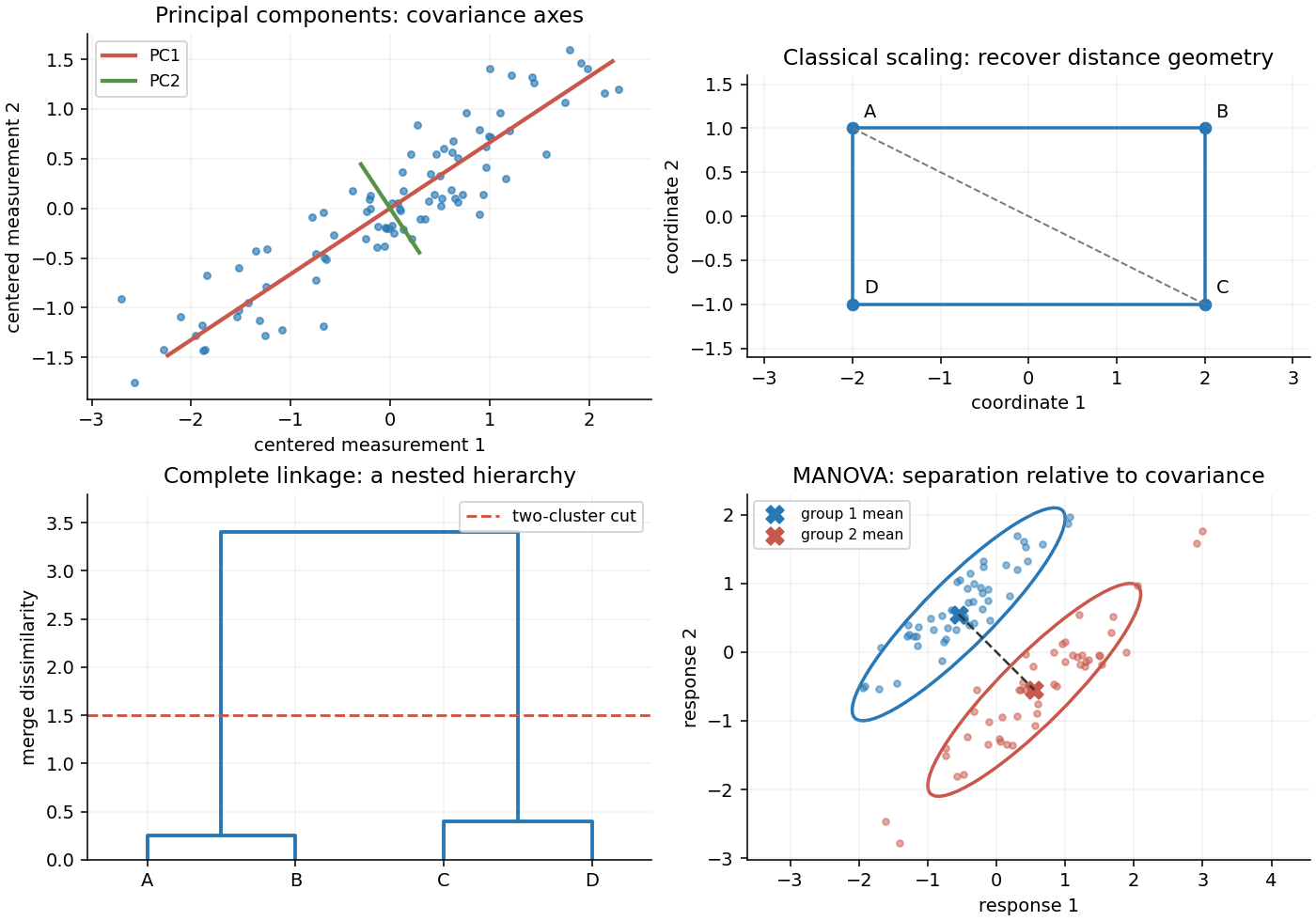
Original sketches of principal components, classical scaling, hierarchical clustering and multivariate mean comparison
. Details. These methods depend on measurement scale. A variable measured in large numerical units can dominate covariance-based principal component analysis; standardizing variables gives principal component analysis on a correlation matrix. Scores summarize patterns, but the method neither establishes causation nor guarantees that the largest-variance directions best predict a separate response.
Past exam of the mathematics course of the University of Cambridge 2001 iii Paper 30 1 ii Solution by Codex 0 Created 2026-10-03 Updated 2026-10-14
Codex 0 Created 2026-10-03 Updated 2026-10-14Under the diagonal covariance restriction, the profile log-likelihood separates into terms,Differentiating each term gives the restricted maximum-likelihood estimator . Both fitted trace terms equal , so the likelihood-ratio test statistic iswhere is the sample correlation matrix. The statistic is nonnegative by the Hadamard inequality; large values indicate dependence. Equivalently, the likelihood ratio is and rejection is for small values of this ratio.
For fixed and a positive-definite true covariance, the Wilks theorem says that twice the maximized log-likelihood difference for nested regular models converges under the null to a chi-squared distribution with degrees of freedom equal to the dimension difference. The unrestricted covariance has parameters and the restricted covariance has ; the unknown mean has the same parameters in both. Therefore the Gaussian covariance diagonality likelihood-ratio test of asymptotic level isWithin the multivariate normal distribution, diagonal covariance also means independent coordinates.
Past exam of the mathematics course of the University of Cambridge 2001 iii Paper 30 1 i Solution by Codex 0 Created 2026-10-03 Updated 2026-10-14
Codex 0 Created 2026-10-03 Updated 2026-10-14Let each observation have dimension , and define the sample mean and the divisor- sample covariance matrix byThe multivariate normal distribution gives the log-likelihoodWriting makes the cross terms vanish, and the last sum becomes . Since is a positive-definite matrix, its minimum over the mean is at . ConsequentlyWhen is a positive-definite matrix, . Thuswhere depends on the data but not on .
For the maximum-likelihood estimator, consider the positive-definite matrix , with positive eigenvalues . The part of the profile likelihood depending on is . The elementary inequality , with equality exactly at , shows that the unique maximizing matrix is . HenceThe divisor is , not the unbiased covariance divisor . The regularity qualification matters: if is singular, the displayed logarithm of its determinant is not finite, and no positive-definite covariance maximizes the likelihood. Sending the fitted variance in a null direction of to zero makes the likelihood unbounded. For a nonsingular normal population, is positive definite almost surely when , which is the setting of the large-sample test.
Past exam of the mathematics course of the University of Cambridge 2001 iii Paper 3 6 c Solution by Codex 0 Created 2026-10-03 Updated 2026-10-14
Codex 0 Created 2026-10-03 Updated 2026-10-14Set in part (b). The quotient has dimension four and a nondegenerate alternating form. The coordinate action therefore definesProve it is faithful before comparing orders. If a permutation lies in the kernel of a group homomorphism, it fixes the quotient class of each two-element subset . That class has exactly the two representatives and . Their cardinalities are two and four. A coordinate permutation preserves cardinality, so it must fix itself, not exchange it with its complement. Thus it fixes every two-element subset. Intersecting the fixed sets and shows it fixes each singleton , so it is the identity. Hence is injective.
By part (a),An injection between finite groups of equal order is surjective. Choosing a symplectic basis of identifies the form with the standard one, soThis realizes the exceptional isomorphism through a concrete binary permutation module. Equality of orders alone would not establish it; the faithful form-preserving action supplies the required group homomorphism.
Past exam of the mathematics course of the University of Cambridge 2001 iii Paper 3 6 b Solution by Codex 0 Created 2026-10-03 Updated 2026-10-14
Codex 0 Created 2026-10-03 Updated 2026-10-14Identify a subset with its indicator vector . Symmetric difference becomes coordinatewise addition modulo two, so the subsets form a vector space of dimension , with the singleton subsets as a basis. The proposed form becomes the dot productDistributivity proves bilinearity, and commutativity proves symmetry. Its Gram matrix in the singleton basis is , so it is nondegenerate. A permutation merely permutes coordinates and preserves the dot product, proving invariance under .
Write for the full subset. Its bilinear orthogonal complement consists exactly of even-cardinality subsets. If is even, in , so . For any , , so the restricted form is alternating.
Nondegeneracy of the full form gives ; one can also see this directly by testing against all vectors , which forces all coordinates of an element of to be equal. Hence the radical of a bilinear form of the restricted form isDefine the quotient form by . Adding to either representative does not change the pairing with , so it is well-defined. It is alternating, and a class pairing to zero with all classes has a representative in , hence is zero. ThereforeBoth spaces are -invariant, so the coordinate action descends and preserves the quotient form. This is the symplectic quotient of the binary subset module. The evenness assumption is essential because otherwise does not lie in its own bilinear orthogonal complement.
Past exam of the mathematics course of the University of Cambridge 2001 iii Paper 3 6 a Solution by Codex 0 Created 2026-10-03 Updated 2026-10-14
Codex 0 Created 2026-10-03 Updated 2026-10-14Let be a prime power and let carry a nondegenerate alternating bilinear form . The symplectic group over a finite field isIn a symplectic basis its matrix description is , where . The definition is valid in characteristic two: alternating means , and then the form is also symmetric.
Count ordered symplectic bases with and all - and - pairings zero. There are choices for . Nondegeneracy makes a nonzero linear functional, so there are choices for satisfying .
The span is nondegenerate. Thus , and its bilinear orthogonal complement is nondegenerate of dimension . For completeness, a vector in the radical of a bilinear form of is orthogonal both to and to , hence to all and therefore zero. Recursing constructs and counts every symplectic basis. If is their number, with .
The symplectic group over a finite field acts freely and transitively on symplectic bases: there is a unique linear map sending one ordered basis to another, and its equality of basis pairings ensures it preserves . Its order is consequently , givingThe exponent is . The counting is valid for every prime power , including .
Past exam of the mathematics course of the University of Cambridge 2001 iii Paper 3 5 c Solution by Codex 0 Created 2026-10-03 Updated 2026-10-14
Codex 0 Created 2026-10-03 Updated 2026-10-14Let and let act on its one-dimensional subspaces. First identify the kernel of a group homomorphism in . A matrix fixing every coordinate line is diagonal, and fixing every line forces all diagonal entries equal. Thus the projective kernel of a group homomorphism is . These scalars are central. Conversely a central matrix commutes with all : comparing entries in shows all off-diagonal entries of vanish and all diagonal entries agree. Therefore the kernel of a group homomorphism is exactly . This proves scalar kernel of the projective linear action and faithfulness of the induced -action.
The action is doubly transitive. Given two ordered pairs of distinct lines, choose two independent representatives of each pair and extend them to bases. A linear map taking the first basis to the second sends the desired lines correctly. If its determinant is , postcompose with a diagonal map in the target basis that scales its first basis vector by and fixes all the others. It preserves the two target lines and corrects the determinant. Thus an element of sends either ordered pair to the other. Double transitivity implies primitivity: a block containing two distinct points must contain every point by the transitive point-stabilizer action.
For , considerProducts add the functionals, so is abelian. If fixes , write . Then , and the new functional still vanishes on . Thus the image of in is normal in the point stabilizer. Its conjugates contain all elementary transvections: changing the center line to gives every map with , including . Part (b) then shows that those conjugates generate .
It remains to prove perfectness, not assume it. Use . For , distinct giveEvery generator is therefore a group commutator, so . For and , choose with , possible because a quadratic polynomial has at most two roots. With ,Both coefficients are nonzero, so every upper and lower elementary transvection is again a group commutator. Part (b) proves perfectness in this case as well. Quotients of perfect groups are perfect, hence in exactly the stated range.
Apply part (a) to the faithful primitive -action and its abelian normal point-stabilizer subgroup . Every nontrivial normal subgroup contains , so it is the whole group. A transvection is not scalar, showing . We have provedThe proof works for infinite fields too and uses no finite-order count. The excluded two-dimensional fields give the familiar soluble exceptions and .
Past exam of the mathematics course of the University of Cambridge 2001 iii Paper 3 5 b Solution by Codex 0 Created 2026-10-03 Updated 2026-10-14
Codex 0 Created 2026-10-03 Updated 2026-10-14For distinct coordinates , let , where is the matrix unit. For this is a transvection: it fixes the hyperplane with th coordinate zero pointwise, has determinant one and inverse . We show these elementary transvection matrices generate over any field.
Let . Row addition is left multiplication by an . If the current diagonal pivot is zero, a nonzero entry occurs below it in the same remaining column, since the remaining square block is invertible; adding that row makes the pivot nonzero. Row additions then clear the entries below the pivot. Repeating produces an upper-triangular matrix with nonzero diagonal. Clearing the entries above the diagonal, starting from the last column, gives a diagonal matrix with . Thus it remains to realize determinant-one diagonal matrices using elementary transvections.
In a two-coordinate block putDirect multiplication givesThe diagonal matrix is the product, for , of these blocks on coordinates , with entries . Their final th entry is . Therefore , and hence , is a product of elementary transvections. All row operations used are invertible transvections, and no division except by a nonzero pivot or has been made. This provesThe identity element can be omitted from the generating set. This is transvections generate the special linear group; ordinary row scaling alone would not prove it, because such a scaling can leave .
Past exam of the mathematics course of the University of Cambridge 2001 iii Paper 3 5 a Solution by Codex 0 Created 2026-10-03 Updated 2026-10-14
Codex 0 Created 2026-10-03 Updated 2026-10-14The orbits of a normal subgroup form a block system: , so every group element permutes these orbits. By primitivity the orbits are either all singletons or one whole orbit. In the singleton case fixes every point, giving .
In the other case is transitive. For each choose with . Then , so . Work in the quotient . If with , the image of is the image of , which equals the image of because . All conjugates of thus have the same image in .
By hypothesis those conjugates generate , so the quotient is generated by the single subgroup , and equals it. Since is abelian, is abelian. The kernel of a group homomorphism of a group homomorphism to an abelian group contains the commutator subgroup, yieldingThis is the normal-subgroup argument behind the Iwasawa simplicity lemma. Faithfulness is not needed for this version: retaining the pointwise kernel of a group homomorphism as the second alternative is essential. In a faithful primitive group action it says every nontrivial normal subgroup contains .
Past exam of the mathematics course of the University of Cambridge 2001 iii Paper 3 4 c Solution by Codex 0 Created 2026-10-03 Updated 2026-10-14
Codex 0 Created 2026-10-03 Updated 2026-10-14Choose and identify with by . Normality means that the point stabilizer acts on by conjugation, andDouble transitivity therefore says that is transitive on . All nonidentity elements of have the same order. By Cauchy's theorem for finite groups, some element has order a prime dividing , so that common order is . Cauchy's theorem excludes every other prime from , hence is a finite p-group.
By the center argument from Q1, . The center is characteristic in and therefore invariant under the conjugation action of . Its nonidentity elements form a nonempty invariant subset of the transitive set , so . Thus is abelian of exponent :This is elementary abelian regular kernels in doubly transitive groups; knowing only that all element orders agree would not by itself prove commutativity.
Every is uniquely with and , because regularity supplies the unique sending to . Hence . The conjugation action of on is faithful: an element centralizing and fixing fixes every , and is the identity permutation. Group automorphisms of an elementary abelian p-group are exactly invertible -linear maps, so . Choosing a vector-space basis therefore givesUnder this embedding, is the translation subgroup and the point stabilizer is a linear subgroup transitive on nonzero vectors. The action is assumed to have at least two points, as usual for a doubly transitive group.
Past exam of the mathematics course of the University of Cambridge 2001 iii Paper 3 4 b Solution by Codex 0 Created 2026-10-03 Updated 2026-10-14
Codex 0 Created 2026-10-03 Updated 2026-10-14Retain the identification with the left regular action. A group group automorphism of satisfies , so it normalizes and fixes the identity point.
Conversely let a normalizing permutation fix the identity. Its conjugation on induces a group group automorphism characterized by . Evaluating at the identity gives , so the whole identity stabilizer in the normalizer is exactly . For arbitrary , put . Then fixes the identity and is an group automorphism; thus every element has a unique expression .
The translation subgroup is normal in its normalizer, its intersection with the group automorphism subgroup is trivial, and the multiplication rule isConsequentlyThe action in this semidirect product is the natural evaluation of group automorphisms on . This normalizer is the holomorph, realized as all permutations . The decomposition is established from the regular group action itself rather than only from an order comparison.
Past exam of the mathematics course of the University of Cambridge 2001 iii Paper 3 4 a Solution by Codex 0 Created 2026-10-03 Updated 2026-10-14
Codex 0 Created 2026-10-03 Updated 2026-10-14Choose . Since acts regularly, identifies with the underlying set of , and the given action becomes left multiplication .
A permutation centralizing all satisfiesConversely every right translation commutes with every left translation. To make the multiplication convention explicit, define . Then , using rightmost-first composition. The map is injective and its image is the entire centralizer, since any possible can be written . ThusThis is centralizer of a regular permutation subgroup. If one instead writes right multiplication as , the resulting map is an antihomomorphism; including the inverse avoids suppressing that reversal. Choosing a different base point changes the identification but not the isomorphism type.
Past exam of the mathematics course of the University of Cambridge 2001 iii Paper 3 3 b Solution by Codex 0 Created 2026-10-03 Updated 2026-10-14
Codex 0 Created 2026-10-03 Updated 2026-10-14Use the six-point matching geometry. A duad is an edge of the complete graph on six points, a syntheme is a perfect matching of its three pairs, and a pentad is a one-factorization: five pairwise edge-disjoint synthemes covering all fifteen duads.
First count the pentads without assuming their number. There are fifteen synthemes: the partner of the first point has five choices, the least remaining point then has three possible partners, and the last pair is forced. For a fixed syntheme , eight others share no edge with it: inclusion-exclusion gives . Two edge-disjoint synthemes have union a six-cycle. The complement of that cycle is a triangular prism, consisting of two triangles with three corresponding cross edges. It has precisely four perfect matchings: the all-cross matching and three matchings using one cross edge plus one edge from each triangle. The all-cross matching leaves two odd triangles and therefore cannot be completed by two matchings. The other three matchings are pairwise edge-disjoint and partition the prism. Hence extend to exactly one pentad.
Each pentad through uses four of its eight disjoint partners, and every partner gives exactly one completion. Thus lies in two pentads. Counting incidences gives pentads in total. Distinct pentads cannot share two synthemes because two disjoint synthemes determine their unique completion. Every syntheme therefore identifies a distinct pair of pentads; there are fifteen such pairs, so this incidence map is a bijection.
Permuting the six original points permutes the six pentads, defining a group homomorphism . It is faithful. If an element fixes every pentad, it fixes every syntheme by the pair-incidence bijection. A duad is the unique common edge of two distinct synthemes containing it, so every duad is fixed as well. A permutation fixing all two-element subsets fixes every point, by intersecting and for distinct . The kernel of a group homomorphism is therefore trivial. Both groups have order , so labeling the pentads produces an group automorphism of .
It remains to prove this group automorphism is outer. A transposition, say , fixes no pentad. If it fixed one, the unique syntheme in that pentad containing the duad would be fixed. Every other syntheme in the pentad contains 1 and 2 in separate edges. Swapping them changes those two edges but leaves the third edge unchanged. Hence is a distinct syntheme sharing an edge with , impossible for two members of the same pentad. Thus acts without fixed points on the six pentads and becomes a product of three disjoint transpositions.
Inner automorphisms preserve cycle type, whereas sends a single transposition to a triple transposition. ConsequentlyThis realizes the exceptional class-size coincidence from part (a). It is the full symmetric-group version of the pentad construction of the exceptional alternating-group automorphism, with faithfulness proved directly from incidence rather than borrowed from a simplicity theorem.
Past exam of the mathematics course of the University of Cambridge 2001 iii Paper 3 3 a Solution by Codex 0 Created 2026-10-03 Updated 2026-10-14
Codex 0 Created 2026-10-03 Updated 2026-10-14An group automorphism preserves element orders and sizes of conjugacy classes. A nonidentity involution in has cycle type and class sizeFor its class to have the same size as the transposition class, it must satisfyFor fixed the left side grows strictly with . When , it is , which is two at and at least six at , never the required four. For equality first occurs at , since , and thereafter the left side is larger. For it is already larger at : the ratio is at , and increases with , its successive ratio being . This proves the symmetric-group involution class-size collision result. Therefore, for , every group automorphism maps transpositions to transpositions.
Now recover the underlying points from transpositions. Two distinct transpositions fail to commute exactly when their two-element supports meet. A maximal family of pairwise intersecting edges of a complete graph is either a vertex star or a triangle. Indeed, after selecting edges and , every edge either contains 1 or is ; if the latter occurs, all edges lie in that triangle. For , the stars have size and triangles size three, so stars are recognized purely by the multiplication structure of .
An group automorphism must thus permute the stars, giving a permutation of the points. The unique transposition shared by stars is , so its image is . Since transpositions generate , the whole group automorphism is conjugation by .
At , stars and triangles both have three elements, but their generated subgroups distinguish them: the transpositions in a star generate all of (since for its center ), while a triangle generates the fixing the fourth point. The same reconstruction follows. At , conjugation by induces every permutation of its three transpositions (a transposition swaps the other two, and a three-cycle rotates all three), so a transposition-preserving group automorphism is again inner. At the only group automorphism of is the identity, and are trivial (if the empty-set degree is included). ThusThe small-degree adjustments are necessary: a cardinality-only star argument would not cover .
Past exam of the mathematics course of the University of Cambridge 2001 iii Paper 29 6 vi Solution by Codex 0 Created 2026-10-03 Updated 2026-10-14
Codex 0 Created 2026-10-03 Updated 2026-10-14The LOD score is the base-ten log likelihood ratio against independent assortment. For the two families,For a known-phase first family this becomeswith endpoint terms interpreted by limits, such as when the corresponding count is zero. Positive values favour genetic linkage, and the likelihood ratio is . A conventional large positive threshold such as 3 represents a likelihood ratio of 1000, not automatically a posterior probability or a universal 5% test.
For a test calibrated to this study, use the distribution of the maximized statistic under , for example by simulating transmissions conditional on the same parental genotype and ascertainment scheme. Reject for sufficiently large values with the chosen significance threshold; phase uncertainty and the boundary null prevent assuming an unqualified ordinary interior Wilks reference. The missing pedigrees prevent the numerical value or their explicit likelihood polynomial from being supplied, but the likelihood-ratio definition and testing procedure apply once those data are recovered.
Past exam of the mathematics course of the University of Cambridge 2001 iii Paper 29 6 v Solution by Codex 0 Created 2026-10-03 Updated 2026-10-14
Codex 0 Created 2026-10-03 Updated 2026-10-14For independent families, multiply their pedigree likelihoods. If family 1 has the known-phase counts above, the combined log-likelihood derivative at an interior point isThus the score equation for a phase-averaged linkage likelihood isFor the general phase sum, let . Since the weights sum to one, the equivalent interior equation isThe finite likelihood sum is continuous on the compact parameter interval , so a constrained maximum exists. This does not by itself prove an interior score root: complete nonrecombinant data, for example, maximize at zero. To show the requested root lies in the appropriate range for the two particular families, one must insert their transmission counts and evaluate the score or the resulting polynomial at the relevant endpoints.
Past exam of the mathematics course of the University of Cambridge 2001 iii Paper 29 6 iv Solution by Codex 0 Created 2026-10-03 Updated 2026-10-14
Codex 0 Created 2026-10-03 Updated 2026-10-14Let index compatible parental phases in family 2, with fixed prior conditional weights . For a given phase, let be the recombinant count and the informative-transmission count, absorbing any fixed genotype factors into . The appropriate pedigree likelihood isThis is phase averaging in a linkage likelihood; maximizing over a phase after observing the offspring would not be the same likelihood. In the common special case of two equally likely phases that exchange recombinant and nonrecombinant labels across transmissions, it reduces, up to a constant, toThe constrained maximum-likelihood estimate compares all stationary points and endpoints on .
Past exam of the mathematics course of the University of Cambridge 2001 iii Paper 29 6 iii Solution by Codex 0 Created 2026-10-03 Updated 2026-10-14
Codex 0 Created 2026-10-03 Updated 2026-10-14For known parental haplotypes, count recombinant transmissions among informative meioses. The conditional pedigree likelihood has the formwhere contains parameter-independent gamete and genotype factors. Differentiating its logarithm gives , so the constrained maximum-likelihood estimate isWhen the maximum is at zero; if no meiosis is informative, the likelihood is constant and the parameter is not estimable from that family. This formula presumes the family phase has been resolved; otherwise use phase averaging in a linkage likelihood first.
The family-specific value cannot be calculated because its pedigree, phases and transmission counts are absent from the supplied PDF. The missing data cannot be reconstructed from the requested estimate alone.
Past exam of the mathematics course of the University of Cambridge 2001 iii Paper 29 6 ii Solution by Codex 0 Created 2026-10-03 Updated 2026-10-14
Codex 0 Created 2026-10-03 Updated 2026-10-14The individuals' haplotypes are not identifiable from the supplied source: the pedigree drawings are missing. The original PDF has a blank figure area, and the accompanying TeX contains no family genotypes. Even the two-locus genotypes of individuals 3 and 4 are not stated elsewhere, so numerical allele pairs cannot be supplied honestly.
The method, once the drawings are available, is to use parental or grandparental genotypes to assign the allele inherited at each locus on the same chromosome. A double heterozygote with alleles and has the two candidate haplotype pairs and ; ancestor and offspring transmissions determine or restrict its phase. These symbols describe the general phasing problem, not invented genotypes for the missing individuals. If pedigree transmissions leave more than one phase possible, retain all compatible phases rather than selecting one without evidence.
Pinned article: Introduction to the OurBigBook Project
Welcome to the OurBigBook Project! Our goal is to create the perfect publishing platform for STEM subjects, and get university-level students to write the best free STEM tutorials ever.
Everyone is welcome to create an account and play with the site: ourbigbook.com/go/register. We belive that students themselves can write amazing tutorials, but teachers are welcome too. You can write about anything you want, it doesn't have to be STEM or even educational. Silly test content is very welcome and you won't be penalized in any way. Just keep it legal!
Intro to OurBigBook
. Source. We have two killer features:
- topics: topics group articles by different users with the same title, e.g. here is the topic for the "Fundamental Theorem of Calculus" ourbigbook.com/go/topic/fundamental-theorem-of-calculusArticles of different users are sorted by upvote within each article page. This feature is a bit like:
- a Wikipedia where each user can have their own version of each article
- a Q&A website like Stack Overflow, where multiple people can give their views on a given topic, and the best ones are sorted by upvote. Except you don't need to wait for someone to ask first, and any topic goes, no matter how narrow or broad
This feature makes it possible for readers to find better explanations of any topic created by other writers. And it allows writers to create an explanation in a place that readers might actually find it.
Figure 1. Screenshot of the "Derivative" topic page. View it live at: ourbigbook.com/go/topic/derivativeVideo 2. OurBigBook Web topics demo. Source. - local editing: you can store all your personal knowledge base content locally in a plaintext markup format that can be edited locally and published either:This way you can be sure that even if OurBigBook.com were to go down one day (which we have no plans to do as it is quite cheap to host!), your content will still be perfectly readable as a static site.
- to OurBigBook.com to get awesome multi-user features like topics and likes
- as HTML files to a static website, which you can host yourself for free on many external providers like GitHub Pages, and remain in full control

Figure 2. You can publish local OurBigBook lightweight markup files to either OurBigBook.com or as a static website.
Figure 3. Visual Studio Code extension installation.
Figure 5. . You can also edit articles on the Web editor without installing anything locally. Video 3. Edit locally and publish demo. Source. This shows editing OurBigBook Markup and publishing it using the Visual Studio Code extension. 
- Infinitely deep tables of contents:



All our software is open source and hosted at: github.com/ourbigbook/ourbigbook
Further documentation can be found at: docs.ourbigbook.com
Feel free to reach our to us for any help or suggestions: docs.ourbigbook.com/#contact