
For an almost complex structure, closure of under the Lie bracket is equivalent to the absence of a component in for every -form . Conjugation exchanges the bracket condition with closure of . For sections of , the exterior derivative identity gives . Its vanishing for all -forms is exactly .
On a finite simply connected planar graph, fix the height of the exterior face to zero. Every divergence-free integer bond current is uniquely the oriented difference of the two neighboring face heights. The positive Graph Laplacian on the remaining faces gives its energy. Applying the Poisson summation formula to these heights and completing the square givesThe Gaussian prefactor equals the spin wave determinant of the original graph, up to angle zero-mode normalization. One way to verify this is that the matrix-tree theorem equates the spanning-tree counts of a planar graph and its dual. Boundaries can admit nonzero total vortex charge; neutrality is an additional periodic or finite-energy condition.
Framed instanton moduli space 2026-10-14
Fix a trivialization at infinity and divide smooth finite-action instantons only by gauge transformations tending to the identity there. Global gauge orientations remain genuine parameters. For regular instantons of charge magnitude , the real dimension is by the ADHM construction. Forgetting the framing divides by the three-dimensional global group action of , giving on the irreducible locus. For one instanton the framed parameters are four center coordinates, one positive size, and three orientation coordinates.
Instanton size modulus 2026-10-14
The scale in a BPST instanton changes the width of its action density while leaving total action unchanged. This reflects conformal invariance of four-dimensional classical Yang-Mills action. As , gauge curvature concentrates at the center and the smooth family approaches a bubbling boundary, not another smooth zero-size instanton.
Retained-ejecta chemical evolution 2026-10-14
Under the instantaneous recycling approximation, forming mass locks into stars. If a fraction of returned material remains in the interstellar medium, the retained original metal mass is , and retained newly made metal mass is , where is the stellar yield per locked mass. Subtracting the metal mass initially consumed gives the displayed equation. Pristine galactic gas inflow adds gas but no metals; enriched inflow adds its metal mass separately. The retained fraction applies to both old and newly made metals in this idealization.
Cumulative mixing efficiency 2026-10-14
Cumulative mixing efficiency is the ratio of total irreversible density-mixing conversion to total irreversible mechanical-energy loss over an interval. It is a loss-rate-weighted average of instantaneous mixing efficiency, not an unweighted time average. Stored kinetic energy, changes in available potential energy and boundary work must be accounted for before replacing its denominator by integrated forcing.
The actual derivative of is . The omitted contribution is first order in acceleration. Its cross term with the translation velocity integrates to zero because . The square adds to the spatially integrated density, since and . Thus the instantaneous-boost effective action for a sine-Gordon kink is an adiabatic truncation rather than the exact action restricted to that accelerating configuration-space profile.
For the Gaussian Brownian drift filter , with independent prior , the observation law has densityrelative to driftless Wiener measure. The law having fixed observation drift has density relative to the same reference. Their ratio is therefore a positive mean-one density on every finite horizon. In the observation filtration it satisfies , where is the posterior mean and the innovation process. This density-ratio argument establishes a true martingale without an unsupported global Novikov condition for the unbounded posterior mean.
Initial displacement 2026-10-14
Initial displacement specifies the configuration of a wave equation at the starting time. For a second-order evolution equation it is paired with the initial velocity. Specifying only the boundary forcing does not determine these initial data.
Initial velocity 2026-10-14
Initial velocity specifies the time derivative of the displacement field at the starting time. A second-order wave equation requires it independently of initial displacement. Both vanish for a causal scattered field before an incident pulse reaches its scatterer.
Forcing term 2026-10-14
For a linear differential equation written , the prescribed right-hand side is the forcing term. It may represent an external input or source, and can be constant or time dependent. Setting gives the associated homogeneous linear differential equation.
Tetrahedral qubit POVM 2026-10-14
Choose the four unit Bloch vectors at the vertices of a regular tetrahedron, so and . The displayed four positive rank-one effects sum to . On input , their probabilities are , giving the reconstruction . This realizes the smallest fixed qubit informationally complete POVM.
Historical source for information projection 2026-10-14
In Information Theory and Statistics: A Tutorial by Imre Csiszár and Paul C. Shields (2004, Historical Notes, §3, printed p. 522), the authors connect systematic studies of information projection with earlier relative entropy minimization principles and geometric work, including Imre Csiszár's I-Divergence Geometry of Probability Distributions and Minimization Problems by Imre Csiszár (1975). This is the tutorial's historical account, rather than a claim of one isolated invention. Its finite-alphabet treatment makes the projection identities available without the additional machinery needed for general probability spaces.
Let be a probability mass function on a finite alphabet with numerical outcomes . Prescribe a mean strictly between the smallest and largest outcomes. Exponential tilting giveswith chosen so that . For any other feasible law , direct substitution yieldsRelative entropy nonnegativity therefore proves optimality and uniqueness. At an extreme prescribed mean, feasible laws may have zero probabilities; a finite tilting parameter need not realize them, although a limit can.
Under the finite-alphabet, positive-reference, closed-convex set assumptions above, every feasible law satisfiesThus a feasible law's excess relative entropy above the optimum is at least its relative entropy from the optimizer. The information projection supplies a quantitative comparison with every other feasible law, not merely the location of a minimum.[ref]
For affine expected value constraints, the result becomes a Pythagorean identity for relative entropy. In relative entropy minimization under a mean constraint, the logarithm of is an affine function of the outcome . Any feasible has the same normalization and mean as , making the residual in the three-point identity for relative entropy zero.[ref]
For a uniform distribution on a finite set of outcomes, direct expansion of relative entropy giveswhere is information entropy in nats. Therefore minimizing relative entropy from this particular reference is equivalent to maximizing information entropy subject to the same constraint. This statement depends on the uniform reference; an arbitrary reference contributes its own weights.
In the three-outcome example, nats. The mean fixes one aggregate quantity, and information projection chooses how to distribute the remaining uncertainty. This extends maximum entropy on a finite alphabet, whose unconstrained maximizer is the uniform law itself.
Information projection on three outcomes 2026-10-14
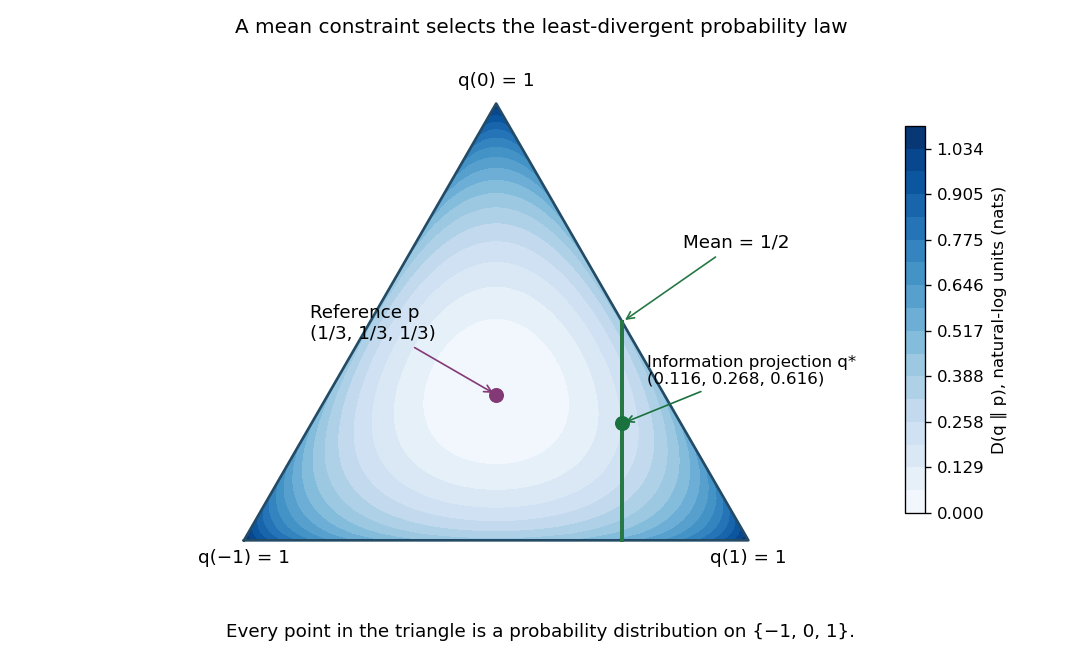
Let the possible numerical outcomes be , and give the reference law uniform distribution on a finite set: . We want a law with expected value . Write the three probabilities in outcome order as . The mean constraint is , while normalization requires .
These conditions leave a whole line of possible probability distributions:For example, and both have the required mean. The constraint alone does not choose between them. Information projection selects the point on this line with the smallest relative entropy from the reference.
Exponential tilting gives weights proportional to . Set and multiply these weights by to obtain . Enforcing the mean givesThe positive root is , henceThe most favored outcome becomes , but all three remain possible. This is an exact constructed example with a stipulated reference law and constraint, not a fitted distribution from measurements.

For positive slope parameter , the exponential-potential field increases during cosmic inflation. The quantity grows by with constant and . Starting from order-one curvature and demanding order-one or smaller present curvature gives the displayed upper bound on the initial field. A specified tighter final curvature tolerance adds one-half its logarithm to the numerator. Thus sufficient cosmic inflation sets an upper, not a lower, initial-field bound for this sign of the potential slope. Instantaneous reheating and subsequent entropy conservation determine .
Reciprocal geometric infinite product 2026-10-14
For , define on . The geometric decay gives locally uniform absolute tail convergence there. Its simple zeros are and for , and reindexing gives . The variable zero is outside its domain, and the poles introduced by each reciprocal factor cannot be interpreted as a value of the product at zero.
// Destination: analysis.bigb
For a stress-free, fixed-temperature layer, the infinite-Prandtl number growth rate of the fundamental vertical normal mode is . For large Rayleigh number, its maximum has and . The infinite-Prandtl number limit must be taken first, or inertia must remain small on the resulting growth-time scale. This optimum differs from the free-slip convection neutral curve minimum, which selects onset rather than fastest growth far above it.
There are unlisted articles, also show them or only show them.