
In electrostatics, Gauss's law isThe surface normal points outward. Spherical symmetry makes the field radial and constant in magnitude on a concentric Gaussian surface.
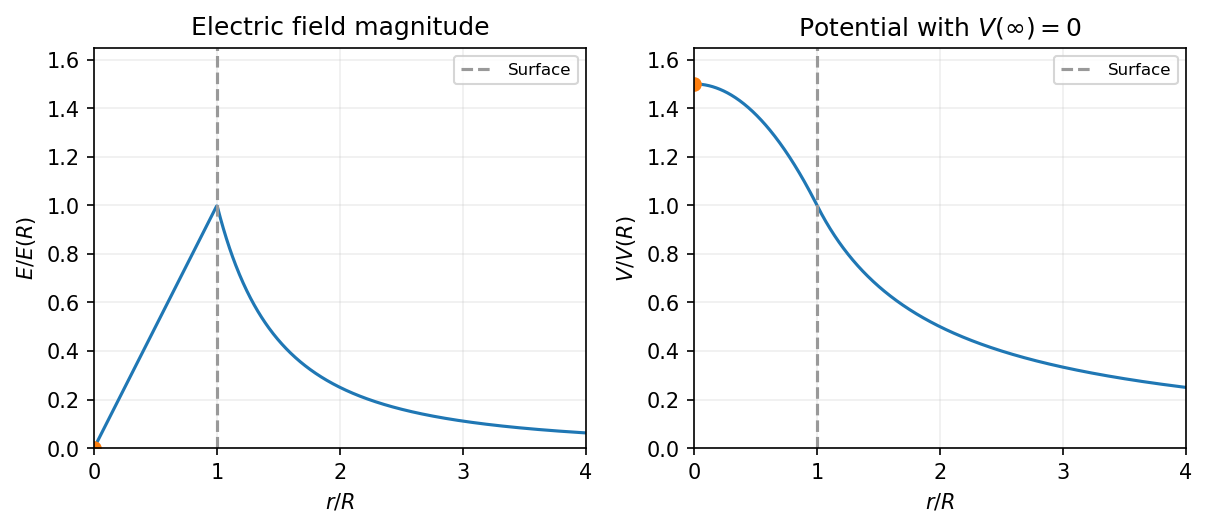
For a uniformly charged sphere, enclosed charge is inside and outside. Thus the radial field isSet potential zero at infinity. Outside, . Inside, integrate from the known boundary value, obtainingThe field rises linearly from zero to its maximum at , then falls as . The potential falls quadratically from to its surface value and then as . Both are continuous at the surface; there is no separate sheet of surface charge.
For the electric field of a hydrogen ground-state electron cloud, its enclosed charge isWriting and using givesThe total electron-cloud charge tends to , as required. Dividing by yieldsThe expression is negative and therefore points inward. Its apparently singular terms cancel at small radius, leaving .
A distant external charge polarizes the neutral atom. Its electric field displaces the positive and negative charge distributions relative to one another, giving an induced dipole with static electric polarizability . The field is stronger on the nearer side, so the opposite-charge attraction exceeds the like-charge repulsion. This is charge-induced dipole attraction, not a net monopole charge on the atom.
Quantitatively, for external charge at separation , the polarization energy is , henceHere negative means decreasing separation. Reversing the external charge reverses the induced dipole but leaves this leading long-range force attractive and of the same magnitude. The factor one half accounts for the energy cost of inducing the dipole.
The supplied charge density describes the unperturbed atom. Adding its electron field to the nucleus field leaves , an exponentially small residual because the cloud has an infinite tail. A completely frozen density would give only that tiny sign-dependent force. Allowing polarization is essential to obtain the dominant attractive power-law force for either sign of external charge when .
At the first two specified times, the displacement profiles areThe second curve is the first shifted right by . More generally a point of fixed wave phase satisfies , so it moves along . Hence the wave travels in the positive direction withThis phase velocity is distinct from the local transverse velocity of a string element.
For the force derivation take a short segment between and . Let the tangent angles to the positive axis be and . The left tension pulls along the negative tangent and the right tension along the positive tangent. With small slopes and approximately constant tension magnitude , the horizontal components cancel to leading order andThe segment mass is , where is mass per unit length, not volume density. Newton's second law therefore givesThe approximation neglects bending stiffness, damping and changes in tension caused by finite-amplitude stretching.
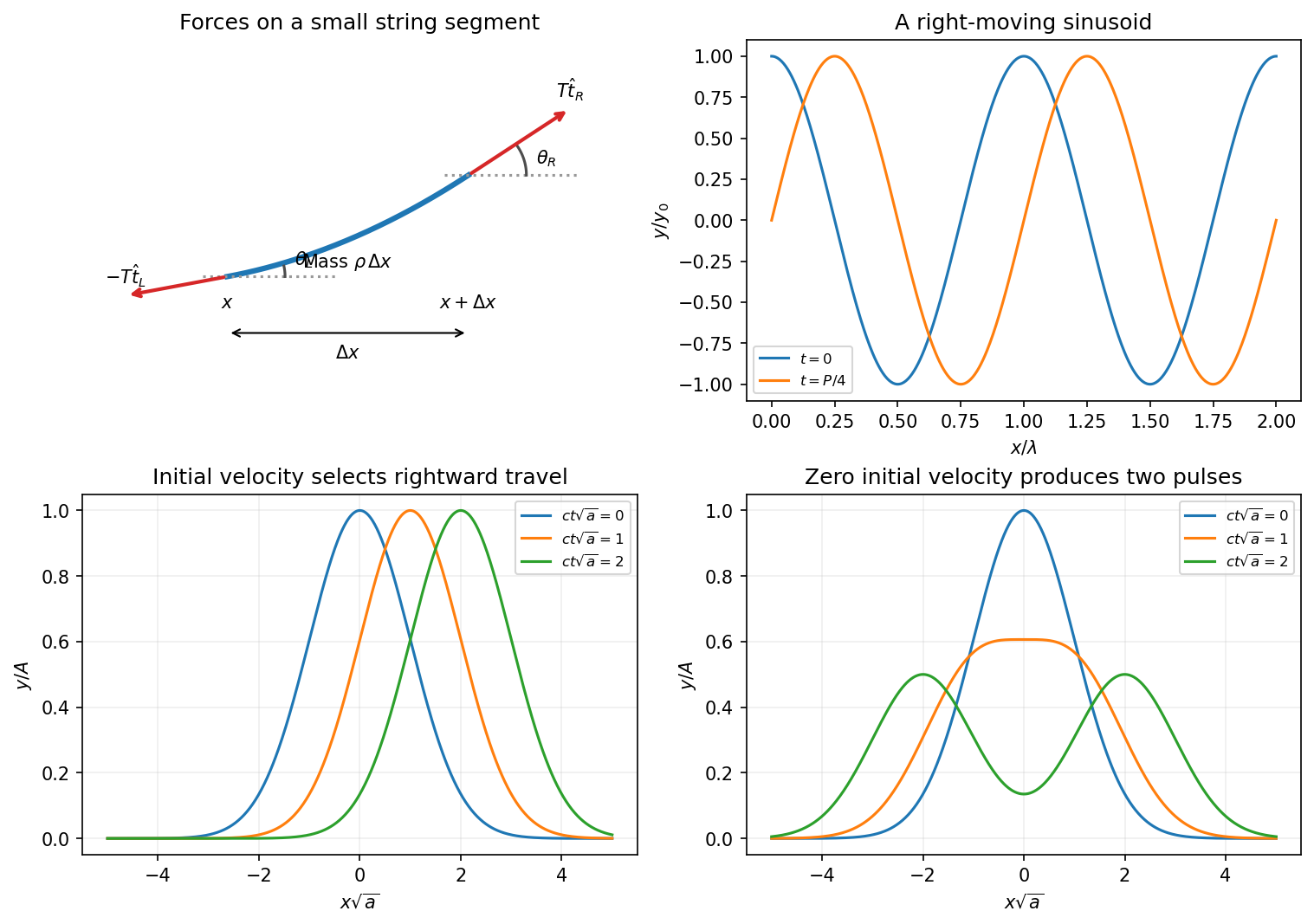
Converting the supplied density gives , soFor the pulse, define with . The given initial velocity is , exactly the velocity associated with a right-moving displacement . ThereforeIt moves right without changing shape in this nondispersive model. With the same initial displacement but zero initial transverse velocity, D'Alembert's formula instead gives the Gaussian pulse splitting from zero initial velocityThe two half-amplitude pulses travel in opposite directions. Their initial velocities cancel, while their initial displacements add to the prescribed Gaussian. The two initial-value problems have different kinetic energies; splitting into half-height pulses does not contradict energy conservation. These forms assume a string long enough that reflections from its ends have not returned.
Here is the potential energy and is the stationary energy eigenvalue. The Schrödinger equation is the eigenvalue equation for kinetic plus potential energy. Its boundary conditions select the allowed energies. For a normalized wavefunction, the Born rule assigns probability to a small area, and . A stationary state's full time dependence is ; its probability density is time-independent.
The infinite walls impose on all four boundaries. For a separated solution in the zero-potential interior,The first term depends only on and the second only on , so each is constant, and . Vanishing at and removes the cosine terms. Vanishing at the other boundaries givesThe normalized two-dimensional infinite square well eigenbasis and energies areNormalization follows from the two sine-squared integrals and . Zero quantum numbers would give an identically zero function. These separated products form a basis, not every possible wavefunction: a general state is their superposition, and a degenerate energy eigenspace can have nonseparable stationary combinations of products with that same energy.
For and , the ground state is and the nearest excitation is , along the longer side. The next quantum along the shorter side costs more energy. ThusThis transition has nonzero dipole matrix element for an electric-field component along . Light polarized strictly along would not drive it, so the minimum assumes an allowed polarization rather than an arbitrary fixed one.
For the requested degeneracy, keep . The first two states are necessarily and , since . The third level is the smaller of and : states with both indices at least two lie above , and higher states on the sequence lie above . Make these two candidates equal:The third-level degeneracy in a rectangular quantum box then has lowest distinct energies , and in units , with multiplicities one, one and two. The third-level pair is exactly and .
Use the diagram's downward displacement , measured from the unloaded plate position, and take . The mechanical energy, with gravitational potential zero at that reference, isThe loaded equilibrium follows from , so its downward shift is .
The shock absorber's force is , hence its power is force times velocity: . Differentiating the energy gives , which yields, with continuity through instants of zero velocity,Set and .
For release from rest, the three step response of a damped oscillator regimes are easy to compare after shifting to . With light damping , write :It overshoots and oscillates around the loaded position with a decaying envelope. At critical damping, , it becomes , approaching monotonically from below. For heavy damping , set and replace the trigonometric bracket by . This is also monotonic, but its slow exponential delays settling.
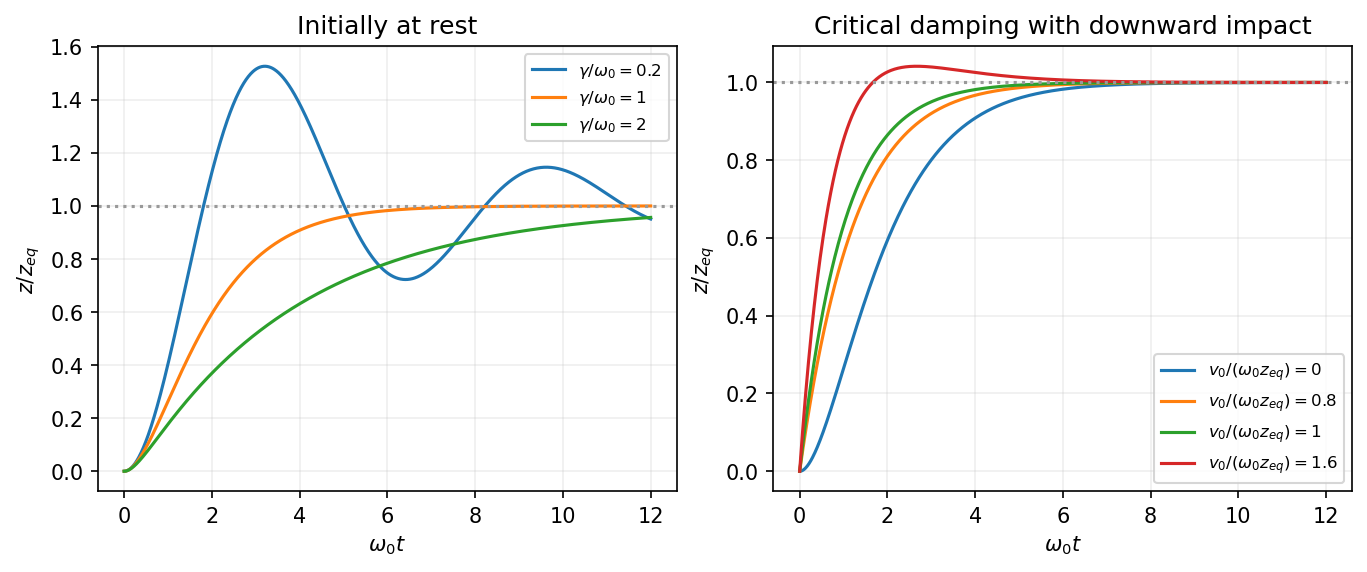
Critical damping gives the fastest nonoscillatory settling from the unloaded rest condition, avoiding a repeatedly swinging reading without the sluggishness of overdamping. Its required coefficient isAt critical damping the repeated characteristic root is . Thus the general displacement under constant load is . The equilibrium and initial conditions give , and , henceSubtracting the final position gives . The exponential is positive and the bracket starts negative. It becomes positive at some if and only if its slope is positive. Therefore critical-damping overshoot from initial velocity requireswith positive downwards. At equality the scale still approaches from below. Critical damping prevents oscillatory modes, but does not guarantee a non-overshooting response to an arbitrarily large impact velocity.
Expand the cloud's potential energy about a stable equilibrium: . Equilibrium gives , stability gives , and reflection symmetry also removes odd terms. For small displacements, and .
Including the electric and damping forces, Newton's second law is . Dividing by gives the Lorentz oscillator modelThe specified convention uses as the damping coefficient per unit mass.
For the steady response, represent the field by and the displacement by , taking real parts for physical quantities. Substitution givesDefine the nonnegative amplitude and . ThenFor positive , . For electrons , the phase of a negatively charged driven oscillator is : the low-frequency displacement is opposite to the field, rather than in phase with it. A signed amplitude could absorb this extra , but the phase convention must then be stated. The induced dipole has phase for either charge sign. Transient free oscillations have been omitted because the question asks for steady state.
For the electron cloud, andThe visible range corresponds to between and , below this resonance. The resonant wavelength is about , in the ultraviolet.
The acceleration amplitude is . At fixed incident field amplitude, the scattered intensity is therefore proportional toWell below resonance and outside strong damping corrections, is nearly frequency-independent and this becomes the Rayleigh scattering wavelength dependence . The shortest visible wavelengths are consequently scattered much more strongly into directions away from the direct solar beam than the longest ones, producing a blue sky. The simple fourth-power approximation gives a factor 16 between 400 and 800 nm at equal incident intensity. Retaining the undamped denominator with the given resonance raises that factor to about 22.7, since the upper end is not extremely far below resonance. The exact ratio needs the unspecified damping and incident solar spectrum; the stronger scattering of the blue end is the robust conclusion here.
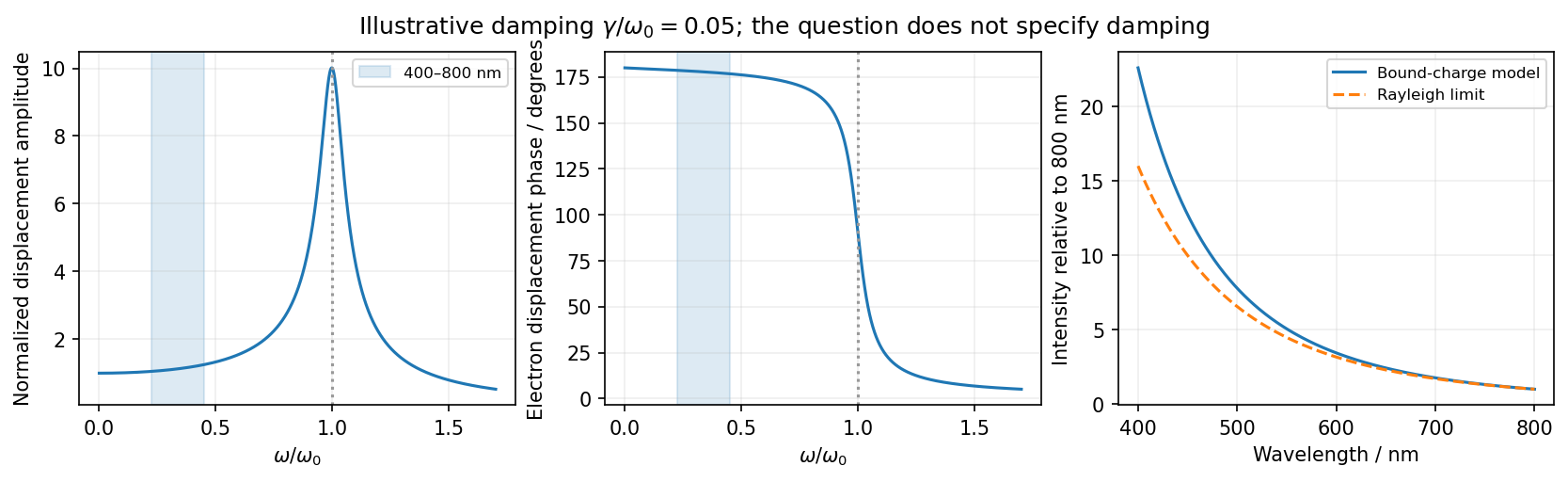


The model describes frequency-dependent scattering, not the detailed perceived color after solar-spectrum weighting and human visual response. It also explains why treating the electrons as free at visible frequencies would miss the bound-charge fourth-power limit.
Use the PDF's notation for the source-frame pulse frequency, and set , . Successive emissions occur at the same train-frame position and are separated by proper time . The Lorentz transformation gives a station-frame emission interval and displacement . For a receding beacon, the second pulse travels an extra distance , soThis derivation includes both time dilation and the change in light-travel time. Expanding for gives , recovering the stated nonrelativistic approximation.
Let be the common wavelength of the identical lights at rest. The approaching and receding relativistic Doppler effect factors giveTheir ratio and product therefore determine the speed and rest wavelength separately:No assumption about the rest color was needed.
The last observation requires a transverse-geometry convention. The general observer-frame ray formula iswhere is the angle between source velocity and photon propagation in the platform frame at emission. Under the usual transverse-ray interpretation, , so for and ,This is the standard transverse redshift from time dilation.
There is a genuine distinction between emission and reception at the instant of passing. A side-mounted source emitting perpendicularly in its own frame instead has by aberration of light, giving . The same blue result occurs if “at the exact moment” means reception when the source's current position is at closest approach, with a small finite transverse offset. For offset , reception and emission satisfy . Setting gives and ; setting instead gives the transverse ray received at . These limits remain different as .
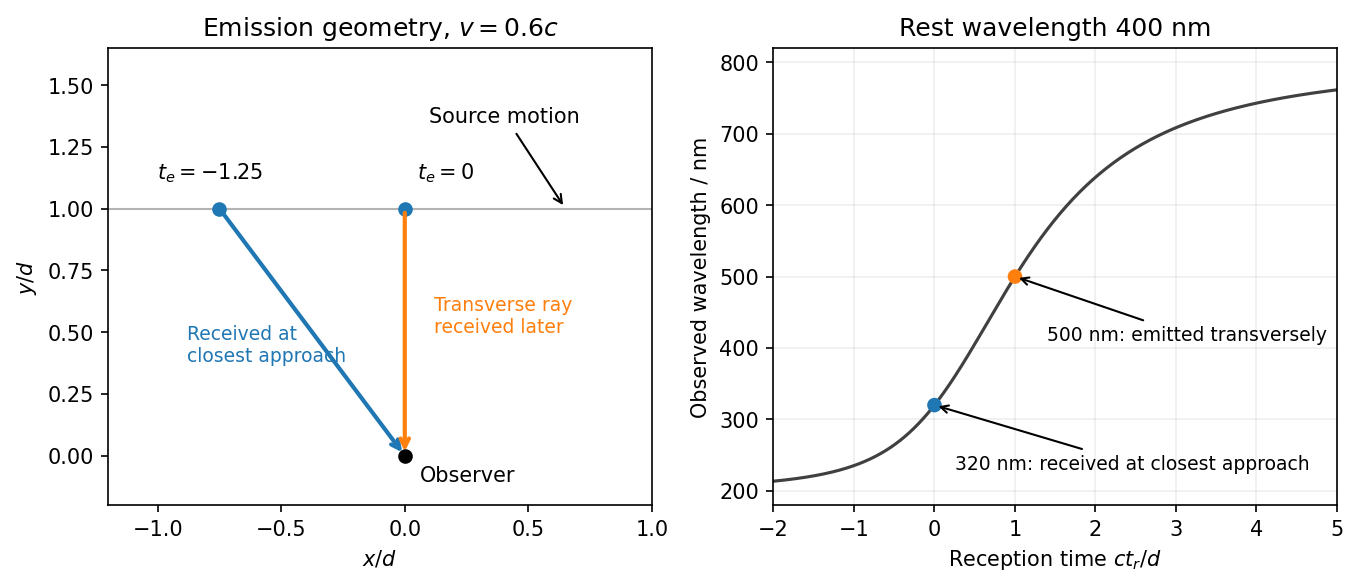
Emission at closest approach and reception at closest approach give different Doppler factors
. Details. 
Thus 500 nm requires the transverse ray in the platform frame; 320 nm applies to reception at closest approach or transverse emission in the train frame. The wording does not distinguish these event/frame choices, so merely neglecting the source-observer separation is insufficient to select between them. The reusable derivation is transverse Doppler shift and observation time.
For particles in an inertial frame, total momentum and angular momentum about a fixed origin areThe momentum derivative is the total external force when internal forces cancel pairwise. Angular momentum is conserved when the total external torque vanishes and the internal torques sum to zero, as for pairwise equal-and-opposite central forces. Equal-and-opposite internal forces alone need not cancel internal torque if their lines of action are different. An isolated system with these internal-force properties conserves both quantities; if fields carry momentum, the complete system must include them.
For a straight rocket, let its instantaneous remaining mass be and let be ejected during a velocity increase . The exhaust's inertial velocity is to first order. Conservation of momentum givesIntegrating from initial mass to dry mass yields the rocket equationIt is the rocket-plus-exhaust system that is isolated; the rocket alone is a variable-mass open system.
For the firework, the original diagram places one tangentially firing point rocket at the end of each radial rod. The parallel axis theorem changes each rod's central inertia to . Adding all rods and fueled rockets givesWhen fuel is exhausted, .
Let now denote the total remaining fuel in all three rockets, so . Fuel at the rim co-rotates before ejection. Its backward tangential exhaust velocity is , and its angular momentum per unit mass about the axle is . For an infinitesimal ejection,Since , the co-rotation terms cancel and leave . The tangential-exhaust rotor with a fixed dry inertia therefore obeysNeglecting the exhaust's initial tangential motion would give an incorrect angular-momentum balance. The rod mass remains in the denominator throughout the burn.
The original diagram has a horizontal bottle neck, so weight does not enter the axial force balance. Gauge pressure acts on the cork's end area and supplies outward force . The radial contact force is the contact pressure times the cylindrical contact area, . The limiting friction is , so outward sliding occurs whenThe assumption of equal static and kinetic friction coefficients removes a separate force drop when slipping starts.
Initially the pressure is marginal at , so . During extraction the contact length decreases, while the pressure force stays constant. The net force is therefore . The cork's mass is , giving the pressure-driven cork ejection equationFor and , solving the constant-coefficient equation givesThe equilibrium is unstable: as the cork moves out, friction decreases and the unbalanced force grows.
Multiplying the equation of motion by and integrating gives . The contact ends at , soEquivalently, the net work is . Exactly zero initial velocity would leave the ideal marginal configuration stationary. The exit time diverges as , even though the limiting exit speed is finite.
The density is , so . For an ideal upward launch at this speed, conservation of mechanical energy gives height above the exitThis neglects air resistance and the small gravitational work during extraction compared with the launch energy. Actual gas pressure need not stay constant, so it is an idealized estimate.
Use distinct symbols for the dimensions of mass, length, time, temperature and amount of substance. The molar gas constant has dimensions , while the given is a molar mass with dimensions . Matching dimensions in the proposed power law giveswith the amount-of-substance equation repeating . ThereforeDimensional analysis fixes these exponents but not a dimensionless multiplier. For example, an open-tube mode number and the gas's heat-capacity ratio enter the actual resonance frequency without changing the dimensions.
For uniform Earth density, the shell theorem says that only mass within radius contributes to the gravitational field there. Since enclosed mass is proportional to ,At depth , . A simple pendulum has small-amplitude period , so the pendulum clock below a uniform-density surface runs at the fraction of its surface-calibrated rate. After a surface-clock hour, its lag isThe mine clock is slower because gravity is weaker under the stated uniform-density assumption. The expansion gives the same result. This is a change in the mechanical pendulum period, not a relativistic clock effect; a realistic Earth density profile would require a different interior-gravity calculation.
Use the thin lens equation with positive object and real-image distances :The transverse magnification is . For an object dimension , the corresponding image dimension isThe minus sign of the magnification means that the image is inverted. This is the ideal thin-lens prediction; it assumes the relevant field is admitted by the camera and ignores lens distortion.
Write . The magnitude of the series RC impedance isFor independent small errors interpreted as standard uncertainties, propagation of uncertainty givesThe input uncertainties are , , and . Thus , andThe fractional uncertainty is . If the stated errors are instead worst-case bounds, their first-order contributions add in magnitude, giving approximately , or , rather than the quadrature result. Both conventions require the error interpretation to be specified.
Take a representative tennis-ball mass of . The speed is nonrelativistic, so the de Broglie wavelength isThis is an estimate because the mass was not specified. The wavelength is vastly smaller than any practicable aperture or obstacle separation: a diffraction angle of order is unresolvably small for laboratory-scale . Moreover, interactions with air, thermal radiation and the apparatus destroy observable coherence between macroscopically distinct paths. Quantum mechanics still applies; the small wavelength and rapid decoherence explain why ordinary experiments reveal classical trajectories rather than a measurable interference pattern.
There are unlisted articles, also show them or only show them.