
Finite-well confinement in a semiconductor heterostructure Created 2026-10-18 Updated 2026-10-20
Consider an original one-dimensional effective mass model with for and outside. Take the same positive effective mass everywhere, an abrupt interface, and no interactions. The wavefunction represents a transverse envelope; free motion parallel to the layer is outside this calculation. A double heterostructure laser need not be thin enough for this quantization to dominate its operation.
Set , , , and . The time-independent Schrödinger equation becomesHere denotes the dimensionless potential; a bound state has . Matching the wavefunction and its derivative at givesFor the even bound state, the interior solution is and the exterior solution is . For the odd bound state, replace by and by . The physical wavefunction is .
Wavefunction normalization includes both exterior tails, not just the active layer. Direct integration givesThe first two terms are the interior integral; the last is the total exterior integral. Thus the interior probability is , with the upper sign for even parity.
Choose . There is one even root in and one odd root in ; higher branches start beyond . Each left-hand side increases on its stated interval while decreases, proving uniqueness there. Numerically,These are calculated values of the chosen finite square well. The excited bound state lies closer to the barrier and has a longer exterior tail: being bound does not mean having unit probability inside the well.
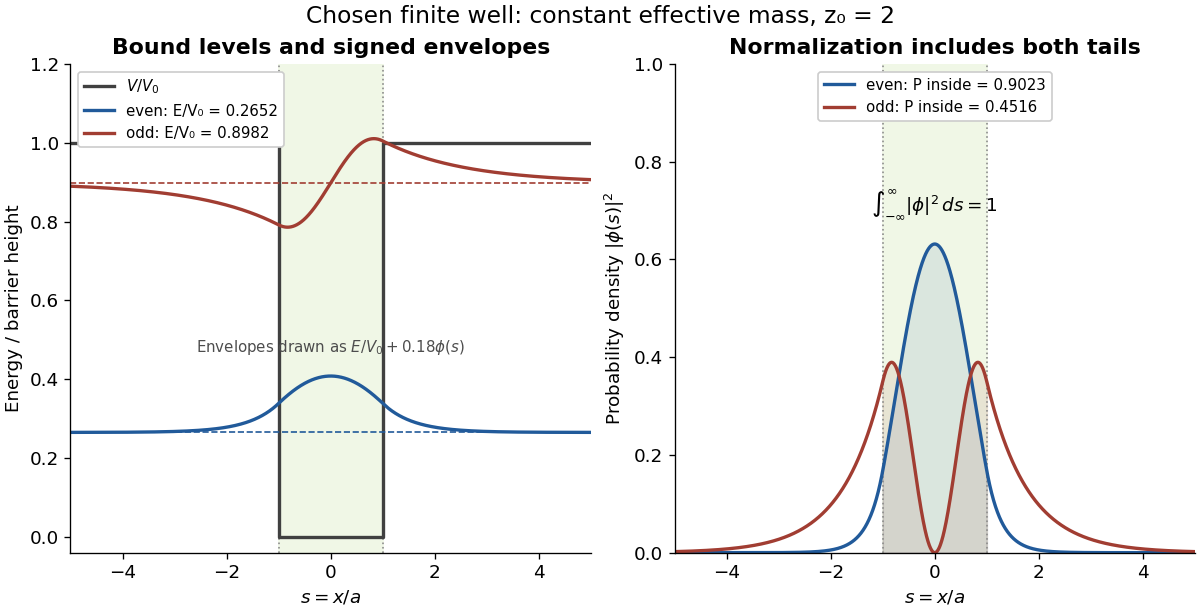
This model demonstrates electronic confinement, not optical refractive index confinement or a complete laser. Unequal effective masses, band bending, interface disorder and interactions require a more detailed model. In particular, continuity of the ordinary derivative above uses the chosen constant effective mass assumption.
Particle resonance Created 2026-10-18 Updated 2026-11-05
A particle resonance is an unstable excitation inferred from an enhanced scattering or decay response near a characteristic energy. It is associated with a pole of the analytically continued scattering amplitude, rather than a permanently normalizable state that survives indefinitely.
For an isolated narrow resonance, a Breit-Wigner form relates the peak scale to a mass and a width, with lifetime approximately . Different final states probe different partial widths and branching fractions. Interference with nonresonant amplitudes, nearby thresholds and detector resolution can shift or distort the observed peak, so a bump's width need not equal the intrinsic decay width without a model. Conservation laws and angular distributions help identify which quantum numbers are compatible with the signal.
Inelastic scattering 2026-10-18
In inelastic scattering, the participants exchange energy with internal degrees of freedom, so their total translational kinetic energy need not be conserved.
X-ray scattering techniques Created 2026-10-18 Updated 2026-11-05
X-ray scattering techniques use the change in a scattered photon's direction and, in inelastic measurements, its energy to probe matter. Inelastic X-ray scattering transfers energy to excitations such as phonons; elastic methods probe spatial structure without that energy transfer.
Scattering angle 2026-10-18
The angle between specified incoming and outgoing directions in a collision; the reference frame and outgoing particle must be stated.
Scattering channel Created 2026-10-18 Updated 2026-11-05
A specified asymptotic configuration of the particles and their internal quantum states in quantum scattering. An incoming channel can scatter into several outgoing channels; S-matrix elements give their probability amplitudes with a stated probability current normalization. A channel can be energetically inaccessible even when other channels are open.
Coulomb distortion in electron scattering Created 2026-10-18 Updated 2026-10-20
The change in incident and outgoing electron wavefunctions caused by the target Coulomb potential. It can invalidate a plane wave treatment in the Born approximation, especially for a large target atomic number.
Step potential 2026-10-18
For constant mass , a finite jump from potential energy zero at to at requires continuity of the wavefunction and its first derivative. With incidence only from the left and , put and . Matching and gives reflected probability amplitude and transmission amplitude . The transmission probability is , conserving probability current.
For , replace by , where is the tunnelling decay constant. The right-hand wavefunction is , with zero probability current. Its probability density decays on length , while its amplitude decays on length . The semi-infinite raised region gives total reflection, unlike a finite potential barrier allowing quantum tunnelling into a second allowed region.
Scattering cross-section Created 2026-10-18 Updated 2026-11-05
A scattering cross-section divides the scattered rate per target by the incident particle flux. Its differential form resolves that rate by outgoing direction. It has units of area for three-dimensional scattering and length for two-dimensional scattering. In two dimensions, the convention gives by comparing outgoing and incident probability currents.
Three-mode revival of a planar quantum rotor Created 2026-10-18 Updated 2026-11-05
For a quantum rotor with angle period , let and prepare . Its only nonzero angular-momentum amplitudes are and . Their energies are and , respectively, soThe state revives after and its density at is the initial density rotated by . At there are four equal angular maxima. This is interference between a stationary component and a degenerate pair of counter-rotating components; it is not a uniformly rotating rigid profile. Angular-momentum and energy probabilities stay constant.
In 1977, H. Jeff Kimble, Mario Dagenais, and Leonard Mandel excited a dilute sodium atomic beam with a resonant dye laser. Apertures restricted the observed atoms; a microscope objective collected fluorescence perpendicular to both beams. A beam splitter sent the collected light to two photomultipliers. Shaped pulses drove the start and stop inputs of a time-to-digital converter; its delay histogram rose away from zero delay, indicating photon antibunching. Turning the atomic beam off measured scattered-laser backgrounds. More than one contributing atom and scattered light limited the comparison with an ideal isolated two-level system; the paper explicitly treated corrections.[ref]
Photon Antibunching in Resonance Fluorescence by Harry Jeffrey Kimble and others. 1977, p. 693, figure 2, equation (6), apparatus and atomic-beam-off/on control; MIT mirror
A simple reason for suppressed immediate re-emission is visible in an ideal two-level system. After spontaneous emission, the atom is in . Its emission operator obeys , so two instantaneous emissions are impossible. Excitation must rebuild the excited-state population before another emission. This argument explains the zero-delay idealization; the actual photon counting record additionally depends on collection, background, timing, and the number of contributing atoms.
Hanbury Brown and Twiss effect 2026-10-18
Robert Hanbury Brown and Richard Q. Twiss sought angular sizes through correlations of detected light intensities. Their method multiplies detector outputs after detection, whereas a Michelson interferometer combines fields before detection.[ref]
Correlation between Photons in two Coherent Beams of Light by Robert Hanbury Brown and Richard Quentin Twiss. 1956, Nature 177, pp. 27–29, accessible opening paragraphs
A monochromatic discharge source illuminated a half-silvered beam splitter and two photodetectors. The averaged current product showed an excess near coincidence. Moving one detector introduced a delay that removed it, supplying a control. Slow response weakened the peak. This photon bunching is compatible with fluctuating classical light intensity.[ref]
One Hundred Years of Light Quanta by Roy Jay Glauber. 2005 individual Nobel lecture, pp. 86–88, figures 3–4
Photon counting 2026-10-18
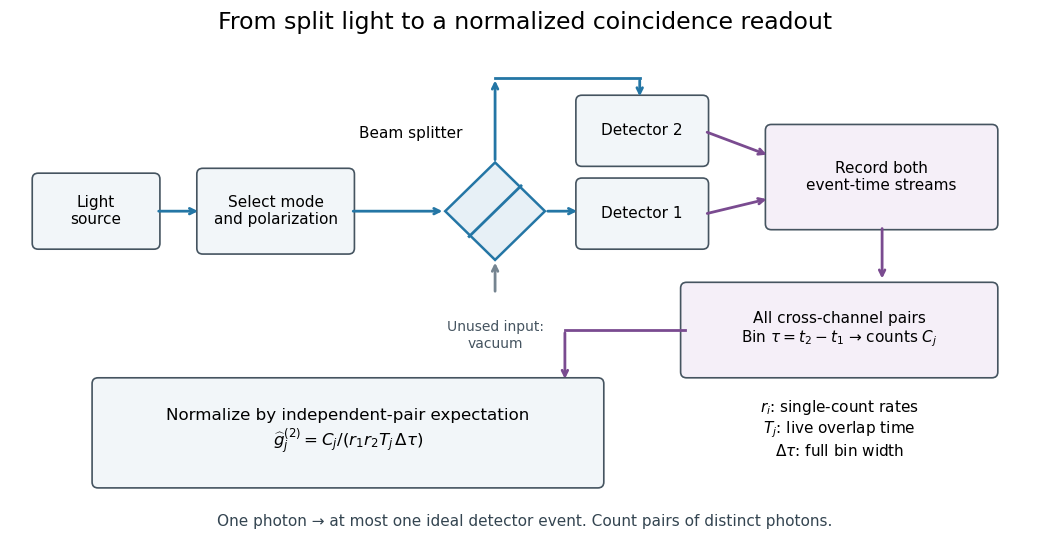
Photon counting registers discrete detector events and their times. A beam splitter sends the selected light to two photodetectors; a coincidence circuit or time-recording system compares the outputs. With a vacuum input at the unused optical port, splitter fractions and independent quantum efficiencies , a selected input photon reaches the two recorded channels with probabilities and . Conditional on input occupation , each pair of distinct photons contributes to the cross-channel pair moment. ThereforeTheir normalized ratio recovers . This assumes number-resolving counts, or sufficiently dilute gates for threshold detectors to approximate them. One photon cannot create both channel counts in this ideal model.


Photon statistics 2026-10-18
Photon statistics is the probability distribution of the number operator in specified field modes, or the distribution of registered counts in a specified gate. Those distributions agree only for an appropriate ideal measurement. Mode selection, losses, and detector dead time matter. For a one-mode density matrix, andThese two sums already distinguish preparations with the same expected value.
Quantum theory of optical coherence Created 2026-10-18 Updated 2026-10-20
Fix a detected position and polarization of waves. Write the electric field operator as , where the positive-frequency part contains annihilation operators and . An ideal absorbing photodetector responds towith density matrix . The diagonal gives the single-count rate up to the detector coupling. Multiple absorptions require higher, normal-ordered field products. Roy J. Glauber used these correlations to develop the quantum account of optical coherence.[ref]
The ordering follows from a detection amplitude. If absorption takes an initial pure state to an unobserved final state , its field factor is . Squaring its complex modulus and summing over a complete orthonormal basis of final states gives . Averaging over initial preparations replaces this expression by a trace. Thus a detector that absorbs cannot count the Fock vacuum, although the vacuum has quantum fluctuations.
For one selected normal mode, . All Fock states with nonzero occupation, coherent states, and thermal light in this same mode havewhere both denominators are nonzero. Its magnitude is one even when the expected value of the field vanishes. Perfect first-order optical coherence therefore does not identify a coherent state. Pair detection supplies additional information.
Quantum simulation Created 2026-10-18 Updated 2026-11-05
Quantum simulation uses a controllable quantum system to reproduce selected properties or dynamics of another quantum system. The motivation is that the Hilbert space of many interacting particles grows rapidly, making a full classical representation expensive.
In an analog simulation, an engineered Hamiltonian approximates the target interactions directly. In a digital simulation, a sequence of quantum gates approximates the target unitary time evolution. For example, interacting spins can model a XXZ spin chain, with measured correlations compared to the target theory. A useful result requires identifying what is reproduced, controlling preparation and measurement errors, and estimating the effect of imperfect interactions. Reproducing a few observables can be valuable even when the simulator does not reproduce every microscopic degree of freedom.
For copies of a positive-energy branch in area , the density of states is . At zero chemical potential, the thermal energy is , giving the displayed fixed-zero-chemical-potential heat capacity. If a symmetric filled negative-energy band also supplies holes, its excitation energy contributes an equal amount. Counting cones, spin species and holes explicitly is necessary before assigning an absolute numerical coefficient.
Oscillator length Created 2026-10-18 Updated 2026-11-05
The oscillator length fixes the spatial scale of a quantum harmonic oscillator of mass and angular frequency . Its normalized ground wavefunction is , so and . The definition of is distinct from the root-mean-square displacement .
Harmonic-oscillator number-state second moments Created 2026-10-18 Updated 2026-11-05
For a number operator eigenstate , the annihilation operator and creation operator satisfy , and . Inserting and gives the displayed second moments and zero means.
Thus the kinetic energy and potential energy each have mean , and the uncertainty product is . Among number states only the ground state saturates the Heisenberg uncertainty relation. A quantum superposition can have nonzero position and momentum means despite each constituent number state's zero means.
In the isotropic three-dimensional quantum harmonic oscillator, the first excited Cartesian energy eigenstates are proportional to times the common Gaussian . If are normalized with the same real phase convention, their combinations in the title are normalized angular momentum eigenstates with and .
Indeed, and identify a common radial factor times the spherical harmonics . The transformation is unitary, so it changes the basis rather than the threefold orbital degeneracy.
There are unlisted articles, also show them or only show them.