
Work by Pierre Agostini 2026-10-18
Holography 2026-10-18
Holography records the wave interference between a holographic object wave and a known holographic reference wave, then uses that record to reconstruct a wavefront. The record is a hologram. A photographic plate or photodetector measures light intensity; the relative wave phase is encoded in the positions and contrast of interference fringes, rather than measured directly as an optical oscillation. Reillumination makes the recorded pattern act as a diffraction grating that produces an image-bearing field.
The useful change of viewpoint is to preserve a field that can propagate again, instead of only a focused brightness picture. Recovered complex amplitude permits refocusing with the Fresnel propagator; a spatially extended hologram can also supply different viewing directions. The recoverable information is limited by the collected aperture, recorded spatial frequencies, optical coherence and separation of unwanted diffraction orders.
Amplitude transmittance Created 2026-10-18 Updated 2026-11-05
Amplitude transmittance is the local ratio of transmitted to incident complex amplitude in a thin optical-element model. It includes wave phase as well as attenuation. For identical incident and transmitted media at normal incidence, the corresponding intensity transmittance is ; itself is not the transmitted power fraction. A pure phase screen has .
Interferometer Created 2026-10-18 Updated 2026-11-05
An interferometer splits or combines coherent wave amplitudes so that an observable depends on their relative wave phase. A Michelson interferometer sends light through two reflected paths before recombination; moving one mirror changes the round-trip optical path difference.
For two detected contributions, under ideal mutual coherence and matched polarization. The varying cross term turns tiny path changes into measurable intensity changes. Stable interpretation requires control of vibrations, beam overlap and optical coherence. A lack of visible fringes can result from those limitations rather than from a lack of light in one path.
Spectral phase Created 2026-10-18 Updated 2026-11-05
Spectral phase is the argument of a complex spectral amplitude as a function of frequency. Writing a pulse spectrum as separates its spectral magnitude from the phase function .
Two pulses can have identical spectral intensities and different temporal shapes because their frequency components add with different relative phases. A phase linear in angular frequency shifts the pulse in time; quadratic phase adds group delay dispersion and commonly broadens an initially unchirped pulse. Measuring spectral intensity alone therefore cannot reconstruct the time-dependent electric field; phase-sensitive information is also required.
Scalar diffraction theory 2026-10-18
Scalar diffraction theory approximates light by one complex field satisfying a scalar wave equation. Aperture propagation is represented by an integral of secondary contributions, with vector polarization of waves and detailed electromagnetic edge conditions suppressed. The approximation is useful for many apertures large compared with wavelength, but is not an exact substitute for Maxwell equations at arbitrary apertures.
Huygens-Fresnel principle Created 2026-10-18 Updated 2026-10-20
The Huygens-Fresnel principle describes propagation by coherent addition of secondary-wave contributions from a wavefront or aperture. Their complex amplitudes, including relative wave phases, must be summed before calculating light intensity. The Fresnel propagator follows by retaining quadratic propagation wave phase in the paraxial approximation.
List of physical oceanographers 2026-10-18
BOOMERANG acoustic-peak measurement 2026-10-18
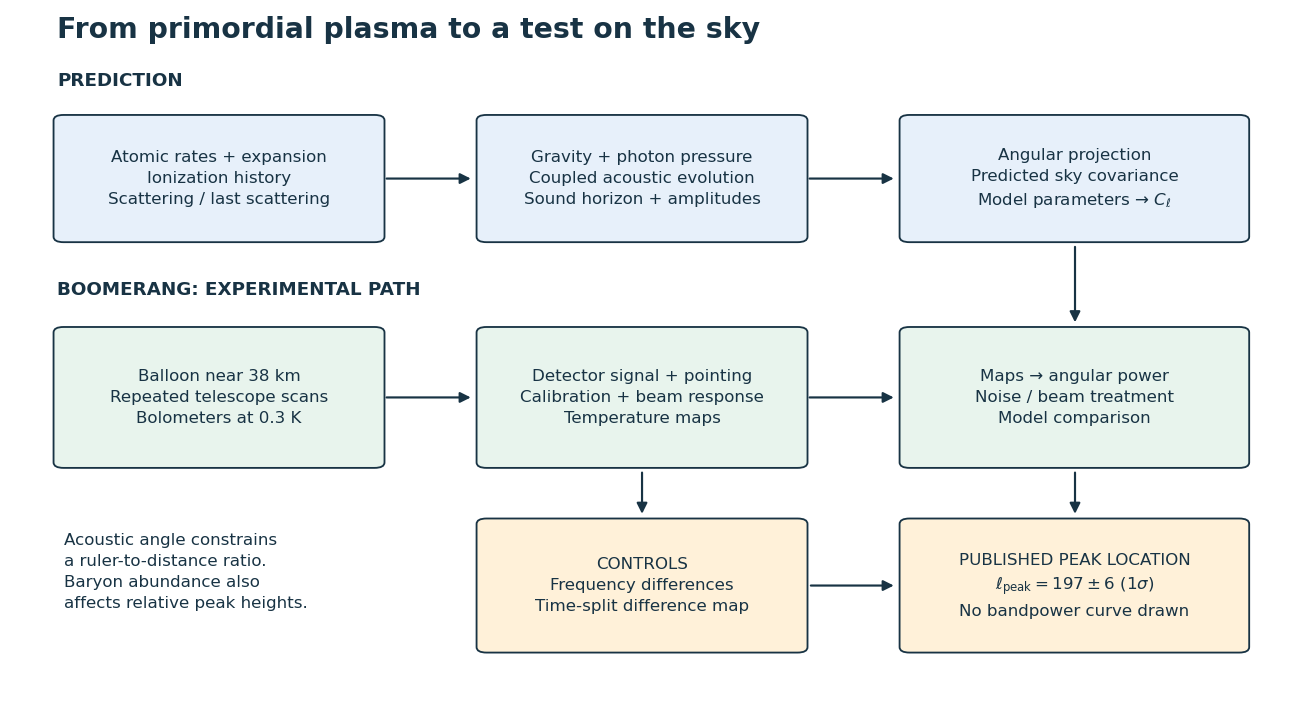
BOOMERANG's 1998 Antarctic balloon flight scanned a low-dust region with a microwave telescope near and bolometers at . Ground beam measurements and microwave angular dipole calibration connected signals to sky temperature. Frequency-map and time-split differences tested contamination. The 2000 paper fitted the Cosmic microwave background power spectrum, finding at one standard deviation. Its near-flat-geometry inference used a chosen model family and parameter priors; secondary peaks were not yet established.[ref]
A Flat Universe from High-Resolution Maps of the Cosmic Microwave Background Radiation by P. de Bernardis and others. de Bernardis et al. (2000), PDF pp.3–9: apparatus, controls, peak fit

Angular sound-horizon degeneracy 2026-10-18
The angular sound horizon compares two lengths using the same distance convention. If is the angular diameter distance to last scattering at redshift , define the transverse comoving distance . A comoving sound horizon has proper length at emission, so its angular size is . Mixing a comoving ruler with would introduce an erroneous factor . In a curved FLRW metric, is generally different from the radial comoving distance.
For a stipulated example, and give radians, or , and an acoustic scale . Multiplying both lengths by gives and with exactly the same and . This example establishes a ratio degeneracy, without claiming that any arbitrary rescaling corresponds to an allowed cosmological model. Equivalently,Other observables are needed to separate changes that preserve the ratio.
The approximate adiabatic acoustic-peak spacing is . The first observed temperature peak is shifted by gravitational driving and angular projection of density and Doppler acoustic sources; it need not occur at . In particular, neither the illustrative nor the BOOMERANG acoustic-peak measurement of should be substituted for the other.
The cosmological baryon density enters through the baryon loading parameter and cosmological recombination, changing relative acoustic amplitudes as well as the sound horizon. The baryon-to-photon ratio counts net baryon number per photon, whereas is an angle. Constraining cosmological baryon density requires the pattern of relative peak heights within a model, with other parameters fitted jointly. Big Bang nucleosynthesis provides a separate abundance test. Baryon-density consistency between nucleosynthesis and the microwave background is consequently a test of one common cosmic history, rather than two direct measurements of the same angle. A first peak by itself cannot determine every component of the cosmological density parameter or uniquely fix spatial curvature of an FLRW universe.
Peebles primordial-plasma predictions Created 2026-10-18 Updated 2026-10-20
P. J. E. Peebles made the connection between microscopic processes and cosmological observables quantitative. His 1968 paper treated cosmological recombination as a kinetic problem. Capturing an electron directly into the hydrogen ground state releases a photon that can ionize another atom. Net neutralization depends on escape of resonance radiation through cosmological redshift and on two-photon spontaneous emission from the state. An equilibrium Saha equation alone does not give that history.[ref]
Recombination of the Primeval Plasma by P. J. E. Peebles. Peebles, Recombination of the Primeval Plasma (1968), §§IIb–IId, pp.3–6
This matters for an acoustic prediction because the hydrogen ionization fraction fixes the supply of free electrons for Thomson scattering. In physical units the scattering rate per photon is . The cosmological visibility function describes the distribution of last-scattering times. Thus atomic physics helps determine when the photon-baryon acoustic oscillator is read out, as well as how rapidly tight coupling fails.
In 1970 P. J. E. Peebles and J. T. Yu followed adiabatic cosmological perturbations by numerically integrating the photon collision equation through cosmological recombination. Their calculation connected acoustic evolution and dissipation to residual matter structure and microwave brightness fluctuations. It did not assume that a perfect photon-baryon fluid remained valid throughout last scattering. Their illustrative cosmological models and normalization were historical choices, rather than the present Lambda-CDM model; their predicted brightness variance versus angular resolution should not be relabelled as a modern measured spectrum.[ref]
Primeval Adiabatic Perturbation in an Expanding Universe by P. J. E. Peebles and J. T. Yu. Peebles and Yu, Primeval Adiabatic Perturbation in an Expanding Universe (1970), pp.815–816; §VI, pp.829–833, Figs.4–9
The continuing idea is a forward prediction: specify initial conditions, evolve the coupled matter and radiation, project onto the sky, and compare the result with an instrument's readout. Coherent initial phases are needed for acoustic variance peaks explains why a collection of oscillating modes does not automatically produce a peaked power spectrum. The BOOMERANG acoustic-peak measurement provides a later observational test of this physical programme.
Gamma ray Created 2026-10-18 Updated 2026-11-05
A gamma ray is a high-energy photon, conventionally associated with a transition of an atomic nucleus, radioactive decay or a particle reaction. X-rays and gamma rays are both electromagnetic radiation; their energy ranges overlap, so the production mechanism can be more informative than an arbitrary energy boundary.
A nuclear energy level transition emits a gamma ray whose energy is approximately the level difference, with a correction for nuclear recoil. Detectors infer the incoming energy from interactions such as photoelectric absorption, Compton scattering and, above threshold, pair production. A measured gamma-ray spectrum can therefore identify nuclear transitions even when a detector does not absorb the entire photon energy in each event.
Photon energy Created 2026-10-18 Updated 2026-11-05
The energy carried by one photon is proportional to its frequency , with proportionality constant the Planck constant . The equivalent forms use angular frequency and vacuum wavelength . Different observers can measure different photon energies because they measure different frequencies; the photon remains massless. In signature , an observer with four-velocity measures , where is the photon's four-momentum and .
Single-photon source Created 2026-10-18 Updated 2026-11-05
A single-photon source prepares light with strongly suppressed simultaneous two-photon emission. One useful implementation repeatedly excites one discrete emitter and collects a selected radiative transition. Photon antibunching, measured through the zero-delay second-order correlation , tests the multiphoton suppression; a weak coherent beam retains Poissonian number fluctuations. Collection efficiency and multiphoton probability are distinct properties.
Photoelectron Created 2026-10-18 Updated 2026-10-24
An electron ejected following photon absorption. For a free residual ion with negligible recoil, the emitted electron's kinetic energy equals incident photon energy minus the ionization binding energy.
Work by Phillip L. Gould 2026-10-18
Work by Philippe Joyez 2026-10-18
Work by Philippe Bado 2026-10-18
Work by Philipp Lenard 2026-10-18
Work by Philip Warren Anderson Created 2026-10-18 Updated 2026-10-24
There are unlisted articles, also show them or only show them.