
Work by Ilya Piatetski-Shapiro 2026-10-18
Work by Ilya Mikhailovich Frank Created 2026-10-18 Updated 2026-10-24
Work by Igor Yevgenyevich Tamm Created 2026-10-18 Updated 2026-10-24
Ideal-solution vapor-liquid equilibrium test 2026-10-18
The Mixture measurements and the Gibbs-Duhem constraint article describes the inspected acetone–chloroform preparation, apparatus, paired readouts, controls and sampling limits.[ref]
Liquid-Vapor Equilibrium of a Binary System by James M. McCormick. Procedure, Figure 1, Tables 1–2: apparatus, calibration, pure-component control, successive additions and paired sampling
That existing apparatus account supplies the experimental controls and limitations. Its refractive index calibration yields mass fractions, which must be converted to mole fractions. For a measured component-A mass fraction and component molar masses ,Apply this conversion separately to the flask sample and to completely condensed vapor to obtain and . Comparing with tests Raoult's law at the measured temperature; using the changing temperature at each composition is essential. The chosen A/B values above are unrelated to the protocol's substances.
The more general diagnostic, retaining an ideal gas vapor and negligible pure-liquid pressure correction, isThis follows by replacing with in the chemical potential subtraction used for Raoult's law. A reproducible discrepancy from can expose failure of the ideal solution approximation, but interpreting it requires checking measurement uncertainty, representative paired sampling and the ideal gas approximation. Apparent agreement within uncertainty supports an approximation over the tested conditions; it cannot establish exact ideality at every composition.
Positive or negative deviations of component partial pressures require activity coefficients different from one under these assumptions. An azeotrope is also absent from the chosen unequal-vapor pressure model: the explicit inequality in ideal binary vapor composition gives throughout . An interior equality would require ; in that degenerate case every composition has , rather than an isolated enrichment reversal. Neither an azeotrope nor liquid phase separation should be inferred from the ideal curves.
Gibbs free energy of mixing 2026-10-18
The Gibbs free energy of mixing compares the final mixture's Gibbs free energy with that of its initially separate components at the same temperature and pressure. For an ideal solution, subtract the pure-component reference from :For one mole of the chosen A/B ideal solution at and ,The individual chemical potential changes are for A and for B. Weighting these by and reproduces the total Gibbs free energy of mixing.
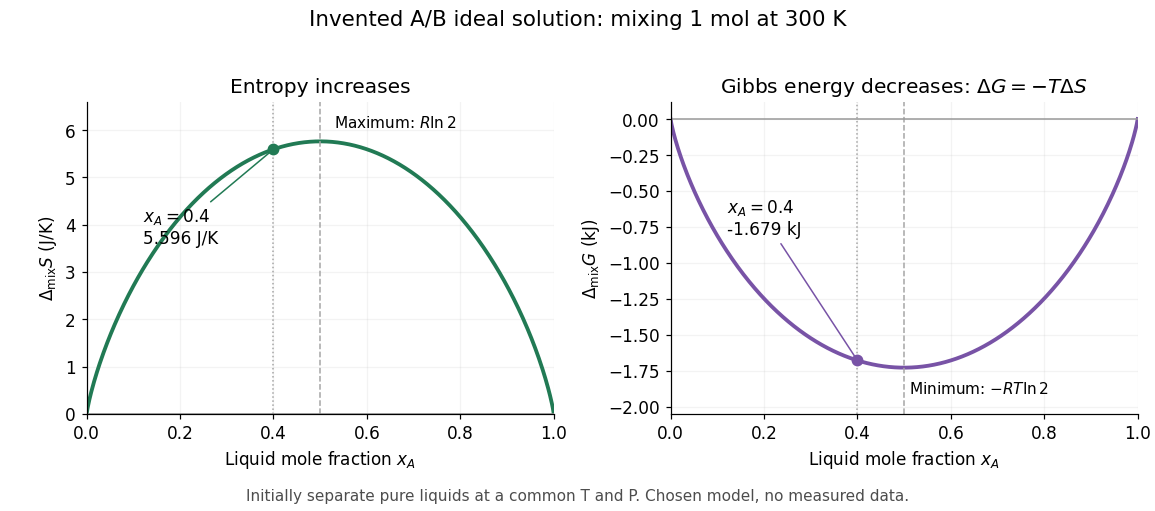

If ideality holds in a neighborhood of the specified temperature and pressure, differentiation at fixed component amounts givesThus the ideal mixing Gibbs free energy decrease comes entirely from the entropy increase; the mixing enthalpy and volume changes vanish. Ideality at a single isolated state alone does not determine temperature or pressure derivatives.[ref]
The same formula rules out spontaneous separation into two liquid thermodynamic phases within this model. Per mole, the mixing Gibbs free energy hasAdding the pure-component reference contributions changes only a term linear in . The total molar Gibbs free energy is therefore a strictly convex function: a separated pair of different compositions has a larger composition-weighted Gibbs free energy than the uniform sample with the same inventory. Such phase separation requires physics beyond this ideal solution model.
Entropy of mixing 2026-10-18
The entropy of mixing is the entropy change between initially separate components and their final mixture, with initial and final temperatures, pressures and component amount of substance values specified. For an ideal solution made from pure liquids at the same temperature and pressure, let . ThenThe right-hand expression is the ideal solution result; the general definition does not require ideality. Each interior mole fraction has a negative logarithm, so mixing distinct components gives positive entropy of mixing. At a pure endpoint, use the limit as .
For one mole of the chosen A/B ideal solution with ,For the same total amount of substance, equal mole fractions maximize this binary entropy of mixing: the composition function hasso its unique maximum is . This is a comparison between different prepared compositions, not a prediction that a closed sample changes its component inventory to become equimolar.
Raoult's law 2026-10-18
In the ideal solution and ideal gas vapor approximation, each component's partial pressure equals its liquid mole fraction times its pure-component vapor pressure at the same temperature:These pressure formulas neglect the change in the pure-liquid reference between its saturation pressure and ; appreciable real gas behavior also requires a more general treatment. The ideal solution definition in terms of chemical potentials does not require either approximation.[ref]
Thermodynamics and Chemistry by Howard DeVoe. §9.4.1, printed pp. 248–249: partial-pressure form and its distinction from the general thermodynamic law; §9.4.2: ideal liquid mixture
A short derivation explains the reference choice. At vapor-liquid equilibrium, each component has the same chemical potential in the liquid and vapor. For an ideal gas mixture, chemical potential of an ideal gas giveswhere is a reference pressure. Approximate by and subtract the pure-component equation from the mixture equation:Taking the exponential function gives Raoult's law. Summing partial pressures and normalizing gives and ; this last step uses the ideal gas vapor assumption separately from the liquid model.
The law is named after François-Marie Raoult, who measured vapor pressures and freezing behavior of chemical solutions.[ref]
Thermodynamics and Chemistry by Howard DeVoe. Printed p. 380, Biographical Sketch: François-Marie Raoult; experimental work on dilute solutions
Hexane Created 2026-10-18 Updated 2026-11-05
Work by Hugues Pothier 2026-10-18
Work by Hugo Atterling 2026-10-18
Work by Hugh Stott Taylor 2026-10-18
Work by Hugh Muirhead 2026-10-18
Work by Hugh David Politzer 2026-10-18
Work by Howard DeVoe 2026-10-18
Work by Horst Störmer Created 2026-10-18 Updated 2026-10-24
Hoare triple 2026-10-18
A partial correctness claim connecting a precondition , a program and a postcondition : every terminating execution begun with ends with . State separately whether total correctness is intended.
Work by Hiroshi Amano 2026-10-18
Work by Hippolyte Fizeau 2026-10-18
Chloroplast dye-reduction experiment Created 2026-10-18 Updated 2026-10-20
The Practical Biology protocol uses cold sucrose in buffer solution, ground green leaves, muslin filtration, centrifugation and cold pellet resuspension. A lamp illuminates extract plus DCPIP from –; a red-filter colorimeter monitors blue-color loss.[ref]
Investigating the light dependent reaction in photosynthesis at Practical Biology. Apparatus and Chemicals; Technical note 2; Procedure a–k; Sample results, Using a bench centrifuge: EEL colorimeter with red filter
Compare extract plus dye in darkness, illuminated dye without extract, extract without dye, and supernatant plus dye: controls for light, extract dependence, background color and incomplete separation. Green supernatant can remain active; a centrifugation pellet establishes neither purity nor intact chloroplasts.[ref]
Investigating the light dependent reaction in photosynthesis at Practical Biology. Procedure i–k, five-tube table; Teaching notes; Questions 1–3 and answers: control interpretations and green-supernatant limitation
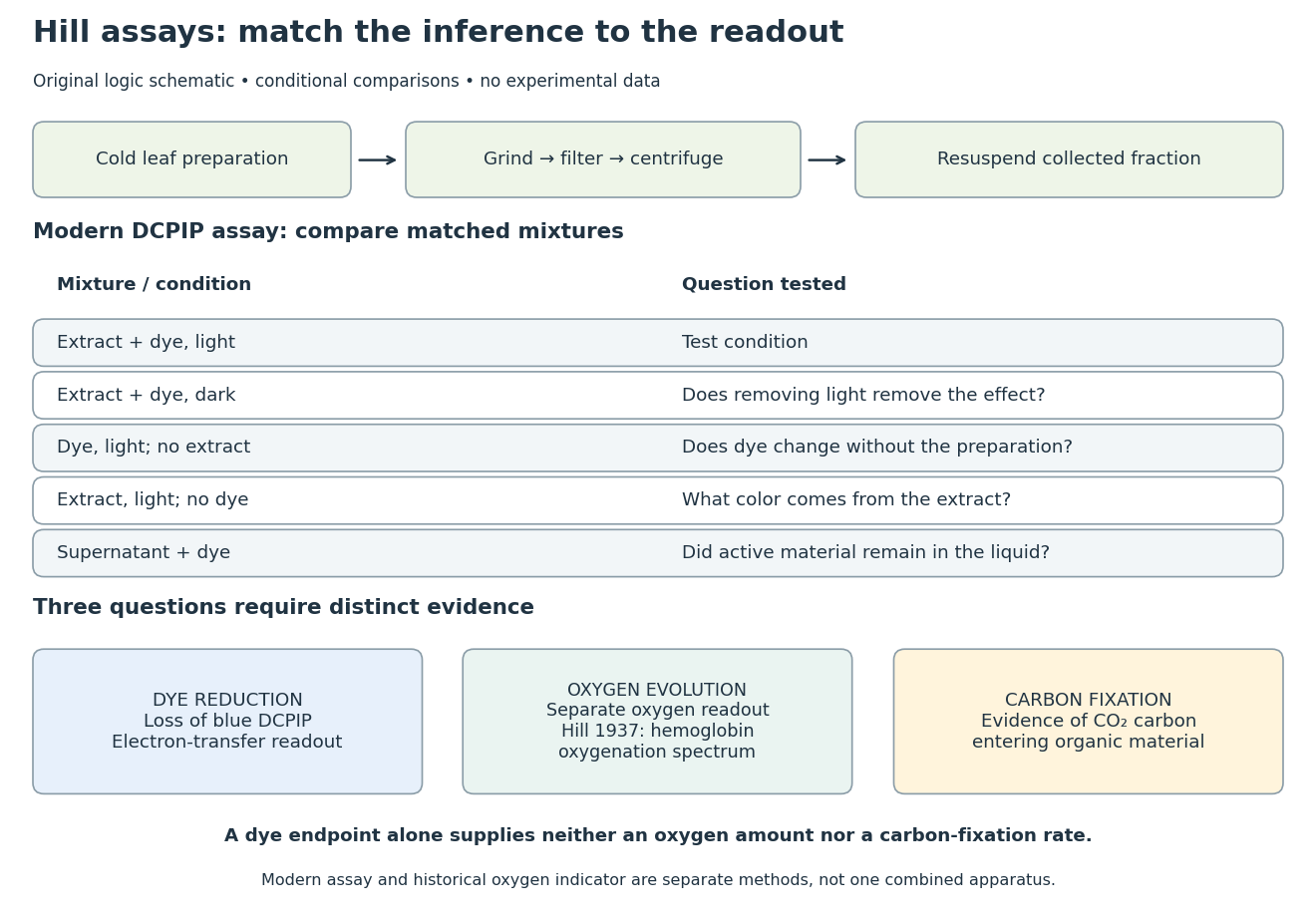
Hill reaction: preparation, comparisons and distinct readouts
. Original experimental-logic schematic. Control outcomes are conditional interpretations, not invented observations. The modern dye assay follows the inspected Practical Biology protocol; the separate historical branch denotes hemoglobin oxygenation. No measured time course, apparatus photograph or published figure is reproduced. Details.
Here is an original logical check of the controls. Suppose only the illuminated extract-plus-dye condition loses blue color, while the dark mixture and illuminated dye-only mixture retain it. Removing light or removing extract each removes the effect in those comparisons. That supports a joint requirement under the tested conditions. If the dye-only mixture also loses blue color, the proposed attribution to extract has failed its control; a faster change in the extract mixture would require a quantitative comparison before attribution. These are conditional cases, not experimental results.
Even the favorable case leaves three distinct questions. Dye reduction demonstrates delivery of electrons to an artificial electron acceptor. An independently calibrated molecular oxygen readout is needed to measure molecular oxygen evolution. Demonstrating carbon fixation additionally requires evidence that carbon dioxide becomes incorporated into organic material. None of the latter quantities is supplied by a blue-color endpoint alone. An absorbance change also needs background and scattering controls before it can be treated as dye concentration; Beer-Lambert law states the relevant assumptions.
In particular, two hypothetical preparations can give the same dye endpoint while differing in whether their stromal Calvin cycle is functional. Observing only the dye discards that distinction. The counterexample establishes why dye decolorization cannot alone prove complete photosynthesis, carbon fixation, or an intact chloroplast. Temperature, extract loading and illumination must also be matched when comparing rates: a lamp can alter both light exposure and heating.
Work by Hideki Yukawa 2026-10-18
There are unlisted articles, also show them or only show them.