
On , both independent homogeneous solutions vanish at the singular endpoint zero. Consequently imposing leaves the nonzero homogeneous solution and does not determine a unique inverse. One valid right Green function, with and zero endpoint values, isIts first derivative has jump one because the Wronskian of and is . Every kernel preserves these properties when the integrals exist. For sources supported away from zero, integration yields one particular solution; the full endpoint-constrained family adds . An additional endpoint selection, such as , can choose a unique member. This is a singular-endpoint phenomenon, not an ordinary regular two-point uniqueness theorem.
Decaying two-sided Green function of a constant-coefficient ordinary differential equation 2026-10-18
Let be a constant-coefficient differential operator, , with distinct characteristic roots having nonzero real parts. The solution of decaying at both temporal infinities iswhere is the Heaviside step function. This follows by partial fraction decomposition of and the first-order kernels for , or for . Both first-order kernels jump by one and solve as distributions.
For example, givesIt is continuous together with its first derivative; its second derivative jumps by one, as required by the jump conditions for a third-order Green function. A solution of is the convolution when it exists. If positive-real-part roots occur, decay at both ends generally requires a nonzero negative-time branch: this is the distinction captured by causality versus stability of a Green function. A causal kernel would retain growing positive-time terms and need not have a real-axis Fourier transform.
The usual Green function formula for a monic second-order equation requires a nonzero Wronskian at the source. At an interior singular point it may fail to define an ordinary inverse for arbitrary forcing. For example, for on , choose and . They satisfy the left and right Dirichlet boundary conditions, and . The displayed kernel is valid for and has unit jump in its first derivative. Its behaviour prevents unrestricted integration through zero. For smooth forcing , the product has a removable singularity, and its integral gives the unique solution extending with two continuous derivatives through zero. That matching condition matters: merely requiring one continuous derivative allows additional piecewise homogeneous solutions. A smooth forcing with cannot have a solution with two continuous derivatives there, as expansion of shows.
Radial modified Helmholtz Green function on the half-line Created 2026-10-18 Updated 2026-10-20
For on , require boundedness at zero and at infinity. The substitution reduces the homogeneous equation to . The adapted solutions are at zero and at infinity, with Wronskian . The displayed Green function is continuous and has first-derivative jump , so with ordinary source measure . It satisfies weighted reciprocity . For forcing equal to one on and zero outside, integration gives inside and outside. Limits define the regular value at zero.
Exchange argument 2026-10-18
An exchange argument modifies an optimal feasible solution to include a desired choice while preserving feasibility and not worsening its objective function value. The modification need not strictly improve the optimum; equality suffices.[ref]
Greedy Algorithms. Algorithms by Jeff Erickson; §4.3 General Pattern, printed pp. 164–165: exchange at the first disagreement
For interval scheduling, the exchange replaces the first selected job with an earliest-finishing job. Its safety comes from the finish-time inequality below. Replacing a job with a shorter one has no such guarantee: it might move the occupied interval into the middle of two useful jobs, as the shortest-duration interval scheduling counterexample shows.
Newtonian binary chirp 2026-10-18
A Newtonian binary chirp is a leading-order model in which loss of orbital energy to gravitational radiation makes an almost circular binary system shrink and its gravitational-wave frequency rise. Here is a derivation with explicit SI units. Let the constant component masses be in kilograms, , , separation in metres, and orbital angular frequency in radians per second. Newtonian gravity, circular motion and the quadrupole formula giveThe factor rather than appears because the dominant mass quadrupole moment repeats twice per orbit. Since , radiative energy loss implies , henceThe quantity is a time in seconds. Thus has units and has units , as required for frequency change per second. This model assumes weak gravity, slow relative motion, negligible eccentricity of a conic, no spin corrections and adiabatic evolution over an orbit. It does not describe merger or ringdown.
Separating variables gives a finite formal coalescence time and accumulated wave phase :Indeed ; the formal divergence at signals extrapolation outside the approximation. Over a finite frequency interval, the number of gravitational wave cycles is . This accumulated phase is why a chirp mass can be constrained even when distance and inclination remain entangled.
GW150914 Created 2026-10-18 Updated 2026-11-05
GW150914 is the first directly detected gravitational wave, interpreted as a binary black hole inspiral, merger and ringdown. Its discovery paper reports a peak projected gravitational wave strain of approximately and a combined matched filter signal-to-noise ratio of 24. The inferred source-frame component masses were and solar masses, with 90 percent credible intervals. These are model-dependent estimates from a detector network.[ref]
Observation of Gravitational Waves from a Binary Black Hole Merger by B. P. Abbott and others. Abstract; II Observation; VI Source discussion, Table I
The interesting measurement is a chain: curvature changes relative light travel times, wave interference turns those changes into a photodetector signal, calibrated records from separate sites constrain a common source, and statistical inference tests competing explanations. The following original models explain that chain; the plotted time series are stipulated calculations, never measured GW150914 data.
k-core of a graph 2026-10-18
For a nonnegative integer , the k-core of a graph is the unique maximum by set inclusion induced subgraph in which every degree of a vertex is at least , allowing the empty graph. Repeatedly delete vertices whose current degree of a vertex is less than . These induced subgraphs are nested: ; the case is the 2-core. In their 2003 preprint, Vladimir Batagelj and Matjaž Zaveršnik give an algorithm for the entire core decomposition, using degree buckets and constant-time position updates. Their general bound is ; the title's form applies to connected graphs with at least two vertices, where . [ref]
Fugacity (statistical mechanics) 2026-10-18
The dimensionless quantum gas fugacity weights particle number in the grand canonical ensemble: a state with energy and particle number has weight . The chemical potential and one-particle energies must use the same reference. When the lowest one-particle energy is zero, makes both fermion and boson occupations small throughout the low-energy spectrum. This dimensionless quantity must be distinguished from the pressure-valued fugacity used in chemical thermodynamics.
Polymer mushroom 2026-10-18
A dilute layer of end-tethered polymer coils whose lateral separation greatly exceeds the isolated coil size. Each coil retains approximately its isolated-solvent conformation, modified by the impenetrable tethering surface. Increasing the grafting density drives overlap and the crossover to a polymer brush.
Polymer brush Created 2026-10-18 Updated 2026-10-20
A layer of sufficiently crowded tethered polymer chains stretched away from their attachment surface. In a good solvent, overlap increases the interaction contribution to free energy; extension relieves this crowding at a cost of chain entropy. The mushroom-to-brush crossover occurs at , where is an isolated coil size. In a simple good-solvent scaling model, the brush height is for effective segment excluded volume and statistical segment length ; if , this becomes . The scaling requires strong stretching relative to the isolated coil but extension well below the contour length .
Golgi tracer interpretation 2026-10-18
The pancreatic secretory-protein pulse-chase experiment of James D. Jamieson and George E. Palade used guinea pig pancreas slices and a short pulse of tritium-labeled leucine followed by a chase. Thin sections on coated grids received Ilford L-4 emulsion; developed grains were read against structures by electron microscopy. Their Table II localized label to peripheral Golgi apparatus vesicles and condensing vacuoles, without significant labeling of the piled flattened Golgi cisternae.[ref]
Intracellular Transport of Secretory Proteins in the Pancreatic Exocrine Cell. II. Transport to Condensing Vacuoles and Zymogen Granules by James D. Jamieson and George E. Palade. p. 598 Methods; p. 609 Table II and its footnote
An important comparison checked the isolated granule fraction by autoradiography and electron microscopy: early labeling came substantially from contaminating condensing vacuoles, rather than mature secretory granules. Thus a fraction's name did not uniquely identify the labeled structure. This supported transport into the Golgi apparatus's condensing region and onward storage, while fixed samples and finite grain localization limited interpretation. It did not establish a resolved cis-to-trans itinerary across every Golgi cisterna. The preparation's labeling also did not mark secretory cargo exclusively.[ref]
Intracellular Transport of Secretory Proteins in the Pancreatic Exocrine Cell. II. Transport to Condensing Vacuoles and Zymogen Granules by James D. Jamieson and George E. Palade. p. 609 Figure 14; p. 613, Transport of Labeled Proteins to Condensing Vacuoles, Zymogen Granules, and the Acinar Lumen: comparison of fraction labeling with microscopy; p. 611, General Premises
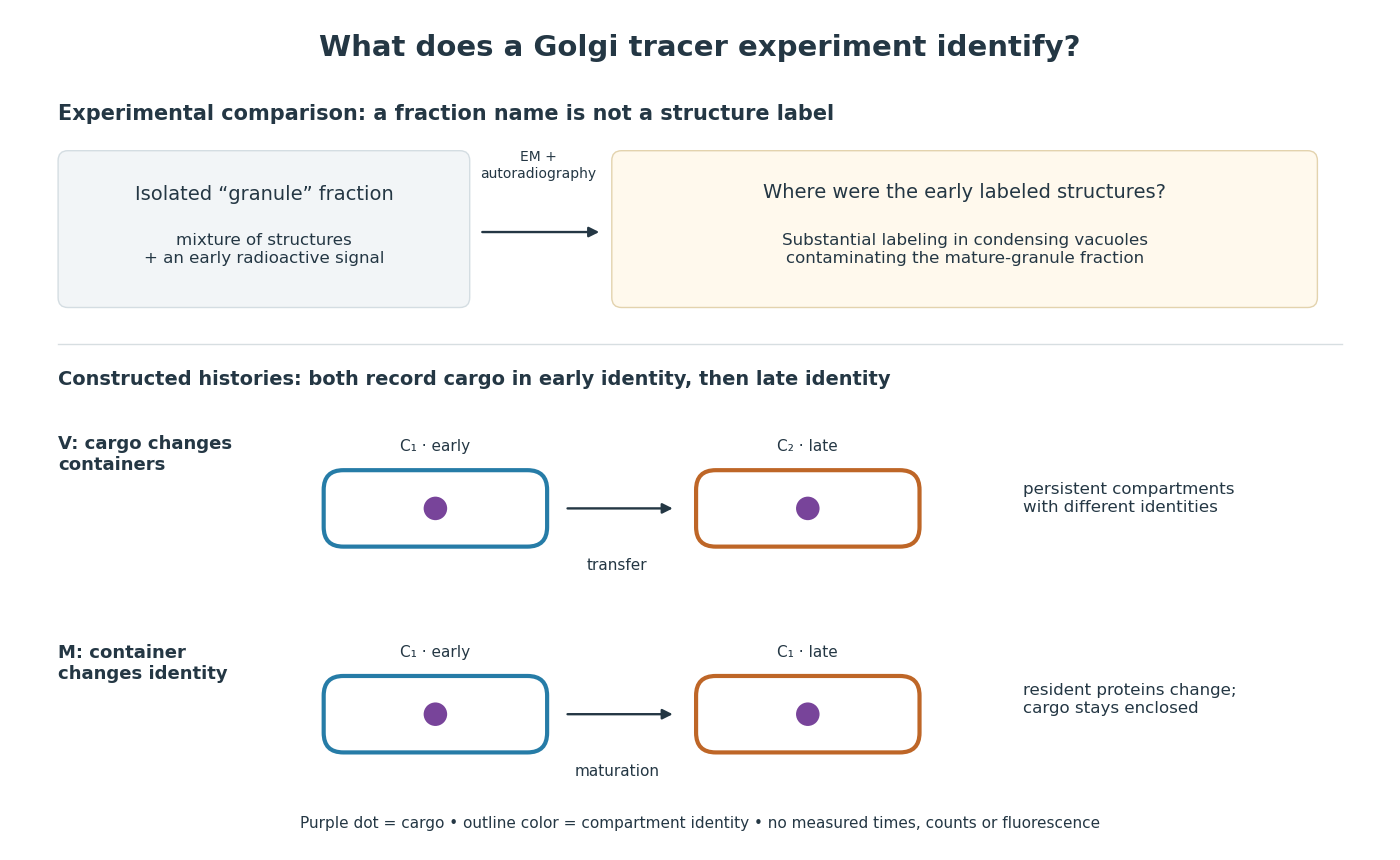

For a minimal worked inference, record only two outcomes for one labeled cargo cohort: early identity first, late identity later. Model V transfers cargo from container to container ; model M keeps it in while changes identity. Both produce the same recorded outcomes, so those outcomes alone cannot distinguish V from M. The proof is constructive: exhibit both histories and discard container identity from each record. More informative tracking would retain both cargo and resident-compartment markers, while resolving whether the same compartment persists. This is why pulse-chase analysis and compartment tracking answer complementary questions about the Golgi apparatus.
Cisternal maturation 2026-10-18
In cisternal maturation, a cargo-containing Golgi cisterna changes from early to later identity as its resident proteins change; retrieval of resident enzymes toward earlier compartments helps maintain Golgi apparatus polarity. In the contrasting stable-compartment model, cargo moves between persistent Golgi cisternae in transport vesicles. These mechanisms need not be mutually exclusive.[ref]
Transport from the ER through the Golgi Apparatus. Molecular Biology of the Cell, 4th edition by Bruce Alberts and others; Transport Through the Golgi Apparatus May Occur by Vesicular Transport or Cisternal Maturation, Figure 13-30 and concluding comparison
The distinction is between following cargo and following its container. A cargo label encountered first in an early processing environment and later in a late one is compatible with either changing containers or a container changing identity. Finding transport vesicles nearby does not by itself establish which cargo they carry or their direction of travel. Testing cisternal maturation therefore requires evidence about compartment identity and continuity as well as cargo position; a single mechanism should not be assumed for every cargo and biological cell.
trans-Golgi network 2026-10-18
The trans-Golgi network is the sorting and export region at the trans side of the Golgi apparatus. Onward traffic can supply the cell membrane, secretory granules, or the lysosome route.[ref]
The Golgi Apparatus. The Cell: A Molecular Approach, 2nd edition by Geoffrey M. Cooper; Protein Sorting and Export from the Golgi Apparatus, Figure 9.27 and lysosomal targeting discussion
Processing and sorting answer different questions. In a constructed example, two cargo proteins could receive the same carbohydrate modification yet carry different targeting information and leave in different transport vesicles. Conversely, two chemically different cargo proteins could share a destination. A processing readout alone therefore cannot establish the final address; an experiment must also identify cargo location or delivery. Return traffic and retention likewise matter: the Golgi apparatus is a working compartment, not merely a one-way queue that empties all of its enzymes into outgoing carriers.
Golgi cargo processing 2026-10-18
Golgi cargo processing includes enzyme-mediated remodeling of attached oligosaccharides. Glycosylation can involve addition of sugars, while processing can also remove them. Different Golgi apparatus regions have different processing enzymes; their substrate requirements constrain the order of possible chemical reactions.[ref]
Transport from the ER through the Golgi Apparatus. Molecular Biology of the Cell, 4th edition by Bruce Alberts and others; Oligosaccharide Chains Are Processed in the Golgi Apparatus; The Golgi Cisternae Are Organized as a Series of Processing Compartments, Figure 13-28
An original model makes the importance of ordering explicit. Write a toy carbohydrate chain as , read with its terminal symbol on the right. Define a trimming function that removes a terminal , and an extension function that adds only when the terminal symbol is . In every other case the corresponding function leaves the chain unchanged. ThenIn particular, but : the two functions do not commute. Each result follows by inspecting the terminal symbol before applying the stipulated rule. These symbols are artificial labels, rather than a natural oligosaccharide sequence or measured enzyme pathway. The example explains why “two processing steps occurred” does not determine the product unless their order and substrate conditions are also specified. In the Golgi apparatus, spatial organization can help arrange successive opportunities for processing.
Golgi cisterna Created 2026-10-18 Updated 2026-11-05
A Golgi cisterna is a flattened membrane-enclosed sac. Stacking several sacs does not make their interiors one open space: membrane separates Golgi lumen from intervening cytosol.[ref]
The Golgi Apparatus. The Cell: A Molecular Approach, 2nd edition by Geoffrey M. Cooper; Organization of the Golgi, Figure 9.22: membrane-enclosed cisternae
The final substrate-level phosphorylation in glycolysis provides a useful experimental handle: pyruvate kinase transfers a phosphate group from phosphoenolpyruvate to ADP, producing pyruvate and ATP. Adding lactate dehydrogenase couples each pyruvate formed to consumption of one NADH:These equations select free ionic forms consistently: phosphoenolpyruvate has charge , ADP , ATP , and pyruvate and lactate each ; NAD+ has one more positive charge than NADH. Each line conserves charge. Cancelling pyruvate gives one NADH consumed per ATP formed in this coupled system. A whole-pathway NADH measurement has a different meaning, because the earlier glycolysis redox step produces NADH.
The published An Optimized Enzyme-Coupled Spectrophotometric Method for Measuring Pyruvate Kinase Kinetics reports recombinant pyruvate kinase prepared in Escherichia coli, purified by chromatography and size-exclusion chromatography. UV-transparent microplate wells contained ADP, phosphoenolpyruvate, NADH, lactate dehydrogenase and a buffer solution with magnesium ions. An Epoch plate reader used spectrophotometry to follow absorbance at every five to ten seconds for one minute at . Its Figure 2 presents , increasing as NADH is consumed. Heat-inactivated pyruvate kinase gave minimal background; a validated active preparation was the positive control. These comparisons support an enzyme-dependent readout in the prepared system, rather than a whole-biological cell glycolysis measurement.[ref]
The same report uses for optical path length in Procedure B.2.i, but approximately in Data analysis §3. An absolute conversion requires the actual path length and sufficient coupling enzyme activity; no measured ATP rate is inferred here.[ref]
An Optimized Enzyme-Coupled Spectrophotometric Method for Measuring Pyruvate Kinase Kinetics by Saurabh Upadhyay. Procedure B.2.i; Data analysis §3; General notes, items 4 and 6: path-length inconsistency and linear-range conditions
For an original dimensional example, stipulate a blank-corrected absorbance decline , a calibrated path length and a chosen calibration coefficient . These are invented teaching inputs, not the protocol's measurements or its quoted coefficient. The Beer-Lambert law givesIn a stipulated reaction volume, this is of NADH consumed and, conditionally, of ATP formed. The conditional inference requires rapid pyruvate consumption by the coupling enzyme, no other NADH-consuming chemical reactions, and a linear, correctly calibrated optical response. The readout measures this last glycolysis step; it cannot establish the full two-net-ATP-per-glucose balance by itself.
Glycolysis cofactor recycling Created 2026-10-18 Updated 2026-10-20
In the payoff stage of glycolysis, oxidation of glyceraldehyde 3-phosphate is coupled to reduction of NAD+. Each NADH carries a two-electron reducing equivalent. The formal half-chemical equationmakes the electron count explicit: two NADH per glucose carry four electrons. This is redox bookkeeping, not a claim that free electrons travel through the chemical solution or that NADH is itself ATP.
Fermentation can return NADH to NAD+ by reducing an organic substrate; reduction of pyruvate to lactate is one example. In aerobic cellular respiration, reducing equivalents reach an electron transport chain, reducing molecular oxygen. Other forms of cellular respiration use other electron acceptors, so absence of oxygen does not uniquely imply fermentation.[ref]
Biology 2e by Mary Ann Clark and others. §7.2, step 6 and its NAD+ regeneration paragraph; §7.5, opening comparison of fermentation and anaerobic respiration, Lactic Acid Fermentation and Figure 7.16 caption
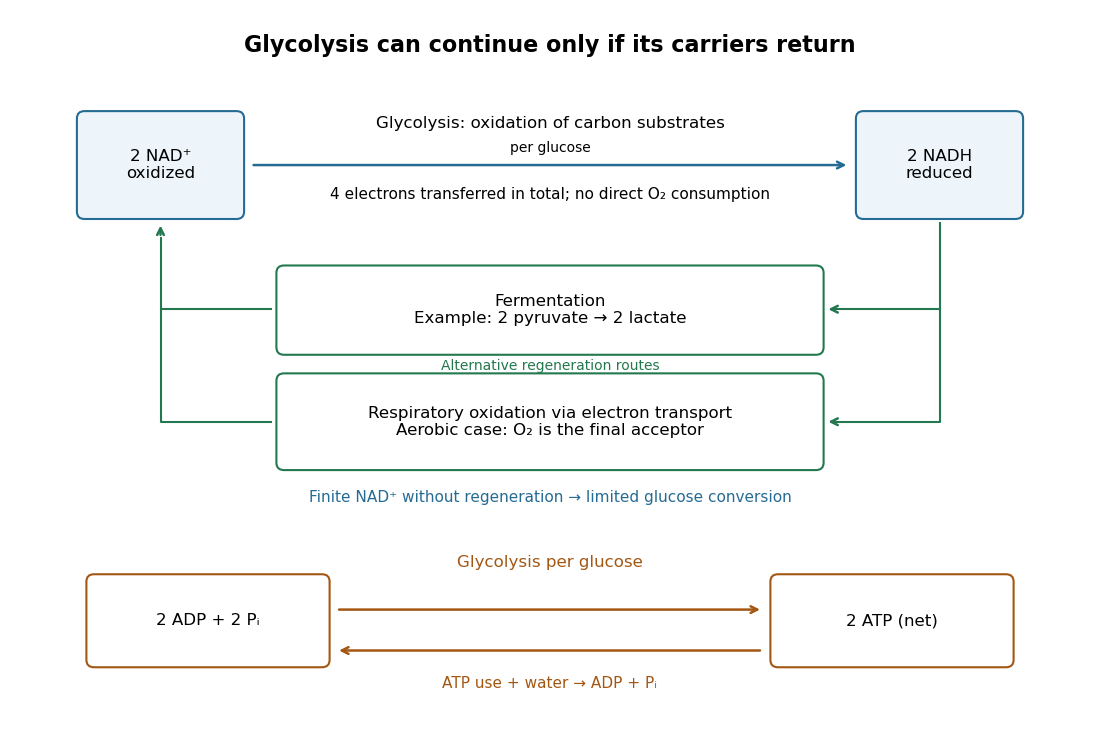

The need for NAD+ regeneration follows from a finite-pool argument. In a hypothetical closed preparation with of initially oxidized NAD+ and no regeneration, at most of glucose can complete the two NAD+-consuming conversions per glucose. This is an upper bound even with excess glucose, not a predicted stopping time: other limitations can stop the preparation earlier. With an intact fixed nicotinamide adenine dinucleotide pool and no side reactions, converting NAD+ into NADH preserves their sum but depletes the usable oxidized form.
ATP recycling imposes a second condition. Glycolysis needs some initial ATP for investment and consumes two net ADP and two inorganic phosphate per completed glucose. In a closed ideal preparation with only of initial ADP, no other source of ADP, and enough initial ATP and inorganic phosphate, at most of glucose can finish. This bound follows from the net ADP consumption, even though investment temporarily produces additional ADP. Initial investment also means that adequate final inventories alone cannot guarantee the route can start.
For continued operation at fixed carrier inventories, other chemical reactions must match the two net ATP formed per glucose with ATP use that restores ADP and inorganic phosphate, or exchange must supply those reactants. ATP hydrolysis coupled to cellular work is one route. Thus glycolysis can sustain useful energy coupling while neither its ATP inventory nor its NADH inventory grows indefinitely; matter cycles while glucose supplies fresh chemical free energy.
Glycolysis carbon and ATP ledger 2026-10-18
Follow one glucose through canonical glycolysis, with no diversion of intermediates into other metabolic pathways. The investment stage uses two ATP to prepare the six-carbon substrate. Cleavage and rearrangement provide two glyceraldehyde 3-phosphate molecules, each containing three carbon chemical atoms. Each then yields one three-carbon pyruvate, one NADH, and two ATP in the payoff stage.[ref]
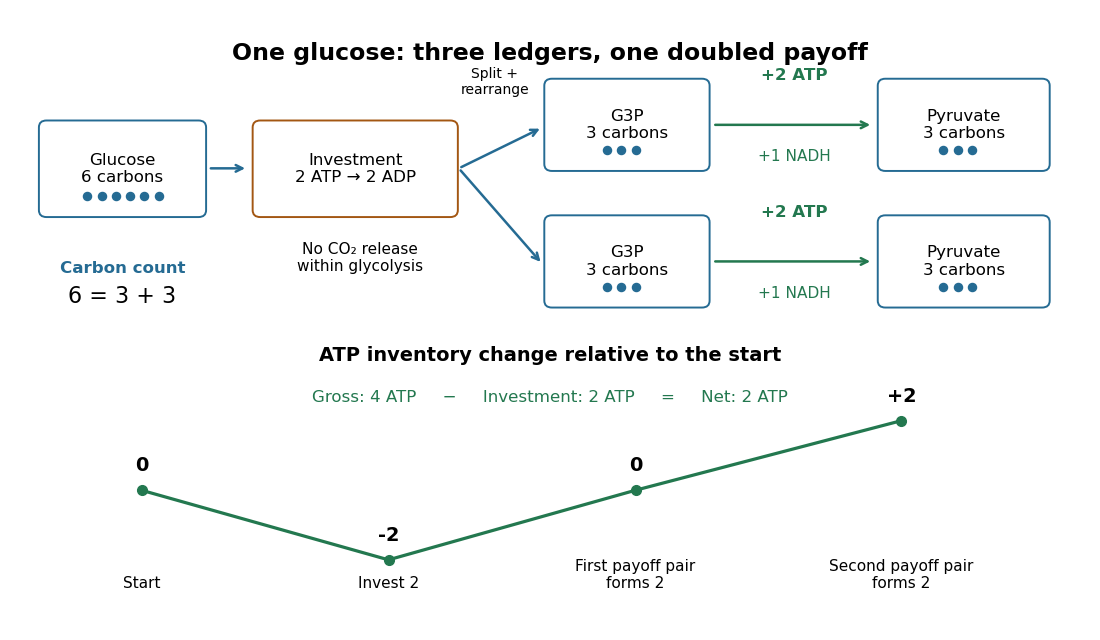

The material check is : all six carbon chemical atoms remain in the two pyruvates. No carbon dioxide has been released within this boundary. In the ATP ledger, each three-carbon route contains two ATP-forming transfers, soThe first pair of payoff transfers only restores the initial ATP inventory; the second pair creates the net gain. Four newly formed ATP is therefore compatible with only two additional ATP remaining.
For an original scaled example, stipulate complete conversion of of glucose. The initial of carbon chemical atoms becomes of pyruvate, still containing of carbon chemical atoms. The pathway spends of ATP, forms of ATP, and adds to the ATP inventory before any other ATP use. It also reduces of NAD+. These are calculated ideal amounts, not observed yields; side routes or incomplete conversion change the outcome.
A common biochemical net chemical equation isHere is inorganic phosphate. The names group biochemical protonation and metal-binding states; the displayed proton and water terms use a common shorthand rather than a unique specification of every chemical species. The robust ledger records two net ADP-to-ATP conversions and two NAD+-to-NADH conversions. Summing the individual chemical equations cancels two invested ATP against four formed ATP and cancels the internal substrates, giving those coefficients.
Work by Glen Rebka 2026-10-18
There are unlisted articles, also show them or only show them.