
At a nonzero critical wavenumber in an isotropic medium, a small transverse wavevector changes its magnitude only at second order. Balancing radial detuning therefore requires the displayed unequal slow-space scales. With the positive carrier , the leading Newell–Whitehead–Segel equation spatial term is . A roll detuning has transverse phase growth ; negative permits a zigzag instability. Changing the carrier convention changes the accompanying sign of . Replacing this operator by an isotropic second-order Laplacian misses the critical circle's geometry.
Stratified formula 2026-10-14
A formula is stratified if its variables can be assigned integer types so that equality relates variables of the same type and membership requires . Unary set predicates impose no additional difference. Stratification is a syntactic condition; it does not assert that the untyped universe actually has disjoint types. Translating a stratified formula into a typed model permits type-shifting automorphism to recover untyped comprehension.
Type-shifting automorphism 2026-10-14
For an integer-indexed typed model, a type-shifting automorphism is a bijection from each type to the next preserving equality, adjacent-type membership and the set predicates. On type zero define by . Stratified formulas are translated by sending a variable of type to . Typed comprehension then gives the untyped comprehension of NFU. Such an automorphism is external; formulas containing it are not included in the typed comprehension scheme.
Bounded characteristic 2026-10-14
A holomorphic function on the unit disc has bounded characteristic when , where . Thus it belongs to the Nevanlinna class. A general meromorphic function requires the additional pole-counting term in its characteristic; the displayed analytic definition has no such term.
Kilonova Created 2026-10-14 Updated 2026-10-25
An optical and infrared transient powered by radioactive decay in material ejected from a compact-object merger. Its evolving spectrum and light curve probe ejecta composition and rapid neutron-capture process production.
Helium sensitivity to the expansion rate Created 2026-10-14 Updated 2026-11-05
During radiation domination, the weak conversion rate scales as whereas the Hubble parameter scales as . Their crossing fixes the cosmological weak freeze-out temperature. A faster expansion raises it, leaving a larger neutron-to-proton ratio, and shortens the interval for free-neutron decay after freeze-out. Both effects increase the helium-4 mass fraction if the extra component does not independently change reaction rates or inject decay products.
Neutral Rayleigh-mode dispersion correction 2026-10-14
Let , , and . The Wronskian identity for the first-order Rayleigh equation for inviscid shear flow, combined with neutral-mode critical-layer matching, gives . For real , its imaginary part is . The Cauchy principal value is necessary when the outer forcing has a simple real pole.
Let count neutral hydrogen absorbers per column density and absorption distance. The summed column per unit proper light-path length is the mean neutral number density. Since and , that density is . Dividing the proper mass density by gives the comoving density in the displayed formula. The denominator is today's critical density; including neutral helium requires a stated mass correction. For a distribution per redshift, replace by .
A neutral-hydrogen column density traces total hydrogen column only after specifying its neutral fraction . Integrating the latter against the distribution per absorption distance gives the comoving gas mass density in the displayed expression. The factor includes helium if desired. In photoionization equilibrium for optically thin, almost fully ionized hydrogen, , so gas density, temperature, photoionization rate and absorber size are required. An observed distribution alone does not fix the total baryon inventory.
Phenomenological paired-pulse recovery Created 2026-10-14 Updated 2026-11-05
Choose the following original phenomenological mathematical model solely to calculate a paired-pulse readout. It is not experimental data, a fit to the teaching experiment, or a simulation of the Hodgkin-Huxley model. The conditioning action potential defines time zero. Test pulses have fixed width ; denotes their inward electric current amplitude. Impose an absolute neuronal refractory period . No finite test amplitude generates an event for . After that hold, stipulate a required amplitudewith , dimensionless and recovery time constant . Emit a test event exactly when , including equality. For this ideal event readout, assign events to pulse onset and assume the conditioning event is successfully evoked. There is no calculated membrane potential, spike waveform, response latency or stochastic success probability.
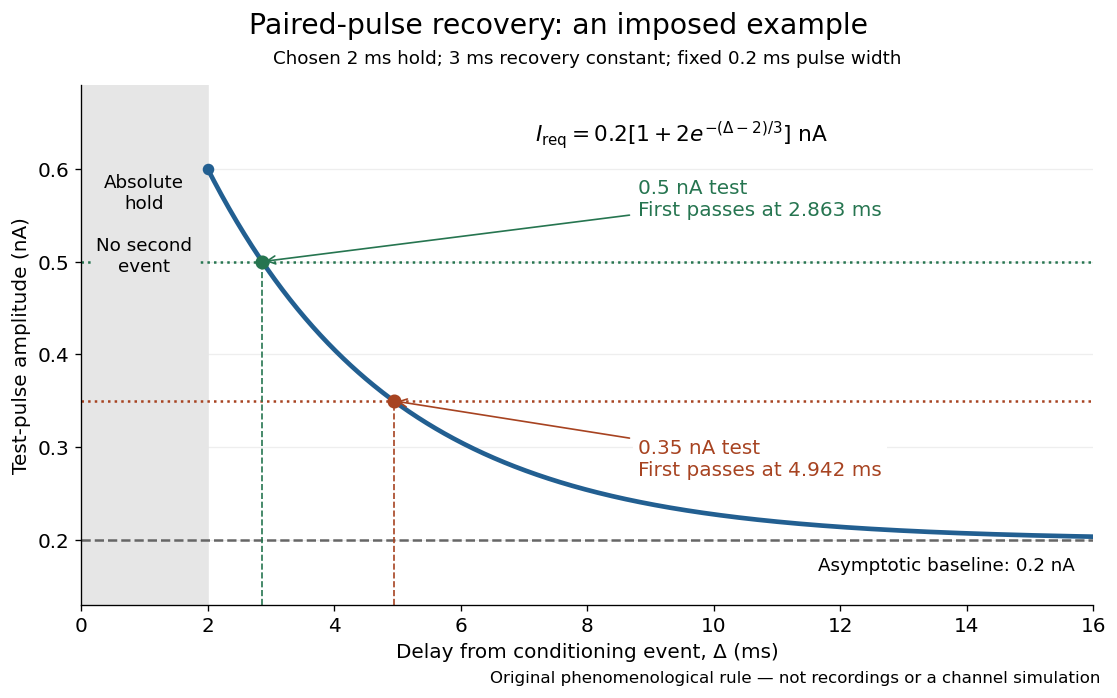

The exponential decay represents a combined recovery deficit; it is neither the Hodgkin-Huxley model's nor a measured potassium electrical conductance. One such curve cannot separately identify sodium recovery and persistent potassium electrical conductance. A constant pulse-width amplitude criterion also does not establish an equivalent rule for other pulse widths or voltage trajectories.
At the hold boundary, . At ,at ,Thus a test fails at because of the imposed hold, fails at because recovery is insufficient for that amplitude, and succeeds at . At , a pulse would instead succeed: failure of the weaker pulse was relative refractoriness.
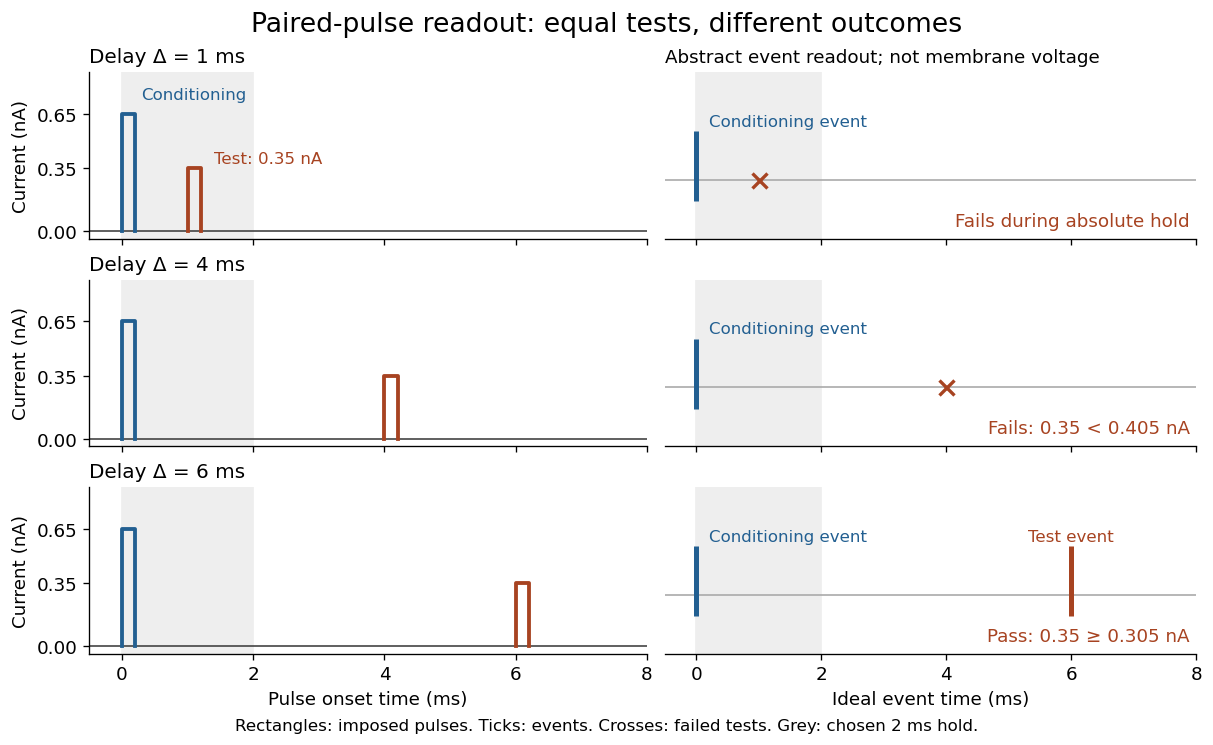

For , solve using the logarithm. The earliest allowed delay isFor this is ; for it is . If , the imposed hold is the only delay restriction. If , no finite delay passes the rule: the required amplitude stays strictly above its asymptotic baseline. A finite experimental “fully recovered” time therefore also needs a tolerance and a readout definition.
Witten spinor equation 2026-10-14
This elliptic equation on a spacelike spin hypersurface uses the restriction of the spacetime spin connection, including extrinsic curvature. The spinor tends to a prescribed constant at spatial infinity. It removes the negative derivative square in the divergence of the Nester two-form. It is weaker than the spacetime Killing spinor equation; generic positive-energy initial data need not admit any Killing spinor.
Witten-Nester identity 2026-10-14
In mostly-plus signature orient the commuting Dirac current to the future by . For the Nester two-form, put . Its covariant divergence has a spinor-gradient term and the Einstein tensor contraction of spin curvature. Projecting onto the hypersurface gives the displayed identity with positive spinor norm. The Witten spinor equation removes the negative square, and the dominant energy condition makes the matter term nonnegative after the Einstein constraints are imposed.
ADM boundary term of the Nester two-form 2026-10-14
For asymptotically constant spinors, the leading intrinsic spin connection term gives half the ADM metric integrand times . The Sen spinor connection correction gives . The constant-spinor derivative term integrates to zero by antisymmetry of the gamma matrices, and the remaining quadratic terms vanish under the standard decay. This identifies the Nester two-form flux with the ADM energy-momentum contraction, including momentum rather than just energy.
Brownian rough path martingale Hölder bound 2026-10-14
Condition on the Brownian values at a dyadic mesh. First-level increments and antisymmetric area increments of its polygonal lift are conditional expectations of the corresponding Brownian increments. Conditional Jensen inequalities and the homogeneous degree-two norm give the displayed bound. The Doob maximal inequality makes the right-hand side uniformly finite almost surely when the Brownian Hölder norm has sufficiently many moments. Dense-time martingale convergence and equicontinuity then yield simultaneous convergence at every time.
Neighbourhood system Created 2026-10-14 Updated 2026-10-31
The neighbourhood system at a point consists of all its neighbourhoods. A neighbourhood basis is a subfamily cofinal under reverse inclusion.
For a nonrotating force-free sphere moving with speed in a stationary tube, use its moving frame: the tube wall has velocity . In the parabolic lubrication gap , , moving-boundary lubrication flux gives . The wall-shear and pressure-drop balance in a tube rules out an net pressure jump. Applying this common pressure recovery to each angular strip gives . The next balance yields the displayed positive localized pressure drop. Meanwhile the integrated leading shear stress on the sphere vanishes in each strip; this is consistent with negligible leading torque, and does not mean the local shear or pressure force vanishes.
NFW mass and circular-speed profile Created 2026-10-14 Updated 2026-11-05
For an NFW profile, and . The circular speed rises as at small radius and eventually decreases as . Its maximum occurs at , with .
Free-convection surface-layer scaling 2026-10-14
For a positive approximately constant vertical turbulent buoyancy flux, dimensional turnover scaling gives and . The negative squared frequency describes unstable overturning, not a real restoring oscillation. The leading dissipation is height-independent, unlike neutral wall turbulence.
Symmetric Nash equilibrium 2026-10-14
In a game invariant under permuting players, a symmetric Nash equilibrium gives every player the same strategy, which may be a mixed strategy. Independent randomization does not require realized resource loads to be equal. When resource delays are affine, a player's expected delay depends on their own certain resource use plus the expected use by the other players; replacing all loads by unconditional total expected loads loses that own-player correction.
Ranked university application game Created 2026-10-14 Updated 2026-10-25
There are distinctly ranked students and labelled universities with seats each. Each student applies to one university; each university selects the greatest ranks, and admitted students receive their admitted cohort's average rank. At a pure Nash equilibrium, every student is admitted: any rejected student could move to a university with a vacancy. The university with the largest average must contain the top ranks, since any omitted higher rank could displace its lowest rank and improve. Repeat on the remaining students to obtain consecutive rank blocks. Assigning these blocks to the labelled universities gives exactly pure equilibria.
There are unlisted articles, also show them or only show them.