
Strictly decreasing function 2026-10-14
A real-valued function is a strictly decreasing function if every pair in its domain of a function satisfies . It is a nonincreasing function and is injective, with a strictly decreasing inverse function on its image of a function. Negating a strictly increasing function gives a strictly decreasing function: is an example on the real line, even though its derivative vanishes at zero. Equal outputs are forbidden, unlike for a general nonincreasing function.
For a continuous unbounded nondecreasing function on the nonnegative half-line and , the non-strict inverse is left-continuous in its level argument. It equals the left limit of the strict generalized inverse of a nondecreasing function . Indeed for , while for every , and choosing gives . Similarly . A flat part of at level gives a discrepancy between the two inverses: selects the beginning of the flat part and its end. For a Brownian running maximum, these are the non-strict and strict passage times.
Nonincreasing function 2026-10-14
A real-valued function is a nonincreasing function if every pair in its domain of a function satisfies . Equal outputs and flat intervals are allowed. For example, is a nonincreasing function, with a falling segment between two flat portions. Requiring instead gives a strictly decreasing function. Negating a nondecreasing function gives a nonincreasing function.
A nonincreasing sequence of natural numbers has finitely many strict drops, so it is eventually constant. This differs from a strictly decreasing sequence, which cannot continue indefinitely within the natural numbers.
// Target: foundations-of-mathematics.bigb
For a continuous strictly decreasing real function, its average lies strictly between and for . There is a unique with . If is differentiable and throughout the positive half-line, the fundamental theorem of calculus and the derivative formula for the monotone inverse giveContinuity of is unnecessary: differentiability of a strictly monotone function with nonzero derivative at a point suffices for differentiability of its inverse there.
Derivative criterion for monotonicity 2026-10-14
Let be a real interval, and let be differentiable in its interior and continuous at any endpoints belonging to . If the derivative satisfies throughout the interior, then is a nondecreasing function on . For in , the mean value theorem supplies withChanging to , , or gives a nonincreasing function, strictly increasing function, or strictly decreasing function, respectively. The endpoint continuity assumption lets the mean value theorem apply even when or is an endpoint. [ref].
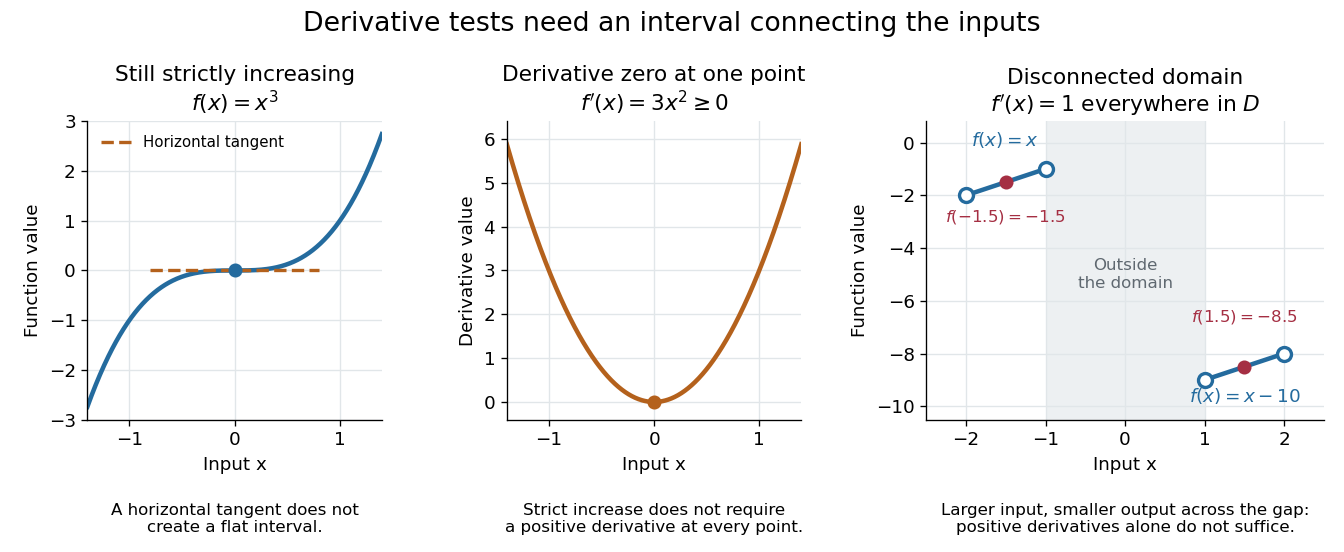
Conversely, if a nondecreasing function on a real interval is differentiable at an interior point , then : the difference quotient is nonnegative for either sign of . A differentiable nonincreasing function has derivative . Strict monotonicity still only forces these weak signs: the strictly increasing function has derivative zero at zero. The sign of the derivative helps locate intervals of monotonicity when sketching a graph. [ref].
The real interval hypothesis matters because a connected subset of the real line contains every point between its inputs. On a disconnected domain of a function, positive derivatives need not give a nondecreasing function. For example, takeHere everywhere in , but while . Each component has a strictly increasing function, yet their outputs are ordered the wrong way across the gap. This function is neither a nondecreasing function nor a nonincreasing function on all of ; the mean value theorem cannot cross the missing interval.

Associate to a finite ordered word the right-associated tensor , retaining a terminal unit: and . Define concatenation maps recursively byThe unit identities derived from the monoidal pentagon and triangle give . Induction on , using the pentagon in the induction step and left-unitor compatibility in the base case, givesNormalize a letter by , a formal unit by , and a tensor expression recursively using . The displayed identities show that normalization commutes with each generating associator or unitor, and therefore also with inverses, tensor products and composites of them. Every structural arrow from expression to expression is consequently , proving monoidal coherence without presupposing it.
Termination proof of monoidal coherence 2026-10-14
Orient associativity towards right association and unit maps towards deletion of unit symbols. A lexicographic measure consisting of the number of leaves and the sum of the sizes of left subtrees decreases at every step. All overlapping reductions have commuting completions: the essential cases are the pentagon identity for a monoidal category, the triangle identity for a monoidal category, and the derived left and right unit identities. Induction on the decreasing measure makes every normalization arrow equal, proving that every structural arrow is determined by its endpoints.
Monodromy permutation 2026-10-14
Lifting a based loop in a covering space from every point of its finite fibre gives a permutation of that fibre. Composition of lifted loops yields the monodromy action of a covering space. If a closed geodesic of length has a cycle of length in its monodromy permutation, the corresponding lift closes after traversals and has length . For a primitive base geodesic, these cycles describe the primitive lift components.
Monodromy of hyperplane sections of a smooth curve Created 2026-10-14 Updated 2026-11-05
Let , , be a smooth irreducible nondegenerate projective variety of dimension one and degree . Let be the open subset of the dual projective space consisting of hyperplanes meeting in distinct points. The incidence projectionis a -sheeted covering space in the complex analytic topology. Its monodromy is the full symmetric group .[ref]
Sectional monodromy groups of projective curves by Borys Kadets. Proposition 1.1; Lemma 2.2 and Remark 3.5
The incidence space choosing two distinct ordered intersection points is irreducible, so the monodromy action of a covering space is two-transitive. A small loop around an ordinary tangent hyperplane exchanges its two nearby intersection points and fixes the others. Conjugating this transposition by double transitivity gives every transposition, and these generate . In particular the action on -element subsets is transitive for each . For a degree-one projective line, a transverse section has one point and the corresponding group is the trivial .
Monin-Obukhov length Created 2026-10-14 Updated 2026-11-05
The signed wall-turbulence length formed from stress velocity and the vertical turbulent buoyancy flux. With upward buoyancy transport positive, stable cooling has and ; heating from below gives . The magnitude marks the transition between shear-dominated and buoyancy-dominated scaling.
Very stable surface-layer similarity Created 2026-10-14 Updated 2026-11-05
In local continuously turbulent scaling at , dependence on the distance to the wall disappears at leading order. The velocity profile is linear and the buoyancy frequency is constant. Local energy balance gives and , with positive dissipation requiring . The coefficients depend on a closure, and this regime should not be imposed on fully collapsed turbulence.
If the similarity functions of a turbulent boundary layer are differentiable at zero and have finite positive neutral values, expanding gives a shear proportional to . Integration yields a logarithmic term plus a linear correction. Dimensional reasoning alone does not fix the coefficients or guarantee this regular neutral limit. The gradient Richardson number is of order , so is a shear-dominated, nearly neutral regime on either side of stability.
Restriction of monad algebras 2026-10-14
A monad morphism induces a functor between Eilenberg-Moore categories, identical on underlying objects and arrows. Its unit equation gives the restricted algebra's unit law. Naturality and the multiplication equation give . Naturality also preserves algebra morphisms.
Integrate field modes with momenta between a fixed microscopic ultraviolet cutoff and a lower cutoff , retaining the modes below as backgrounds. The exact statistical Hamiltonian includes all generated interactions and field-independent constants. Integrating its retained modes reproduces the original partition function, so long-distance observables do not depend on the arbitrary intermediate cutoff. With sources retained, the corresponding coarse observables reproduce long-distance response and connected correlation functions. A local gradient expansion or a finite-coupling truncation is an additional approximation, rather than a consequence of cutoff independence. The momentum-shell construction is also explained in the Cambridge statistical field theory lecture notes.
Module homomorphism Created 2026-10-14 Updated 2026-11-05
Locally free module Created 2026-10-14 Updated 2026-11-05
A locally free module is one whose associated sheaf is locally a free module. In the finite constant-rank case, it is a finite projective module whose localization at a prime ideal has rank everywhere. Equivalently, it becomes on a finite cover by principal open subsets. Its associated sheaf is a locally free sheaf and defines an algebraic vector bundle.
A surjection onto such a module splits. If its source is also a finite projective module, the kernel is finite projective as a direct summand. A source hypothesis is essential: the projection splits and has a free target, but its kernel is not projective.
Finitely presented module Created 2026-10-14 Updated 2026-11-05
A module is finitely presented if it has finitely many generators and finitely many defining relations, equivalently an exact sequence of the displayed form with m and n finite. Over a commutative ring a relation matrix records the presentation, and its minors define the Fitting ideals.
// Target: knot-theory.bigb
Polynomial module from a linear operator 2026-10-14
A linear operator on a vector space over a field makes a module over the polynomial ring : let act as , let constants act as the original scalars, and define . The identity for polynomials verifies the multiplication axiom. The submodules are precisely the invariant subspaces of . This construction is described in Keith Conrad's Introductory Notes on Modules, section 6.
For a computed example, take , , andThen , , and . ConsequentlyEvery equals . The module homomorphism , , is therefore surjective, and its kernel is the ideal . It induces a module isomorphism . This is a cyclic module and a torsion module over , since . Over it is a free module with basis and has no nonzero torsion elements of a module. Over its nonzero elements also have infinite additive order of a group element. Changing scalars changes the questions one asks about the same addition law.
Abelian groups as integer modules Created 2026-10-14 Updated 2026-10-25
Every abelian group has exactly one unital module structure over the integers. For , define by adding to itself times, put , and put . The module axioms force this action, so no additional choice is involved. Moreover, every Abelian group homomorphism respects it and is a module homomorphism. See David McKinnon's Modules, the integer-scalar example.
Manin symbol Created 2026-10-14 Updated 2026-11-05
For a finite-index modular subgroup, a Manin symbol records a coset and its associated oriented unimodular edge. Over the rationals the presentation has the relations and , for inversion and translation . They express reversing an edge and the boundary of a triangle. Integral computation also removes torsion caused by elliptic stabilizers. The boundary map sends the symbol to its terminal cusp minus its initial cusp; its kernel is absolute homology.
There are unlisted articles, also show them or only show them.