
Susceptible-weighted next-generation matrix Created 2026-10-14 Updated 2026-11-05
For a heterogeneous SIS model with common recovery rate and a positive endemic equilibrium , force balance gives . When the transmission matrix is irreducible and nonnegative, the positive equilibrium vector and the Perron–Frobenius theorem imply the displayed spectral radius identity. It replaces the homogeneous scalar relation : different recipient types generally have different susceptible fractions.
Spherical binding-energy mass integral 2026-10-14
Assembling a spherical mass distribution in shells gives gravitational potential energy . Integration by parts gives the displayed identity when vanishes at both endpoints. It includes each interacting pair once; no extra factor of one half belongs in the original shell-assembly integral.
Planetary quadrupole coefficient Created 2026-10-14 Updated 2026-10-18
The dimensionless coefficient describes the leading axisymmetric departure of a planet's external Newtonian gravitational potential from a monopole: , where is colatitude from the spin axis. An oblate mass distribution has positive . The disturbing function is minus the nonspherical potential term. On a circular inclined Kepler orbit, , so orbit averaging gives . The exact circular nodal rate is ; its small-tilt limit is .
Cosmological Newtonian potential Created 2026-10-14 Updated 2026-10-25
The potential describes the lapse perturbation in conformal Newtonian gauge. The spatial curvature perturbation is conventionally denoted ; the two are equal when the linear scalar anisotropic stress vanishes. On scales where the Newtonian limit applies, agrees with the peculiar gravitational potential. Its Fourier-mode variance and the power spectrum of a comoving curvature perturbation are different observables.
Strain-rate tensor Created 2026-10-14 Updated 2026-11-05
Oberlin College's documented demonstration uses a track, two collision carts, two force probes set to the range, added bars, and a laptop with a Vernier interface. Preparation consists of entering the measurement calibration, securing the force probes to the carts, and zeroing them. Rubber stoppers serve for elastic collisions, clay for inelastic collisions, and hooks with string for pulling. Comparing the two force records tests the mutual interaction; adding mass to one cart tests whether unequal masses change the equality. [ref]
Collision Carts and Force Sensors. Oberlin College, Collision Carts and Force Sensors, Apparatus, Description, and Notes: ranges, mounting, zeroing, attachments, and unequal-mass control
Vernier's force probe uses a bending beam with strain gauges; changing electrical resistance produces a voltage readout calibrated as force. Its manual recommends zeroing in the working orientation. If recalibration is needed, use an unloaded reading and a known suspended gravitational weight; for the range its example is giving . Re-zero after changing orientation. The manual quotes calibrated accuracy , distinct from the resolution of that range, and warns that the interface's data-collection rate can limit collision measurements. [ref]
The following sampling and control choices are proposed additions to that documented experiment. Level the track and check unloaded motion in both directions for slope and friction. Use a soft bumper and one interface for simultaneous records; start before contact and stop after separation. A trial sampling rate of , if supported, would put about 100 samples across a interaction. Increase the sampling rate and repeat until the peak and integrated impulse comparison are stable; a large sample count alone does not establish adequate response. Measure each total moving mass, including the force probe and added bars.
Convert both channels to the same right-positive force convention. Oppositely facing force probes can have matching raw signs because their local positive directions differ; check each sign by a gentle push of known direction before the run. Overlay and , and also examine their signed sum. Integrate both over the same contact interval to compare impulses. Repeat with added mass on one cart, exchange the probes between carts, and check unloaded zeros before and after. These controls help distinguish a physical mass change from a channel offset or gain error.
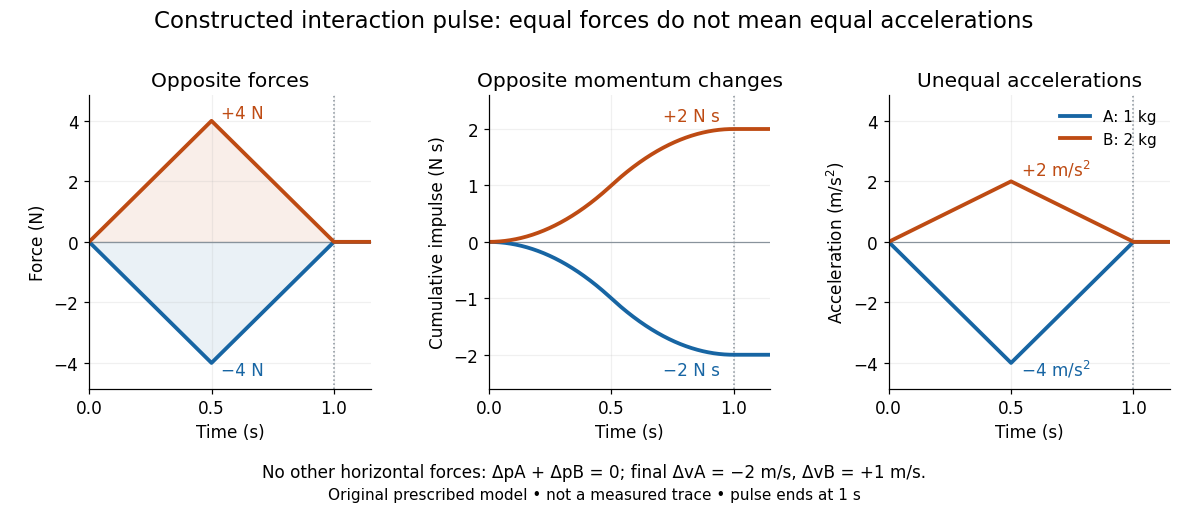
Agreement within measurement error supports the pair-interaction model over the resolved interval; it does not establish exact equality at arbitrarily short time scales. Misalignment, a loose mounting, sensor-beam dynamics, saturation, unequal timing, and zero drift can spoil the comparison. Track friction and cable pulls are additional external forces; a probe measuring bumper contact need not measure the entire net force on its cart. If a massive connector carries appreciable changing momentum, compare the full cart–connector collection rather than assuming its endpoint forces are an instantaneous cart-to-cart pair. The constructed pulse diagram above illustrates what to compare, and supplies no measurements from this apparatus.
For a fixed collection of two constant-mass bodies in an inertial frame, separate their mutual forces from the resultant external force on each:Adding the two Newton's second law equations and using Newton's third law givesThis is the proof of internal-force cancellation in system momentum. For more bodies, each internal force cancels with its partner once both appear in the sum. A boundary that excludes one interacting body leaves its force in the external force sum. A massive connecting spring must also be included, or its own changing momentum accounted for; its two endpoint forces are not automatically one third-law interaction pair between the carts.
Zero resultant external force gives momentum conservation; complete absence of external forces is sufficient but unnecessary. For constant total mass , the centre of mass has velocity and obeys . Internal interactions can move the parts apart while leaving the centre of mass moving uniformly.
Additional external forces do not invalidate the identified mutual pair. At the instant above, suppose a hand also exerts on . The mutual forces remain and , but the net forces become on and on . Consequently , , , and the centre of mass has acceleration . Pair equality by itself does not promise constant total momentum.
Choose right as positive and let two carts have total moving masses and , including any attached apparatus. At an instant when their repulsive interaction has magnitude , assume no other horizontal forces. Then Newton's third law gives and , while Newton's second law givesThe smaller mass has the larger acceleration magnitude. For a nonzero interaction and zero other horizontal forces, . Meanwhile in force units. The two carts' velocities change while total momentum stays constant.
To distinguish an instantaneous force from its accumulated impulse, prescribe an original triangular interaction pulse lasting :This chosen pulse reaches at ; it is a constructed model, not an experimental trace or a claim about a particular bumper's material response. Its positive area is . The impulse-momentum theorem therefore givesOpposite impulses give opposite momentum changes, while the velocity changes differ because of the unequal masses. The cumulative positive impulse is during the first half and during the second half. Thus and cancel throughout the pulse, not merely at its endpoint.

Third-law interaction pair 2026-10-14
A third-law interaction pair consists of the two forces belonging to the same mutual interaction, with their agent and recipient exchanged. The names action-reaction pair do not imply a delay: in the instantaneous model, the two forces occur together. Test a proposed pair by naming both bodies and the interaction, rather than merely noticing equal magnitudes and opposite directions.
For a book resting on a table, the table's upward normal force and Earth's downward gravitational weight both act on the book. They can balance in the book's free-body diagram, but they are not a third-law interaction pair. The partner of the table's normal force on the book is the book's downward contact force on the table. The partner of Earth's gravitational force on the book is the book's gravitational force on Earth. Their equality does not require equal accelerations: Earth's much greater mass makes its response correspondingly smaller for a given net force.
Similarly, friction on a sliding block from a surface is paired with friction on that surface from the block. For the collection containing only the block, that friction is an external force; including the contacting surface makes both members internal forces. Changing the collection changes the bookkeeping of momentum, not the physical interaction.
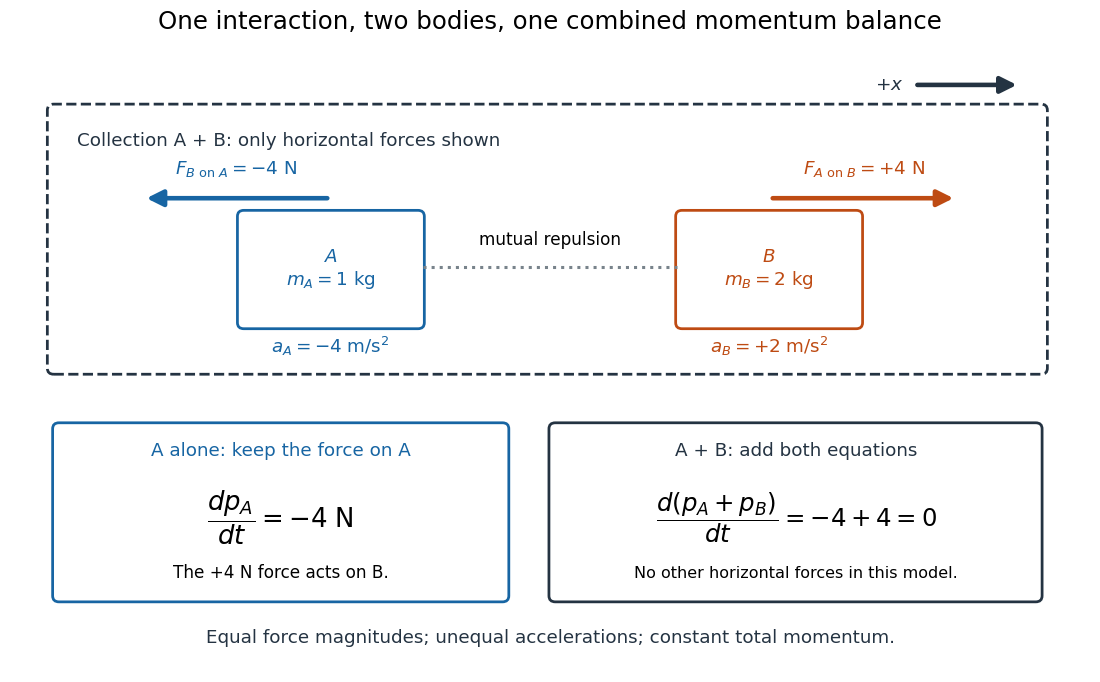
Equal opposite interaction forces act on different bodies and cancel only in the combined momentum balance
. Original one-dimensional model with right positive, and . The upper arrows are the mutual forces; the lower panels retain the force on alone and add both bodies' momentum equations. Only horizontal forces are shown; balanced vertical support is omitted. Details.
Avalanche front with linear mass entrainment 2026-10-14
An idealized front at distance down a uniform slope entrains stationary material so that its moving mass is proportional to . Its linear momentum balance is , where . Multiplying by gives . Every forward-moving branch tends to as , and . Acceleration is smaller than the constant-mass downslope value because some momentum accelerates newly entrained material.
Newton identities in positive characteristic Created 2026-10-14 Updated 2026-11-05
The polynomial identities remain true in positive characteristic of a field, but recovering elementary symmetric polynomials by division can fail. In the prime field of characteristic two, the root lists and have the same power sum zero for every positive exponent: and . Their monic polynomials differ, however: and . Thus even all positive power sums need not determine the polynomial when its degree meets the characteristic. The relation becomes and supplies no value for .
Root sensitivity in power-sum reconstruction 2026-10-14
Exact reconstruction does not promise that small errors in power sums produce proportionally small errors in individual polynomial roots. For two roots, let and . Newton's identities give and , so the monic polynomial is . Its polynomial roots are . A zero value of gives a multiple root; positive splits it into two real roots, and negative splits it into a complex-conjugate pair.
With , the second power sum changes by while each polynomial root moves by . The ratio grows without bound as tends to zero. Thus coefficients can stay close while individual root locations are more sensitive. This is a reason to distinguish recovering coefficients by Newton's identities from subsequently approximating the polynomial roots.
For a complex matrix , is the sum of the th powers of its eigenvalues, counted with algebraic multiplicity. This does not require diagonalizability: a similar upper triangular matrix has the eigenvalues on its diagonal, and taking powers raises those diagonal entries to their corresponding powers. Newton's identities therefore recover its characteristic polynomial from the first such traces.
For the Jordan block , and . Hence and , giving . The repeated eigenvalue is recovered even though this matrix is not diagonalizable.[ref]
Root power-sum recurrence 2026-10-14
For the monic polynomial , its root power sums satisfyEach root obeys . Multiplying that equation by and summing over root positions proves the recurrence relation. The first power sums are initialized by Newton's identities; their later values require only this fixed-order recurrence. For , it gives . Directly, . No new root-solving step is needed.[ref]
Inertial motion in an accelerating frame 2026-10-14
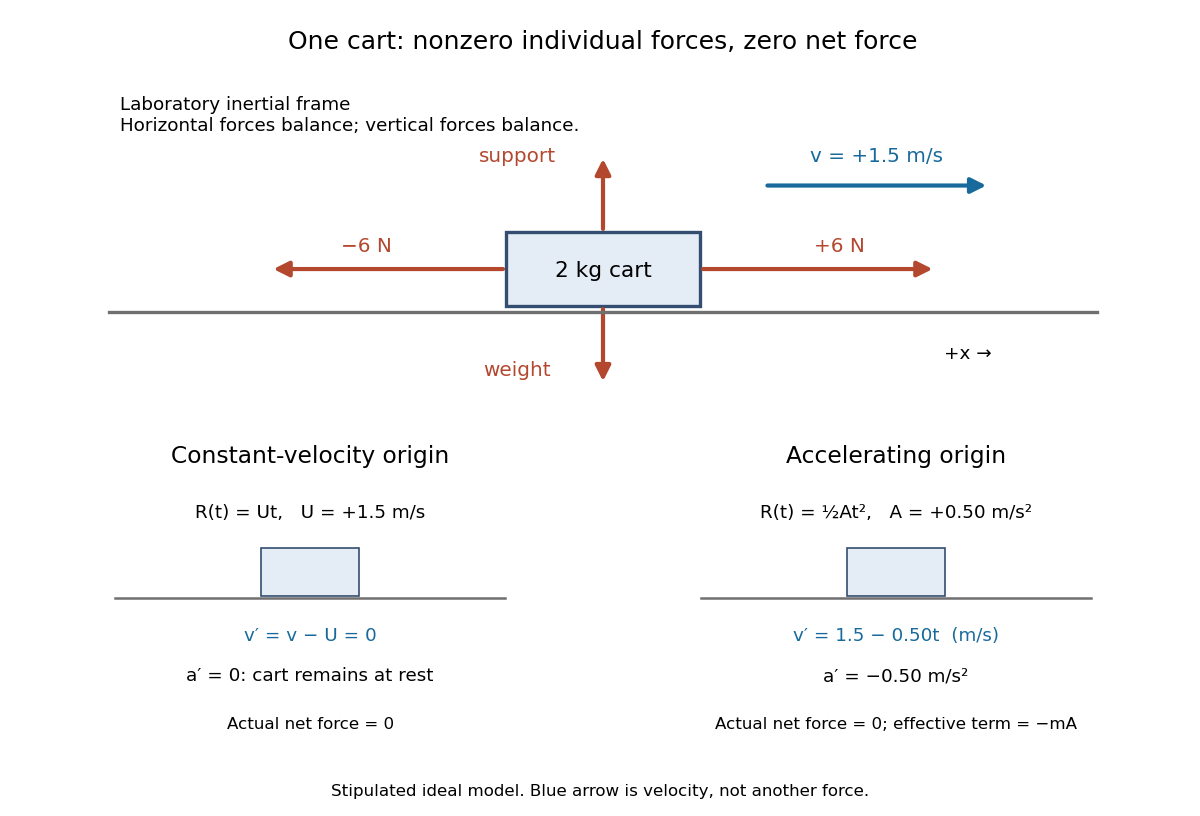
Constant velocity depends on the reference frame. For nonrotating axes and a moving origin of laboratory position , subtracting that origin givesIf with constant velocity , the Galilean transformation leaves acceleration unchanged. The cart moving at in the laboratory is at rest in a frame moving right at . Both descriptions obey Newton's first law.
Instead choose an origin with , where the stipulated constant points right. The same cart hasAt , the cart is instantaneously at rest relative to this accelerating origin, but its relative acceleration is nonzero. In this translating accelerated reference frame, Newton's second law must include the effective inertial force . This term accounts for the accelerating coordinates; the actual external forces on the cart still sum to zero. No rotation-dependent terms are present because the axes remain parallel to the laboratory axes.
Air-track test of inertial motion 2026-10-14
An actual teaching experiment in Arbor Scientific's The Level Air Track uses one glider, an air track, two photogates, and a ruler. Turn on the blower and place the glider near the middle. Adjust the feet until it does not drift when released. Put the photogates at least half a track length apart and align them with the glider's flag. Measure the length that interrupts the beams. Give a gentle push, let go, and record each beam-blocking time . The readout is the pair of speeds . The worksheet asks how those speeds compare, which forces remain after the push, and which interaction the air track minimizes.[ref]
The motivating contrast is between a brief push and the subsequent glide. The air cushion reduces contact friction; it does not remove the downward gravitational weight or the upward support force. Similar successive speeds after release are consistent with a small horizontal net external force, rather than with a continuing push. The experiment approximates the zero net external force model over a finite track and observation interval.
To strengthen the documented procedure, use independent measurement calibration: check the flag length and each timer against a known length and time reference; measuring sets the length scale but does not calibrate the timer. Repeat launches in both directions without contact during the timed passage, and check for drift at several track locations. These are additional controls, not reported steps or measured results in the worksheet. A residual inclined plane produces a downhill component of gravitational weight with the same laboratory direction on both runs; friction and drag force oppose the direction of travel. Reversing the launch can therefore help distinguish these effects.
A photogate directly measures a beam-blocking time; is an average speed during that passage, not an exact instantaneous velocity. Assign the direction separately. Equal readings at two gates do not prove zero acceleration everywhere between them: opposing changes could cancel. Measurement uncertainty from timer resolution, an incorrectly measured flag length, residual slope, airflow disturbances, and remaining friction or drag force limit the inference. No measured glider speeds are assumed here.
Balanced forces and constant velocity 2026-10-14
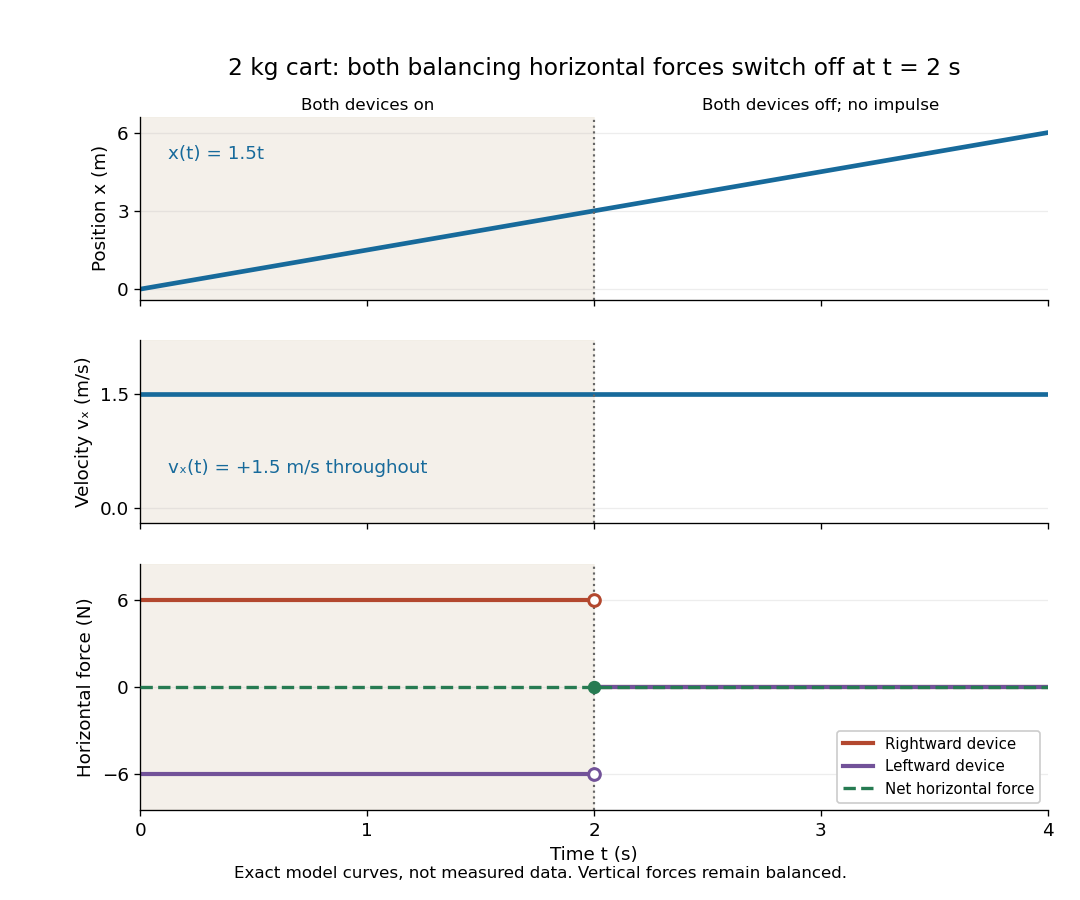
Consider a stipulated ideal cart modeled as a point mass of mass on a horizontal track in a laboratory inertial frame. Its initial position is and its initial velocity is to the right. Independent devices exert horizontal forces and on this same cart. Its upward support force balances its downward gravitational weight; no other forces contribute. Rotation and deformation are excluded from this model.After , the cart is at , still moving right at . Starting the same model at rest instead would leave it at rest. Force balance determines the zero acceleration, while the initial velocity determines whether the cart moves.

For the plotted model, both horizontal devices are switched off simultaneously at , with no impulse. The support and gravitational weight remain balanced. The individual horizontal forces change, but their sum stays zero on both sides of the switch, so the velocity stays continuous and unchanged. Switching off just one device would be a different model with a nonzero net external force.

Let , and near . The integral Taylor remainder givesA small ball with is invariant under . Iteration there converges at least quadratically, with for .
// Target: numerical-analysis.bigb
Frozen Newton correction for a fixed-point equation Created 2026-10-14 Updated 2026-10-25
To solve , let be a bounded approximation to and set . Its derivative is . Every fixed point of is fixed by ; the converse holds when is injective. A good inverse approximation makes a contraction mapping even if itself has an expanding direction.
// Target: analysis.bigb
Newtonian tidal curvature 2026-10-14
Using , the Newton–Cartan gravitational connection has only the displayed Hessian components and their antisymmetric partners in the last two indices. The geodesic deviation equation gives relative acceleration . The Poisson equation for Newtonian gravity is therefore . A spatially uniform gravitational acceleration has zero tidal curvature even if the connection coefficients do not vanish in the original coordinates.
There are unlisted articles, also show them or only show them.