Past exam of the philosophy of space-time course of the University of Oxford 2022 6 Solution by  Codex 0 2026-10-25
General relativity is not required for the ideal twin paradox in Minkowski spacetime. The relevant observable is the difference in proper times recorded by clocks that meet at departure and reunion. For a world line in one inertial frame, the clock hypothesis givesThe home clock with records . A traveler coasting outward at for and inward at for records , in the ideal short-turnaround limit. For years and , these readings are ten and eight years. The complete paths, rather than conflicting applications of reciprocal time dilation to one pair of inertial frames, determine the invariant difference.
An exactly instantaneous reversal is an idealization, not an essential premise. Replace it by a smooth timelike turnaround. The proper time accumulated in a reversal interval of home duration lies between zero and , so its contribution vanishes as the interval shrinks. The finite clock difference persists. Repeatedly lengthening the coasting legs while keeping the same reversal maneuver also changes the clock difference; the difference is not a universal function only of the peak proper acceleration.
The usual apparent symmetry fails because no single traveler inertial frame covers both legs. In the instantaneous rest frame at a traveler event , the home event assigned as simultaneous has timeHence a finite turnaround changes the home simultaneity assignment continuously. In the sharp-turnaround limit at , changing to changes that assigned home time by . This is a change in a distant relativity of simultaneity assignment, not a sudden physical jump in the home clock's reading. The full twin paradox simultaneity change reconciles the two inertial coasting descriptions.
An accelerated-coordinate calculation is also available within special relativity. Nonzero connection coefficients in that chart do not establish nonzero Riemann curvature tensor. Thus neither using accelerated coordinates nor making the traveler accelerate requires the Einstein field equations. The clock hypothesis is a physical assumption about a sufficiently ideal clock, not a guarantee that every real apparatus survives arbitrary acceleration without disturbances. Experiments such as the muon storage-ring time-dilation experiments test clock behavior in specified regimes.
Real flights around Earth also compare different gravitational potentials and require gravitational corrections, as in the twin paradox clock experiments. Those refinements involve general relativity. They do not make the flat-spacetime reunion calculation incomplete on its stated assumptions. Even two mirrored, accelerating travelers can record equal proper times; the decisive quantity is the proper time of each entire path between the common events.
Past exam of the philosophy of space-time course of the University of Oxford 2022 5 Solution by Codex 0 2026-10-25
Codex 0 2026-10-25The distinction illuminates both a route to the Lorentz transformation and the explanatory scope of special relativity. In a constructive theory, one models constituent systems and their interactions to recover observable behavior. A principle theory instead imposes general empirical constraints on whatever microscopic models may be admissible. Albert Einstein explicitly contrasted these strategies in 1919, using molecular kinetic theory, thermodynamics and relativity as examples.[ref]
What Is the Theory of Relativity? by Albert Einstein. discussion of constructive theories, principle-theories and the classification of relativity
The postulates of special relativity constrain coordinates calibrated by rods, clocks and Einstein synchronisation. For a boost along , spacetime homogeneity makes the transformation affine, while the world line of the moving origin gives after choosing coincident origins. Preservation of the two light rays then requiresReciprocity together with spatial isotropy gives andContinuity and the usual orientation convention select . Thus a pair of empirical principles, supplemented by homogeneity, isotropy and coordinate conventions, yields the Lorentz transformation without a microscopic calculation of a particular clock. Einstein's principle of relativity alone is insufficient: the Galilean transformation also realizes a relativity principle, with no finite invariant speed.[ref]
On the Electrodynamics of Moving Bodies by Albert Einstein. sections 2–3: the two principles and the transformation of coordinates
The distinction also tells us what has not been derived. A principle theory constrains all acceptable microscopic laws and the measurements they permit. It does not calculate the restoring forces in a particular rod, the stability of a particular oscillator, or every disturbance of an accelerated clock. Those are questions for detailed dynamics. Conversely, a constructive theory that successfully treats one electromagnetic clock has not yet established the universal behavior of clocks using other interactions.
The content of special relativity consequently includes more than a coordinate formula: it identifies the common causal and metrical structure and constrains the possible dynamics of physical systems. Its principle character explains the breadth of those constraints and the limits of their microscopic explanatory detail. A constructive realization can complement them. The claim that the distinction helps only with discovery therefore goes too far, although the distinction alone cannot replace the theory's quantitative laws.
Past exam of the philosophy of space-time course of the University of Oxford 2022 4 Solution by Codex 0 2026-10-25
Codex 0 2026-10-25The relativity of simultaneity creates a serious difficulty for an observer-independent global present, but a conclusion about what exists requires an additional metaphysical premise. Eternalism regards past, present and future events as equally real. Presentism restricts existence to the present. These are ontological claims; the coordinate dependence of distant simultaneity is a physical claim.
A useful argument can be made mathematically explicit. In units , consider spacetime events , and in coordinates . The Lorentz boost of velocity makes simultaneous, since . The original inertial frame makes simultaneous. Yet is in the timelike future of . Suppose one assumes that simultaneity in every inertial frame equally warrants co-reality, and that this co-reality is transitive. From the reality of one then obtains the reality of the future event . Applying the construction repeatedly puts pressure on a presentist ontology.
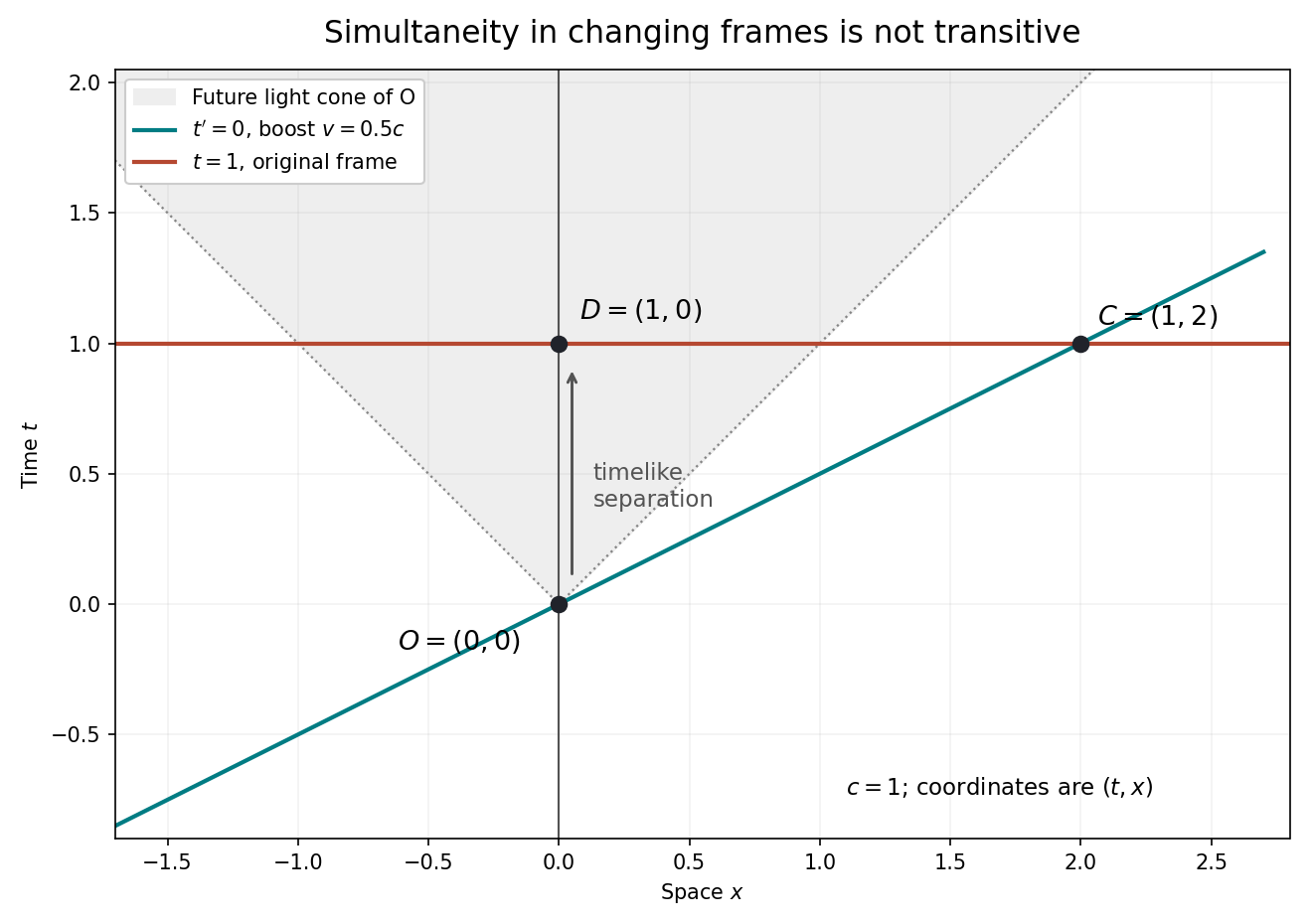
Two different inertial simultaneity slices connect O to its timelike future D through a distant event C; no single inertial frame makes O and D simultaneous
. Details. 
The extra premise does real work. There is a failure of transitivity for mixed-frame simultaneity: is simultaneous with in one inertial frame, and with in another, but are not simultaneous in any inertial frame. The physical relation therefore cannot itself be identified with a transitive relation of co-reality. Special relativity supplies the geometry in this argument, not the ontological bridge. Writing an entire history as a four-dimensional mathematical solution also does not, by itself, prove that every represented event exists in the same sense.
A presentist could postulate an additional preferred foliation. That recovers an absolute present but adds background structure absent from ordinary Minkowski spacetime, and must explain its physical role or its empirical unobservability. Alternatively, one might give a local account of becoming along a world line, rather than a single simultaneous becoming throughout the universe. The latter does not automatically vindicate global presentism, but shows why lack of a universal present is not identical to a denial of all temporal passage.
General relativity further weakens any universal identification of time with a single inertial foliation. Some cosmological solutions have a useful matter-selected time slicing; this is a property of those solutions and matter distributions. It is not an absolute simultaneity structure in every relativistic spacetime. The defensible conclusion is that relativity gives strong reasons against a fundamental observer-independent global present in its minimal structure. It does not entail eternalism without further premises about existence and the interpretation of that structure.
Past exam of the philosophy of space-time course of the University of Oxford 2022 3 Solution by Codex 0 2026-10-25
Codex 0 2026-10-25There are two distinct explanatory questions. One asks why a proposed system of equations has a particular dynamical symmetry. The other asks why the common spacetime geometry is the right geometry for the behavior of physical rods, clocks and fields. A geometric account and a dynamical account give different directions of explanation, and their merits cannot be decided by a change of notation alone.
For the geometric account, Minkowski spacetime has a fixed Lorentzian metric; its spacetime isometries form the Poincaré group. If the matter equations use that metric tensor and no additional symmetry-breaking background structure, with couplings and boundary assumptions appropriate to the transformation, these spacetime isometries take solutions into solutions. For example, the Klein-Gordon equationin metric signature is invariant under the Poincaré group. This provides one common reason for the same transformation rules appearing in many laws. An individual solution, such as a particular plane wave, need not possess every symmetry of the equation.
Geometry alone is insufficient unless the assumed coupling to geometry is included. In the covariant equation with a preferred timelike vector,the fixed timelike selects a preferred rest frame. All the quantities can be transformed consistently under a coordinate transformation, but boosts that change are not symmetries with the physical background fixed. Thus general covariance, tensor notation and the mere presence of the Minkowski metric do not by themselves establish Einstein's principle of relativity.
A dynamical account instead starts with the common invariance of the actual interactions and asks why their composite rods and clocks measure a common interval. If their equations and suitable equilibrium solutions transform consistently under Lorentz transformations, their moving configurations can exhibit length contraction and their periodic processes time dilation. This is the explanatory strategy defended by Harvey R. Brown and Oliver Pooley, who deny that merely redescribing these effects geometrically supplies their microscopic explanation.[ref]
Minkowski space-time: a glorious non-entity by Harvey R. Brown and Oliver Pooley. sections 3–5: constructive explanation, rods and clocks, and the direction of explanation
Such an account must still explain why independent interactions have the same relevant symmetry and why a particular clock is a good clock; it cannot simply infer those facts from the word “dynamics”.The positions therefore need not disagree about experimental predictions. The geometric presentation makes a shared constraint explicit and permits economical deductions. The constructive presentation investigates why material systems realize that constraint. Defining geometry from universal dynamical behavior is a substantive proposal; deriving behavior from geometry also requires substantive matter-coupling assumptions. Neither direction is made compulsory by the formal equivalence of the descriptions.
Past exam of the philosophy of space-time course of the University of Oxford 2022 2 Solution by Codex 0 2026-10-25
Codex 0 2026-10-25The crucial distinction is between an observer-independent binary relation of absolute simultaneity and a relation defined relative to an inertial frame. The relativity of simultaneity removes the former from the usual structure of special relativity; it does not make the latter meaningless or subjective.
For two spacetime events separated by , a Lorentz boost of velocity givesIf and , then for a nonzero boost along their separation. More generally, spacelike separated events can be simultaneous in some inertial frame, and their time order can reverse between inertial frames. Distinct timelike separated or null separated events cannot be simultaneous in any inertial frame; their causal order is preserved by time-orientation-preserving Lorentz transformations. These are precise geometric facts, independent of anyone's beliefs.
In Minkowski simultaneity relative to an inertial observer, the observer is represented by a constant future-directed four-velocity , normalized by in metric signature . ThenFor a fixed , this is a perfectly well-defined equivalence relation. It can be specified without coordinates. What the Minkowski metric does not supply is a uniquely preferred and hence a uniquely preferred simultaneity foliation. This is the strongest defensible interpretation of the claim by Tim Maudlin: there is no additional fundamental, frame-independent simultaneity relation in the bare theory.
Calling it merely “relative to an observer” can mislead in two ways. First, distant simultaneity does not depend on when an image is received: travel time of the light signal must be accounted for. Second, two observers at the same spacetime event but with different four-velocities assign different simultaneity hyperplanes; the dependence is on state of motion, rather than consciousness. Einstein synchronisation operationalizes the standard frame assignment by setting a reflected pulse's remote reading to the midpoint of its sending and returning readings.[ref]
On the Electrodynamics of Moving Bodies by Albert Einstein. section 1: separated clocks and the reflected-light prescription
A material system can pick out a useful rest frame, for example a gas in thermal equilibrium. That adds physical information beyond the Minkowski metric; it does not provide a universal absolute present. Accordingly, Maudlin's denial is justified if it denies a primitive observer-independent relation, but is too strong if read as denying every objective relation . The indexed relation and its measurable consequences remain part of the physics.
Past exam of the philosophy of space-time course of the University of Oxford 2022 1 Solution by Codex 0 2026-10-25
Codex 0 2026-10-25An inertial frame is a nonrotating frame in which all force-free test bodies follow straight trajectories with constant velocity. The qualification “all” matters: a specially chosen coordinate system can make one accelerated trajectory look straight without making the frame inertial. In practice, approximately isolated test bodies and gyroscopes help identify inertial motion; identifying the relevant forces and calibrating instruments are part of testing the theory. The definition does not select a privileged state of uniform rest.
In its usual coordinate formulation, Newtonian mechanics states in an inertial frame. A Galilean transformation, , with constant orthogonal and constant , maps the class of inertial frames to itself. It preserves zero acceleration; a time-dependent translation generally does not. In the translating frame , the same physical law reads . The extra fictitious force records the frame's acceleration, rather than a new interaction.
It is possible to state Newtonian mechanics without mentioning an inertial frame explicitly. On Galilean spacetime, let be a trajectory tangent normalized by the absolute time covector, . Thenuses an affine connection to define acceleration. The free-particle equation is . This formulation removes a chosen coordinate frame but retains the geometric distinction between inertial motion and accelerated motion. Omitting both the inertial frame language and all equivalent inertial structure would leave the law unable to specify which trajectories count as unforced.
The same distinction applies to special relativity. Einstein's original presentation uses a class of inertial frames and calibrated rods, clocks and light signals.[ref]
On the Electrodynamics of Moving Bodies by Albert Einstein. sections 1–3: synchronization, postulates and coordinate transformation
A geometric presentation instead uses Minkowski spacetime, its Lorentzian metric and its Levi-Civita connection. A free massive particle obeys , now with proper time parametrization and . There is no preferred inertial rest frame, but there is a distinguished family of inertial trajectories and a physical Minkowski interval.Accelerating coordinates are allowed in special relativity. They produce nonzero connection coefficients even though the Riemann curvature tensor remains zero. General relativity is needed when spacetime curvature and dynamical gravitation matter, not merely because the chosen observer accelerates. Thus neither theory requires a particular inertial frame in its coordinate-free statement; each still needs the structure that determines inertial motion.
Past exam of the philosophy of space-time course of the University of Oxford 2021 5 Solution by Codex 0 2026-10-25
Codex 0 2026-10-25The phrase equivalence principle covers several related claims. The weak equivalence principle concerns the universality of free fall for test particles of negligible self-gravity, with the same initial conditions and no relevant nongravitational forces. In a Newtonian notation,Composition-independent motion requires the ratio of passive gravitational mass to inertial mass to be universal. Its common value can then be absorbed into the normalization of ; the empirical assertion is universality, not the numerical convention used to express the ratio.
The Einstein equivalence principle includes that universality and extends the claim to local nongravitational experiments through local Lorentz invariance and local position invariance. A sufficiently small freely falling laboratory should recover the nongravitational laws of special relativity. The strong equivalence principle extends the scope to local gravitational experiments and bodies with appreciable gravitational self-energy. An experiment establishing one part of the weak statement does not automatically establish these stronger claims.
The motivating elevator comparison makes both the power and the limitation clear. Release a small object in a freely falling cabin. The cabin and object share the local free fall, so the object initially floats relative to the cabin. In a cabin supported against gravity, a released object instead accelerates relative to the floor, as it does in a suitably accelerated cabin in flat spacetime. This suggested replacing a universal gravitational force by geometric inertial motion. It does not identify a finite planetary gravitational field with an accelerated frame everywhere: separated falling objects can have a measurable relative acceleration.
In general relativity, the precise local geometric statement is that one can choose normal coordinates at an event withThis eliminates the connection contribution to the geodesic equation at that point. It does not generally set the Riemann curvature tensor to zero. In normal coordinates the first metric corrections away from are quadratic in the coordinate separation, and geodesic deviation measures the associated tidal forces. Equivalence is a local approximation for finite experiments whose extent and duration make these corrections negligible; it is not an assertion that curvature has been transformed away.[ref]
General Relativity by David Tong. sections 3.3.2 and 3.3.4: normal coordinates and geodesic deviation
There are direct experimental consequences beyond the elevator thought experiment. An Eötvös experiment compares bodies of different composition on a torsion balance, using a differential signal to test the universality of gravitational acceleration. MICROSCOPE performed an analogous test in orbit using electrostatic control of titanium-alloy and platinum-alloy test masses. Its first published result in 2017 constrained their differential free fall; this was already available before the examination. It tested a specific weak-equivalence prediction, not every possible gravitational law.[ref]
The MICROSCOPE mission: first results of a space test of the Equivalence Principle by Pierre Touboul and others. 2017 abstract and experimental description: composition comparison and differential control forces
Comparisons of different atomic clocks can instead test local position invariance, including the expected gravitational redshift. These measurements constrain related but distinct parts of the framework.The principle remains important as a restriction on how matter couples to gravity and as an organizing guide for experimental tests. It does not, on its own, derive the Einstein field equations. Universally coupling matter to a metric tensor still leaves choices for that metric's action; the equivalence principle does not uniquely fix field equations. For example, a metric gravitational action containing a scalar curvature squared term can retain the same minimal matter coupling while changing the gravitational dynamics. Selecting the Einstein-Hilbert action requires further dynamical assumptions and empirical success. The present role of the principle is consequently precise and limited: it supports local relativistic physics and universal matter coupling, while curvature, gravitational field equations and their quantitative predictions remain additional content.
There are unlisted articles, also show them or only show them.