Past exam of the philosophy of space-time course of the University of Oxford 2021 4 Solution by  Codex 0 2026-10-25
The numerical coordinates assigned to an event can be changed without changing the event. It does not follow that every relation between coordinate systems is devoid of physical content. A standard inertial frame includes a family of resting measuring standards and synchronized clocks. Its coordinates are normalized so that the Minkowski metric has the same standard form. The relation between two such descriptions therefore records properties of the standards and of spacetime, not just an arbitrary choice of names.
Write and use metric signature . A Lorentz transformation satisfiesAn origin translation can also be included without changing the Minkowski interval. The displayed condition preserves the interval between events, including the null cone and proper time along a timelike curve. Its physical significance lies in the claim that comparisons made with actual idealized rods and clocks obey this same metric structure.
A more general passive relabeling is allowed, but then the metric components must change with the labels. For example, let and leave fixed. In the new coordinates,Nothing physical has changed, but no longer has the original clock-normalized meaning of . Retaining the old metric components as well as the new labels would change the mathematical model. This distinction is part of the physical content of a passive Lorentz transformation: the transformation between standard inertial coordinate systems preserves a specified metric form, whereas arbitrary relabelings need not preserve that form.
For an operational example, a clock moving at velocity between two events on its world line accumulatesin the first frame. In its own rest frame the same result is simply the interval between its local readings. The equality is a physical agreement about one clock, derived using the preserved Minkowski interval. It is not a claim that the two coordinate-time differences are identical. Similarly, an observer measures a light angular frequency through , where is the wave four-vector and the observer's four-velocity. Transforming both sets of components leaves this scalar unchanged. Comparing two different observers gives the physical relativistic Doppler effect rather than a disagreement over one observer's measurement.
There is a further distinction between passive transformations of the same situation and active changes to a situation. Re-expressing a particular experiment in different coordinates is always possible if all geometric fields are transformed consistently. Preparing a second, moving copy of the apparatus is a different physical arrangement. Its relation to the first is governed by a dynamical symmetry only if the relevant laws and background structure have the appropriate invariance. An active Lorentz transformation of a vector field makes the changed field configuration explicit.
This is why mere Lorentz covariance of notation must not be confused with the Lorentz invariance of the dynamics. A physically preferred timelike vector field can be transformed as a vector under passive relabeling while distinguishing particular states of motion. Holding that preferred field fixed can destroy the active boost symmetry of the matter dynamics. The covariant equation with a preferred timelike vector is a concrete example.
Coordinates are therefore labels, but the Lorentz transformation relates labels tied to shared physical standards and a definite metric structure. Its measurable consequences follow from that structure and the dynamical assumptions, not from the bare act of changing labels.[ref]
On the Electrodynamics of Moving Bodies by Albert Einstein. sections 1–4: operational definitions of time and length, and the transformation of moving standards
Past exam of the philosophy of space-time course of the University of Oxford 2021 3 Solution by Codex 0 2026-10-25
Codex 0 2026-10-25The age comparison is a local comparison of clocks at two shared spacetime events: departure and reunion. No convention about the simultaneity of distant events is needed to read two adjacent clocks. The result is determined by the proper time along each complete world line. For an ideal clock following a timelike curve in the home observer's inertial frame,The home observer stays at , whereas the traveler goes outward at velocity and returns at velocity . Ignoring the duration of a short turnaround gives home age and traveler age . The twin paradox with fixed reunion events derives this directly. There is no contradiction because the traveler does not remain in one inertial frame throughout the trip.
Relativity of simultaneity becomes essential to a different question: how can the traveler consistently describe the home clock as running slowly during both straight legs? The statement about a distant clock's rate refers to a sequence of remote events selected as simultaneous by a specified inertial frame. Changing that frame changes the selected sequence. Adding the two slow-rate comparisons while silently preserving one distant-time assignment is the error.
Let turnaround be in the home frame. Constant outward-frame time means is constant. Thus the home event simultaneous with according to the outward frame occurs atFor the return frame, constant time means is constant, so its simultaneous home event occurs atThese are two different remote spacetime events, even though both assignments pass through the same turnaround event. The twin paradox simultaneity change isEach leg contributes to the home clock advance assigned within that leg's frame. Including the reassignment gives , exactly the home reading at reunion. For the illustrative values and years, the traveler's elapsed proper time is eight years; the two leg assignments give years of home advance, and the frame change supplies the missing years. The distant home clock does not physically jump.
Nor should simultaneity assignments be confused with received light signals. An observer sees emissions after a propagation delay and measures a Doppler shift. The received history remains consistent through a finite turnaround, but it is not the same sequence of events as a constant-coordinate-time slice. The Lorentz transformation relates the latter; signal travel times must be included separately when discussing what is seen.
An instantaneous turnaround is only an ideal limit. In the twin paradox with finite acceleration, the world line and the momentarily comoving frame vary continuously. The distant home-time assignment is , soThe reversal at positive makes the last contribution positive. Its integrated effect replaces the ideal reassignment. By the clock hypothesis, the traveler's own elapsed proper time has no extra term depending directly on acceleration; physical disturbances of a particular clock are a separate experimental issue.
Thus relativity of simultaneity explains the consistency of the traveler's successive inertial descriptions. It is not a convention-dependent cause of the final age difference. The invariance of reunion ages under clock resynchronization makes that distinction explicit: remote time labels can change while the two reunited clock readings remain unchanged.
Past exam of the philosophy of space-time course of the University of Oxford 2021 2 Solution by Codex 0 2026-10-25
Codex 0 2026-10-25Historically, electromagnetism was central to Albert Einstein's 1905 argument. His opening example compares a moving magnet and a moving conductor. The same relative motion produces the observed induction, but a description using electric fields in one frame and the magnetic part of the Lorentz force in another seemed to divide the explanation according to which object was called stationary. The unsuccessful search for an observable preferred state of rest also motivated treating the laws of mechanics, optics and electromagnetism on a common footing. That establishes a strong historical connection, not a deduction that relativity applies only to electromagnetic systems.[ref]
On the Electrodynamics of Moving Bodies by Albert Einstein. opening magnet–conductor example and statement of the two postulates
The logical starting points of the kinematical argument are Einstein's principle of relativity and an invariant speed of light in vacuum, together with the assumptions needed to compare homogeneous inertial frames and physical measuring standards. Einstein synchronisation assigns distant clock readings by light exchange. In standard coordinates, the resulting Lorentz transformation for a boost along isNeither the derivation of this transformation nor the deductions of relativity of simultaneity and time dilation require solving Maxwell equations for every particular material system. They constrain the relation between measurements made in different inertial frames.[ref]
On the Electrodynamics of Moving Bodies by Albert Einstein. sections 1–4: synchronization, the transformation, and its kinematical consequences
There is nevertheless an empirical commitment in identifying with the speed of vacuum light. It is not a freely chosen numerical label: the theory says different inertial observers, using the prescribed standards, obtain the same measured value. More generally, specifies the causal structure of Minkowski spacetime. A theory could contain a massive scalar field with a Lorentz invariant equation and no electromagnetic field at all. Its particles, proper times and causal propagation would still be governed by relativistic geometry. This gives a direct sense in which the framework is logically more general than electromagnetism.
Conversely, the presence of Maxwell equations alone would not establish the full relativity principle for all matter. One could append a law involving a physically preferred timelike vector field, giving a nonelectromagnetic sector a preferred frame while retaining the usual electromagnetic equations. The covariant equation with a preferred timelike vector is an explicit model of this distinction. Requiring every relevant interaction to respect Lorentz invariance adds content; writing its components in four-dimensional notation does not supply that content automatically.
The magnet–conductor puzzle is resolved because electric fields and magnetic fields are related parts of one electromagnetic field, with the Lorentz force transforming consistently. The measured current must be compared for the same physical arrangement, including the conductor's state of motion, rather than by demanding the same electric and magnetic components separately. This is an application of the general frame transformations to a particular interaction, not the definition of every possible relativistic interaction.
Albert Einstein's later distinction between a principle theory and a constructive theory clarifies what the 1905 argument provides. It places universal restrictions on admissible laws without constructing every rod and clock from a particular microscopic model. A constructive explanation can additionally investigate why actual material standards approximate the required behavior. Harvey R. Brown and Oliver Pooley emphasize this dynamical question; it does not make the kinematical transformations meaningless or confine them to electromagnetic phenomena.[ref]
What Is the Theory of Relativity? by Albert Einstein. 1919 article: distinction between constructive theories and principle theories
[ref]Minkowski space-time: a glorious non-entity by Harvey R. Brown and Oliver Pooley. sections 3–5: rods, clocks, and dynamical explanation
The strongest account therefore distinguishes historical motivation, the operational use of light, and the theory's universal scope. The 1905 paper addresses an electromagnetic problem through a framework whose restrictions extend to every physical process claimed to obey special relativity.
Past exam of the philosophy of space-time course of the University of Oxford 2021 1 Solution by Codex 0 2026-10-25
Codex 0 2026-10-25There are two different issues: whether a law follows logically from the other laws, and whether an experiment can test it without assuming anything else. Newton's laws of motion have empirical content when combined with rules for identifying inertial frames, measuring mass and specifying forces. An experiment tests predictions of that combination. Calling every observed acceleration an otherwise unspecified force would remove the empirical constraint rather than verify Newton's second law. The distinction is central to the empirical testing of Newton's laws of motion.
Newton's first law contributes the claim that a common family of inertial frames exists: bodies with zero net external force have uniform straight motion in those frames. It is not enough to choose coordinates which straighten the trajectory of just one body; an admissible frame must accommodate many independent bodies and interactions. Once that frame and the ordinary constant-positive-mass form of Newton's second law are assumed,This conditional deduction does not establish the existence of the required frame, or independently identify the physical circumstances in which the net force vanishes. Defining an inertial frame and then counting a straight trajectory as proof of the definition would not be a test.
Nevertheless, the law of inertia has testable implications in a network of assumptions. Consider low-friction motion along an air track: determine positions at measured times, reduce the known residual influences, and ask whether the remaining acceleration approaches zero in the same laboratory frame for different bodies. Rotating the frame changes the description through Coriolis forces and centrifugal forces; this dependence must be accounted for. No finite experiment establishes that every unmeasured influence is absent, but varying the apparatus can discriminate an interaction from a frame effect. A failed prediction is evidence against some part of the package, not automatically the isolated verbal statement of Newton's first law.
Newton's second law is more than a definition if the force law and mass assignments constrain predictions before the new acceleration is measured. For instance, independently characterize a spring's reproducible extension response, specify the same interaction in several configurations, and compare the resulting accelerations for different bodies. If its strength and every mass are freely refitted to each outcome, agreement is empty. If they are fixed by an independently checked model and calibration, the law predicts held-out trajectories. Such a test remains conditional on the spring model, initial conditions and frame identification; this is an instance of the Duhem problem, not a reason to deny all empirical content.
Newton's third law supplies a different constraint. For two bodies exchanging forces, Newton's second law giveswhen there is no net external force. Equal-and-opposite interaction forces imply conservation of momentum for the pair. The two second-law equations alone do not require that cancellation: assigning and is algebraically consistent with both second-law equations while violating the third law. This is a logical countermodel, not a proposed isolated physical interaction. Measuring paired impulses or checking the pair's total momentum therefore tests an additional constraint, conditional on the assumed absence of momentum exchange with anything else.
The system boundary matters. In electromagnetism, matter can exchange momentum with the electromagnetic field. Instantaneous mechanical forces between two particles need not satisfy the simple pairwise statement, although total matter-plus-field momentum is conserved under the appropriate closed-system conditions. Likewise, Noether theorem can derive conservation of momentum from a translationally invariant action; that uses an extra symmetry assumption and does not derive the third law from the second alone.
Thus the first law is not an additional differential consequence once the full second-law framework is fixed, and the third law is not a consequence of that framework. All three can contribute to empirical tests, but none is tested in total isolation from frame, interaction and measurement assumptions. This preserves the difference between logical dependence and experimental testability.[ref]
The Mathematical Principles of Natural Philosophy by Isaac Newton (1846 edition). Axioms, or Laws of Motion: Laws I–III and the discussion following Law III
Past exam of the philosophy of space-time and philosophy of quantum mechanics paper of Parts A and B of the physics course of the University of Oxford 2019 9 Solution by Codex 0 2026-10-25
Codex 0 2026-10-25An empty wave is a nonzero component of the wave function in Bohmian mechanics containing no actual particle configuration. Its persistence is a question about ontology and explanation, not an inconsistent prediction of duplicate detected particles. In de Broglie-Bohm theory, the wave function evolves by the Schrödinger equation while the actual configuration evolves by the guidance equation. For spinless particles without a magnetic vector potential,The physical state includes both elements, so a component of need not contain another set of particles.[ref]
A Suggested Interpretation of the Quantum Theory in Terms of Hidden Variables I by David Bohm. 1952, guidance dynamics and definite particle configurations
After a position-recording interaction, write the universal wave function as , with apparatus configurations supported in disjoint regions. If the actual lies in the first region, and its relevant local derivatives vanish in the ideal disjoint-support model. Evaluating the guidance equation at therefore gives the velocity field of the occupied component alone. For realistic nearly disjoint packets this is an approximation justified by decoherence. The other component is empty in configuration space, even when the system packets overlap in ordinary SPACE. This is the effective wave function in Bohmian mechanics.
The empty component cannot simply be deleted from the fundamental theory. In a coherent interferometer, separated packets can later overlap and both contribute to the actual probability current. Their relative quantum phase can change the outgoing particle's path. An empty arm is therefore capable of future dynamical significance. When an environment records the alternatives in very many degrees of freedom, restoring their configuration-space overlap is overwhelmingly difficult; that explains effective collapse without a literal change to the universal wave function.
There are two serious objections. First, if every branch has the detailed functional organization of a detector and observer, what additional work do the particles do in making only the occupied branch a world with records? A many-worlds critic can question whether the particle ontology is doing explanatory work rather than merely labelling one branch. The Bohmian response is that ordinary objects and records are constituted by actual configurations, not by every formally similar pattern in . Assessing that response requires an account of material constitution; counting amplitudes alone settles neither side.
Second, the universal wave function affects particles without the usual reciprocal influence of particles on it. This can look unlike a material field. A nomological interpretation of the wave function treats its role more like law than additional matter, although time-dependent effective subsystem waves make that position philosophically demanding.[ref]
Bohmian Mechanics and the Meaning of the Wave Function by Detlef Dürr and others. discussion of absent back-reaction and the proposed law-like status of the universal wave function
Neither objection licenses assigning ordinary particle energy separately to every empty component as though it contained a second classical apparatus. Such an assignment would require further assumptions. The definite mathematical theory reproduces standard equilibrium statistics while retaining empty components. The problem is the cost and intelligibility of that ontology, especially relative to alternatives, not an unexplained failure of its specified guidance equation.
Past exam of the philosophy of space-time and philosophy of quantum mechanics paper of Parts A and B of the physics course of the University of Oxford 2019 7 Solution by Codex 0 2026-10-25
Codex 0 2026-10-25Quantum decoherence explains the practical stability of records and suppression of observable interference; it does not alone select one outcome. The measurement problem arises when universal unitary time evolution, a complete wave function description and a unique definite outcome are all demanded. A theory must explain which commitment is changed or supplemented, not merely replace a pure composite description by a reduced one.
Model an ideal quantum measurement and its environment byTaking the partial trace over the environment gives the system–apparatus reduced density matrixEnvironmental records make very small for macroscopically distinct alternatives. If independent fragments have overlaps , their combined overlap is , explaining the rapid suppression. The apparatus interaction also favours robust records, giving environment-induced pointer-basis selection rather than an arbitrary choice of basis.[ref]
Pointer basis of quantum apparatus: Into what mixture does the wave packet collapse? by W. H. Zurek. 1981 paper, apparatus–environment coupling and stable pointer records
What follows is approximate agreement, for local apparatus observables, with a classical probabilistic mixture. What does not follow is that either term has ceased to exist. Even with orthogonal environmental records, the global quantum state is a pure state with quantum entanglement. For orthogonal branches , the global observable has expectation in the superposition and zero in the corresponding incoherent mixture. Its practical inaccessibility is not its mathematical disappearance. The reduced state is an improper mixed state, not proof that an unknown single branch was selected.
Different interpretations use this result differently. In Bohmian mechanics, disjoint environmental configurations make one occupied branch an effective description of the actual apparatus. In the many-worlds interpretation, robust branches supply approximately autonomous relative records, without a unique global outcome. In the GRW model, a separate stochastic change of the wave function selects a dominant component; environmental decoherence helps explain ordinary records but is not the collapse law. These are different completions of the argument.
Nor does diagonality derive the Born rule. Interpreting the diagonal entries as experienced outcome probabilities requires a probability rule or an interpretive argument. Extremely small overlaps also leave approximations and possible quantum recoherence; a finite controlled environment can in principle be manipulated to reveal the global coherence. The appropriate verdict is that decoherence resolves much of the preferred-record-basis and effective-classicality problem while leaving the unique-outcome and probability problems dependent on further theory. It is an essential physical mechanism in many accounts, not a self-contained solution by relabelling a partial trace as collapse.
Past exam of the philosophy of space-time and philosophy of quantum mechanics paper of Parts A and B of the physics course of the University of Oxford 2019 6 Solution by Codex 0 2026-10-25
Codex 0 2026-10-25An observer-independent global presentism conflicts with the absence of a distinguished simultaneity relation in bare special relativity. It is not a formal contradiction to add a preferred foliation. The issue is what the proposed present contains, and whether that extra structure is part of the physical theory or an additional metaphysical commitment. Presentism must be distinguished from the harmless indexical fact that an observer calls their own current event “now”.
Let two spacetime events have coordinate differences , in an inertial frame. A relatively moving frame assignsThey are simultaneous in one frame and not in another. For a fixed event , each inertial four-velocity defines a different simultaneous hyperplane through by . No particular is selected by the Minkowski metric alone. Thus an extended objective present cannot both be the equal-time slice of one ordinary inertial frame and be invariant under all Lorentz transformations.
An equivocation can make the incompatibility seem stronger than it is. If one defines “real together” using one observer's simultaneity, then changes observers in the next inference, transitivity across the mixed relations has not been justified. It is the failure of transitivity for mixed-frame simultaneity. The physics supplies the frame-indexed relations; it does not supply a single absolute co-existence relation formed by silently joining all of them. A sound argument against relativistic presentism challenges the physical basis of its preferred relation, rather than proving all events real by that equivocation.

There are several coherent responses, with different costs. A preferred foliation can be appended to Minkowski spacetime, declaring one of its slices the objectively existing present. If it affects no physical process, it has no support from the relativistic laws and breaks the symmetry of the total ontology without changing observable predictions. If it affects matter, new laws must explain why ordinary tests display Lorentz invariance. This is additional structure, not a logical impossibility. Eternalism, by contrast, treats the complete spacetime history as real and makes simultaneity relational, but the relativity of coordinate time by itself does not deductively establish that metaphysics.
A local present containing only is invariant once is given, yet it abandons a spatially extended world existing now. The past light cone is invariant too, but contains events of different ages and is not an instantaneous spatial present. An observer-relative present is meaningful, but relativizes the existence claim rather than defending a unique global present. The defensible conclusion is therefore an incompatibility among bare relativistic structure, an objective extended present, and full symmetry of existence claims; it is not an unconditional proof that every formulation of presentism is incoherent.
Past exam of the philosophy of space-time and philosophy of quantum mechanics paper of Parts A and B of the physics course of the University of Oxford 2019 5 Solution by Codex 0 2026-10-25
Codex 0 2026-10-25Spacetime geometry gives an acceptable structural explanation of length contraction, provided the relation between material rods, measurement and the metric tensor is included. It is not a force that squeezes a rod, and the mere existence of a quadratic form cannot guarantee how arbitrary matter behaves. The explanatory issue is whether a common geometrical constraint is sufficient for the phenomenon at issue, or whether a constructive theory of the rod is also required.
For an equilibrium rod with proper length , use its rest frame , where its endpoint histories are and . In a laboratory frame useA laboratory measurement compares endpoints at the same laboratory time. Subtract the two endpoint equations at to obtainThe two frames measure different pairs of spacetime events. There is no contradiction in each assigning the other's moving rods smaller lengths; their simultaneity relations differ. This is neither an optical distortion nor an invariant compression diagnosed by an attached strain gauge. A photograph also involves unequal emission times and propagation of light, so it is not this simultaneous endpoint measurement.
The geometrical explanation has genuine unifying content. Once all suitable equilibrium rods measure the spatial distances induced by the same Minkowski metric, the result is independent of chemical composition. It relates length contraction to time dilation and relativity of simultaneity, rather than postulating separate mechanisms for every device. A structural explanation need not be a temporal causal story: the result compares descriptions of an existing world tube, not successive states of a rod being accelerated.
The main objection asks what warrants the italicized measurement premise. Matter on a mathematical Minkowski spacetime could obey equations involving an additional preferred vector field, as in 3. Such matter need not form devices with the usual transformation behaviour. Harvey R. Brown and Oliver Pooley argue that a constructive understanding must attend to the Lorentz-invariant dynamics of matter.[ref]
Minkowski space-time: a glorious non-entity by Harvey R. Brown and Oliver Pooley. §§3–5, critique of assigning constructive explanatory work to bare geometry
This objection has force against treating a bare metric tensor as an independently acting agent. It does not invalidate the endpoint derivation once the physical metric interpretation is established.Acceleration introduces a different explanatory task. A rod pushed at one end can undergo stresses, heating and oscillations; its final proper length can change. A dynamical calculation is needed to determine whether it settles into an equivalent equilibrium state. The comparison assumes a specified equilibrium proper length, and does not assert that every acceleration history preserves it. Geometry constrains the measurement of that state; material dynamics explain its formation and stability. Those explanatory roles can coexist without making either empty.
Past exam of the philosophy of space-time and philosophy of quantum mechanics paper of Parts A and B of the physics course of the University of Oxford 2019 4 Solution by Codex 0 2026-10-25
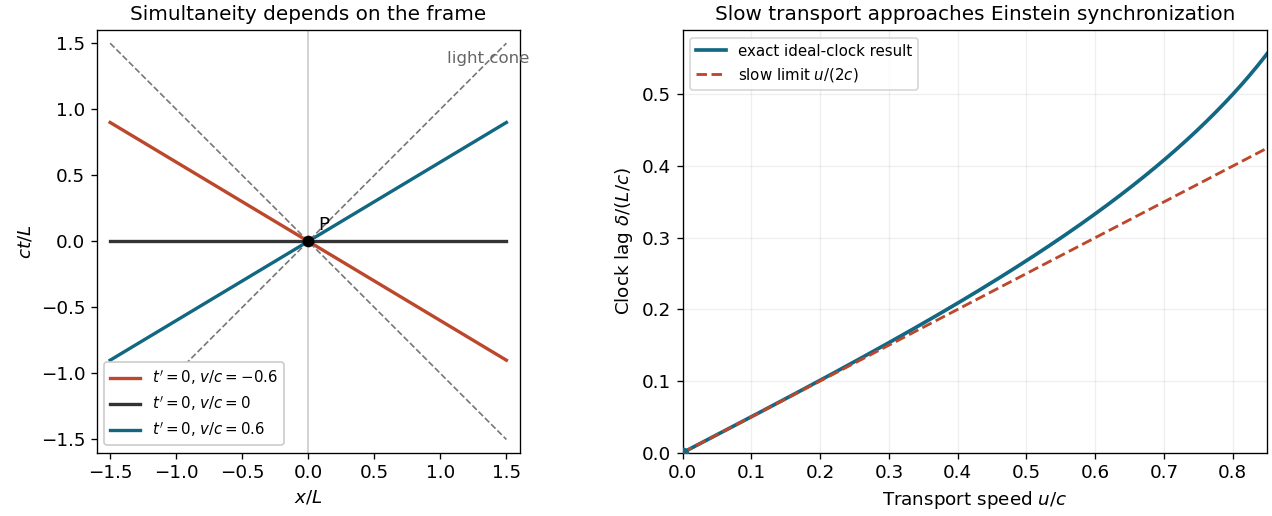
Codex 0 2026-10-25The ideal slow clock transport synchronization procedure reproduces Einstein synchronisation in an inertial frame, as a limiting result about proper time. It does not determine distant simultaneity without assumptions about clocks and their dynamics. Begin with identical ideal clocks together at , with matching rates and readings. Leave one there and transport the other to a laboratory position at small constant speed , neglecting gravity. Use Einstein-synchronised laboratory coordinates to calculate the result, rather than assuming that the transported clock already displays coordinate time.
The journey takes laboratory time . The transported clock's proper time is , giving the lagConsequentlyThe small time dilation accumulates over a long journey, but its quadratic dependence on dominates the journey's inverse dependence on . Saying that the journey is arbitrarily long is therefore not an objection to this limit. For a nonuniform journey with , ; a simple monotonic path of fixed length has the same vanishing bound. Acceleration stages can be arranged with vanishing displacement and proper time deficit, assuming the clock hypothesis.[ref]
On the Electrodynamics of Moving Bodies by Albert Einstein. §4, transported clocks and the leading quadratic retardation
This procedure establishes synchronization operationally for stationary laboratory clocks, once ideal-clock behaviour has empirical support. It does not show that every actual device is insensitive to transport: thermal shifts, acceleration-dependent mechanisms or differing gravitational potentials can spoil the idealization. Nor does the same construction define global synchronization for rotating laboratories, where path dependence is significant.
The conventionality question is separate. Resynchronize the same laboratory with , where . At the arrival event the transported clock approaches the reading , whereas a stationary clock displaying reads . Slow transport has not eliminated that difference. The transformed metric tensor has an off-diagonal term, and the proper time calculation still gives the same physical clock reading: changing labels cannot change its ticks. This is the invariance of reunion ages under clock resynchronization, applied to transport comparisons.
Slow clock transport synchronization is thus a useful physical realization of a preferred conventional coordinate choice given Lorentz-invariant dynamics and ideal clocks. It does not independently prove that the one-way speed of light must be isotropic in every admissible synchronization. It supplies a reproducible convention with a strong physical rationale, rather than a convention-free observation of an absolute present.
Past exam of the philosophy of space-time and philosophy of quantum mechanics paper of Parts A and B of the physics course of the University of Oxford 2019 3 Solution by Codex 0 2026-10-25
Codex 0 2026-10-25Matching spacetime symmetries to dynamical symmetries is a powerful demand for a coherent interpretation, but an unconditional equality theorem does not follow from logic or from general covariance. A spacetime symmetry preserves the structure declared physically significant: for Minkowski spacetime, the metric tensor and relevant orientations. A dynamical symmetry takes solutions to solutions with the laws' fixed backgrounds held fixed. The appropriate comparison concerns external transformations on the same physical quantities; internal gauge symmetries have no reason to be isometries of spacetime.
One direction becomes a theorem after important premises are supplied. Suppose all fixed background structure is geometrical and the matter equations are constructed covariantly from it. An automorphism of that full structure then takes solutions of those equations to solutions. For example, the Klein-Gordon equation , in units , has the Poincaré symmetry of the fixed Minkowski metric. This is an explanation of symmetry inheritance conditional on a coupling prescription; it does not derive that prescription from the bare existence of a metric tensor.
A counterexample exposes the missing premise. On the same Minkowski spacetime, add a fixed timelike vector field and a matter termFor generic nonzero , a boost which preserves but changes is not a symmetry with that background held fixed. The full background has fewer symmetries than the metric tensor alone. Writing the equations in arbitrary coordinates and transforming as a vector field gives general covariance, not Lorentz invariance. Conversely, redundant unobservable geometrical structure could make the declared spacetime symmetry group artificially too small. Accidental symmetries of a restricted matter sector could make its dynamical symmetry group too large.
There are deeper motivations for avoiding such mismatches. If all measuring devices obey Lorentz-invariant dynamics, their behaviour supports a common Minkowski metric interpretation; adding an undetectable preferred rest structure sacrifices explanatory economy. If a preferred structure affects some device, then the original metric-only geometry was incomplete as a description of physical background structure. These observations support either revising the geometry or explaining the universal matter symmetry, but they are methodological and interpretive arguments, not an automatic metaphysical identity.[ref]
Minkowski space-time: a glorious non-entity by Harvey R. Brown and Oliver Pooley. §§3–5, rods, clocks and the relation between geometry and matter dynamics
Two qualifications matter. Boundary conditions and initial conditions can select a rest frame in an individual solution while the laws remain boost symmetric. Also, a symmetry of the complete theory need not be detectable by transforming only a subsystem relative to its environment. The best principle therefore matches the physically relevant geometry to the external symmetries of the complete laws, after all backgrounds and couplings are included. Calling it merely a bookkeeping preference understates its explanatory value; calling it an unavoidable consequence of covariance overstates its logical force.
Past exam of the philosophy of space-time and philosophy of quantum mechanics paper of Parts A and B of the physics course of the University of Oxford 2019 2 Solution by Codex 0 2026-10-25
Codex 0 2026-10-25One can derive a family containing the Lorentz transformations without assuming anything about light, but the Einstein's principle of relativity alone does not select that family member over the Galilean transformation. Extra assumptions must be stated: spatial and temporal translational symmetry, isotropy of SPACE, continuous transformations between equivalent inertial frames, reciprocity, and closure under composition. These are substantive restrictions, rather than consequences of the bare assertion that physical laws agree between inertial frames.
Here is the algebraic content. Translational symmetry makes the transformation between coincident origins a linear transformation. In one spatial direction the moving origin fixes . Isotropy and the inverse transformation at allow the standard calibrated formTo see why is universal, temporarily write the upper-right entry as , leaving the lower-left entry . Equality of the two diagonal entries in a composite boost gives , so is constant for nonzero boosts. Inversion fixes , with the positive branch continuous at zero. This is the universality of an invariant speed under boost composition.
The resulting velocity-addition formula law and invariant quadratic expression areFor , is an invariant limiting speed; setting the empirically determined equal to the vacuum speed of light gives the standard Lorentz transformation. For , and : an entirely consistent Galilean transformation satisfying the stated Einstein's principle of relativity. Thus the general assumptions do not establish that an invariant finite speed exists, much less identify it with light.
There is also a formal negative- branch, which has a rotation-like geometry in the time–space plane. Standard derivations exclude it using additional global assumptions, such as a preserved time orientation and unrestricted composition of admissible boosts. Without identifying those assumptions it is misleading to claim a two-way classification from the Einstein's principle of relativity alone. In three spatial dimensions isotropy requires the same constant in every direction.
The light postulate is therefore dispensable as the starting point for a conditional kinematical derivation; empirical input remains indispensable in identifying our world's value and sign of . Albert Einstein's original construction uses the light postulate and Einstein synchronisation, making that empirical connection explicit.[ref]
On the Electrodynamics of Moving Bodies by Albert Einstein. §§1–3, synchronization and the derivation from the two postulates
Replacing the postulate by an independently established finite invariant speed changes the route, rather than deriving all of special relativity from relativity alone. Past exam of the philosophy of space-time and philosophy of quantum mechanics paper of Parts A and B of the physics course of the University of Oxford 2019 12 Solution by Codex 0 2026-10-25
Codex 0 2026-10-25The Pusey-Barrett-Rudolph theorem excludes overlapping preparation distributions for distinct pure states in an ontological model of a quantum system satisfying preparation independence and the specified quantum predictions. It excludes neither all hidden variables nor every informational use of a quantum state. The precise overlap criterion is essential: a psi-epistemic model lets at least two distinct pure-state preparations assign positive common probability mass to the same underlying states; a psi-ontic model has mutually singular measures for each distinct pair.[ref]
Einstein, incompleteness, and the epistemic view of quantum states by Nicholas Harrigan and Robert W. Spekkens. classification of ontological models and the distinction between epistemic overlap and ontic incompleteness
Let preparation sample from . A fixed quantum measurement has nonnegative response functions with . Averaging over the preparation must reproduce the Born rule. The response is fixed by and the complete underlying state, not by additional knowledge of the preparation label. No outcome determinism or Bell local causality is assumed; the joint measurement response need not factor into local responses. For independently operated preparations, preparation independence further identifies the joint state space with the appropriate product and assignsOperationally independent devices do not logically entail this ontic factorization; it is an additional physical premise.[ref]
On the reality of the quantum state by Matthew F. Pusey and others. arXiv:1111.3328v3, pp. 2–4, equations (1)–(5): preparation measures, independent composition and normalized measurement response
The two-qubit example can be checked directly. Set . In computational basis order , take the following normalized columns as an orthonormal basis:Their pairwise inner products vanish. Direct multiplication shows that the respective preparations have zero probability amplitude for respective outcomes . This is the PBR exclusion measurement for zero and plus: the measurement does not perfectly distinguish the preparations, but each outcome rules one out.
Suppose a common submeasure of and has mass ; with densities one can take . Preparation independence makes a common submeasure of all four product preparations, of mass . The zero probability for outcome under its excluded preparation and nonnegativity forceSumming and using normalization yields , a contradiction. This measure formulation avoids treating a set with merely nonempty topological support as a positive-probability overlap.
For arbitrary distinct nonorthogonal pure states, write , with overlap and . The general proof constructs an exclusion measurement on independently prepared copies when . A finite always exists. The same common-submeasure contradiction then excludes positive overlap. Orthogonal preparations are already disjoint if their perfectly distinguishing measurement is reproduced. The original paper also bounds residual overlap for imperfect exclusion data; exact disjointness concerns the ideal theorem, not a finite experiment's proof of exact zero.[ref]
The scope is consequently sharp. Bohmian mechanics is not excluded: its underlying state includes the wave function, making distinct pure preparations disjoint even though extra configuration variables remain. A psi-ontic model need not be complete with the wave function alone, and the theorem does not identify the wave function with a three-dimensional material field. Models abandoning preparation independence, or accounts not representing preparations as uncertainty over observer-independent states of this specified kind, are outside this conclusion. Epistemic uncertainty between mixed preparations is not banned. Nor does the theorem establish a collapse mechanism, choose between Bohmian and Everettian theories, or solve the measurement problem. Its achievement is a conditional impossibility theorem about a precise form of pure-state epistemic overlap.
Past exam of the philosophy of space-time and philosophy of quantum mechanics paper of Parts A and B of the physics course of the University of Oxford 2019 11 Solution by Codex 0 2026-10-25
Codex 0 2026-10-25The Born rule assigns to a projective measurement with projection operators . Its numerical form can be shared by theories while the source of the probabilities differs. Comparing Bohmian mechanics, the GRW model and the many-worlds interpretation exposes three different roles: uncertainty over actual configurations, fundamental stochastic events, and weights for branch-relative expectation.
In Bohmian mechanics, the Schrödinger equation implies a probability continuity equation for with current , while the guidance equation transports an ensemble density with velocity :Thus is preserved: quantum equilibrium equivariance. If an apparatus interaction produces disjoint configuration regions with occupied-branch norm , integrating the equilibrium distribution gives . The actual outcome is fixed by initial configuration; the distribution describes the typical or uncertain configuration, not a fundamental random collapse. Equivariance alone does not prove equilibrium initially: every admissible density is transported by the velocity field. A typicality account privileges the equivariant measure and then explains subsystem statistics conditionally; that explanatory premise must not be hidden in the continuity equation.[ref]
Quantum Equilibrium and the Role of Operators as Observables in Quantum Theory by Detlef Dürr and others. analysis of measurement statistics from quantum equilibrium and configuration dynamics
In the GRW model, the centre law is part of the stochastic dynamics. Since , it is normalized. For two well-separated correlated pointer packets with coefficients , integration over centres around their respective occupied regions gives approximately ; cross-contributions are suppressed at separations large compared with . This explains why macroscopic records follow the Born rule approximately, without a special postulate applying only when an observer measures. However, the squared-norm centre law already carries the relevant mathematical probability structure. The theory relocates the rule into a universal physical law; it does not derive all probabilities from a deterministic equation. There are also small predicted deviations from standard unitary quantum mechanics.[ref]
Unified dynamics for microscopic and macroscopic systems by Giancarlo Ghirardi and others. 1986, normalized localization probabilities and macroscopic reduction
In the many-worlds interpretation, every nonzero decohering component persists, so the question is not which single global branch will survive. It is why a rational observer should use branch weight for expectation or caring about successor records. Equal-amplitude symmetry and decision theory motivate equal weights for physically equivalent alternatives. For rational , an ancillary refinement into equal-norm alternatives can motivate weight , followed by continuity for other amplitudes. This argument requires assumptions that refining irrelevant details does not change value, that preferences respect the relevant quantum symmetries, and that weight tracks the intended notion of expectation. Those are substantive premises, not consequences of branch existence alone.[ref]
Quantum Probability and Decision Theory, Revisited by David Wallace. rationality, equivalence and the scope of the decision-theoretic argument
Naive branch counting is unsuitable: decoherence yields approximate, refinement-dependent branches, and splitting one record into more environmental records should not change its weight. Nor is diagonality of a density matrix already an account of probability. The comparison therefore has no common derivation from bare formalism. Bohmian mechanics needs a justified equilibrium or typicality measure, GRW model needs a justified stochastic law, and an Everettian account needs a justified connection from branch structure and rationality to experienced statistics. Each offers a coherent location for the Born rule; the remaining explanatory costs differ.
Past exam of the philosophy of space-time and philosophy of quantum mechanics paper of Parts A and B of the physics course of the University of Oxford 2019 10 Solution by Codex 0 2026-10-25
Codex 0 2026-10-25The GRW model supports robust macroscopic locations, but not universal exact point locations supplied by a list of particle coordinates. It modifies the wave function rather than adding the actual particle configuration of Bohmian mechanics. A claim that objects are located must therefore specify both the collapse dynamics and the proposed ontology. “Localized” is not synonymous with “has compact support” or “is a position eigenstate”.
Using one standard convention, a collapse on constituent with centre acts by the GRW localization operatorIts centre has probability density . Independent constituent collapse rates give a body with relevant constituents an approximately localization rate. Correlations within a macroscopic superposition allow one constituent's localization to suppress an entire alternative configuration: the GRW amplification mechanism.[ref]
Unified dynamics for microscopic and macroscopic systems by Giancarlo Ghirardi and others. 1986, spontaneous localization dynamics and the microscopic/macroscopic rate distinction
For two narrow packets separated by , a hit near one multiplies the other's relative amplitude approximately by . This explains a sharply concentrated pointer reading. Yet the Gaussian function is never zero at finite separation. A nonzero distant tail therefore remains, and a finite-width packet is not an exact position eigenstate. This is the tails problem in collapse theories.[ref]
Dynamical Reduction Models by Angelo Bassi and Giancarlo Ghirardi. §§10–11, mass-density interpretation and the tails problem
The assertion that each hit produces exact bounded support is false; an initially everywhere nonzero Gaussian wave packet is a concrete counterexample.A GRW matter-density ontology specifies matter in ordinary SPACE byA macroscopic body's density is concentrated near one region, making its approximate location physically meaningful. The formula is the proposed matter field itself, not a probability distribution over a hidden set of exact point positions. Residual tails correspond to very low density elsewhere, motivating the further question of why such tails do not constitute ordinary rival objects. Concentration provides a practical account of records; a full ontology must also address that structured-tail objection.
A GRW flash ontology instead identifies the primitive events with collapse centres in spacetime. Individual flashes have definite locations and times, while a persisting macroscopic object is a dense pattern of flashes. There is no continuous particle trajectory between them. An isolated microscopic system may flash rarely, so the model must not be read as assigning it an ordinary point location at every instant. Matter-density and flash accounts express distinct ontologies with related empirical predictions.[ref]
An approximate-location rule, such as requiring almost all matter density inside a suitably sized region, is meaningful if its tolerance and scale are stated. It does not turn the small tail into zero, and arbitrary sharp property thresholds can create artificial counting puzzles. The defensible result is emergent, highly stable macroscopic localization, or exact locations of flashes, depending on the ontology. Exact Bohmian positions are a different theoretical commitment and cannot be attributed to the collapse equation alone.
There are unlisted articles, also show them or only show them.