
Ernest Walton and John Cockcroft produced nuclear reactions with a controlled beam of electrically accelerated protons. Their 1932 lithium experiment detected energetic alpha particles from the target. The apparatus made both the incident proton energy and the outgoing reaction products experimentally accessible, replacing reliance on naturally emitted projectiles alone. The result demonstrated how accelerator control could be used to investigate the binding and transformation of atomic nuclei.[ref]
Experiments with High Velocity Positive Ions. II. The Disintegration of Elements by High Velocity Protons by John Douglas Cockcroft and Ernest Thomas Sinton Walton. 1932 accelerator experiment and observed disintegration products
A physicist.[ref]
https://www.dib.ie/biography/walton-ernest-thomas-sinton-a8909. Independent professional profile
[ref]https://www.tcd.ie/news_events/articles/tcd-exhibition-celebrates-nobel-laureate-dr-ernest-walton/. Independent professional profile
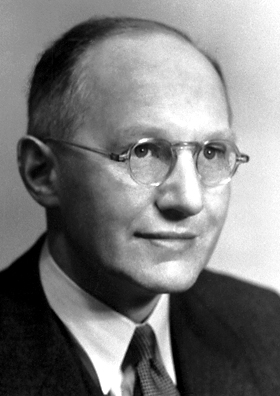
Portrait of Ernest Thomas Sinton Walton
. Source. An experimental physicist who coauthored the Bloch nuclear induction experiment measurements of Felix Bloch and Martin Packard. A sample's precessing nuclear magnetization induces a radiofrequency signal in a pickup coil. Detecting that signal connects the collective motion of nuclear magnetic moments to nuclear magnetic resonance, making the same sample's magnetic dynamics repeatedly observable.[ref]
The Nuclear Induction Experiment by Felix Bloch and others. Byline and induction apparatus, Physical Review 70, 474–485
An experimental physicist who coauthored Felix Bloch's nuclear-induction experiments. Precessing nuclear magnetization generated a radiofrequency signal in a coil surrounding the sample. Detecting the induced signal made collective nuclear motion directly measurable and helped establish bulk nuclear magnetic resonance as a laboratory technique.[ref]
The Nuclear Induction Experiment by Felix Bloch and others. Byline and induction apparatus
An experimental physicist who coauthored observation of nuclear magnetic resonance in a solid with Edward Mills Purcell and Robert Vivian Pound. A radiofrequency field drives transitions of nuclear magnetic moments in an applied magnetic field; resonance appears as enhanced absorption. The method provided access to nuclear properties without requiring a freely traveling atomic beam.[ref]
Resonance Absorption by Nuclear Magnetic Moments in a Solid by Edward Mills Purcell and others. 1946 letter: bulk solid resonance absorption
An experimental physicist who, with Glen Rebka, measured the gravitational redshift of gamma radiation over a laboratory height difference. Narrow nuclear resonance and a controlled Doppler shift made an extremely small gravitational frequency change accessible. The experiment linked a prediction of general relativity to resonant absorption in an apparatus on Earth.[ref]
An experimental atomic physicist who, with Willis Eugene Lamb Jr., measured the Lamb shift in 1947. Their microwave method distinguished hydrogen levels that the simplest relativistic theory placed at the same energy. The experiment made a small spectral discrepancy into a precise test, helping motivate improved calculations in quantum electrodynamics.[ref]
Frits Zernike developed phase-contrast microscopy, making transparent structures visible through changes in wave phase. A weakly absorbing specimen may change the wave phase of transmitted light without producing much ordinary intensity contrast. Shifting the relative wave phase of the direct and diffracted components lets their wave interference convert that information into visible brightness differences. His discovery began with imperfections in diffraction gratings, before becoming a method for observing transparent specimens.[ref]
How I discovered phase contrast by Frits Zernike. 1953 authored lecture, diffraction-grating motivation and phase-strip microscopy
A physicist.[ref]
https://www.rug.nl/fse/nobelprize-zernike/frits-zernike-1888-1966?lang=en. Independent professional profile

Portrait of Frits Zernike
. Anefo; Nationaal Archief, 4 November 1953. Individual photographer not separately named in the File. Creative Commons CC0 1.0 Universal Public Domain Dedication. Source usage terms, via Wikimedia Commons. Source.Cecil Frank Powell developed nuclear emulsion methods for studying cosmic rays. A charged particle leaves a microscopic sequence of developed grains; track length, scattering and grain density can then constrain its energy and mass. His work with colleagues on connected stopping tracks helped identify the pion and its decay into a muon. The method combined long exposures with repeated microscope measurements, turning rare cosmic events into quantitative evidence.[ref]
The Cosmic Radiation by Cecil Frank Powell. 1950 authored lecture, photographic-emulsion methods and meson studies
A physicist.[ref]
https://www.bristol.ac.uk/university/distinctions/. Independent professional profile: Powell biographical paragraph: appointed Melville Wills Professor of Physics in 1948; full name and life years in heading

Portrait of Cecil Frank Powell
. Source. Hugh Muirhead coauthored the 1947 observations that distinguished charged pions from their lighter decay products. In a nuclear emulsion, one stopping particle track was followed by another emerging from its endpoint. Track ranges and ionization provided evidence for a two-stage process involving different masses. The recorded geometry made a decay recognizable even though neither particle was directly followed in real time.[ref]
Processes Involving Charged Mesons by Cesare Mansueto Giulio Lattes and others. 1947, connected meson tracks and interpretation of the stopping-particle events
A theoretical nuclear physicist who develops descriptions of nuclear forces through effective field theory. His joint review relates the allowed low-energy interactions of nucleons to symmetries of quantum chromodynamics. Organizing interactions systematically makes it possible to improve a nuclear calculation in stages and compare few-body predictions with measured nuclear properties.[ref]
Modern Theory of Nuclear Forces by Evgeny Epelbaum and others. Abstract and foundations of the low-energy expansion
A theoretical nuclear physicist working on effective field theory descriptions of nuclear forces. His review with Evgeny Epelbaum and Ulf-G. Meißner compares descriptions at different resolution scales. Selecting the relevant low-energy degrees of freedom permits controlled calculations of few-nucleon systems while retaining constraints from quantum chromodynamics.[ref]
Modern Theory of Nuclear Forces by Evgeny Epelbaum and others. Abstract and introduction: resolution scales and light-nucleus applications
A theoretical nuclear physicist who studies nuclear forces using effective field theory. His joint review with Evgeny Epelbaum and Hans-Werner Hammer explains how the symmetries of quantum chromodynamics constrain low-energy interactions between nucleons. The approach organizes increasingly accurate calculations without treating a nucleus directly as a collection of interacting quarks.[ref]
Modern Theory of Nuclear Forces by Evgeny Epelbaum and others. Abstract: systematic derivation from QCD symmetries and applications to light nuclei
A theoretical atomic physicist who coauthored calculations of the Lamb shift in hydrogen and light hydrogen-like ions. The work reviews theoretical contributions and uncertainties needed for precision spectroscopy. Such predictions let a small measured difference between energy levels test relativistic quantum interactions rather than just the leading Coulomb potential.[ref]
Theory of the Lamb shift in hydrogen and light hydrogen-like ions by Vladimir Yerokhin and others. Abstract and summary of theoretical contributions
A theoretical atomic physicist who coauthored a precision review of the Lamb shift. The analysis assembles distinct corrections to hydrogenic energy levels, allowing high-resolution spectroscopy to be compared with quantum electrodynamics. Separating nuclear-size contributions from purely electronic corrections is essential when extracting a nuclear radius.[ref]
Theory of the Lamb shift in hydrogen and light hydrogen-like ions by Vladimir Yerokhin and others. Abstract and treatment of radiative, recoil and nuclear-size contributions
A theoretical atomic physicist who coauthored precision calculations of the Lamb shift in hydrogen and light hydrogen-like ions. These calculations combine radiative, recoil and finite-nuclear-size effects. Their uncertainty matters when a measured transition is used to test quantum electrodynamics or infer nuclear structure.[ref]
Henry Michael Foley and Polykarp Kusch compared atomic magnetic resonance frequencies to determine the electron magnetic moment. They selected quantum states whose orbital angular momentum and spin contributions enter with different weights. Ratios of the measured frequencies revealed a departure from the simplest electron spin g-factor of exactly two. Comparing responses in the same magnetic field reduces dependence on absolute field calibration, turning a small spectral difference into a precision test of the magnetic response.[ref]
The Magnetic Moment of the Electron by Polykarp Kusch and Henry Michael Foley (1948). Abstract: compared gallium, indium and sodium states, measured resonance-frequency ratios and departure from the simple magnetic-factor values
A physicist and professor of physics at Columbia University.[ref]
https://findingaids.library.columbia.edu/pdf/cul-4078769.pdf. p. 3, creator name and Biographical / Historical note
The Kusch-Foley magnetic moment experiment describes his work with Polykarp Kusch.John Bardeen and Walter Brattain connected semiconductor surface behavior with the operation of the point-contact transistor. Carrier injection near closely spaced contacts allowed a small input to control a larger electrical response, making amplification possible in a solid-state device.[ref]
The Transistor, A Semi-Conductor Triode by John Bardeen and Walter Houser Brattain. Physical Review 74, 230 (1948), device operation
He later coauthored BCS theory, in which a coherent paired-electron ground state explains central properties of conventional superconductivity. This links microscopic interactions with an excitation gap and collective magnetic and thermal response.[ref]
Theory of Superconductivity by John Bardeen and others. Physical Review 108, 1175 (1957), microscopic paired-state theory
A physicist.[ref]
https://www.nobelprize.org/prizes/physics/1956/bardeen/biographical/?NMW_TRANS=ext. Independent professional profile

Portrait of John Bardeen
. Source. Tsung-Dao Lee co-developed experimentally testable challenges to parity conservation with Yang Chen-Ning. In a polarized nuclear decay, the parent spin supplies an axial direction while the emitted particle's momentum supplies a polar direction. Their scalar product changes sign under parity, so a preferred emission direction can expose a symmetry failure. The proposal made a foundational assumption into a laboratory question.[ref]
A physicist.[ref]
https://www.nobelprize.org/prizes/physics/1957/lee/biographical/. Independent professional profile

Portrait of Tsung-Dao Lee
. user:smartneddy. CC BY-SA 2.5, via Wikimedia Commons. Source.Chien-Shiung Wu and collaborators tested parity conservation by measuring the beta decay of oriented cobalt-60 nuclei at very low temperature. Their apparatus placed a beta counter inside a demagnetization cryostat and used the accompanying gamma ray anisotropy to monitor nuclear orientation. The emitted electrons favored one direction relative to the nuclear spin. Because parity reverses momentum while leaving angular momentum unchanged, that directional asymmetry distinguishes a process from its mirror image and demonstrated parity violation in the weak interaction.[ref]
Experimental Test of Parity Conservation in Beta Decay by Chien-Shiung Wu and others. Opening argument, Fig. 1 cryostat and observed electron asymmetry
A physicist.[ref]
The Fall of Parity Photo Gallery with Short Biographies by National Institute of Standards and Technology. Independent professional profile


An experimental physicist whose cryogenic expertise contributed to the Wu experiment. The National Bureau of Standards laboratory could align atomic nuclei at extremely low temperature, enabling a directional beta decay test in cobalt-60. The collaboration demonstrated a failure of parity conservation.[ref]
The Reversal of Parity Law in Nuclear Physics by National Institute of Standards and Technology. NBS low-temperature laboratory, collaboration list and nuclear alignment

Portrait of Ernest Ambler
. External portrait linked by the National Institute of Standards and Technology institutional exhibit. Source. There are unlisted articles, also show them or only show them.