
Wander Johannes de Haas and Albert Einstein investigated mechanical motion produced by changing the magnetization of a suspended body. Magnetic reversal changes microscopic angular momentum; a compensating rotation of the body tests angular-momentum conservation. Their experiment connected an apparently internal magnetic property with a visible mechanical response. Interpreting a gyromagnetic measurement requires the relation between magnetic moment and angular momentum, rather than treating magnetization as a force acting independently of its microscopic carriers.[ref]
Experimental proof of the existence of Ampère's molecular currents by Albert Einstein and Wander Johannes de Haas. 1915 report, magnetic reversal and mechanical rotation experiment
A physicist who researched magnetism and became a professor at Leiden in 1924.[ref]
Wander Johannes de Haas, 1878–1960 by H. B. G. Casimir. Career paragraphs: PTR research staff 1913–1915; Delft, Groningen and Leiden professorships

Portrait of Wander Johannes de Haas
. Unknown photographer; Huygens Laboratorium, Universiteit Leiden; reproduced in Dirk van Delft, Heike Kamerlingh Onnes: Een biografie (2005), p. 529. Public domain (author life plus 70 years; published before 1931). Source usage terms, via Wikimedia Commons. Source.
Anders Jonas Ångström developed quantitative optical spectroscopy, including precise measurements of the solar spectrum. His 1868 study measured the wavelengths of Fraunhofer lines, turning reproducible spectral landmarks into numerical standards. The ångström, metres, bears his name. Such calibrated wavelength measurements let observations made with different instruments be compared, helping move spectroscopy from descriptions of colour to tests of material composition and physical models.[ref]
Anders Ångström by Uppsala University. 1853 optical investigations, 1868 solar-spectrum measurements and the wavelength unit
A physicist appointed professor at Uppsala in 1858, whose research included spectroscopy.[ref]
Anders Ångström by Uppsala University. Anders Ångström: optical spectroscopy research and appointment as professor of physics in 1858

Portrait of Anders Jonas Ångström
. Hulda Schenson; Vetenskapsakademiens porträttsamling. Public domain (PD-Art / Public Domain Mark 1.0, as stated on Commons). Source usage terms, via Wikimedia Commons. Source.
An experimental optical physicist who coauthored measurements of the spatial coherence of three bright stars. Separate telescopes recorded intensity fluctuations whose correlations depend on their separation, applying stellar intensity interferometry to angular measurements. The approach links a laboratory quantum-optics correlation to a stellar observation.[ref]
An experimental optical physicist who coauthored stellar stellar intensity interferometry work, publishing under the surname Fouché. The experiment correlated fluctuations of starlight recorded by separate telescopes, applying the Hanbury Brown and Twiss effect to astronomical observations.[ref]
Spatial intensity interferometry on three bright stars by William Guerin and others. Byline M. Fouché and telescope intensity-correlation experiment
[ref]Mathilde Hugbart. CV: publications under Hugbart or Fouché
An experimental optical physicist who coauthored stellar stellar intensity interferometry measurements. Correlating fluctuations detected at separated telescopes probes the spatial coherence of starlight. The method extracts angular information from photon statistics rather than requiring the optical electric fields from the telescopes to remain phase locked.[ref]
Robin Kaiser studies collective scattering of light and coherent transport in clouds of cold chemical atoms. His ANDLICA project asks whether Anderson localization of light can be observed in three-dimensional cold ytterbium samples. The project distinguishes localization from effects such as absorption and inelastic scattering of light, which can imitate some transport signatures. It connects controlled atomic samples and time-resolved measurements with the physical question of whether disorder can prevent extended wave transport.[ref]
ANDLICA cold-atom research project. Project description, sample choice, interpretation of transport signatures and Kaiser as principal investigator; stated aims, not a claim of successful localization
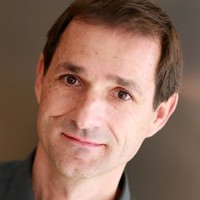
Portrait of Robin Kaiser
. External portrait hosted by Université Côte d’Azur, Institut de Physique de Nice. Source.Clinton Davisson and Lester Germer measured strong angular structure in electron scattering from a nickel crystal. Its dependence on incident electron energy agreed with a wavelength set by the electron momentum through the de Broglie wavelength. The crystal therefore supplied a periodic structure against which electron wave behavior could be tested. The Davisson–Germer experiment linked a tunable electron source and angularly resolved detector with the theoretical idea of matter waves.[ref]
A physicist whose route into research included a telephone-company job when he could not afford to continue at Chicago. He later worked at Bell Telephone Laboratories, retiring in 1946 after 29 years, and taught physics at Virginia in 1947–1949.[ref]
Clinton Davisson – Biographical. Biography: financial interruption, laboratory employment and visiting professorship
The Davisson–Germer experiment connects that industrial-laboratory work to electron diffraction and matter waves.
Portrait of Clinton Davisson
. Source. 
A physicist associated with the Barkhausen effect: the magnetization of a ferromagnet can change in discrete jumps even when the applied magnetic field varies smoothly. A pickup coil detects the accompanying changes in magnetic flux; amplification makes the irregular signal audible. The experiment connects a macroscopic noise measurement with sudden rearrangements of magnetic domains and the motion of domain walls.[ref]
The Barkhausen effect by Gianfranco Durin and Stefano Zapperi. Experimental methods, domain-wall interpretation and translation of Barkhausen’s original report
His work at Dresden also developed the experimental teaching of electrical engineering.[ref]Uni-Gebäude und ihre Namen: Barkhausen-Bau by Jörg Zaun. Heinrich Barkhausen section: founding of the Dresden institute and teaching
A physicist responsible for magnetism, materials and spintronics research at INRiM in 2023.[ref]
Settori scientifici omogenei by INRiM. January 2023 scientific sectors, ML5: Magnetismo, materiali e spintronica — Gianfranco Durin
Stefano Zapperi and Gianfranco Durin studied the statistics of Barkhausen effect avalanches in soft ferromagnets. Slowly changing the applied magnetic field produces bursts of magnetization as pinned domain walls move. Their 2000 work measured avalanche-size distributions in polycrystalline and amorphous materials and found distinct scaling classes in the slow-drive limit. Interpreting the data through the release of pinned domain walls connects irregular magnetic noise with a collective phase transition, including a quantitative relation between the distribution cutoff and the demagnetizing factor.[ref]
Scaling exponents for Barkhausen avalanches in polycrystals and amorphous ferromagnets by Gianfranco Durin and Stefano Zapperi. abstract: measured exponents, slow-drive limit and domain-wall interpretation
A physicist and professor of theoretical physics of matter at Milan.[ref]
Stefano Zapperi: university profile. Description, Professional positions: professor of theoretical physics of matter, University of Milan, from 2015

Portrait of Stefano Zapperi
. Francesc Font Clos (explicit caption credit on the official FAU article). External portrait hosted by Friedrich-Alexander-Universität Erlangen-Nürnberg. Source.Walter Schottky explained a fundamental source of electrical noise: even a steady mean electric current can fluctuate because charge arrives in discrete units. His 1918 paper studies intrinsic limits to detecting weak signals with amplifying tubes, distinguishing charge discreteness from thermal motion. For independent charge-transfer events, the modern shot noise relation is for the one-sided current-noise power spectral density. Its dependence on the mean current makes the noise a probe of charge-transfer statistics, rather than merely a defect of an amplifier.[ref]
Über spontane Stromschwankungen in verschiedenen Elektrizitätsleitern by Walter Schottky. Annalen der Physik 57, 541–567 (1918), introduction and charge-discreteness contribution
A physicist who held a theoretical-physics professorship at Rostock from 1923 to 1927.[ref]
Walter Schottky by Stiftung Werner-von-Siemens-Ring. Werdegang: professor of theoretical physics at Rostock, 1923–1927; subsequent Siemens research

Portrait of Walter Schottky
. Source. 
Samuel Jackson Barnett demonstrated that mechanical rotation can magnetize a material, the Barnett effect. Rotation couples to the angular momentum associated with microscopic magnetic moments, producing a magnetic response without using an applied field as the driving cause. The effect connects mechanical angular momentum with magnetization and complements experiments in which a change of magnetization produces mechanical motion. It makes the magnetic moment's connection with microscopic angular momentum experimentally accessible.[ref]
A physicist listed as professor of physics at the University of California, Los Angeles, in its 1927–1928 faculty announcement.[ref]
Announcement of the University of California at Los Angeles for the Academic Year 1927–28 by University of California, Los Angeles. Officers and Faculty, p. 15: Professor of Physics (1927–1928)
Ladislav Sieger coauthored teaching experiments that connect the Seebeck effect and Peltier effect in a single thermoelectric device. In generator operation, a temperature difference produces an electromotive force; in cooler operation, an electric current pumps heat. The analysis includes Joule heating and thermal conduction, so the cooling power is not simply proportional to the supplied current. Comparing useful heat removal with electrical input also distinguishes refrigerator performance from heat-engine efficiency.[ref]
Measurement of characteristics of a Peltier cell by Milan Červenka and Ladislav Sieger. sections 1.1 and 1.4, energy balances for generator and cooler operation
A physicist listed among the academic teaching staff of the physics department at the Czech Technical University in Prague.[ref]
Lidé na katedře – podle zařazení by Czech Technical University in Prague, Department of Physics. Odborní asistenti: Sieger Ladislav; Department of Physics staff table
Frank Steglich coauthored an apparatus for measuring very small magnetostriction in pulsed magnetic fields. A fibre Bragg grating serves as an optical strain gauge attached to a small crystal: changes in its reflected wavelength report changes in length. The 2010 instrument resolved strain of order with 47,000 hertz bandwidth and was demonstrated on gadolinium compounds at low temperatures. It connects an optical measurement to the way electronic and magnetic changes deform a solid.[ref]
High resolution magnetostriction measurements in pulsed magnetic fields using Fibre Bragg Gratings by Ramzy Daou and others. Review of Scientific Instruments 81, 033909 (2010), abstract and instrument description
A physicist studying correlated electrons and emeritus director of the Max Planck Institute for Chemical Physics of Solids.[ref]
Hohe Auszeichnung für Frank Steglich by Einstein Stiftung Berlin. Opening paragraph: physicist in correlated-electron physics; founding director and director emeritus of MPI for Chemical Physics of Solids

Portrait of Frank Steglich
. MPI CPfS (photo credit on the named institutional article; individual photographer unspecified). External portrait hosted by Einstein Stiftung Berlin. Source.An experimental physicist who, with Robert Vivian Pound, measured gravitational redshift over a laboratory height difference in the Pound-Rebka experiment. The Mössbauer effect supplies an exceptionally narrow nuclear resonance, allowing a tiny change in gamma ray energy to be detected. Controlled motion of the source produces a compensating Doppler shift, turning a difficult absolute energy comparison into a measurement of the velocity needed to restore resonance.[ref]
Apparent Weight of Photons by Robert Vivian Pound and Glen Rebka. 1960 report: resonant absorption, vertical separation and compensating source motion
A theoretical physicist whose research connects spin-orbit coupling with electrical control of electron spin. The coupling allows the electron's motion and local electric environment to affect its spin, providing routes to manipulation and transport in semiconductors. His review emphasizes how this link changes the meaning of spin currents and their relation to measurable spin accumulation.[ref]
Spin-orbit coupling and spin transport by Emmanuel Rashba. Abstract: electrical spin control, spin transport and relation to spin accumulation
A theoretical physicist who reformulated the single-electron Schrödinger equation as hydrodynamic equations, now called the Madelung equations. Writing the wave function in terms of magnitude and phase connects its evolution with a density and a flow. The formulation makes a useful bridge between quantum-wave dynamics and fluid descriptions while retaining an additional quantum contribution to the force balance.[ref]
Quantentheorie in hydrodynamischer Form by Erwin Madelung. Summary and pp. 322–326: hydrodynamic transformation of the one-electron equation
A theoretical physicist who developed a collective-electron account of metallic ferromagnetism. Instead of treating every magnetic moment as belonging to an isolated atom, the approach considers electrons occupying extended states throughout a crystal. Combining Fermi-Dirac statistics with their interactions connected magnetic behavior with the occupation of electronic bands and its change with temperature.[ref]
Collective electron ferromagnetism by Edmund Clifton Stoner. Original 1938 collective-electron treatment, pp. 372–414
George Gabriel Stokes connected fluid viscosity with corrections to precision physical pendulum measurements and with resistance on small moving bodies. His memoir explains why correcting only for buoyancy misses the fluid's inertia and frictional effects. For steady creeping flow of a Newtonian fluid around a rigid sphere, the Stokes drag law is , where is dynamic viscosity, is the sphere's radius, and is its relative speed. The result assumes a no-slip boundary condition and an unbounded surrounding fluid. It connects measured settling or damping with fluid properties.[ref]
On the Effect of the Internal Friction of Fluids on the Motion of Pendulums by George Gabriel Stokes. Opening pendulum motivation; Part I, section IV, articles 39–42, especially equation (126), steady sphere resistance; modern notation
A physicist and mathematician associated with Stokes flow, Stokes' second problem and Stokes theorem.

Portrait of George Gabriel Stokes
. Swan Electric Engraving Co., as credited by the File; Archivio storico dell’Accademia delle Scienze di Torino, catalog 0155, accession IST. 4.1.3. 2. Commons claims origin/life-plus-100-or-shorter public domain and pre-1931 United States publication. Source usage terms, via Wikimedia Commons. Source.
There are unlisted articles, also show them or only show them.