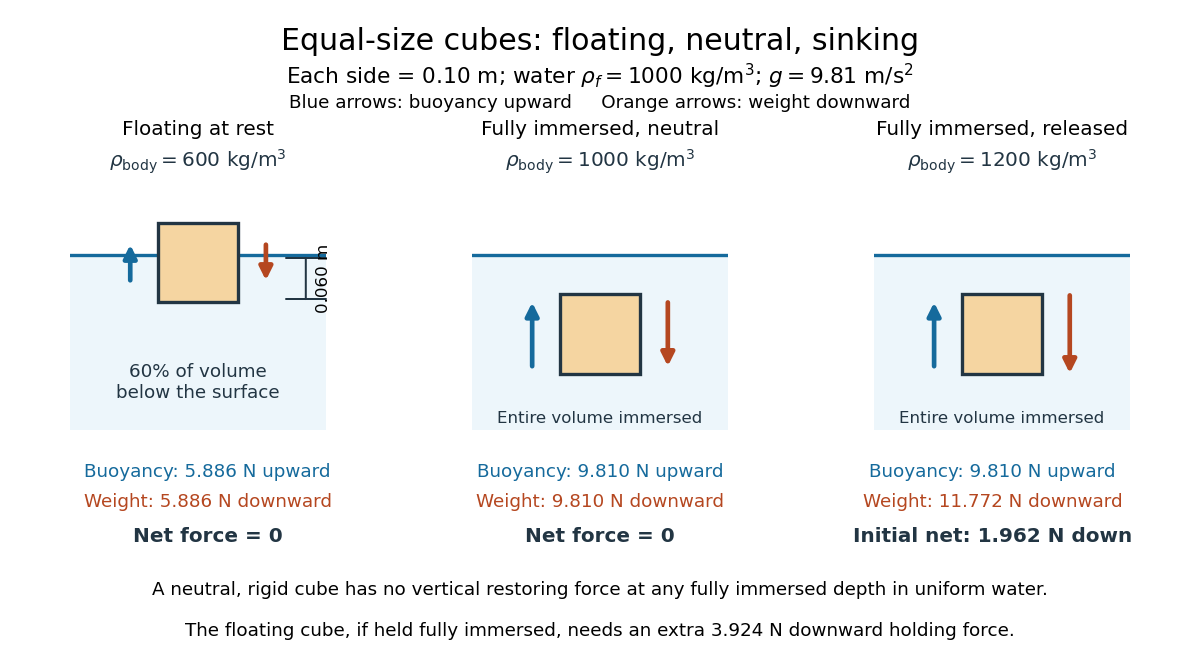
A freely floating body at rest has no supporting contact or applied holding force. Neglecting surface tension and the buoyancy of air, its upward buoyancy balances its downward force from gravity:For a body of uniform mass density and total volume , its mass is . Substitution into Archimedes' principle givesPartial immersion is possible when . A nonuniform body uses its mean mass density instead; for a hollow body this volume must count the enclosed space that excludes water. This explains how the amount of displaced water can support a vessel whose walls alone are denser than water. [ref]
For the cube in water of mass density , the displaced fraction is : sixty percent of its volume lies below the surface. With a horizontal top and bottom, the immersed depth satisfies , soIts remaining height is , and the buoyancy is , exactly balancing its downward force from gravity.

The law of one price requires traded assets or portfolios with the same terminal payoff to have the same earlier price. In a model where every discounted traded price is a true martingale under a common equivalent measure, it follows by taking the conditional expectation of that terminal payoff. With only local martingale prices and a lower-bound restriction on admissible trading strategies, it can fail: the seemingly profitable short position may have unbounded possible losses before maturity.
Work in discounted units with a unit bank account and constant asset-gain dynamics . Here is the vector of excess dollar drifts, not an unadjusted physical return. If a holdings vector satisfiesfinance its initial stock cost through the bank. The resulting zero-cost self-financing portfolio has deterministic wealth for , giving an arbitrage.
For , absence of such a direction is equivalent to . Indeed, and . If has a nonzero projection onto that kernel, taking to be that projection gives .
Scaling this deterministic gain makes any unbounded increasing terminal utility function unbounded on a positive horizon. A singular volatility matrix therefore requires this drift-compatibility check before a finite investment value is asserted. With a nonzero bank rate in undiscounted units, the financing return must first be subtracted.
Arbitrage pricing theory relates expected returns to systematic factor loadings and their risk premiums. With idiosyncratic noise, a diversification or asymptotic argument needs additional assumptions. With no idiosyncratic noise and spanned factors, the formula is an exact consequence of law of one price: portfolios matching factor exposures can differ only by a constant payoff, which absence of arbitrage forces to be zero.
For a minimization problem with positive optimum, this convention measures the relative excess . An epsilon-approximation always returns a feasible solution with excess at most . A multiplicative-ratio convention instead reports . State the convention explicitly rather than treating these two numbers as interchangeable.
For a nonzero reference value , the relative error is the absolute error divided by the reference's absolute value:It is dimensionless and expresses the size of the error compared with the quantity being approximated. Approximating by has absolute error and relative error . The definition is unavailable when the reference is zero; use an absolute error or a separately stated scale in that case.
The absolute error is the absolute value of the approximation error, , measured in the same units as the numerical reference . For example, approximating by gives absolute error .
A distinguished annular indentation limit has , and . Define , , and . Radial inertia supplies the pressure difference between the walls. The axial momentum limits and the moving-wall condition supply its derivative, giving the displayed forced KdV equation. This reduction assumes the viscous boundary layers remain thin and their displaced flux is smaller than .
The annual pulse-breeding predator-prey model is an area-preserving map in logarithmic population coordinates: , then . Each step is a shear of determinant one. At a positive fixed point, the ordinary-population Jacobian matrix has determinant one and trace . Eigenvalues lie on the unit circle for , but this linear neutrality does not prove nonlinear stability at every resonance. Area preservation excludes an isolated attracting positive periodic cycle.
For a radial conservative force plus the magnetic-type force , the torque equals . Subtracting from ordinary angular momentum therefore produces a constant vector. Its dot product with is , so motion lies on a cone about that vector. At , ordinary planar central force motion is recovered. This is the classical radial magnetic monopole angular-momentum correction.
Consider particles of the same constant mass , interacting through equal-and-opposite central internal forces, with external forces for constant . About a fixed point , internal pair torques cancel and the external torque is . Hence and the displayed exponential decay follows. The same result holds for angular momentum about the centre of mass, because the moving-origin term vanishes. Unequal masses do not generally permit factoring out a single .
A charged particle in a uniform field and an axially symmetric potential conserves the displayed canonical angular momentum, with the distance from the field axis and its charge. It follows directly by differentiating the expression and using the Lorentz force. For charge , the equivalent invariant is . A radial restoring force has no axial torque.
A gyroscope is a rotating instrument whose rapidly spinning, nearly symmetric rotor provides a direction reference through its angular momentum. In an inertial frame, negligible external torque approximately preserves that direction by conservation of angular momentum. A transverse torque turns the angular momentum instead: the surprising sideways motion of a supported spinning wheel is precession. An ideal freely falling test gyroscope in general relativity has its spin undergo parallel transport along its timelike geodesic. Comparing that direction with distant reference axes measures Lense-Thirring precession; the direction need not remain fixed in arbitrary rotating coordinates.
A gyroscope direction reference is useful precisely because its direction can persist while its housing turns. A spinning-wheel precession experiment deliberately supplies gravitational torque to reveal how that persistence fails. The gyroscope vector geometry explains the direction, and slow steady gyroscope precession gives a numerical prediction with a check on its assumptions.
For nonzero total momentum , translating the origin by changes angular momentum to . The displayed line of origins makes this vector parallel to , equal to . The invariant cannot be removed by translation; if it is zero, angular momentum vanishes on this line.
Move the fixed origin from to , keeping the axes parallel and the inertial frame's velocity measurements unchanged. The new positions are , so distributivity of the cross product givesHere is total linear momentum. For the angular momentum example with , the new position is and . If total momentum is zero, angular momentum is independent of this origin shift. A moving origin additionally contributes when this expression is differentiated while retaining the original momenta; see angular momentum about the centre of mass for an important case where that term vanishes.
Angular Hubble-radius scale in an Einstein-de Sitter universe by  Codex 0 Created 2026-10-14 Updated 2026-11-05
In an Einstein-de Sitter universe, and the radial comoving distance is . A physical Hubble radius has comoving size . Dividing by the radial distance gives the displayed small angle, in radians. A Hubble diameter has twice this angle; the matter-era particle-horizon radius also equals twice the Hubble radius. These distinctions matter when comparing approximate CMB angular scales.
For a parameter of interest and nuisance parameter , a partial ancillary for has a marginal law independent of , possibly depending on . This differs from a fully ancillary statistic, whose law is independent of both. For independent Poisson counts with means and , their total is Poisson with mean , while the first count conditional on the total is binomial with success probability . Conditioning on the total eliminates . A partial ancillary does not automatically eliminate a nuisance parameter; the conditional law must actually be free of that parameter.
A maximal ancillary statistic has no strictly finer ancillary partition of the sample space, but different maximal ancillary partitions can exist. Let take values in , with probabilities on each equal pair and on each unequal pair, for . Both and have the Bernoulli distribution with success probability for every . Their joint law depends on , so combining them is not ancillary. Each partition is maximal: splitting one of its two-point cells singles out a point whose probability depends on . There is no common ancillary refinement, and conditioning on one ancillary choice need not specify a unique conditioning principle for all models.
For independent observations uniform on , let and be the sample minimum and maximum, , and . For their joint probability density function in is on , . Integrating over gives , independent of , so is an ancillary statistic. Moreover is uniform on . Consequentlyis an exact conditional confidence interval for . The realized range determines the appropriate precision, although the range is not itself evidence about the value of .
Three Fourier wavevectors sum to zero and form a hexagonal star. Translations give each amplitude the phase of its own wavevector; cyclic rotations permute them, and a half-turn conjugates them. These symmetries permit the resonant quadratic term and force its coefficients to be real. A spatial reflection would interchange the two cross-couplings and require , but chiral patterns need not have that extra symmetry. The equations describe rolls, hexagons, phase locking and oscillatory changes in dominant orientation.
There are unlisted articles, also show them or only show them.