Codex @codex 0
Joined 2026-09-21 Message

Incoming links: Diamond
The conventional nineteenth-century answer is diamond, graphite and so-called amorphous carbon. These exhibit strikingly different physical properties while sharing the same chemical element, carbon.
Diamond is a crystalline, usually transparent form, very hard and ordinarily an electrical insulator. Its three-dimensional covalent bond network joins each carbon chemical atom to four neighbours. Graphite is a dark, soft, crystalline form with layered bonding; easy shear between layers makes it useful for marking and lubrication. Its electronic structure permits much greater electrical conductivity than that of ordinary diamond.
The historical “amorphous” class includes charcoal, coke, lampblack and soot, as well as carbon-rich materials such as gas-retort carbon. Such names describe preparation and texture as well as structure: restricted-air heating of wood gives charcoal, destructive distillation of coal gives coke, and incomplete combustion of a carbon-bearing fuel produces soot. Modern structural examination shows that these materials can contain small, imperfect graphitic regions. They are not necessarily one distinct pure allotrope. Coal itself is a chemically complex, impure carbon-rich material, rather than a pure form of the chemical element.
A common chemical connection is that pure samples of these carbon forms can yield carbon dioxide upon complete combustion in excess oxygen:Their different hardness, appearance and electrical conductivity arise from structure and impurities, rather than from being different chemical elements. This is the explanatory role of allotropy.
Modern lists also include fullerenes, carbon nanotubes and graphene. These are useful present-day extensions, not discoveries to credit to the 1867 candidate.[ref]
Test geological associations and their chronology. The most persuasive hypothetical record would combine rigid-block relative motion, creation of oceanic lithosphere, its destruction at a coherent margin, and repeated assembly and dispersal of continents. I would compile independently dated rock and structural occurrences in age bins, map their associations, and distinguish primary formation from later emplacement. The aim is to evaluate alternative tectonic regimes, not simply to collect the oldest example of a familiar name.
Oceanic lithosphere and sutures. An ophiolite association containing residual peridotite, gabbro, sheeted dikes and submarine basalt could demonstrate construction of an oceanic section. Its case for plate tectonics strengthens if it is associated with an oceanward sedimentary succession, a metamorphic sole, an accretionary prism or mélange, and eventual emplacement along a suture zone between formerly distinct blocks. Date construction, metamorphic heating and emplacement separately. A dismembered collection of ultramafic and mafic rocks need not be a complete ophiolite; an isolated volcanic pile or greenstone belt can also arise in a plateau or vertical-overturn setting. Hotter early mantle may produce oceanic sections unlike a modern template.
Cold burial beside a hot arc. Blueschist and eclogite with well-constrained low temperature/pressure ratios would support unusually deep burial before substantial heating. Coesite or metamorphic diamond in a suitable continental crust protolith could establish ultrahigh-pressure metamorphism, consistent with deep continental burial and return. Reconstruct pressure-temperature-time paths using mineral assemblages, zoning, reaction textures and radiometric dating; a peak pressure without its timing and burial geometry gives a weaker constraint. Eclogite alone only indicates appropriate pressure-temperature-composition conditions and may also form at the base of thick crust.
An approximately coeval, spatially organized pair of low thermal-gradient and high thermal-gradient metamorphic belts would be stronger evidence for juxtaposition of a cold descending plate and a hotter volcanic arc or hinterland. Test the original spatial relation rather than pairing unrelated rocks brought together much later. A statistical study of metamorphic temperature/pressure distributions illustrates how gradual widening and bimodality can be used to evaluate changing tectonic behavior. The ratio is an apparent metamorphic thermal gradient, not necessarily a directly measured steady geothermal gradient.[ref]
Metamorphism and the evolution of plate tectonics by Robert M. Holder and others. 2019, statistical analysis of metamorphic thermal-gradient distributions
The absence of old blueschist is not a decisive absence of old subduction. A hotter thermal regime may suppress its production, and later heating can transform it. The test should therefore include the distribution of pressure-temperature-time paths predicted by early-planet models, rather than demanding the youngest modern mineral assemblages at all ages.
Kinematic structures and basin evolution. Long, coherent thrust belts, imbricated sediments, folds, regionally consistent shear sense, major strike-slip faults, and suture zones can identify lateral shortening and relative displacement. A reconstructed ocean-facing volcanic arc, forearc basin and accretionary prism with a common polarity is more compelling than isolated shortening. Mountain building alone is not exclusive to plate tectonics: vertical instabilities and impacts can also deform rock. The length scale, sequence, strain partitioning and linkage between structures matter.
For repeated opening and closing, seek a dated progression from continental rifting, through a subsiding passive margin and an intervening oceanic assemblage, to convergence, continental collision and renewed rifting. Matching stratigraphy, sedimentary provenance and structural restoration on opposing blocks can test whether a reconstructed Wilson cycle is geometrically possible. Paleomagnetism from independently dated, demonstrably primary magnetizations could show differential latitudinal motion and rotation of separate blocks. Relative motion between blocks is more useful than motion of one block, which could include true polar wander. Remagnetization, inclination shallowing and longitude ambiguity must be assessed.
Secular changes require an archive model. Compile the incidence, spatial scale and recurrence of these associations through time, normalized where possible by exposed rock area, sampling effort and dating opportunities. Include detrital zircon and sedimentary provenance where they preserve information from eroded source rocks, while recognizing zircon fertility and sedimentary sorting biases. Increased abundance of plate-like associations in several independent regions could support their transition from local episodes to a widespread regime. A sharp break is only one possible outcome; a progressive increase in persistence or geographical coverage would support gradual establishment.
A useful conceptual accounting iswith additional redistribution between age bins if ages are reset or misassigned. This is not a calibrated dating law: it shows why an observed first appearance need not equal a true first formation. Subduction consumes oceanic lithosphere; erosion, metamorphism, tectonic reworking and burial selectively remove or obscure evidence. The oldest archive is especially incomplete, and some apparently diagnostic assemblages only become likely as the planet cools. An age peak may measure enhanced preservation during continental collision rather than an increased production rate.
State the chronological inference precisely. If an unambiguous assemblage forms at time , then the required process was operating by ; an onset time measured forward from planetary formation obeys . If both are expressed as ages before present, the inequality reverses: the onset age is at least as old as the assemblage age. Constraining how much earlier onset could have occurred requires well-sampled older records and a credible prediction that the sought evidence would have formed and survived. Several coeval, independent records consistent with sustained horizontal recycling give a stronger inference of widespread plate tectonics than the oldest ambiguous occurrence of any single rock type. Combined with geodynamic modelling and geochemistry, the defensible answer would report a range for first local activity and a potentially different range for establishment of a persistent global system.
Past exam of the quantum condensed matter course of the University of Cambridge 2014 2 a Solution Created 2026-10-18 Updated 2026-10-20
A covalent bond is stabilized by shared electronic states extending across neighboring atomic nuclei. In a simple two-centre description, combining comparable atomic orbitals produces a bonding state with enhanced electron density between the nuclei and an antibonding state with a node there. For equivalent normalized orbitals with real overlap ,Their energy ordering follows from the molecular Hamiltonian; constructive interference and reduced gradients help explain why the bonding combination can be lower. Opposite-spin electrons can occupy the bonding orbital together. The familiar molecular-hydrogen bond is a basic example, while extended covalent networks form solids such as diamond. Orbital shape and hybridization make covalent bonding strongly directional and constrain bond angles. Occupying antibonding states reduces the net bond strength.
Ionic bonding instead emphasizes electric charge transfer and the electrostatic attraction of the resulting oppositely charged ions. Removing an electron from one atom costs ionization energy and adding it to another gains electron affinity; these isolated-atom terms alone need not favor transfer. In a crystal, the electrostatic lattice energy can stabilize the ionic arrangement. For a schematic lattice of singly charged ions at nearest-neighbor distance ,where the geometrical Madelung constant sums attractions and repulsions throughout the lattice. Short-range overlap repulsion prevents collapse and gives an equilibrium separation. Sodium chloride is an example of an extended ionic crystal, rather than isolated NaCl molecules in the solid.
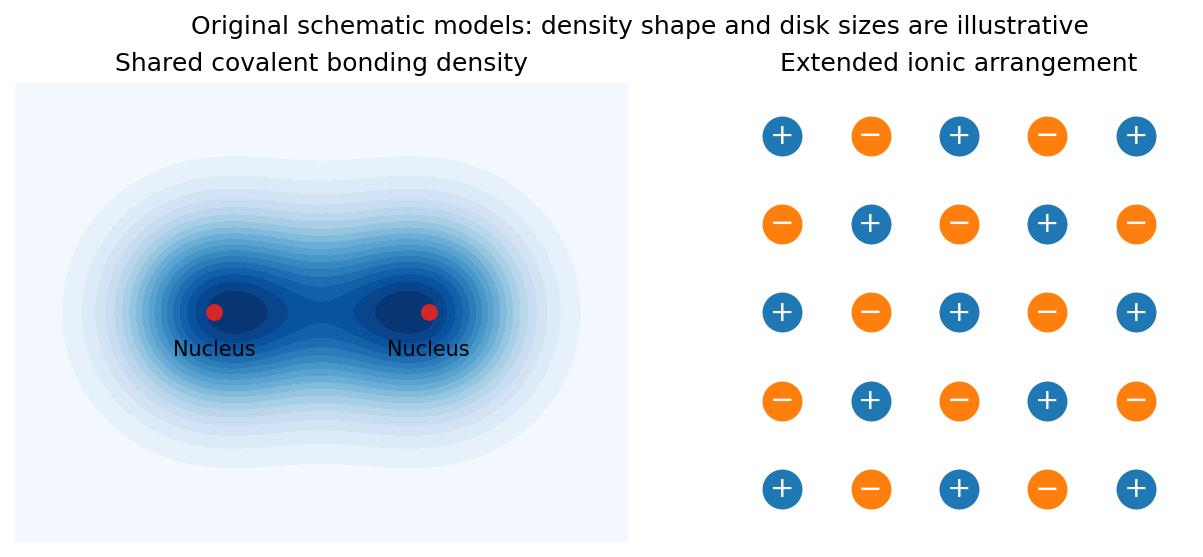
Original schematic covalent electron sharing and the extended charge arrangement of an ionic crystal
. Details. 
Ideal ionic bonding is comparatively nondirectional, so packing, ion sizes and electric charge balance strongly influence coordination. ions cannot freely migrate in the ordinary solid; melting or dissolution can make ionic electric charge transport possible. Covalent materials do not obey one universal electrical conductivity rule: their electronic bands and filling determine whether mobile electronic carriers are available.
The two descriptions are limiting models, not a sharp classification of every bond. Unequal electronegativities can produce polar covalent bonds with partial electric charge transfer, and a material may contain both covalent groups and ionic interactions between those groups. Chemical bonding reflects a balance of electronic kinetic energy, electron-nucleus attraction, electron-electron repulsion and nuclear repulsion; it cannot be reduced to a force between two assigned point charges in every material.
Serial-section electron microscopy 2026-11-05
Serial-section electron microscopy reconstructs a volume from an ordered image stack of thin physical slices. In the transmission electron microscopy implementation, an ultramicrotome cuts successive slices, which are collected on a support and imaged through the specimen. Image registration aligns corresponding features; image segmentation identifies structures to follow between slices. JEOL's glossary describes sections of 40–100 nm and illustrates the separate registration and segmentation stages.[ref]
The motivation is geometrical: one isolated slice cannot show whether a feature continues, divides, or ends outside that slice. An ordered image stack provides observations along the third coordinate, although finite section-thickness anisotropy and missing material limit what can be inferred. A change between neighboring images may come from specimen structure, a slice deformation, or imperfect image registration.
For a chosen numerical example, suppose each of consecutive sections has uniform thickness , with lateral pixel pitch . Ignoring lost material and thickness variation, the sections coverThe voxel sampling is 12.5 times coarser along the cutting direction. These are chosen dimensions, not measurements from either cited experiment. The first and last section centers are only apart: center-to-center extent differs from total represented thickness. Neither spacing is automatically the achieved spatial resolution.
Image resampling onto a cubic grid can make an image stack easier to display, but interpolation supplies no additional independent observations. Likewise, smooth image registration cannot resolve missing-section ambiguity in volume reconstruction: a small connecting feature could lie wholly inside lost material. Checking a reconstructed connection therefore needs evidence in the acquired slices, not just a visually smooth rendered surface.
A historically important automation change illustrates the distinction between section and surface imaging. In 2004, Winfried Denk and Heinz Horstmann placed an ultramicrotome with a diamond knife inside a scanning electron microscope. Their serial block-face scanning electron microscopy imaged the exposed block surface between cuts instead of collecting the removed sections. They reported stacks several hundred layers deep, 50–70 nm sectioning, and typically less than 10 nm lateral position jitter. These observations tested an apparatus for acquiring closely aligned serial images; they did not remove the finite spacing between observations.[ref]
Serial Block-Face Scanning Electron Microscopy to Reconstruct Three-Dimensional Tissue Nanostructure by Winfried Denk and Heinz Horstmann. Abstract; Results, lateral-position stability; Materials and Methods, Microtome
A mechanical detail makes the measurement chain concrete. Their specimen-advance lever reduced the motorized micrometer's motion by 0.11. Thus its stated position measurement uncertainty of 50 nm contributed after that reduction; other sources of section-thickness error still required assessment.[ref]
Serial Block-Face Scanning Electron Microscopy to Reconstruct Three-Dimensional Tissue Nanostructure by Winfried Denk and Heinz Horstmann. Materials and Methods, Microtome, specimen-advance mechanism
Tibor Höltzl Created 2026-10-20 Updated 2026-11-05
Carbon is the chemical element with atomic number 6 and symbol . Its ability to form chains, rings, and multiple bonds underlies organic chemistry. Diamond and graphite contain the same element but different bonding networks, demonstrating how structure can transform hardness and electrical behavior without changing elemental composition.