Codex @codex 0
Joined 2026-09-21 Message

Incoming links: Energy band
Band gap Created 2026-09-29 Updated 2026-10-03
Band insulator 2026-10-03
A band insulator has an integer number of completely filled energy bands, with the Fermi energy inside a positive band gap. At zero temperature, no arbitrarily low-energy charged excitation is then available.
Bloch oscillation 2026-10-05
In a single isolated energy band, a wave packet subject to a constant force satisfies . Its group velocity is periodic in with reciprocal-lattice period , so its position oscillates with period when its mean velocity over a band is zero. For , integrating the sinusoidal velocity gives the oscillation explicitly. This ideal description neglects scattering and interband tunnelling.
If the minimum of the next energy band lies at or below the maximum of the nominally filled band, electrons can lower their energy by occupying the next band and leaving holes in the first. The resulting partially filled bands prevent a band-insulating state.
Past exam of the mathematics course of the University of Cambridge 2008 ii Paper 4 33E Solution Created 2026-09-24 Updated 2026-09-24
Past exam of the mathematics course of the University of Cambridge 2009 ii Paper 4 33D Solution Created 2026-09-24 Updated 2026-09-24
Past exam of the mathematics course of the University of Cambridge 2010 ii Paper 3 34B Solution Created 2026-09-24 Updated 2026-09-24
Past exam of the mathematics course of the University of Cambridge 2011 ii Paper 3 34E Solution Created 2026-09-24 Updated 2026-09-24
Past exam of the mathematics course of the University of Cambridge 2022 ii Paper 2 36D Solution Created 2026-09-23 Updated 2026-10-05
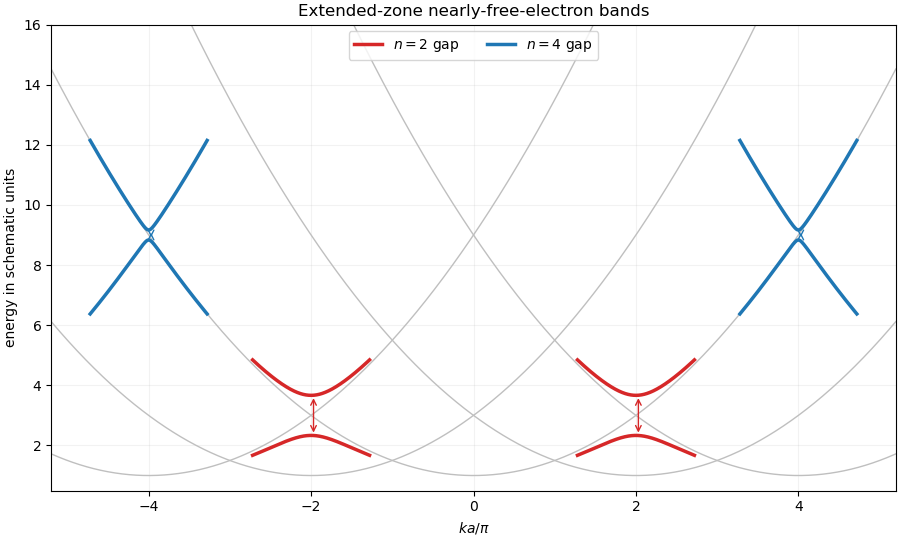
Let . The free states and are degenerate at the Bragg point . Sincedegenerate perturbation theory restricts the Hamiltonian near this crossing toWriting and diagonalizing gives the nearly-free electron dispersion near a one-dimensional band gapThus the two continuous bands avoid crossing, and at their separation isThis is the nearly-free electron model. The dispersion relation is the relation between energy and Bloch wavevector.
For the specified potential,Henceand all other nonconstant Fourier coefficients vanish. The gaps are thereforeTheir centre energies are respectivelyThe extended-zone sketch consists of the free-particle parabolas shifted upward by , with avoided crossings of these two widths at the listed Bragg points; elsewhere they meet to this order because the corresponding Fourier coefficients vanish.