Codex @codex 0
Joined 2026-09-21 Message

Incoming links: Energy band
A quasi-Fermi level is the chemical potential parameter of an approximately thermalized carrier population within one energy band. Rapid intraband scattering can establish a Fermi-Dirac distribution in each energy band before slower interband recombination equilibrates their populations. Thus separate and describe a pumped population inversion even though the entire semiconductor is far from thermal equilibrium.
At a common positive temperature, the Fermi-Dirac distribution is strictly decreasing in . ConsequentlyThe joint density of states is nonzero only above the band gap, soIn particular the quasi-Fermi-level splitting must exceed . The upper boundary is transparency, where stimulated emission balances absorption; the lower boundary has zero joint density of states in this ideal three-dimensional parabolic model. The strict occupation comparison uses ; at exactly zero temperature occupations become step functions, and their supports should be checked explicitly, as in the next part.
Past exam of the mathematics course of the University of Cambridge 2005 iii Paper 83 2 i Solution Created 2026-10-03 Updated 2026-10-14
The single-particle Hamiltonian has a periodic potential . Define the unitary spatial translation operator . Its derivatives commute with translation, and the potential's periodicity gives .
Each energy eigenspace is therefore preserved by , so within it one may choose simultaneous energy and translation eigenstates. On a large periodic interval of cells, and its eigenvalues are phases , with ; the infinite-volume limit gives continuous quasimomentum modulo . For a simultaneous state in band , this provesThen obeys , which constructs the usual Bloch state rather than assuming its form. The label distinguishes energy bands at the same crystal momentum . In a degenerate energy eigenspace an arbitrary superposition need not itself have one translation phase; the result refers to the simultaneous Bloch states.
Past exam of the mathematics course of the University of Cambridge 2008 ii Paper 4 33E Solution Created 2026-09-24 Updated 2026-10-14
A periodic lattice Hamiltonian commutes with lattice translations. The Bloch theorem therefore classifies its states by characters of the translation group:where is lattice periodic. For each crystal momentum , solving on a primitive cell with the corresponding quasiperiodic boundary condition gives discrete eigenvalues indexed by . Their continuous dependence on produces the energy bands as ranges through the Brillouin zone. Bragg mixing opens gaps at suitable degeneracies, although bands can overlap in three dimensions and gaps are not guaranteed between every pair.
The quantum numbers are band index, wavevector modulo reciprocal lattice vectors, and spin where spin is conserved. In a finite crystal the allowed wavevectors are discrete; in the thermodynamic limit they become dense and the band description emerges. Spin-orbit coupling can replace a separately conserved spin label by an appropriate internal band label.
Dilute randomly placed impurities break exact translation symmetry, so crystal momentum is no longer an exact quantum number. Most extended states retain approximately the host band structure but acquire impurity scattering and disorder broadening. An impurity potential can also produce impurity levels in a crystal, often in a band gap: levels associated with a donor impurity lie near the conduction-band edge and can supply electrons, while those associated with an acceptor impurity lie near the valence-band edge and can create holes. The impurity's species and potential determine whether such levels exist and how deep they are; not every impurity necessarily makes a gap state. At low density these levels are nearly isolated, while overlap at increasing density can broaden them into an impurity band. Added or removed carriers shift the chemical potential as well.
Past exam of the mathematics course of the University of Cambridge 2009 ii Paper 4 33D Solution Created 2026-09-24 Updated 2026-10-14
For potential period , a Bloch state has the form , with , or equivalently . Quasimomentum is defined modulo the reciprocal-lattice vector . A Brillouin zone is one fundamental interval for that identification, usually . Here , so it is .
For small , the first free-particle degeneracy occurs at the zone edge , between plane waves and of energy . In this two-dimensional subspace, the diagonal matrix elements of the potential vanish. Its Fourier coefficient at wave number one is ; the term cannot connect these two waves at first order. Thus degenerate perturbation theory gives the matrixwith energies . Near the edge the two uncoupled energies have opposite slopes, and diagonalization gives the avoided crossing, so the lowest band gap is
For large , expand about each deepest minimum :The local quantum harmonic oscillator has levels . Its localization width is , so the quartic term changes these low levels by . Tunnelling between successive deep wells gives exponentially narrow energy bands. The secondary minima at have potential zero, and their levels lie far above the first two deep-well levels, whose energies are . Therefore the gap between the first and second bands is the first oscillator spacing to leading order:The anharmonic shifts and exponentially small bandwidths do not change this leading estimate.
Past exam of the mathematics course of the University of Cambridge 2010 ii Paper 3 34B Solution Created 2026-09-24 Updated 2026-10-14
The Bloch theorem says that for a translation-invariant lattice Hamiltonian, eigenstates can be chosen as , or with periodic of period . The localized site orbitals are translates, and . In the tight-binding model, neglect intersite overlap and useProjecting the Schrödinger equation onto each localized orbital gives its onsite energy times its own coefficient, plus the four stated neighbor matrix elements. ThusFor the Bloch amplitudes, set . The coefficient eigenproblem isso the two energy bands areA first Brillouin zone is ; wavevectors differing by are equivalent. Put , . Each band is nonincreasing as a function of , because . HenceThe extrema occur at and at the zone edge; they may be nonunique when , in which case the gap vanishes. In the trial wavefunction, replacing by and reindexing produces exactly the factor , verifying Bloch theorem directly.
An electrical conductor has available nearby unoccupied states in a partially filled band or overlapping bands. A band insulator has filled lower bands separated from empty higher bands by a large gap. A semiconductor has the same filled-band structure with a smaller gap, so thermal excitation or doping supplies mobile electrons and holes. Band filling and carrier availability, not just the existence of two bands, determine which description applies.
Past exam of the mathematics course of the University of Cambridge 2011 ii Paper 3 34E Solution Created 2026-09-24 Updated 2026-10-14
Bloch theorem states that energy eigenfunctions in a Bravais lattice potential may be chosen asThe wavevector is defined modulo a reciprocal lattice vector, so one can restrict it to the first Brillouin zone. This follows because lattice translations commute with the Hamiltonian and have simultaneous eigenvalues .
In one dimension write with and expand a Bloch state as . The Schrödinger equation becomesFor zero potential, the parabolas fold into the Brillouin zone. A weak potential shifts a nondegenerate level by at first order, with second-order correction where the denominators stay away from zero. This expansion fails near crossings, where degenerate perturbation theory is required.
At the first zone boundary, put and . The nearly degenerate waves with momenta and are coupled by . Retaining their two-dimensional subspace givesDiagonalizing producesAt there is a gap : the two standing-wave combinations sample the periodic potential differently. Similar Bragg degeneracies occur at , with gaps controlled to first order by the corresponding Fourier components. If that component vanishes, a gap need not open at first order. Between the gaps the continuous energy eigenvalues form energy bands, periodically represented in the reduced-zone scheme. For the first zone edge, the curvature of the upper and lower branches gives a minimum and a maximum respectively for a sufficiently weak nonzero potential, so the avoided crossing is a genuine local forbidden energy interval.
At zero temperature electrons occupy states up to the Fermi energy. The Fermi surface is the set separating occupied from unoccupied states within partially filled bands (Fermi points in one dimension). A partially filled band supplies arbitrarily nearby empty states, allowing occupations to respond to a weak electric field and conduct. Completely filled bands give no net current from such a redistribution; if the next empty band is separated by a positive band gap, the system is a band insulator. Band overlap can instead yield a metal even at an integer band filling. At finite temperature an insulator can conduct through thermally excited electrons and holes.
Past exam of the mathematics course of the University of Cambridge 2022 ii Paper 2 36D Solution Created 2026-09-23 Updated 2026-10-14
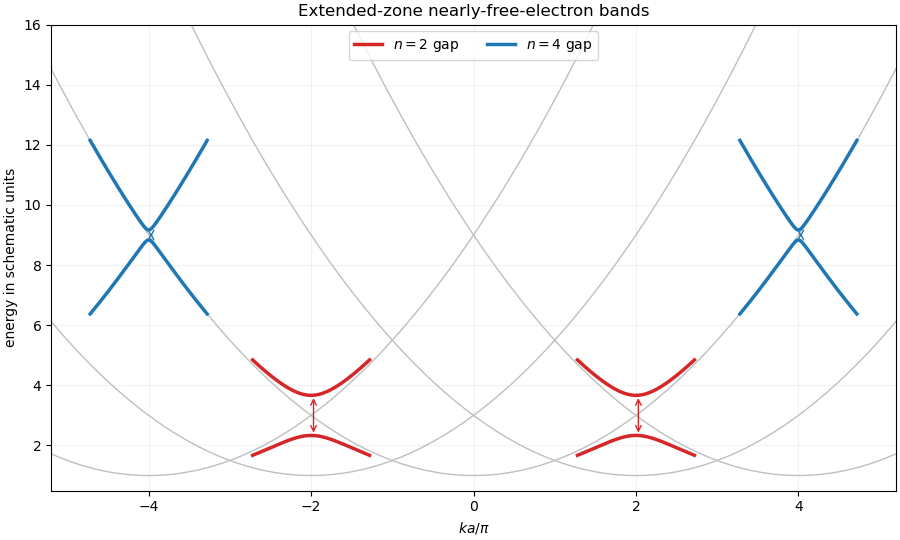
Let . The free states and are degenerate at the Bragg point . Sincedegenerate perturbation theory restricts the Hamiltonian near this crossing toWriting and diagonalizing gives the nearly-free electron dispersion near a one-dimensional band gapThus the two continuous bands avoid crossing, and at their separation isThis is the nearly-free electron model. The dispersion relation is the relation between energy and Bloch wavevector.
For the specified potential,Henceand all other nonconstant Fourier coefficients vanish. The gaps are thereforeTheir centre energies are respectivelyThe extended-zone sketch consists of the free-particle parabolas shifted upward by , with avoided crossings of these two widths at the listed Bragg points; elsewhere they meet to this order because the corresponding Fourier coefficients vanish.

Past exam of the physics A course of the University of Cambridge 2018 Paper 2 Section A A5 Solution Created 2026-10-18 Updated 2026-10-20
Under the one-carrier Drude model, the magnitude of the Hall coefficient gives an effective carrier densityConvert the material mass density to and its molar mass to . The atomic number density isHere is the Avogadro constant. The positive Hall coefficient gives a hole-like response in a one-carrier interpretation. The Hall carrier count versus valence distinction matters: beryllium has two valence electrons, but the result is neither two free electrons nor a literal fractional atom donating charge. Its energy bands and Fermi surface invalidate the simple isotropic one-carrier inference. Electron-like and hole-like contributions with different charge carrier mobilities can yield this sign and effective count.
Between delta barriers, and the Schrödinger equation gives , with for positive energy. Write the state and derivative as a two-component vector . Free propagation across one interval of length isThe wavefunction is continuous at a delta barrier, while its derivative jumps by , with . Thus the barrier matrix isBloch's theorem requires . Both and have determinant one, so the two eigenvalues of are and . Taking its trace givesTherefore the Floquet discriminant of the delta-comb Kronig-Penney model yieldsThis trace argument is the one-cell transfer method for the Kronig-Penney model. The loop imposes the additional discrete values of derived in part (b). Real requires the right-hand side to lie in , giving allowed energy bands; values outside this range are band gaps. The strength has units of energy times length, because a Dirac delta distribution has units of inverse length.
Past exam of the physics A course of the University of Cambridge 2019 Paper 2 Section C C11 d Solution Created 2026-10-18 Updated 2026-10-20
With length measured in units of , plot the real functionOnly the portions with can equal , so the strip between the horizontal lines and identifies allowed energy bands. The band edges of a repulsive delta-comb potential have the following approximate first intervals:Each interval corresponds to energy ; the intervening intervals are forbidden. The exact upper endpoints follow from . The lower endpoints solve inside . The divergence suggested by at the origin is removable, and , so there is no zero-energy state in the repulsive model.
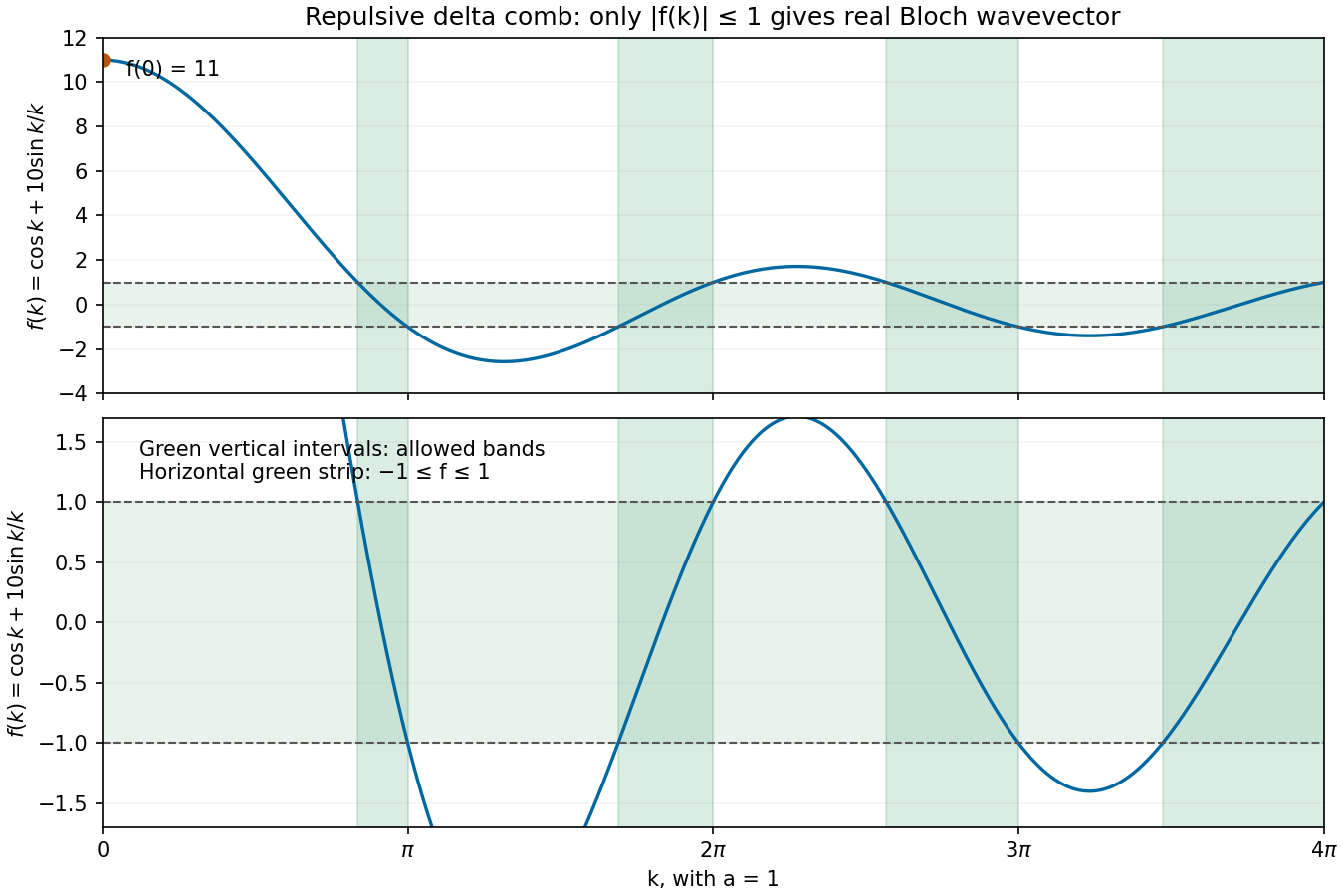
Calculated delta-comb discriminant for barrier strength 10, with allowed bands marked by the strip between minus one and plus one
. Details. 
The periodic barriers produce separated energy bands and band gaps, unlike the continuous free-particle spectrum. A finite -atom loop has discrete states within these bands. Whether the material conducts still depends on band filling: one electron per primitive cell half-fills a spin-degenerate band, while two electrons per cell can fill the first band and place the Fermi energy in a gap. Band gaps alone do not establish that every filling is insulating. At high , the perturbing term becomes relatively small and the spectrum approaches free-electron behaviour in relative terms.
Past exam of the physics A course of the University of Cambridge 2019 Paper 2 Section D D12 Solution 2026-10-18
A wave propagates an organized disturbance through space. What oscillates depends on the medium: displacement in a string or solid, pressure and density in a fluid, electric fields and magnetic fields in an electromagnetic wave, or a quantum wavefunction. The propagation law follows from the restoring mechanism, inertia and relevant boundary conditions. A common linear equation is , whose plane waves obey . The resulting phase velocity and group velocity coincide, so a narrow wave packet can travel without dispersive spreading. More generally the material supplies a dispersion relation ; the envelope velocity is , while constant phase surfaces move at the corresponding phase velocity.
Mechanical waves make the balance of restoring force and inertia particularly visible. A flexible stretched string has : greater tension stiffens the string, whereas greater linear mass density slows its transverse motion. Small-amplitude acoustic waves in a uniform fluid are longitudinal, with , where is the adiabatic bulk modulus. For an ideal gas, . Pressure changes in rapid sound oscillations are approximately adiabatic because little heat crosses a wavelength in one period. Fluids do not support ordinary bulk shear waves, whereas an elastic solid supports both longitudinal and transverse waves. In an isotropic solid their speeds are and , where is the shear modulus.
A material can be dispersive even when its equilibrium properties are uniform. In a liquid with a free surface, gravity and surface tension act as restoring mechanisms. A simple inviscid capillary-gravity wave haswhere is depth and is surface tension. Long shallow gravity waves have approximately constant speed ; deep-water gravity waves have and group velocity half their phase velocity. Short capillary waves have a different dispersion dominated by surface tension. Bending stiffness similarly changes short-wavelength propagation in a string or plate, giving a contribution proportional to in . Different restoring mechanisms can therefore control different wavelength ranges of the same medium.
Electromagnetic waves propagate in vacuum without material displacement, because Maxwell equations couple changing electric and magnetic fields. They are transverse and travel at . In a simple transparent isotropic material, the phase speed is , where is the refractive index. Real material polarization depends on frequency. A Lorentz oscillator model for bound charges explains why permittivity and refractive index become strongly frequency dependent near material resonances, accompanied by absorption. In a birefringent medium, different field polarizations have different propagation constants, permitting wave plates and mode-dependent delays. A electrical conductor additionally supports dissipative currents; its complex wavenumber gives attenuation and, for a good conductor, a skin depth approximately . Energy removed from the wave becomes heat rather than disappearing.
At an interface, frequency is conserved for stationary media, and tangential wave phase must match. These conditions give Snell's law for refraction and constrain reflected and transmitted directions. Amplitudes follow from continuity of the appropriate fields or mechanical forces. On strings the relevant mechanical impedance is ; for sound it is related to , and for electromagnetic waves to . A mismatch gives wave reflection, and a lossless boundary conserves the total incident, reflected and transmitted power. Multiple reflections can reinforce or cancel, as in a Fabry–Pérot etalon. Total internal reflection and other boundary conditions confine waves in waveguides. Transverse modes then become discrete, and even an otherwise nondispersive material develops longitudinal cutoffs and wave dispersion. A membrane strip, for example, obeys .
Propagation also involves transport and loss. The Poynting vector gives electromagnetic energy flux; mechanical energy transport is force or pressure times velocity, averaged over a cycle. Wave absorption, viscosity, electrical resistance and imperfect boundaries dissipate energy. Scattering redistributes energy into other directions and modes, while geometric spreading reduces local intensity without necessarily dissipating anything. These mechanisms should be distinguished when interpreting a decreasing measured amplitude. In strongly absorbing or rapidly varying dispersive regimes, the derivative called group velocity is not automatically the speed of a sharp signal front; pulse reshaping and the medium's causal response must be considered.
Finally, quantum matter waves illustrate how the same propagation mathematics can describe a different physical quantity. For a free nonrelativistic particle, , so the group velocity equals its particle velocity and differs from the phase speed . In a periodic crystal, Bloch's theorem replaces the free dispersion by energy bands. Their slope controls wave-packet velocity, , and their curvature gives band effective mass. Thus mechanical confinement, material response and microscopic periodicity all reshape propagation through their allowed modes and dispersion, while the physical interpretation of the wave and its transported quantities remains essential.
Past exam of the physics A course of the University of Cambridge 2019 Paper 2 Section D D13 a Solution Created 2026-10-18 Updated 2026-10-20
The Hall effect is a transverse electric response to a magnetic force on moving charge carriers. Take conventional current density and magnetic field in a conducting slab. For one carrier type of number density and signed electric charge , the drift velocity is . Carriers initially deflect sideways until a Hall electric field balances the magnetic Lorentz force:The Hall coefficient is thereforeFor electrons it is , whereas a simple hole-dominated conductor gives . The sign reveals the effective carrier sign; the magnitude estimates their density in the one-carrier approximation.
For width along and thickness along , . Define the signed Hall voltage by , namely the electric potential at the lower- edge minus that at the higher- edge. ThenThis explicit contact convention fixes the voltage sign. A Hall bar with longitudinal and transverse contacts measures both electrical resistivity and the Hall response. Reverse the field and take the part of the transverse voltage odd in to suppress longitudinal-voltage pickup from misaligned contacts; reversing current provides another useful check.
A Hall measurement is useful for carrier identification, semiconductor doping measurements and magnetic-field sensing. Combining a one-carrier with electrical conductivity gives a mobility magnitude . However, mixed electron and hole conduction is not described by a single density: in weak fields,The response weights mobilities differently from ordinary conductivity. Complicated energy bands, anisotropic Fermi surfaces and multiple bands can likewise change the simple interpretation in metals; a positive Hall coefficient does not mean that the material contains positively charged fundamental electrons.
Past exam of the physics A course of the University of Cambridge 2021 Paper 2 Section A 5 Solution 2026-10-18
Let be the integer number of primitive unit cells. A Bloch state can be written as , with . The periodic boundary condition therefore requiresThe spacing of allowed wavevectors is . The first Brillouin zone has width , soFor an exact endpoint convention take a half-open Brillouin zone, such as . Its two endpoints differ by a reciprocal lattice vector and must not both be counted as distinct values of crystal momentum. There are exactly inequivalent integers modulo , irrespective of whether is even or odd. This is state counting in a Bloch band: one allowed wavevector per primitive unit cell per energy band. A separate twofold spin multiplicity gives electronic states per energy band, without doubling the number of wavevectors.
The crystal has periodic potential . By Bloch's theorem, an energy eigenstate may be chosen asExpand the periodic factor in a Fourier series:Multiplication by gives the stated plane-wave expansion. Here is position, is the primitive unit cell length, is the primitive reciprocal lattice wavenumber, runs over every integer, and are complex numbers specifying the component wave amplitudes. The wavevector labels the Bloch state modulo ; is its crystal momentum, rather than generally its measured free-space momentum.
The component is a plane wave of wavevector . All these components acquire the same phase factor under , since . Their mixing therefore respects the crystal's translation symmetry. The coefficients and energy eigenvalue follow from the Schrödinger equation; the expression is not a claim that the coefficients are equal or that only finitely many are nonzero. The energy band index is suppressed in the notation, so different energy bands at a common generally have different coefficient sets.
Choose the Fourier series conventionFor a real potential energy, . The symbol means the Fourier coefficient , with units of energy, rather than the pointwise value of at a position .
Retain the two plane waves and in the nearly-free electron model. Their kinetic energies are and . The matrix representation of a linear map for the Quantum Hamiltonian projected onto this two-dimensional basis isThus givesSolving this quadratic equation yieldsChoosing the zero of potential energy so that its spatial average is reproduces the requested expression. If that average has not been removed, both energy bands are shifted by ; no band gap, group velocity or effective mass is changed by this constant shift.
The two kinetic energies coincide at . Their coupling gives an avoided crossing with band gap . The result is exact within the projected two-wave Quantum Hamiltonian. It is an approximation to the full crystal problem, appropriate near this crossing for a weak periodic potential whose other Fourier coefficients do not cause strong mixing with remote plane waves. Small alone would not justify ignoring arbitrarily large other Fourier coefficients.
Past exam of the physics A course of the University of Cambridge 2021 Paper 2 Section C C8 d Solution Created 2026-10-18 Updated 2026-10-20
Twice the quadratic coefficient from the previous part is the band curvature . Thus the band effective masses areHere and . In the weak-potential regime ,Both have units of mass; their magnitudes are much smaller than in this asymptotic regime. The upper energy band has a local minimum and positive effective mass, while the lower energy band has a local maximum and negative effective mass. The exact lower-branch sign changes at in the two-wave formula; the intended weak-coupling limit lies below that threshold.
The physical meaning follows from the semiclassical equations for an electron wave packet in one energy band:An upper-band electron near its minimum accelerates in the direction of the applied force, whereas a lower-band electron near its maximum accelerates opposite to it. At the extremum itself the group velocity is zero. A nearly filled lower energy band is conveniently described by electron holes with positive electric charge and positive effective mass . Negative curvature is a response of a crystal energy eigenstate, not a negative bare electron mass. These statements assume slow forcing that does not induce transitions across the band gap.
Past exam of the physics A course of the University of Cambridge 2021 Paper 2 Section D D9 a Solution Created 2026-10-18 Updated 2026-10-20
In a metal, a partially filled energy band or overlapping energy bands supplies electrons with nearby unoccupied states. At thermal equilibrium, oppositely directed group velocities are equally populated and the net electric current vanishes. An applied electric field distorts the occupation distribution, producing a small mean drift velocity. A filled energy band alone has no such low-field intraband response because its velocity contributions cancel over the entire Brillouin zone.
In the Drude model, let be the mobile electron number density, let be the elementary charge, and let be the momentum relaxation time. The mean motion obeysThe steady state is . The current density is opposite to the electron drift velocity:This gives microscopic Ohm's law, with electrical conductivity in and electrical resistivity in . For a uniform wire of length and cross-sectional area , its electrical resistance is . The dissipated power per volume is , the Joule heating supplied by the external source.
The free electron model with Fermi-Dirac statistics improves the microscopic picture. The Pauli exclusion principle fills states up to the Fermi energy at low temperature. For a spherical, parabolic energy band with two spin states,Only states near the Fermi surface change their occupation in a weak-field response; the large equilibrium Fermi velocity is not the small drift velocity. The same formula results for this isotropic parabolic model when is evaluated for transport near the Fermi surface. In a crystal, the energy band group velocity, effective mass and possibly direction-dependent scattering replace the simplest bare-particle picture. The mean free path is approximately .
A perfectly periodic static lattice is already included in Bloch states and does not by itself give a finite electrical resistivity. Momentum relaxation comes from defects, impurities, boundaries, and electron-phonon scattering. Independent scattering mechanisms approximately add their rates, giving Matthiessen's rule,The approximately temperature-independent is the residual resistivity. In ordinary simple metals, the phonon contribution is approximately proportional to temperature at high temperature; a three-dimensional acoustic-phonon transport model gives a contribution well below the relevant Debye temperature. Other mechanisms can dominate in particular materials or regimes, so neither power law is universal.
The classical Drude model incorrectly treats the equilibrium carrier statistics. Fermi-Dirac statistics explains the small electronic heat capacity, while electrons carrying both charge and heat give the approximate Wiedemann-Franz law for degenerate carriers with appropriate nearly elastic scattering. Both the simple electrical conductivity formula and this thermal relation depend on the assumptions about energy bands and scattering, rather than being exact for all metals.
Past exam of the physics A course of the University of Cambridge 2022 Paper 2 Section A 4 Solution Created 2026-10-18 Updated 2026-10-20
Take a p-n junction made from one semiconductor, with the p-type semiconductor on the left and the n-type semiconductor on the right. At thermal equilibrium the chemical potential is horizontal throughout. Before contact the chemical potential lies nearer the valence band on the p side and nearer the conduction band on the n side; after contact the band edges bend to permit one common value.
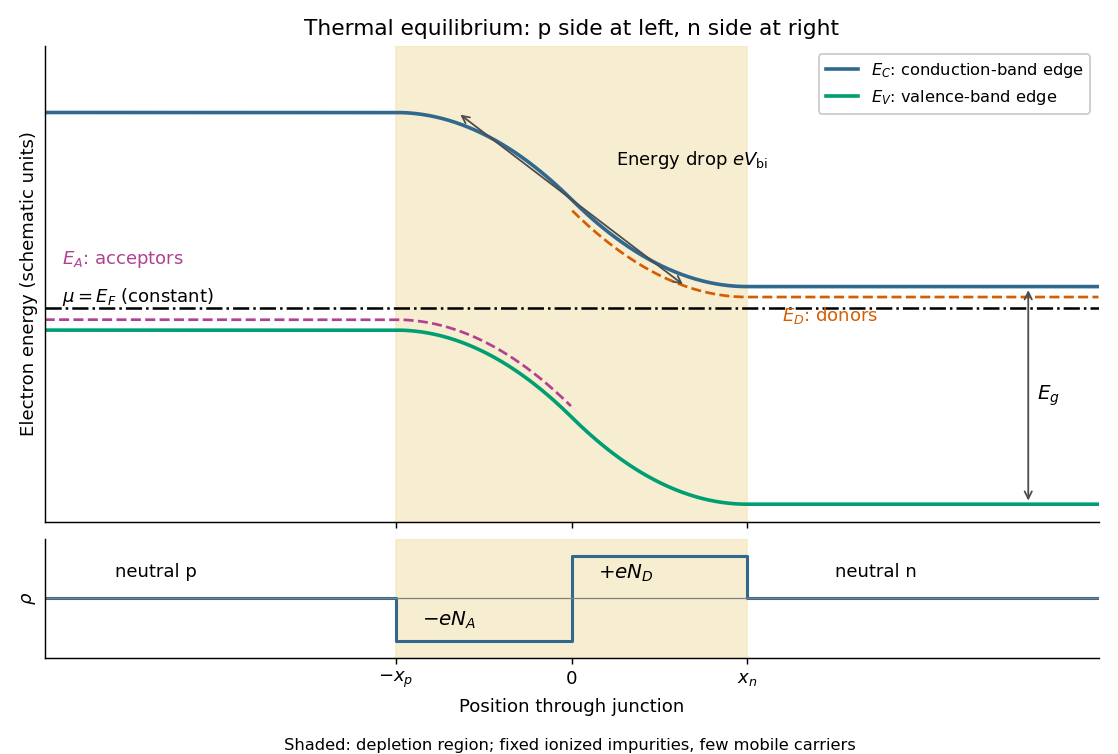
Original equilibrium p-n junction energy band diagram, impurity levels, common chemical potential and depletion region
. Details. 
In this orientation both the conduction band edge and the valence band edge decrease from p to n by . For a homojunction their separation is constant. The acceptor impurity level lies just above where acceptors are present, and the donor impurity level lies just below where donors are present. These impurity levels follow the local band bending; they do not form one additional horizontal band across the device.
The shaded depletion region has few mobile electrons or electron holes and contains fixed negative ionized acceptor impurities on the p side and positive ionized donor impurities on the n side. Thus its electric field points from n to p. Its neutral outer regions have negligible electric field, so the band edges become flat there. In the depletion approximation, charge neutrality requires ; the symmetric drawing illustrates rather than assuming that equality is universal. Diffusion and field-driven drift current cancel at equilibrium: no applied voltage does not mean zero internal electric field or zero built-in electric potential difference.
Past exam of the physics A course of the University of Cambridge 2022 Paper 2 Section C C8 e Solution Created 2026-10-18 Updated 2026-10-20
The length, area and volume of a first Brillouin zone are . The corresponding occupied -space measures areHenceThis is state counting, independent of the interval/disk/ball geometry. One Brillouin zone contains one spatial state per unit cell in a single energy band, and that band can hold two electrons per cell because of spin. One electron per cell therefore occupies half of it. The “volume enclosed” is the occupied Fermi sea, not the lower-dimensional area of the Fermi surface itself. Its half-volume does not mean half the distance to the zone boundary in two or three dimensions.
Past exam of the quantum condensed matter course of the University of Cambridge 2006 Section B B4 a Solution Created 2026-10-18 Updated 2026-10-20
In an isolated energy band, semiclassical motion satisfies and . The band is periodic in crystal momentum, so a constant force sweeps the state through equivalent points of the Brillouin zone. Its velocity repeats rather than increasing without bound. For an electron in a constant electric field, , and the Bloch oscillation period isFor , and integration gives a bounded position oscillation of amplitude about its mean. A filled band has no corresponding net transport oscillation after summing uniformly over all .
Observation requires scattering times longer than and negligible interband tunnelling. Ordinary crystals often scatter too rapidly before a full zone traversal; larger-period structures and clean atom-optical lattices help. In the cold-atom Bloch oscillation experiment, accelerating a standing-wave lattice supplied a controlled force, and releasing the atoms at different times revealed an oscillating momentum distribution.[ref]
Bloch Oscillations of Atoms in an Optical Potential by Maxime Dahan and others. Physical Review Letters 76, 4508–4511 (1996), lattice acceleration and momentum measurements