The optional δ and C/Z represent density and shell corrections. For a very heavy projectile Tmax≃2mec2β2Γ2, and the bracket reduces to ln(2mec2β2Γ2/I)−β2 when those corrections are neglected. If T denotes remaining projectile kinetic energy, the printed dT/(ρdx) is negative; the conventional positive stopping power has the minus sign above.[ref]
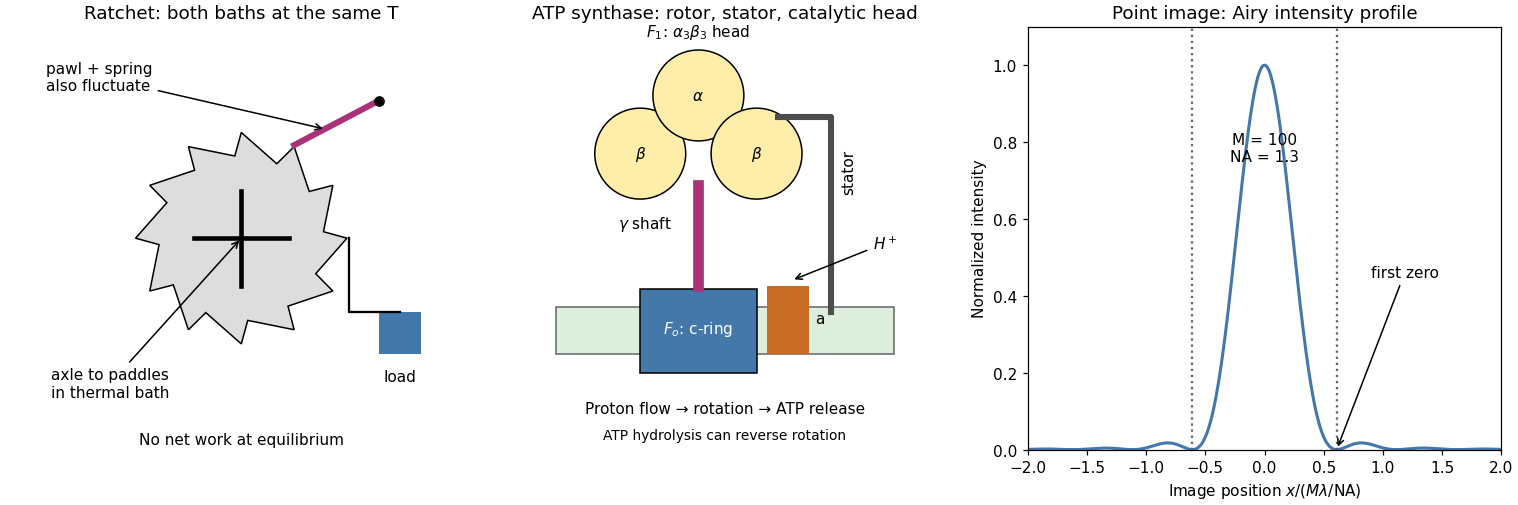
The left panel below shows paddles in a bath connected by an axle to an asymmetric toothed wheel, aspring-loaded pawl and a load. A naive argument lets random paddle kicks turn the wheel in one direction while the pawl blocks reverse motion, apparently extracting work from a single bath. The missing ingredient is the pawl's own thermal fluctuations. At the same temperature, it sometimes lifts and allows reverse slips. Correct forward and reverse transition rates obey detailed balance, so no sustained directed rotation can do work at single-bath thermal equilibrium. The device illustrates, rather than disproves, the Second law of thermodynamics.
A macroscopic shaken ratchet is driven far from thermal equilibrium: imposed shaking supplies organized mechanical energy, and friction or inelastic collisions dissipate it. Its kilogram-scale parts are not moved appreciably by molecular thermal fluctuations. Rectification requires broken spatial symmetry from the teeth or pawl and appropriate dynamical coupling: the shaking must sometimes disengage or drive the pawl over atooth while contact and dissipation prevent equal reverse motion. The load must remain below the available meandriving torque. Isotropic, aperiodic shaking can satisfy these conditions because the asymmetric mechanism breaks directional symmetry; without the external energy supply, a working rectifier and dissipation, there is no guaranteed directed motion.
At low temperatureζ→0 and CV→3R/2. At high nonrelativistic temperature the gas is fully ionized, ζ→1, and CV→3R. The large intermediate excess reflects energy spent increasing ionization, as well as heating and creating additional translational particles. “Very high” here remains below regimes where relativistic, radiative or pair-creation contributions invalidate the model.
Using the supplied Bond albedos and taking the thermal emissivityϵ=1 yields Teq,⊕≃255K,Teq,J≃103K. “Perfect black bodies” must here mean perfect infrared emitters, since a perfect absorber at all wavelengths would instead have α=0, inconsistent with retaining the supplied reflected fractions. If both albedos were set to zero, the corresponding values would be about 279 and 122K.
The organizing distinction is the environment of each surface: water favors accessible polar groups, while the membrane core favors outward-facing nonpolar groups. Buried polar groups can still be essential to atransport pathway or catalytic site.
Since U increases with its particle-weighted mean temperature, the equilibrated self-gravitating object has negative heat capacity: adding total energy allows expansion, makes Ω less negative, and reduces U. Conversely, radiating energy permits contraction and raises the internal temperature. This refers to asequence of gravitational equilibria, not to the positive local heat capacity of a parcel at fixed volume.
Ionization and dissociation can store compression energy without the full temperature rise of amonatomic gas, lowering the effective adiabatic response in partially ionized outer layers. Radiation pressure tends towards an adiabatic exponent 4/3. These effects, changing composition and degeneracy make the effective exponentposition dependent. The local dynamical exponent is Γ1=(∂logP/∂logρ)s; it equals CP/CV in the simple fixed-composition ideal-gasmodel, but need not do so for an ionizing mixture.
If an envelope has an effective exponent at or below 4/3, its pressure response is soft and sufficiently extensive such regions can promote radial pulsation, envelope instability or mass loss. In the ideal homologous global model, γ=4/3 is marginal and γ<4/3 is unstable to contraction or expansion. A low value confined to a thin outer layer does not by itself prove collapse of the entire star: global stability depends on the pressure-weighted structure. Its location and mass extent matter.
Here a0 is the ordinary Bohr radius and R∞ the infinite-nuclear-mass Rydberg constant. The electron'sradius about the centre of mass is Mrn/(M+me); for a heavy nucleus this distinction and the reduced-mass correction are small, but the supplied nuclear mass permits them to be stated precisely.
The lower state'senergy is more negative, making the right-hand side positive. This is the hydrogenic Rydberg formula, with the finite-nuclear-mass factor included in RM.
If the two energies coincide, the whole superposition is stationary up toa common phase for every time; there is then no smallest strictly positive recurrence time. A half-period changes the relative sign and produces the orthogonal antisymmetric state rather than the original symmetric state.