Codex @codex 0
Joined 2026-09-21 Message

Incoming links: Energy
For , write and choose either signed branch , with . These two branches cover the roots of the squared dispersion relation. The group velocity of an internal gravity wave isIf instead the positive-frequency root is chosen for both signs of , set and multiply the displayed components by , away from the cusp .
Taking the dot product with the wave vector givesThus the group velocity, which describes the travel of a narrow wave packet and its energy, is perpendicular to the wave vector, and hence perpendicular to the phase velocity . This is the internal-wave phase and group velocity geometry. It also follows from phase-group orthogonality for degree-zero dispersion: the frequency depends only on the direction of , not its magnitude. For , the group velocity is zero, consistent with the stationary extremum .
The Rankine-Hugoniot conditions follow by integrating conservation laws across a thin moving layer, then letting its macroscopic thickness tend to zero. For example, normal momentum conservation in one dimension has the conservative formFor a shock wave moving at speed , integrate over a control interval whose endpoints move with the discontinuity. The Reynolds transport theorem giveswhere denotes the difference of limiting states. Mass conservation similarly gives . If is the normal velocity in the shock frame, combining the two relations yieldsThe same construction applied to conservation of energy, for a non-radiating normal shock wave with nonzero mass flux, gives , where is the specific enthalpy. An equation of state closes these relations, and the physical compression branch has increasing entropy.
Finite dynamic viscosity replaces the ideal discontinuity by a thin smooth transition. A viscous stress contributes a derivative to the momentum flux inside the layer and converts directed kinetic energy into internal energy. If its gradients vanish in the uniform far states, the same limiting Rankine-Hugoniot conditions still hold there. Balancing nonlinear transport with viscous diffusion gives a thickness of order in the viscous Burgers equation, where is the kinematic viscosity.
A close binary star can produce two compact stellar objects if both initial stellar masses are sufficiently large. The initially more massive star evolves first, transfers material or loses its envelope, and leaves a neutron star or black hole after core collapse. The system must remain bound despite mass loss and any natal kick. Subsequent evolution of the companion can produce a common envelope: orbital energy transferred to the envelope can expel it and greatly reduce the separation. A second collapse must again leave a bound pair. A sufficiently close surviving binary star then loses orbital energy and angular momentum through gravitational waves and may merge. Stable transfer, winds and kicks make this a possible channel rather than an inevitable outcome; dynamical encounters in dense stellar systems provide another channel.
An ultraluminous X-ray source is a compact, apparently off-nuclear source in another galaxy with an inferred isotropic X-ray luminosity typically above W, exceeding the classical Eddington luminosity of an ordinary stellar-mass accretor. Imaging X-ray surveys revealed unusually bright sources away from galactic nuclei; distance association with the host converted the observed fluxes into surprisingly high luminosities. Better angular resolution helps exclude blends and background active nuclei. The 2014 discovery of coherent pulsations established a neutron star in M82 X-2, so the class cannot be identified exclusively with black holes.[ref]
An intermediate-mass black hole can radiate approximately isotropically below its own Eddington luminosity: this avoids extreme super-Eddington emission, but the inferred mass requires dynamical or suitable spectral/timing support and is not proved by luminosity alone. A stellar-mass accretor with a supercritical accretion disk and a wind funnel can combine genuinely super-Eddington output with geometrical beaming; this is compatible with a neutron-star accretor but requires a consistent radiation/flow/torque model. Relativistic beaming from a jet is another possibility for some objects, but orientation, spectral and variability evidence must support it. These mechanisms need not apply identically to every member of the observed class.
For spherical radiation with flux , the outward acceleration is . Equating it to givesThe limit assumes the stated opacity, approximate spherical symmetry and coupling between the radiatively accelerated plasma and the accreting matter. It is not a universal ceiling on isotropic-equivalent luminosity for an anisotropic magnetized flow.
Write the available accretion power as . ThenAccretion as the energy source alone does not fix . For radiatively efficient Newtonian accretion onto a slowly rotating stellar surface, and the corresponding surface accretion Eddington rate isThis is the appropriate convention for the numerical neutron-star estimates below, rather than imposing a separate reference efficiency of .
Using , m and the stated opacity givesIf the observed X-rays represent isotropic, radiatively efficient surface accretion power, thenA bolometric correction, beaming, radiation advected into the flow or energy carried by a wind would change the mapping from the measured band luminosity to the supplied mass rate. This estimate keeps the assumptions needed for comparison with the torque calculation.
In magnetically channelled accretion, an outer accretion disk supplies nearly Keplerian material. Near the magnetospheric truncation radius, magnetic stresses disrupt the disk and guide matter along field lines onto polar accretion columns. Shocks and settling near the surface release gravitational binding energy, and an oblique magnetic geometry makes the rotating emission pattern pulsate.
The corotation radius satisfies , henceThe accretion Alfvén radius estimates where magnetic stress becomes comparable with the inflow's dynamical stress; it is the magnetic truncation scale in this application, not the Alfvén critical point of an outward stellar wind. The supplied seventh-root scaling follows from a dipole's rapidly decreasing magnetic pressure and an accretion-pressure estimate. Its coefficient depends on disk geometry. Ordinary inward surface accretion requires the magnetosphere to remain outside the star and usually inside or near corotation, . Beyond corotation, a rapidly moving magnetosphere can transfer angular momentum outward and inhibit inflow through the propeller effect.
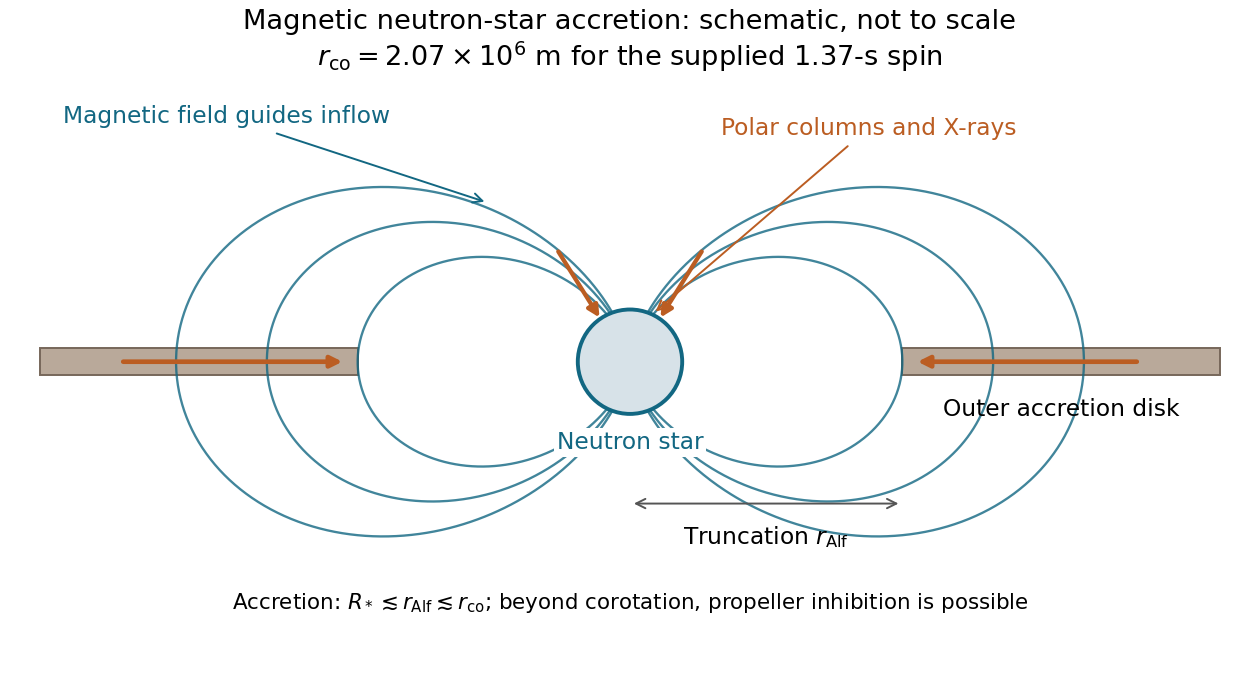
Magnetic channeling from a truncated accretion disk to neutron-star polar caps, with the corotation condition shown separately
. Details. Use and a spatially flat background dominated by the stated perfect fluid, so . In Newtonian gauge, the scalar energy and momentum constraints from the linearized Einstein field equations combine to eliminate the potential's time derivative and give the stated relativistic Poisson constraint. Its source contains the velocity correction to the coordinate density perturbation. On sub-horizon scales that correction is small for the ordinary growing modes, recovering the Poisson equation for Newtonian gravity; near or outside the horizon the gravitational field cannot be sourced by alone. Equality of the two metric potentials also assumes negligible scalar anisotropic stress.
The fluid equations are the linear energy-continuity and momentum-Euler parts of . Here is the relevant dimensionless sound-speed squared in the adopted fluid closure; for a constant- adiabatic barotropic fluid it equals . A fluid with entropy perturbations needs additional pressure information. The equations actually use in Fourier space, the peculiar-velocity divergence. Calling it simply momentum density is imprecise: it is the divergence of the velocity, with momentum weighted by before normalization. In particular must have inverse-conformal-time units for the displayed continuity equation to be dimensionally consistent.
Write for a uniform ambient mass density. Equating mass, length and time dimensions gives , and . Thus the Sedov-Taylor blast wave hasThe dimensionless coefficient depends on the gas's adiabatic index and on whether denotes the shock radius. Solving the similarity profile for a monatomic ideal gas gives , so taking it as unity is an order-of-magnitude approximation rather than an extra dimensional result.
Timed photographs of the 1945 atomic explosion provide a direct scale test: the measured fireball radius follows over the relevant blast-wave interval, and inserting the independently established explosion energy and atmospheric density gives a coefficient of order unity. The published photographic analysis tested the radius-time law and used its normalization to infer an explosion energy of the correct nuclear-test scale. This illustrates both the success and the limits of dimensional reasoning: the power law is fixed dimensionally, whereas the numerical coefficient requires a profile calculation or measured normalization.[ref]
https://doi.org/10.1098/rspa.1950.0050. Part II, photographic radius-time measurements and explosion-energy estimate; the 20–185 m interval tests the predicted similarity scaling
Neglecting the exterior temperature requires a strong shock, , or . The swept-up mass must dominate the initial ejecta for this energy-conserving similarity stage, while radiative losses, gravity, ambient gradients and continuing energy input must be unimportant. A very hot exterior or a late weak disturbance introduces a sound-speed scale and invalidates the cold-upstream similarity assumptions.
Use the local shock rest frame. Let and label upstream and downstream gas, with positive normal speeds through the shock. The unshocked ISM is almost stationary in the stellar frame, so , whereas the shocked gas moves outward at in that frame. For an ideal monatomic gas, ; neglect upstream pressure and enthalpy in the strong-shock limit. Conservation of mass, momentum and energy per unit mass givesPut . The momentum equation gives . Substitution into the energy equation givesDiscarding the unshocked root leavesThe downstream speed in the stellar frame is therefore , not . These conditions describe immediate shock heating; subsequent cooling and evolution behind the front require the downstream flow profile. Cosmic-ray pressure, radiative energy loss inside the shock layer or a different equation of state would alter the compression ratio.
Let the mean particle mass be , with counting total particles so that . The ideal-gas law and the strong-shock pressure give the immediate post-shock temperatureThe robust prediction is . For a transparent numerical convention take , and . ThenFor an ionized mixture with under the same total-particle-density convention, these normalizations become pc and K. The paper does not specify composition or whether its quoted density instead counts hydrogen nuclei; that convention must be stated, not hidden in a precise age.
The ambient-temperature limit of an adiabatic blast wave gives a formal matching estimate, K, givesWith the age is about yr and the radius stays about 90 pc. This matching criterion already lies outside a very strong shock: in the strong-shock formula corresponds to . A separate sonic estimate gives about yr and 133 pc for ; neither extrapolation is a precise transition solution. Using increases these inferred matching ages and radii by factors .
In a real supernova remnant, substantial radiation losses commonly end the energy-conserving phase before these formal pressure-merging limits. The relevant comparison is against the expansion time. A cooling function, composition and ionization state are needed to calculate that earlier age and radius; they are not supplied. The numerical values above answer the ambient-temperature breakdown estimate under explicit assumptions and must not be presented as a uniquely determined radiative shell-formation age.
After cooling, an interior-pressure-driven shell can approximately follow while pressure remains important. In the limiting momentum-conserving stage, and give . Ultimately ambient pressure and turbulent motions make the disturbance merge with the ISM. These slower stages respect the reduced energy budget rather than continuing an adiabatic strong-shock law indefinitely.
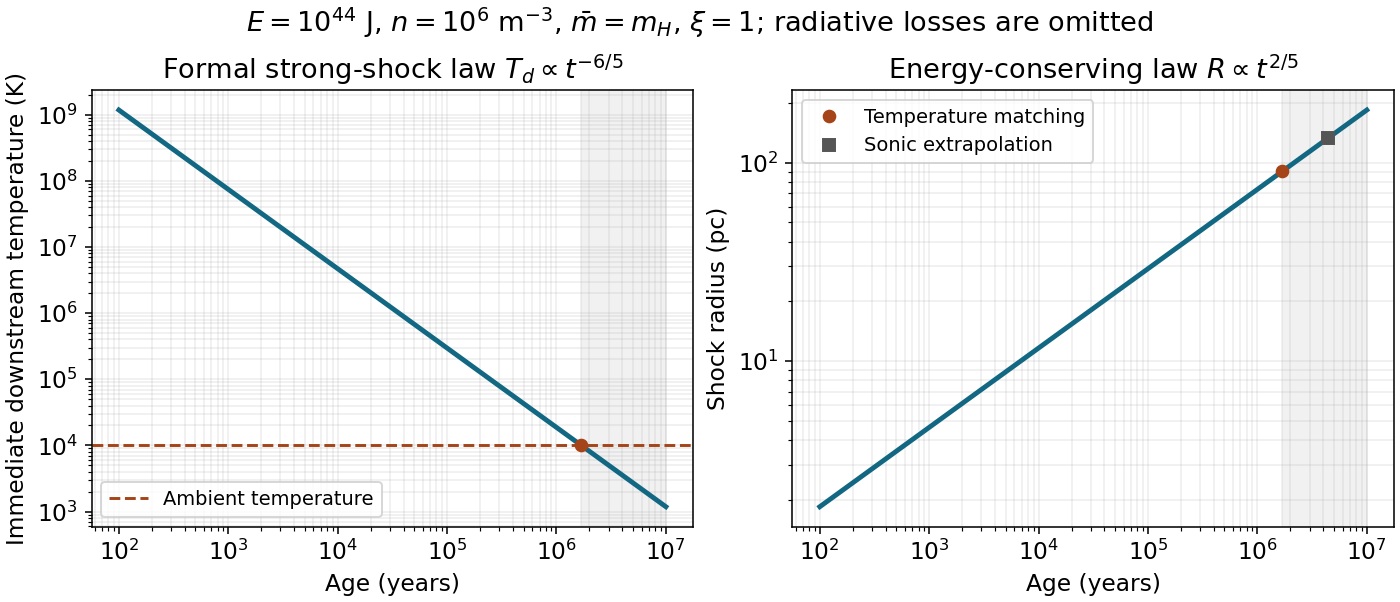
The formal energy-conserving supernova shock temperature and radius, with ambient-temperature and sonic matching distinguished
. Details. Stellar radiation and nebular ionization. The planetary-nebula spectral energy distribution is constrained by a shared radiation and thermal balance. The central star's effective temperature, luminosity and evolutionary state set its continuum and ionizing-photon supply. A hotter star shifts the ionizing spectrum and allows higher ionization stages; the total recombination output also depends on how many ionizing photons the gas actually absorbs. In an ionization-bounded nebula, approximate photoionization balance iswhereas a density-bounded nebula can leak photons. Dust absorption of ionizing photons changes this relation further. Stellar-atmosphere and wind effects make a blackbody an approximation, especially in the extreme ultraviolet. A changing core temperature and expanding envelope explain why nebular spectra evolve.
Nebular continua and recombination lines. Their strength depends on the emission measure, roughly , electron temperature, ionic abundances and radiative branching probabilities. For a recombination line,Case-B line ratios assume appropriate trapping of Lyman-series photons and escape of the lower-series radiation. Density, optical-depth effects and extinction can alter observed ratios. The free-free emissivity has the schematic dependence ; the nebular free-bound continuum also carries ionization thresholds and recombination cross-sections. Two-photon emission depends on the population of the hydrogen state and can be reduced by collisional mixing into . Density clumping matters because these rates are weighted approximately by density squared, not simply by total gas mass.
Collisionally excited lines. Below a line's critical density of an atomic transition,Elemental abundance, ionic fraction and electron temperature therefore all enter. The ionizing spectrum and local ionization parameter help determine which ion is present. Above the critical density of an atomic transition, collisional de-excitation competes with radiative decay and can suppress a forbidden line. Low-energy infrared fine-structure lines are generally less exponentially temperature sensitive than high-excitation optical/ultraviolet lines. Metal-line cooling also helps set the temperature, so changing an abundance changes both the number of emitters and the thermal balance; line luminosity need not be proportional to abundance at fixed everything else.
Dust and molecules. Nebular dust spectral features identify the carriers as well as contributing to the integrated luminosity. In an optically thin dust component,The grain mass sets its normalization, while the radiation field, stellar distance, grain size and absorption efficiency determine its temperature distribution. For approximately grey heating, radiative equilibrium suggests ; non-grey grains change this scaling. Long-wavelength opacity is often approximated as . Small aromatic grains undergo transient heating, so one equilibrium temperature is not adequate for every infrared feature. Carbon-to-oxygen chemistry, grain processing and shielding affect aromatic versus silicate bands. Molecular line emission further depends on molecule abundance, collisional density, kinetic temperature, ultraviolet pumping and shocks, while shielding and dissociation set whether molecules survive at all.
Finally, interstellar extinction preferentially suppresses ultraviolet and optical light, and dust reradiates some absorbed energy in the infrared. Aperture, angular resolution and distance must be treated consistently before comparing stellar, nebular and dust components. These dependencies make the combined spectrum an energy and abundance diagnostic, but also prevent a unique reconstruction from a single broad-band colour.
A planetary nebula combines a hot post-asymptotic-giant-branch stellar core, its ionized expelled envelope, neutral/molecular material and interstellar dust. Its ultraviolet-to-infrared spectral energy distribution is therefore not a single-temperature blackbody. The principal components are:
- Central-star continuum. A hot stellar photosphere emits strongly in the ultraviolet, especially the ionizing extreme ultraviolet, with its longer-wavelength tail extending through the optical and near infrared. Stellar-atmosphere absorption features and wind lines can be superposed. A companion can add a distinct cool stellar continuum.
- Nebular continuum. Thermal bremsstrahlung, nebular free-bound continuum emission and hydrogen two-photon emission produce a broad continuum. Free-bound edges, especially the Balmer discontinuity at 364.6 nm and the Paschen discontinuity near 820 nm, can be apparent. Hydrogen two-photon decay redistributes the Ly-alpha transition energy into a continuum of pairs rather than one 121.6-nm photon.
- Gas emission lines. Hydrogen and helium recombination lines include H-alpha, H-beta and He II 468.6 nm. Collisionally excited lines of metal ions can dominate individual bands: examples include optical [O III] 495.9/500.7 nm and [N II] 654.8/658.3 nm, ultraviolet C III] near 190.9 nm, and infrared fine-structure transitions such as [Ne II] 12.8 micrometres. A broad-band photometric peak may therefore be a line rather than continuum.
- Dust emission and solid-state structure. Grains absorb stellar/nebular radiation and reradiate it as a broad infrared continuum, often from a distribution of temperatures of order tens to hundreds of kelvin; compact hot dust can add near-infrared emission. Carbon-rich material may show aromatic bands around 3.3, 6.2, 7.7, 8.6 and 11.3 micrometres, while oxygen-rich material may show silicate features near 9.7 and 18 micrometres. These are compositional alternatives, not mandatory features of every nebula.
- Neutral and molecular emission. Surviving molecular material in dense clumps or a photodissociation region can contribute infrared rotational/rovibrational lines, notably molecular-hydrogen emission such as the 2.12-micrometre line. Shocks as well as ultraviolet pumping can excite it. Colder dust continues into the far infrared, and low-lying CO rotational lines extend the overall spectrum into the submillimetre/millimetre range.
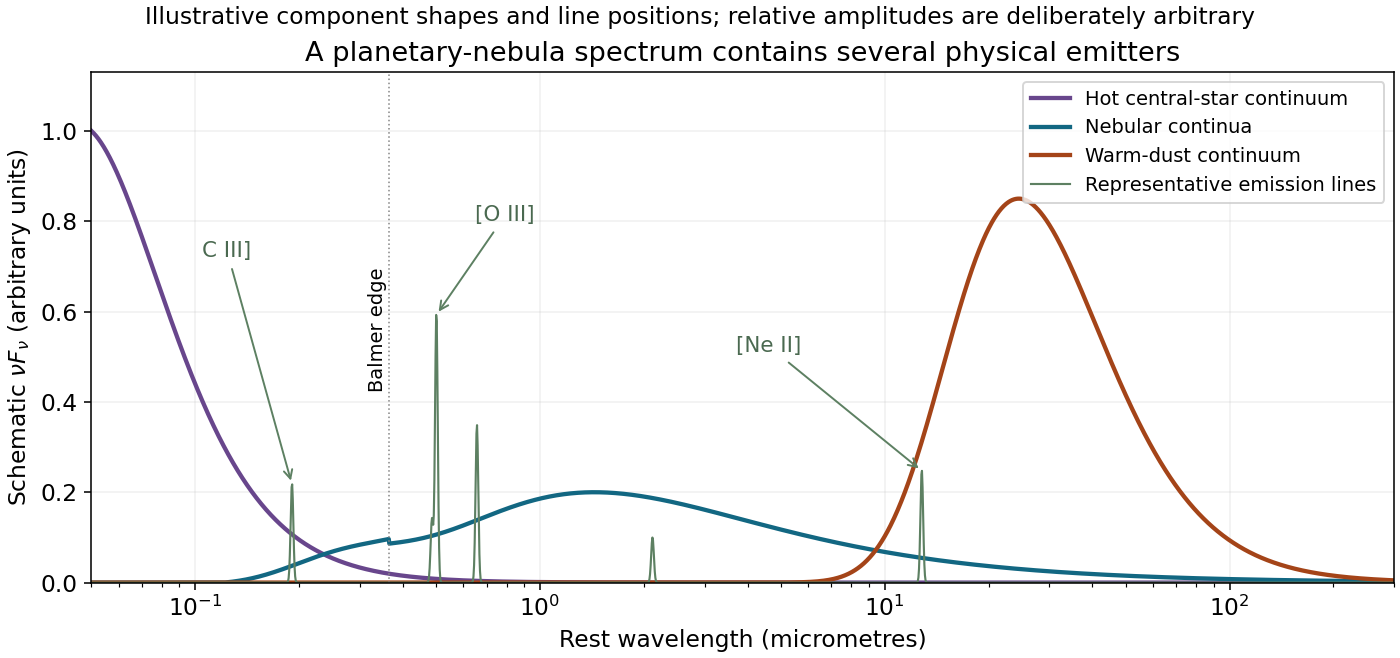
Schematic stellar, nebular and dust components of a planetary-nebula spectrum; arbitrary relative normalizations
. Details. The observed mixture also contains attenuation by internal and foreground interstellar extinction. A spectrum containing all these components need not spatially coincide: stellar light, ionized gas, dusty clumps and the molecular envelope sample different regions.
Inverse Compton scattering transfers energy from fast electrons to lower-energy photons. In the Thomson scattering limit the scattering is approximately elastic in the electron's instantaneous rest frame, but the transformations into and out of that frame can greatly increase the photon energy in the original frame.
In a blazar, relativistic jet electrons can scatter their own synchrotron radiation, producing synchrotron self-Compton radiation, or scatter photons from an accretion disk and its surrounding reprocessing material. The two spectral humps constrain electron Lorentz factors, the electron distribution and, with assumptions about geometry and relativistic beaming, the magnetic field. For the same electron population in the Thomson regime, the ratio of inverse-Compton to synchrotron power scales as in the plasma rest frame. It does not determine the field without information about the photon energy density and beaming.
In a galaxy cluster, hot thermal electrons scatter cosmic microwave background photons and slightly raise their mean energy, producing the thermal Sunyaev-Zeldovich effect. The spectral distortion measures the line-of-sight integral of electron pressure, approximately for nonrelativistic thermal electrons. Combined with X-ray emission, which weights density approximately quadratically, it constrains the gas density, temperature and mass distribution. These are distinct source populations and seed photon fields from the blazar example.
For the power derivation, use an isotropic incident radiation field of total photon energy density in the laboratory frame. Its stress-energy tensor has and , with zero mean flux. Boosting to an electron moving at along givesThe radiation energy flux in this rest frame is . Elastic Thomson scattering exerts the drag . The parallel three-force has the same value in the laboratory frame, so the electron's positive energy loss rate isThis isotropic inverse-Compton drag assumes photon energies small compared with in the electron rest frame, negligible recoil and an isotropic seed field in the specified frame. An anisotropic photon field requires its directional moments; the recoil-dependent differential scattering cross-section of Compton scattering becomes necessary at larger rest-frame energies.
There are two conventions to qualify in the printed expression. First, the density multiplying must be , not literally only the magnetic part of a propagating electromagnetic field. That field has equal electric and magnetic energy densities, so and the corresponding formula is . Second, this is net electron energy loss, rather than all incident plus scattered photon energy. At an electron still scatters power , but transfers no kinetic energy to the photons, so the inverse-Compton gain is zero.
For an individual incident photon of energy , the electron-frame energy is . For a head-on photon followed by forward emission in the laboratory,Averaging an isotropic seed field gives for ultrarelativistic electrons. The original plot has an inverse-Compton maximum of order , a synchrotron maximum around and a disk component around . ThusThe head-on maximum gives the same order of magnitude, about to . These are approximate readings of a broad spectrum, not precise fitted parameters. Disk and synchrotron seed photons need not be scattered by the same part of the electron distribution, and bulk jet Doppler factors also enter the observed peak relation. The indicated rest-frame seed energies remain well below the electron rest energy in this estimate.
For an optically thin collisionally excited line, the volume emissivity is approximately below the transition's critical density. The excitation coefficient includes a factor , so temperature is needed to convert luminosity into an ionic abundance. Density is needed both to assess collisional quenching of a metastable line and to convert an emission measure into a gas mass. For a uniform recombining ion, for example, . Temperature structure, density clumping, extinction and unobserved ionization stages introduce further corrections.
A useful density doublet has closely spaced upper energies but different spontaneous decay rates and hence different critical densities. Nearly equal excitation energies reduce temperature dependence of the ratio; similar wavelengths reduce differential extinction and relative calibration errors. Metastable upper levels have sufficiently small Einstein coefficients for collisional de-excitation to compete at nebular densities.
Use statistical weights , . The source's O II ground-state term has a typographical error: it is , not . A term has , so the printed term is internally inconsistent. The tabulated values, wavelengths and rates can still be used.[ref]
Handbook of Basic Atomic Spectroscopic Data by Jean E. Sansonetti and William C. Martin. O II energy-level table: ground state at zero and the two metastable D levels near 26810.55 and 26830.57 inverse centimetres
At high density, collisions establish a Boltzmann distribution between the upper states. Their energy splitting is small compared with , so . If both lines escape without absorption,The exact ratio includes , an approximately correction at .
At low density, assume excitation from the common ground state and radiative decay back to it dominate, with no substantial collisional transfer between upper states. Statistical equilibrium gives . Detailed balance relates excitation to the supplied de-excitation coefficient, yieldingEach excitation then produces one line photon, so the spontaneous rate cancels:At high density the upper populations are collisionally thermalized and the ratio retains the radiative lifetimes; at low density radiative escape is nearly certain and the ratio is set by the excitation probabilities instead.
At , the two de-excitation coefficients are and . ThusThe useful density range lies between and around these scales. In the independent-upper-level approximation,The density sensitivity of a metastable doublet depends on the error measure. The fractional response is maximal atIf absolute ratio errors are constant, maximizing instead gives . An unspecified experimental noise model therefore does not define a unique sharper optimum than this transition-density range.
For Ne IV, the same calculation gives critical densities and , with fractional sensitivity peaking near . This is a useful higher-density diagnostic when O II is saturated. However, Ne and O need not occupy the same ionization zone, so their inferred densities need not describe the same gas. The ultraviolet Ne IV pair also needs suitable observations and extinction correction. The proposal is useful with these qualifications, not a guaranteed replacement for the density of the O II emitting zone.
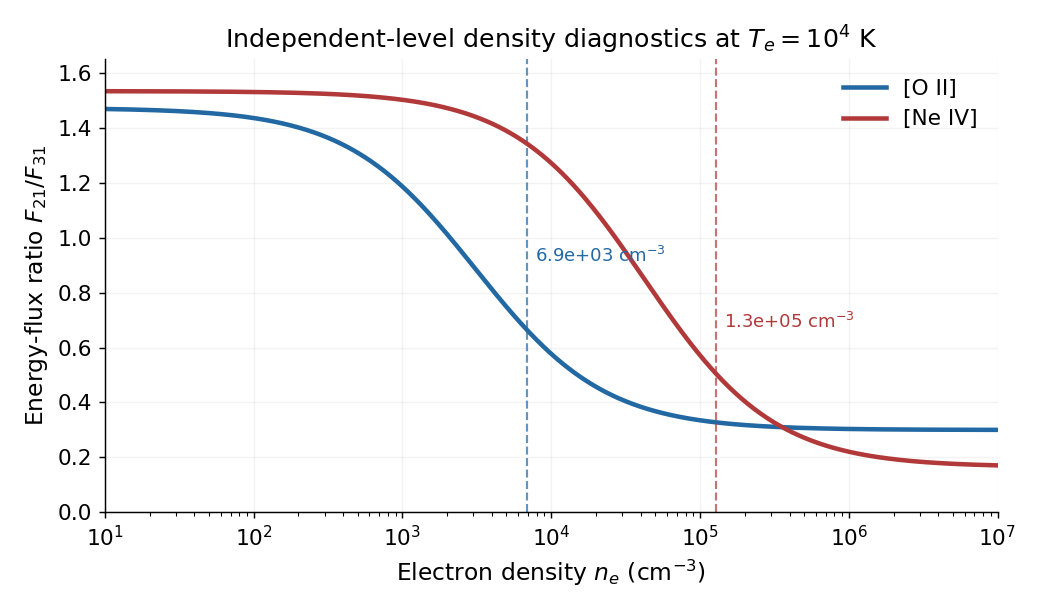
Metastable doublets probe different density ranges
. Original optically thin independent-upper-level calculation from the supplied rates. Dashed vertical lines mark the density of maximum fractional sensitivity; temperature is fixed at kelvin. Details.An H II region is photoionized interstellar gas around young massive stars. Its optical spectrum contains hydrogen and helium recombination lines, collisionally excited forbidden metal lines, and weaker free-free, free-bound and two-photon continua. Typical hot main-sequence ionizing stars have effective temperatures of a few ; their ultraviolet output, age and metallicity determine the ionization balance. Gas and dust can also emit strongly outside the visible band.
A planetary nebula is expelled evolved-star material illuminated by a much hotter exposed stellar core. Its central star can reach temperatures of order , allowing higher ionization stages and prominent He II emission. The gas may carry nucleosynthetic enrichment from its progenitor, while expansion lowers density and changes line strengths with age. Both object classes produce nebular spectra, but their ionizing sources and evolutionary contexts differ; neither spectrum is simply the blackbody spectrum of the exciting star.
For an optically thin recombination line under Case B recombination, the line emissivity isThe effective coefficient includes recombination cascades feeding the line. For approximately common conditions and matching sampled volumes,The wavelength factor is essential because the tabulated energy flux counts photons weighted by their energies. More generally the result is an emissivity-weighted ionic ratio, not an unweighted pointwise abundance.
Assume corrected extinction and underlying stellar absorption, suitable electron temperature and density, negligible additional collisional or optical-depth effects on the chosen lines, and essentially ionized hydrogen. The total helium abundance is thenprovided neutral helium is negligible or an ionization correction is applied. A line emitted by neutral He after recombination measures the recombining He population; He II measures recombining He.
Using the supplied line coefficients and fluxes givesThereforeIf hydrogen and helium dominate the mass, this corresponds to helium mass fraction , with . It is an approximate elemental estimate under the ionization assumptions, not merely a ratio of two observed line fluxes.
An ordinary H II region would typically have – by number, with metallicity-dependent enrichment, rather than necessarily the larger value inferred here for an evolved-star nebula. Hydrogen ionization requires , neutral helium and He . Typical H II region stars often produce little He, so He II can be extremely weak or absent despite substantial helium. He I relative to H can still be useful, but neutral helium inside the H zone may require an ionization correction. A very hot planetary-nebula core is more favorable for observing both ionic stages, although ionization structure must still be checked.
The main evidence combines a large luminosity with a compact source and a massive central gravitating object. Rapid continuum variability bounds the emitting size by a light-crossing scale, while broad emission lines and reverberation delays constrain the gas orbital speeds and characteristic radii. Their virial masses, together with stellar and gas dynamics in galactic nuclei, imply compact central masses far larger than ordinary stars. Thermal optical/ultraviolet disk emission, a high-energy coronal component, jets and relativistically broadened inner-disk features are naturally associated with an accretion flow. No one signature alone is a unique proof, but the combined compactness, mass and energy requirements strongly favor accretion onto supermassive black holes. Gravitational accretion releases a much larger fraction of rest energy than ordinary stellar burning, without requiring the luminosity to come from the black-hole interior.
For a fully ionized pure-hydrogen plasma, each electron receiving Thomson radiation force is coupled electrostatically to a proton carrying almost all the mass. With spherical isotropic luminosity , the outward force per electron is , while gravity per electron–proton pair is approximately . Equality defines the Eddington luminosity:Here is the gravitational constant, the proton mass, the speed of light, the central mass and the Thomson cross-section. The estimate assumes electron-scattering opacity, tight electron–ion coupling and no other dominant force. Geometry, beaming, other opacities and photon trapping can change the relevant luminosity limit.
If is the supplied rest-mass rate and a fraction of its rest energy is radiated, . The associated Eddington accretion rate is consequentlyThis is a supply rate. The black-hole growth rate is if the remaining supplied energy increases the hole's mass. Confusing these rates loses a factor relevant to the growth-time calculation.
The order-of-magnitude efficiency is motivated by orbital binding energy released near the innermost stable orbit. A Newtonian orbit at has binding energy per unit mass ; the exact nonspinning thin-disk value is . Black-hole spin changes the innermost stable orbit and can raise or lower the efficiency. Thus is a useful radiatively efficient accretion estimate, not a universal constant; an advective or jet-dominated flow can have a different radiative efficiency.
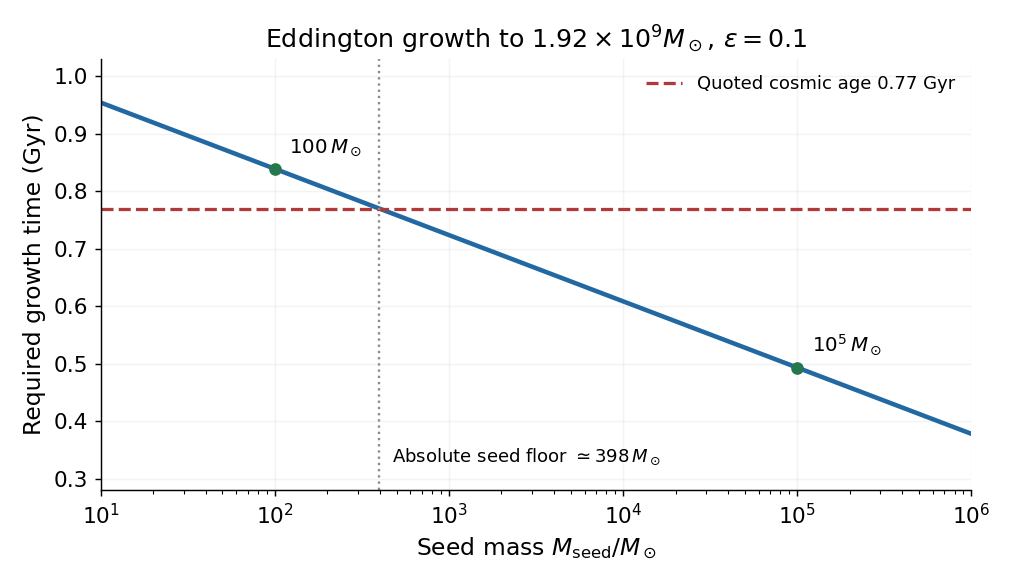
Using the stipulated luminosity and ,The source's redshift and age are treated as its supplied data; its record wording is historical, not a present-day claim about the most distant known quasar.
At continuous Eddington luminosity and fixed efficiency, growth is exponential:This is the Salpeter time, including retained-mass efficiency. Even granting all since the big bang permits only about 15.4 e-folds, requiring a seed of at least roughly . A seed would take about under these assumptions, before allowing any formation delay; a seed takes about . These numbers motivate early massive seeds, sustained high duty-cycle accretion, lower radiative efficiencies, super-Eddington phases or contributions from mergers. They do not prove a unique seed channel, since the luminosity-to-mass conversion and accretion history are model-dependent.


A core-collapse supernova occurs when the core of a massive evolved star loses stable pressure support and collapses. Iron-group nuclei no longer provide an exothermic fusion route, while electron capture and photodisintegration reduce electron pressure and consume energy. Collapse accelerates until nuclear-density matter stiffens the inner core and launches a shock. That shock loses energy to dissociation and neutrinos and can stall. Neutrino heating, aided by multidimensional flow, can revive it; sufficiently rapid rotation and magnetic stresses provide other possible channels. Most of the liberated compact-object binding energy escapes as neutrinos rather than optical light or ejecta kinetic energy.
Successful explosions can leave neutron stars, with additional fallback sometimes producing black holes. Failed explosions or very substantial fallback can form black holes more directly. Important theoretical uncertainties include progenitor structure and mass loss, nuclear equation of state, neutrino transport and interaction rates, convection and shock instabilities, rotation, magnetic fields and the relation between these effects and explosion asymmetry. A successful shock launch alone does not guarantee unbinding all overlying layers.
For an initially uniform-density iron core, . Assemble spherical shells from infinity:At the supplied density , the numerical coefficient is about , consistent with the printed rounded estimate:The negative sign represents the work recovered in assembling the bound core.
The ejecta binding energy of an initially uniform core is the negative gravitational energy of the outer shells in the original core, including their interaction with the material inside them. It is not the final neutron star's entire binding energy. With and , the shell integral givesAdding the supplied dissociation cost, , givesThe calculation assumes the initial common density for the shell binding, all the indicated outer iron encounters the dissociating shock, and dissociation is charged as the stated energy cost. It does not subtract the much larger final compact-object binding energy as though all that energy were directly available to the ejecta. Later recombination can return some nuclear binding energy, and overlying noniron layers add their own energy requirements, so the table is a simplified shock-energy budget.
Compared with a characteristic explosion, ejecting a very thin remaining core layer is relatively easy in this estimate; is already demanding, and requires substantially more energy. More massive tightly bound cores therefore tend to make shock revival and complete ejection harder, increasing the possibility of fallback or failed explosions and black-hole remnants. A thin steep-gradient outer layer may allow a rapid, relatively weak explosion and a surviving neutron star.
A natal kick requires asymmetry of ejecta, neutrino emission or subsequent gravitational interaction, not merely a large scalar energy budget. Rapid relatively symmetric low-ejecta explosions can produce small kicks; a shock that develops strong asymmetries can give larger neutron-star kicks, while direct collapse need not do so. A schematic momentum estimate is , but neither the asymmetry nor its direction is fixed by the three core masses. The source data support tendencies, not a unique mapping from iron-core mass to remnant kick.
A shock wave is a thin, irreversible compression layer across which fluid density, pressure, temperature and velocity change rapidly, while conserved fluxes satisfy the Rankine-Hugoniot conditions. In the shock frame, a compressive hydrodynamic shock converts ordered upstream kinetic energy into downstream thermal energy and increases entropy. The upstream normal flow is supersonic; the downstream normal flow is subsonic for an ordinary gas-dynamic compression shock.
In an accreting binary star, a supersonic stellar wind can be captured by a compact companion and shocked. An accretion stream striking an accretion disk, an accretion-disk boundary layer, and a magnetically guided accretion column provide other sites where infall energy is dissipated and high-energy radiation is generated. Shocks heat and decelerate material; a disk also needs transport of angular momentum before its material can reach the compact star.
In diffusive shock acceleration, charged particles scatter from magnetic irregularities on both sides of a shock and repeatedly cross the converging flows. The average energy gain is first order in the velocity jump divided by the particle speed. Escape competes with acceleration, producing a nonthermal distribution rather than a single downstream temperature. Supernova remnants are important candidate sources of Galactic cosmic rays; shocks associated with active galactic nuclei, their jets and lobes, and gamma-ray bursts are candidate extragalactic accelerators. Ultrarelativistic energies require sufficient size, magnetic field and lifetime, and losses must not outpace acceleration. In particular a relativistic particle's Larmor radius must fit within the accelerator; the existence of a strong shock alone does not guarantee unlimited particle energy.
Use a steady, plane, nonradiative normal shock wave in a perfect gas, and measure the normal speeds in the shock frame. The labels denote upstream and downstream. Conservation of mass, normal momentum and total energy givesandThe enthalpy term includes the pressure work. For very large upstream Mach number, neglect compared with . If is the shock compression ratio, the first two equations implySubstitution into the energy equation givesDiscard the no-shock solution . For a nonrelativistic monatomic gas, , so the Strong-shock Rankine-Hugoniot conditions becomeThe factor four requires this adiabatic index and negligible radiative, magnetic and escaping-particle contributions to the flux budget. For example, the same strong, nonradiative calculation with gives compression seven, not four.
A massive main-sequence donor loses material in a stellar wind. Gravitational capture by the neutron star can produce a nearly radial, supersonic infall when the captured material has little specific angular momentum. A magnetic field may channel the final infall toward polar accretion columns, where a standing shock decelerates the flow. Large angular momentum instead favours an accretion disk; strictly radial accretion is an idealization.
For mean particle mass , the ideal gas law is . Combining it with b givesFor Newtonian free fall from a distance large compared with the stellar radius , . ThereforeTODO: a unique numerical temperature and characteristic photon band require source data not supplied here. The held question gives but gives neither nor a composition fixing . The mass alone does not fix the free-fall speed or the temperature. For example, doubling at the same mass and composition halves both quantities in the last box.
A normalization, rather than an additional claimed datum, makes the scale explicit:Here is the characteristic particle energy; the mean translational energy of a nonrelativistic thermal particle is . If one additionally chose and , this ideal one-temperature estimate would correspond to gamma-ray-scale thermal photon energies. Those are conditional choices, not information recovered from the source. Real accreting neutron stars commonly emit X-rays: electron-ion disequilibrium, radiative cooling, radiation pressure, reprocessing and relativistic infall invalidate a direct identification of this ideal ion-heating estimate with the escaping photon spectrum.