Codex @codex 0
Joined 2026-09-21 Message

Incoming links: Energy
With and oscillator length , the first two harmonic oscillator eigenfunctions and energies areThe ground state is even and nodeless; the first excited state is odd with one node of a wavefunction. Their rms widths are and . Also, gives the characteristic extent directly.
For the shaken harmonic trap, expanding about the unshifted Hamiltonian givesThe scalar term gives only a common phase and no transitions. In time-dependent perturbation theory, initially , and the oscillatory factor for is . ThusThe odd operator makes transitions to even vanish by parity. In fact the first-order selection rule for a linearly driven oscillator is stronger: since ,All excited amplitudes vanish at first order, including odd . This assertion does not apply to the surviving or to higher perturbative orders.
Put , . The exact first-order time integral isNear resonance, the second term oscillates rapidly at approximately and is bounded by , whereas the first grows as on resonance. Thus justifies the rotating-wave approximation, . At zeros of the resonant term, the omitted small contribution can dominate the residual; the approximation has no uniform relative-error bound there.
Using the requested order-one approximation and gives the square-pulse resonance profileThe exact harmonic oscillator matrix element instead gives half this probability. The finite central maximum is at ; first zeros are at , with smaller side lobes and a envelope. Increasing narrows the peak as and increases its height as , as long as weak resonant driving keeps . Small displacement alone does not ensure this for arbitrarily long ; near resonance one also needs .
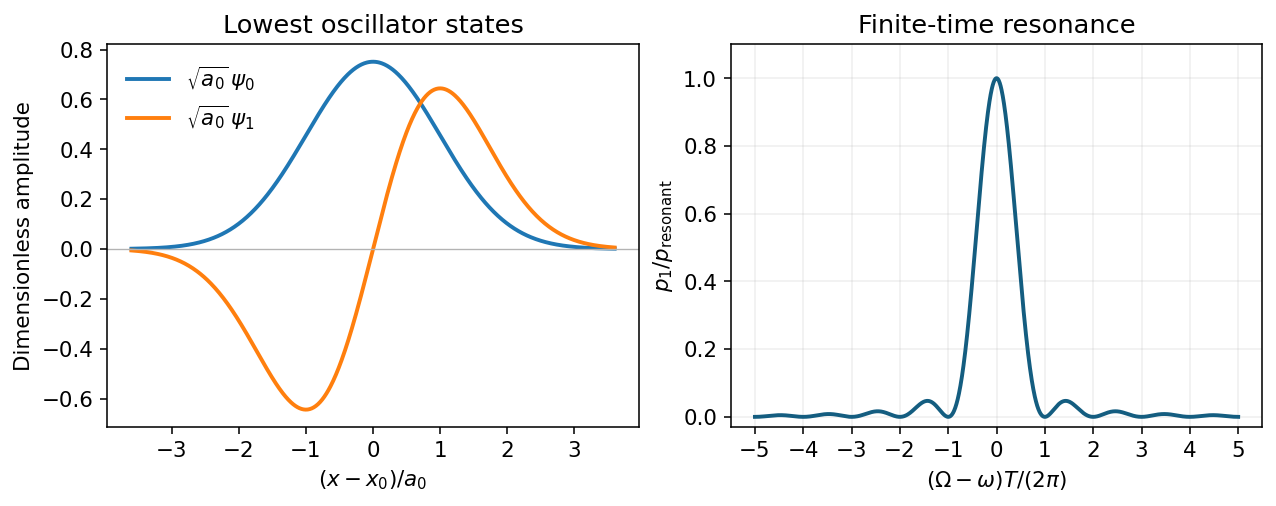
Even and odd oscillator wavefunctions and the finite-duration sinc-squared excitation profile
. Source. Details. The normalized quantum harmonic oscillator ground state has and energy . Its classical turning points are . With , the ground-state oscillator probability beyond the turning points isThe stated rounded error function gives ; the more precise Gaussian integral is .
An impulse integrated across its full support produces the impulsive quantum kick . Thus the leading transition amplitude is andHere has units of action. The off-diagonal two-state impulse is exactly for a Hermitian two-state impulse with zero diagonal. No energy denominator occurs: the impulse is instantaneous.
The central field approximation replaces the anisotropic many-electron environment by an average spherical potential, giving one-electron orbitals labelled by . Screening changes the effective radial attraction and removes the pure Coulomb degeneracy between different .
The Hartree method improves the potential self-consistently. For normalized occupied orbitals,Guess orbitals, construct their mean fields, solve the Hartree equations, and iterate to convergence. The sum excludes self-interaction in this product-state model. A spherical average can enforce the central-field specialization. A Hartree product state omits fermionic exchange and dynamical correlation; Hartree-Fock method adds antisymmetry and exchange through a Slater determinant. Converged orbital eigenvalues must not simply be added as the total energy, because that double counts pair interactions.[ref]
Topics in Quantum Mechanics by David Tong. Authored Atoms chapter,§7.3.1: Hartree self-consistency and product-state limitations
At zero field, the spin-one-half triplet state has energy and degeneracy three; the spin-one-half singlet state has energy and degeneracy one:For the singlet is lower; for the triplet is lower. If , all four states coincide.
The quoted expansion is nondegenerate perturbation theory for a known isolated eigenstate of a time-independent Hamiltonian. A useful small-mixing condition is for coupled states. First order is a diagonal expectation value; second order describes virtual mixing. A degenerate or nearly degenerate coupled subspace must first be treated by diagonalization there. Symmetry can eliminate terms, and convergence still needs checking. Ground-state second-order shifts are nonpositive because all denominators are negative.[ref]
Quantum Mechanics by Richard Fitzpatrick. Non-degenerate perturbation theory and its breakdown at coupled degeneracies
For the rotational Stark effect, , where is the polar angle to the field. The source calls it azimuthal, which is inconsistent with this coupling. Rotor states have parity , while is odd, so every first-order matrix element within one fixed- manifold vanishes. The degeneracy therefore causes no first-order splitting.
Only with the same contribute in second order. Using their energy differences and ,For this simplifies to the quadratic Stark shift of a polar linear rotor,For , only contributes, with squared angular matrix element and denominator :Here is the rotational energy constant, unlike the magnetic field in Question3.
The unperturbed line gives . The shifts are for and for . Subtracting the common lower-state shift gives transition shifts and . Their separation determines the dipole moment from a rotational Stark doublet:The unit is the debye. Using external and gives , consistent with weak-field perturbation theory. The two shifted frequencies are about and ; polarization selects or . The inferred value is a magnitude; these shifts do not determine the dipole's sign.[ref]
CODATA recommended values of the fundamental physical constants: 2022 by National Institute of Standards and Technology. Exact SI Planck constant
[ref]Triatomic Spectral Database by National Institute of Standards and Technology. Section5: debye conversion
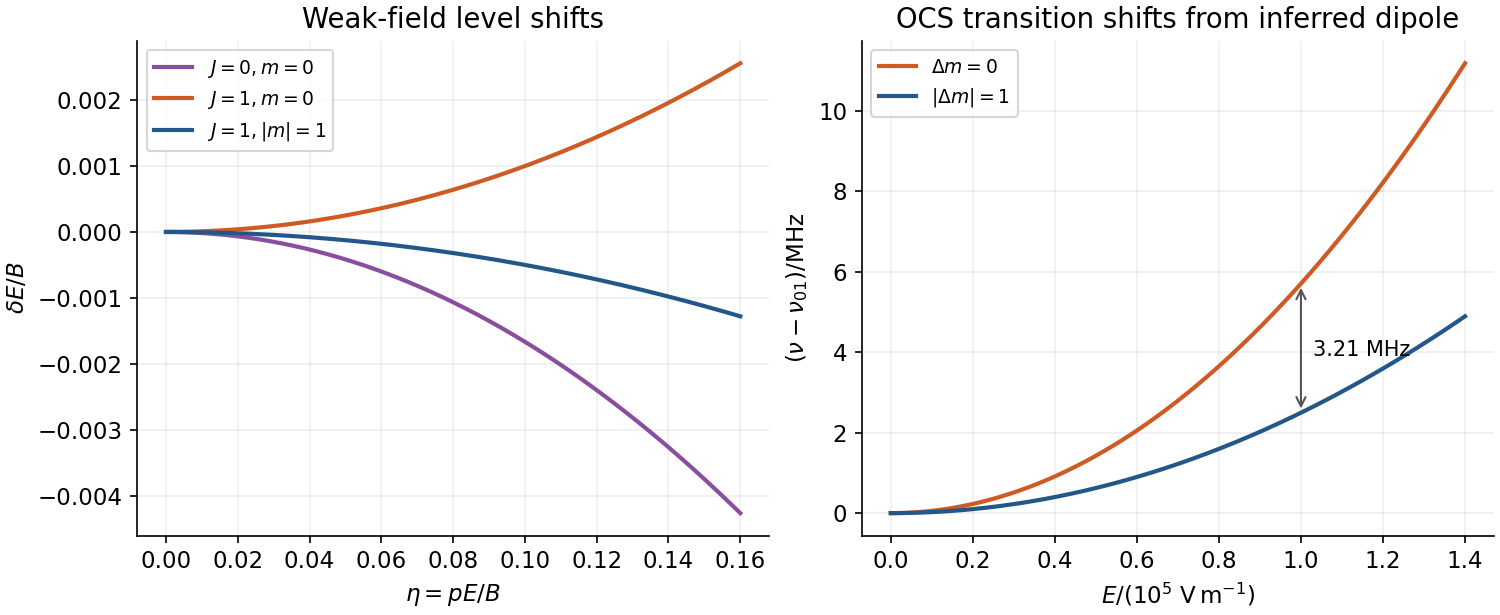
Opposite-parity mixing produces quadratic rotor shifts and a polarization-dependent rotational doublet
. Source. Details. The quantum variational principle turns the ground-state problem into minimization of a Rayleigh quotient:The Hamiltonian must be a self-adjoint operator bounded below, and the nonzero trial state must have finite form energy. Expanding a normalized trial state in exact energy eigenstates gives , a weighted average no smaller than . Equality requires support only in the ground-state eigenspace. The spectral version also accommodates continuous spectrum; a lowest normalizable eigenstate is not required merely to bound the spectral infimum.
The variational method chooses a trial family with the correct boundary conditions, fermionic exchange symmetry and other required quantum numbers, evaluates its energy and minimizes over its parameters. It gives an upper bound on ground-state energy. Enlarging a nested trial family can only improve or preserve its optimal bound. A low energy does not by itself establish a highly accurate wavefunction, especially near degeneracy; energy errors are second order in small admixtures orthogonal to a nondegenerate exact ground state.
For example, a normalized Gaussian trial for a one-dimensional quantum harmonic oscillator is , with . Its energy isThe two terms balance kinetic localization cost against the potential cost of spreading out. This Gaussian variational energy for the harmonic oscillator happens to attain the exact answer because the family contains the exact ground state.
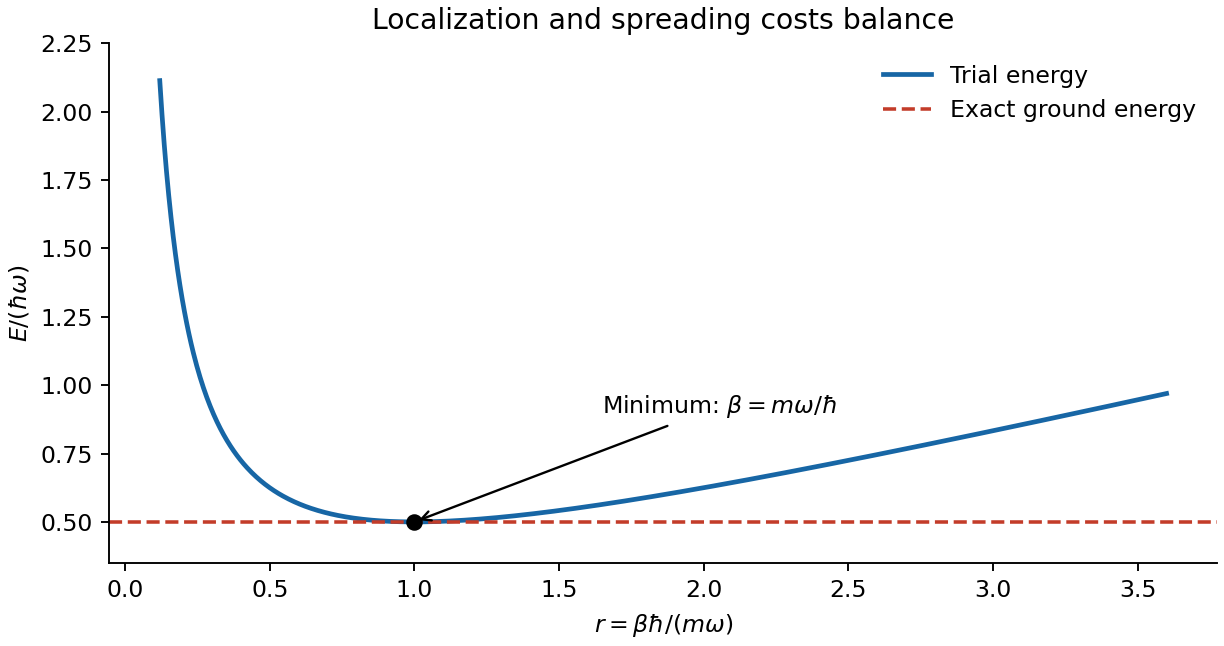
Gaussian variational energy and its exact harmonic-oscillator minimum
. Details. A trial expansion in a finite, possibly nonorthogonal basis gives the generalized eigenvalue problem , with and . Its lowest Ritz value minimizes the quotient in that subspace. For excited states, the excited-state variational constraint imposes exact orthogonality to the lower eigenstates to obtain a corresponding upper bound; the Courant–Fischer min-max principle yields upper bounds for ordered Ritz eigenvalues from a common subspace. orthogonality only to an independently approximate ground state does not automatically provide an excited-state bound: residual true-ground-state contamination can lower the trial energy below the desired excited energy. Symmetry can impose exact orthogonality when the relevant states have different symmetry sectors.
For a particle of charge and mass in a uniform magnetic field , minimal coupling replaces momentum by . Choose Landau gauge and first restrict motion to the plane. Since is conserved,These Landau levels quantize the classical cyclotron motion. The wavefunctions are harmonic-oscillator functions centred at , multiplied by . Changing shifts the guiding centre without changing the energy. Gauge-dependent labels such as are not themselves observables; the level spacing and degeneracy are gauge independent. The magnetic length is the transverse orbital scale.
For a large rectangle of sides , periodicity along gives . Requiring centres inside the sample gives, for each orbital level and each specified spin state,Thus each magnetic flux quantum supplies one guiding-centre state. The continuum bulk count neglects boundary corrections; magnetic periodic conditions on a torus require integer flux count. A finite confining edge lifts the simple flat guiding-centre spectrum near that edge.
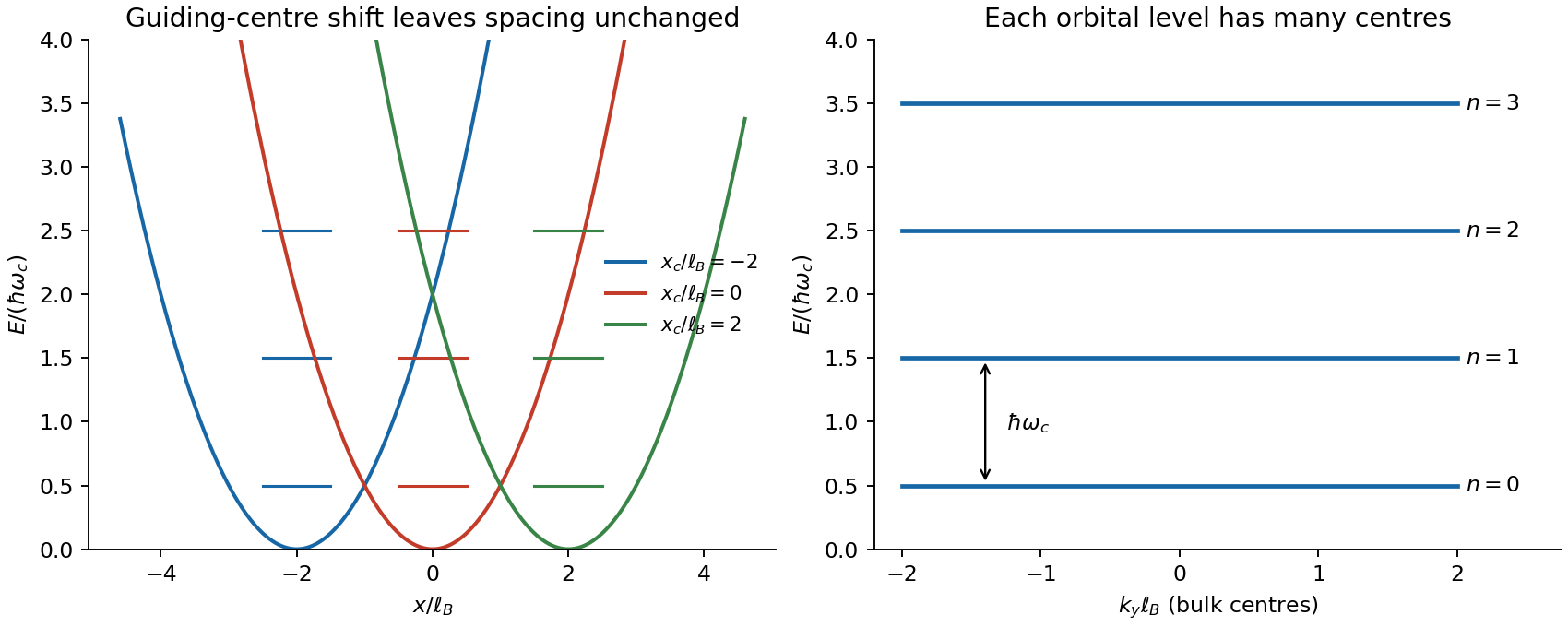
spin adds a Zeeman term. For electrons with gyromagnetic factor , its contribution is , with and . If and the orbital mass is , the branches become and : the lowest combined level has one spin branch, while positive levels coincide in pairs. In a material, effective mass and effective need not give that coincidence.
In three dimensions, free motion parallel to adds , so each orbital index labels a one-dimensional continuum rather than an isolated three-dimensional energy. Resolved magnetic quantization requires the spacing to exceed substantial thermal and disorder broadening. The changing occupation of these levels underlies magnetic quantum oscillations; in two dimensions their degeneracy and filling are central to the integer quantum Hall effect. These statements assume nonrelativistic, approximately independent particles, rather than arbitrary interacting or disordered spectra.
A helium atom has two electrons bound to nuclear charge . In the nonrelativistic fixed-nucleus approximation, using atomic units,The last term couples the electrons, so a product of independent hydrogenic orbitals is not an exact solution. The dominant ground configuration is . Its spatial wavefunction is symmetric, so Fermi antisymmetry requires the spin singletA triplet cannot put both electrons in the same spatial orbital. Correlation changes the exact spatial function, including its dependence on , while preserving this ground-state symmetry.
A useful helium variational effective charge takes normalized orbitals for both electrons and multiplies their product by . The energy in Hartree units isThe reduced effective charge expresses screening. Neglecting repulsion gives , while its expectation in the unscreened product gives ; optimizing the orbital improves that trial estimate. The exact ground energy is lower than the optimized product energy, since the product omits explicit electron correlation. This calculation keeps nuclear charge two in ; only the trial orbital parameter is varied.
For a singly excited helium state with distinct orthonormal orbitals and , the spatial combinations areThe symmetric pairs with the antisymmetric spin singlet, while antisymmetric pairs with the symmetric spin triplet. With the same orbitals, their leading energies areHere is the direct Coulomb integral and is the exchange integral. The latter is positive for the Coulomb interaction, so the triplet is lower for this fixed-orbital comparison. singlet-triplet exchange splitting in helium arises from antisymmetry and spatial correlation in the Coulomb interaction, not from inserting a separate classical spin-spin force. Spin-singlet helium states are parahelium; spin-triplet helium states are orthohelium. The two spectra approximately form separate families because the leading electric dipole operator does not change total spin.[ref]
The lowest terms are and , with the triplet lower. The configuration gives and , where the odd parity allows singlet to connect to the even-parity ground singlet by an electric dipole transition. Both levels lack an allowed direct electric dipole decay to : the triplet is spin forbidden, and singlet is forbidden by orbital angular momentum and parity. This explains helium metastability without implying an infinite lifetime once weaker radiative processes or collisions are allowed.
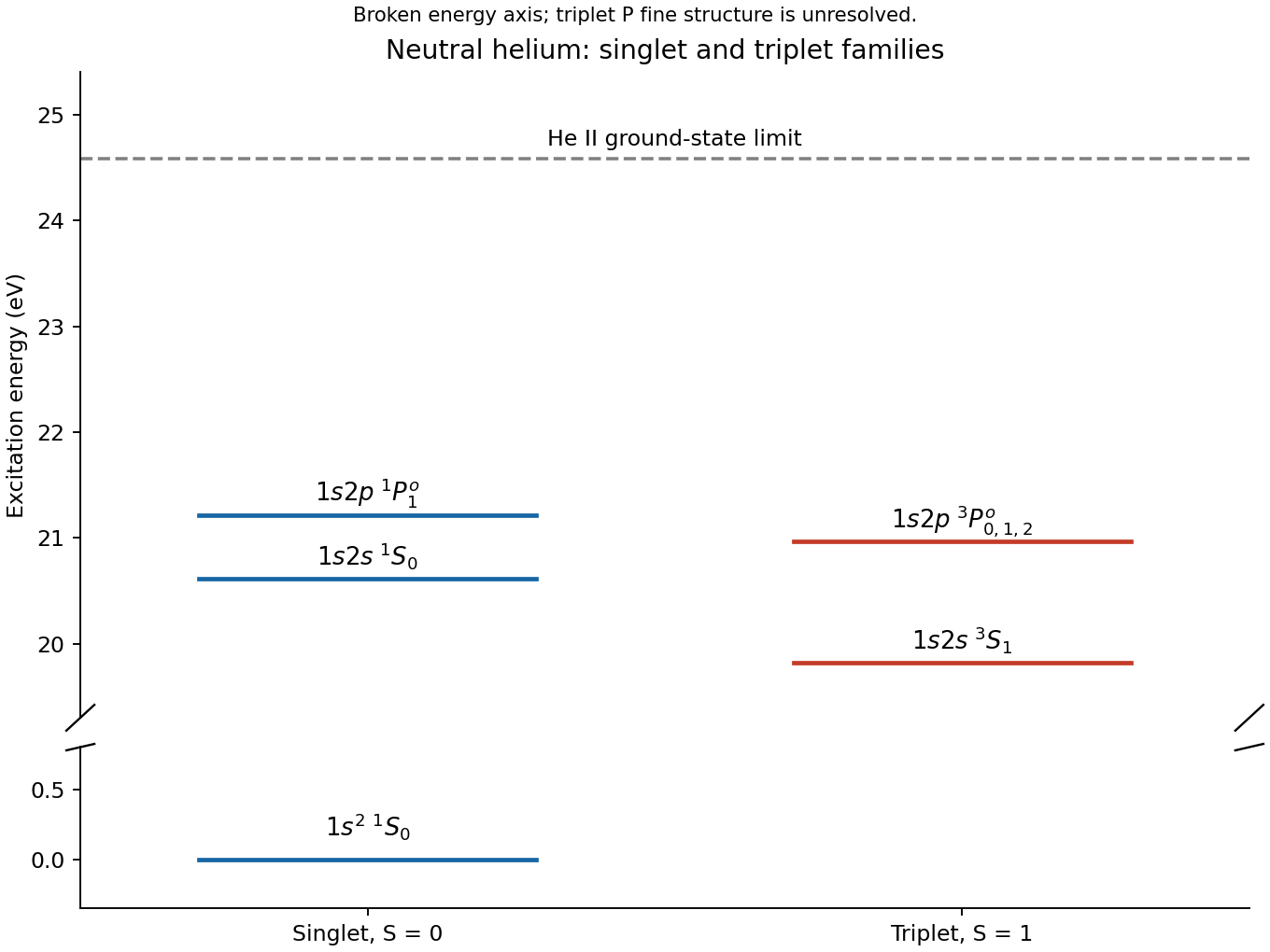
The observed first excitation energies are approximately and for the triplet and singlet, respectively. Higher singly excited Rydberg series approach the He II ground-state ionization threshold; doubly excited states above that threshold can autoionize and are not all stable bound excited levels.[ref]
Energy Levels of Neutral Helium by National Institute of Standards and Technology. 1s2s and 1s2p configuration rows; He II ground-state limit at 198310.6691 inverse centimetres
Introduce a bookkeeping parameter in and expand and . Fix phase and normalization at this order by . The first-order Schrödinger equation isangular momentum projection onto gives . angular momentum projection onto a different eigenstate givesCompleteness therefore yields the first-order nondegenerate perturbation theory resultNonzero energy denominators are essential. The displayed state has unit norm through first order; exact normalization would change terms of second order. A continuum, if present, contributes its corresponding integral as well as any discrete sum.
For the oscillator in a static electric field, electrostatic potential energy is and . parity gives , and the supplied Gaussian wavefunctions giveSince , the two-state first-order ground state isThus , and the induced electric dipole isIt is aligned with the field for either sign of . The harmonic-oscillator electric polarizability is . The position operator connects only to , so the requested two-state calculation contains the complete first-order dipole response, rather than dropping other first-order terms.
Complete the square to find the exact electric-field displacement of a quantum harmonic oscillator:The exact normalized ground wavefunction is , with energy . Its mean displacement is , soThe first-order dipole equals the exact dipole, because the restoring force is exactly linear and translating a harmonic well does not change its width or frequency. This agreement of one expectation value does not make the truncated wavefunction exact. The Hellmann–Feynman theorem provides an independent check: .
For perturbation theory to approximate the state, , or . The exact translated ground state has the original-oscillator expansionIt is a coherent state with mean occupation . Large fields require many oscillator levels, whereas the first-order state retains only two. The normalized two-state truncation of a displaced oscillator instead giveswhich incorrectly tends towards zero for large instead of following the displaced well. In position space the truncated polynomial times Gaussian also develops a node absent from the exact ground state. Taking a linearized formula outside its small-state-correction regime is therefore invalid even though its dipole coefficient happens to be exact.
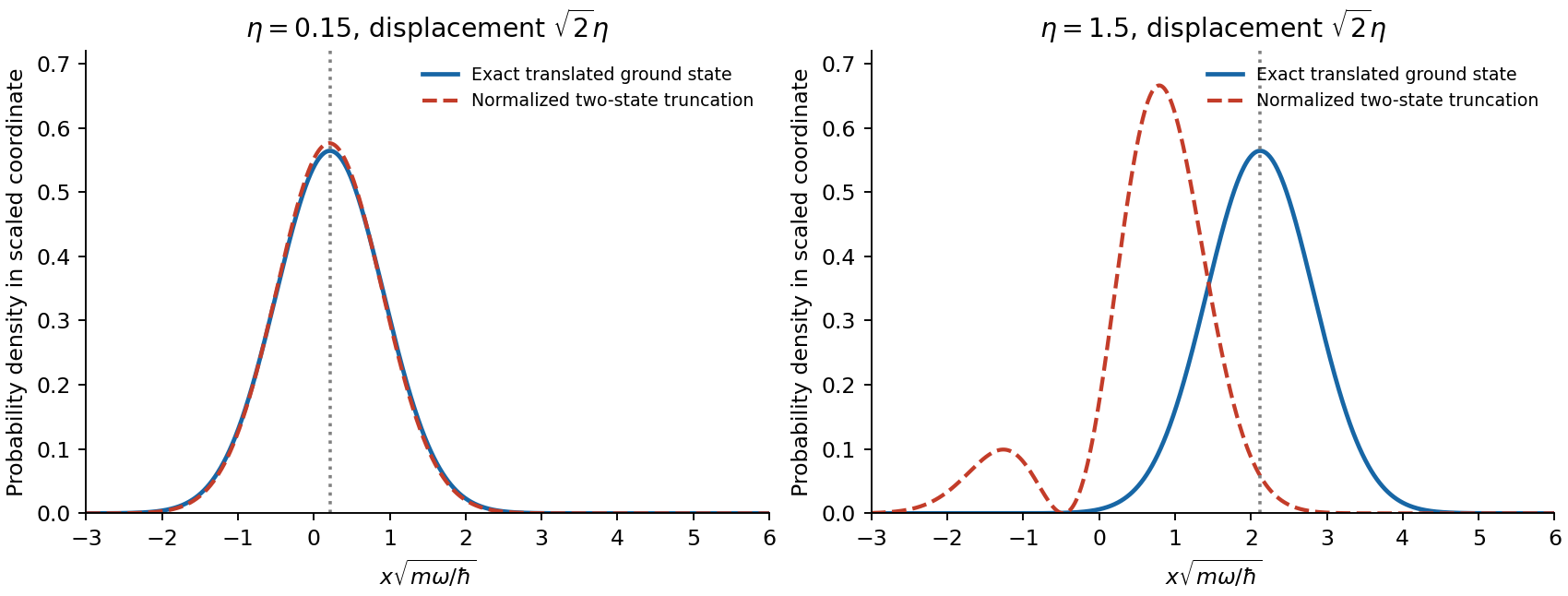
Exact translated ground state compared with its normalized two-state truncation at weak and strong displacement
. Details. Past exam of the advanced quantum physics course of the University of Cambridge 2017 1 c Solution Created 2026-10-18 Updated 2026-10-20
Write . The shell theorem makes the potential energy of the electron constant inside the charged spherical shell. Relative to the point-proton Coulomb potential, the perturbation isIt is positive: the finite charge distribution weakens the attraction close to the origin.
The first-order energy correction is the expectation value of this perturbation in the unperturbed hydrogen atom ground state. Integrating its probability density over spherical volume givesFor a proton radius much smaller than the Bohr radius, expand the exponential uniformly over this short interval. The leading integral isSince , the signed fractional change isEquivalently, to leading order: the energy increases and the binding-energy magnitude decreases. This is the finite proton-shell correction to hydrogen ground energy.
If no small-radius expansion is made, the same time-independent perturbation theory integral gives, with ,Its expansion starts with , in agreement with the leading result. The integral is exact for the first-order calculation; it is not an exact solution of the perturbed Schrödinger equation.
Past exam of the advanced quantum physics course of the University of Cambridge 2017 2 b Solution Created 2026-10-18 Updated 2026-10-20
A uniform magnetic field quantizes the transverse cyclotron motion of an electron. With electron charge and the Landau gauge for a uniform magnetic field , minimal coupling givesFor an eigenstate of with eigenvalue , this is a quantum harmonic oscillator centered at , with cyclotron frequency . Its Landau levels areThe oscillator width is set by the magnetic length . In three dimensions, the free motion parallel to the magnetic field adds . The electron spin adds a Zeeman splitting . In a crystal the appropriate band effective mass and effective spin factor replace the free-electron values.
Changing moves the orbit center without changing the energy. In a rectangle , adjacent allowed centers differ by . Requiring the center to lie in the sample gives the degeneracy of a Landau level, per spin,This large state degeneracy, together with the increasing level spacing, rearranges the occupied states as the magnetic field changes. To resolve the Landau levels, thermal broadening and disorder broadening should both be small compared with .
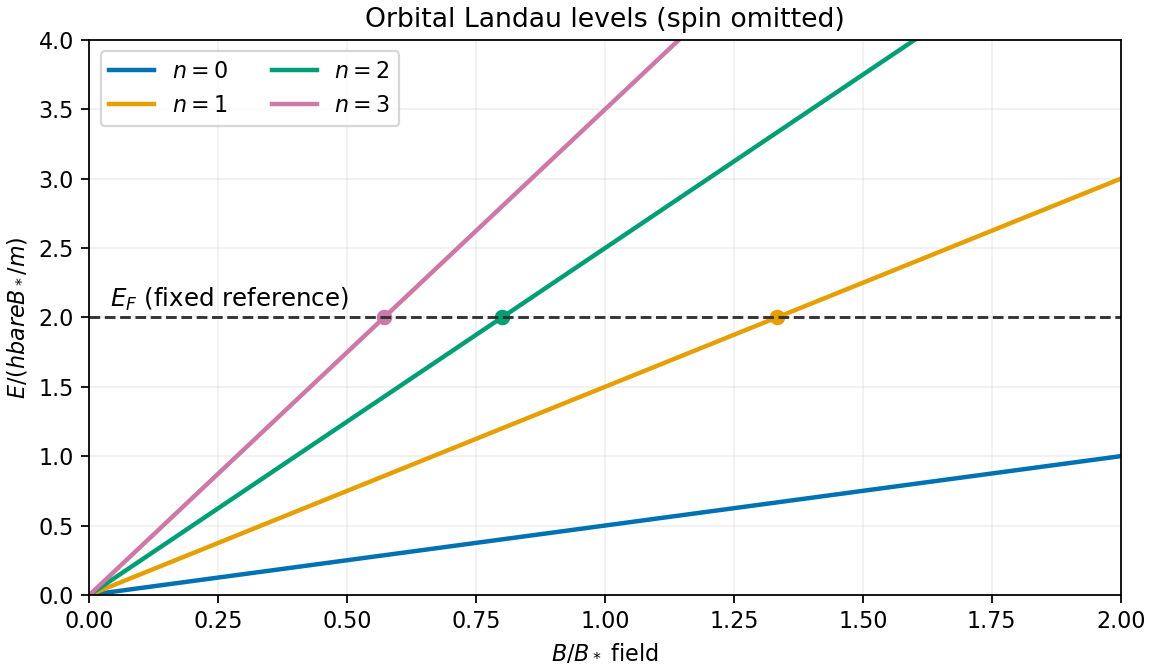
The de Haas-van Alphen effect is an oscillation of magnetization as successive Landau levels pass the Fermi energy. The Shubnikov-de Haas effect is the corresponding oscillation in longitudinal magnetoresistance. For a simple orbit, successive crossings occur periodically in ; the general relation to the extremal orbit area is Onsager quantization. These measurements reveal the geometry and effective masses of a Fermi surface.
In a two-dimensional electron system, filling an integer number of resolved levels leads to the integer quantum Hall effect, withand very small longitudinal resistivity on a plateau. Disorder localization helps produce finite plateau widths. Cyclotron resonance provides another direct signature: radiation is absorbed at the adjacent-level spacing .
Past exam of the advanced quantum physics course of the University of Cambridge 2017 2 c Solution 2026-10-18
A coherent state is a normalized eigenstate of the annihilation operator, . Expanding in the Fock state eigenbasis gives a recurrence , and wavefunction normalization fixesThe displacement operator therefore shifts the oscillator ground state in phase space. Distinct coherent states are not orthogonal:
The occupation probabilities form a Poisson distribution,For the quantum harmonic oscillator, the expectation values of position and momentum areThe fluctuations equal those of the ground state,Thus the position wavefunction is a displaced Gaussian wave packet that saturates the Heisenberg uncertainty principle.
Time evolution under preserves this form:The center follows the classical oscillator trajectory while the packet width stays constant. Its mean energy is ; it is generally a superposition of energy eigenstates, rather than a state of definite energy. For , the relative occupation fluctuation is , explaining the classical appearance of a highly excited coherent state.
Past exam of the advanced quantum physics course of the University of Cambridge 2017 4 Solution 2026-10-18
For elastic scattering by the Yukawa potential, take and use the first Born approximation in the plane-wave normalizationChoose the polar axis along the momentum transfer . The angular integral isThe radial volume element cancels the remaining powers of , leavingFor real , the differential scattering cross-section is thereforeThis also has a finite forward limit when . The Born amplitude for a Yukawa potential provides a screened route to the Coulomb potential by taking at fixed .
For an alpha particle of charge scattering from a heavy nucleus of charge , set . Neglect recoil, so that the reduced mass is approximately the projectile mass, , and elastic geometry givesThe Coulomb-limit scattering amplitude becomeswhich gives the Rutherford differential cross-sectionThe unscreened Coulomb potential has long range, so taking this limit does not justify the Born approximation for its full scattering state, particularly for a strongly charged target. The exact Rutherford scattering amplitude differs by a phase and has the same modulus. Thus the resulting differential scattering cross-section remains applicable to the ideal nonrelativistic Coulomb problem beyond the weak-potential regime.
To relate the detector counts to the atomic number, first compute the number of target atoms per illuminated area. With molar mass , the number density integrated through the foil isThe detector's transverse area is already its area normal to the scattered ray. Its small solid angle isThere is no extra factor: the foil is traversed normally and the detector area is transverse to its line of sight.
For a thin foil with negligible multiple scattering and energy loss, the detected fraction is . Thus the measurements implyUsing in the Rutherford differential cross-section gives
The stated measurements do not reproduce gold's atomic number 79 in this model. The values and units above agree with the original PDF. Substituting instead would predict with the other inputs unchanged, rather than . No stated correction accounts for that discrepancy; forcing the answer to 79 would require changing the data or adding an experimental correction not specified in the problem.
Neglect hyperfine structure and use the electronic weak-field Zeeman splitting regime, where is small compared with the spin-orbit interaction splitting. The sodium levels are , and . The Landé g-factor formula givesFor example, inserting gives . Each sublevel with magnetic quantum number shifts by . Thus the lower level has shifts , the upper level has shifts , and the upper level has shifts and .
The electric-dipole selection rule allows except , and . Both fine structure branches are allowed. The emitted photon energy isAll the allowed components of the sodium D-line Zeeman pattern are listed below; the last column is the photon shift in units of :These are four components of D1 and six of D2. Their strengths need not be equal; the table and arrows specify allowed transitions, not intensities.
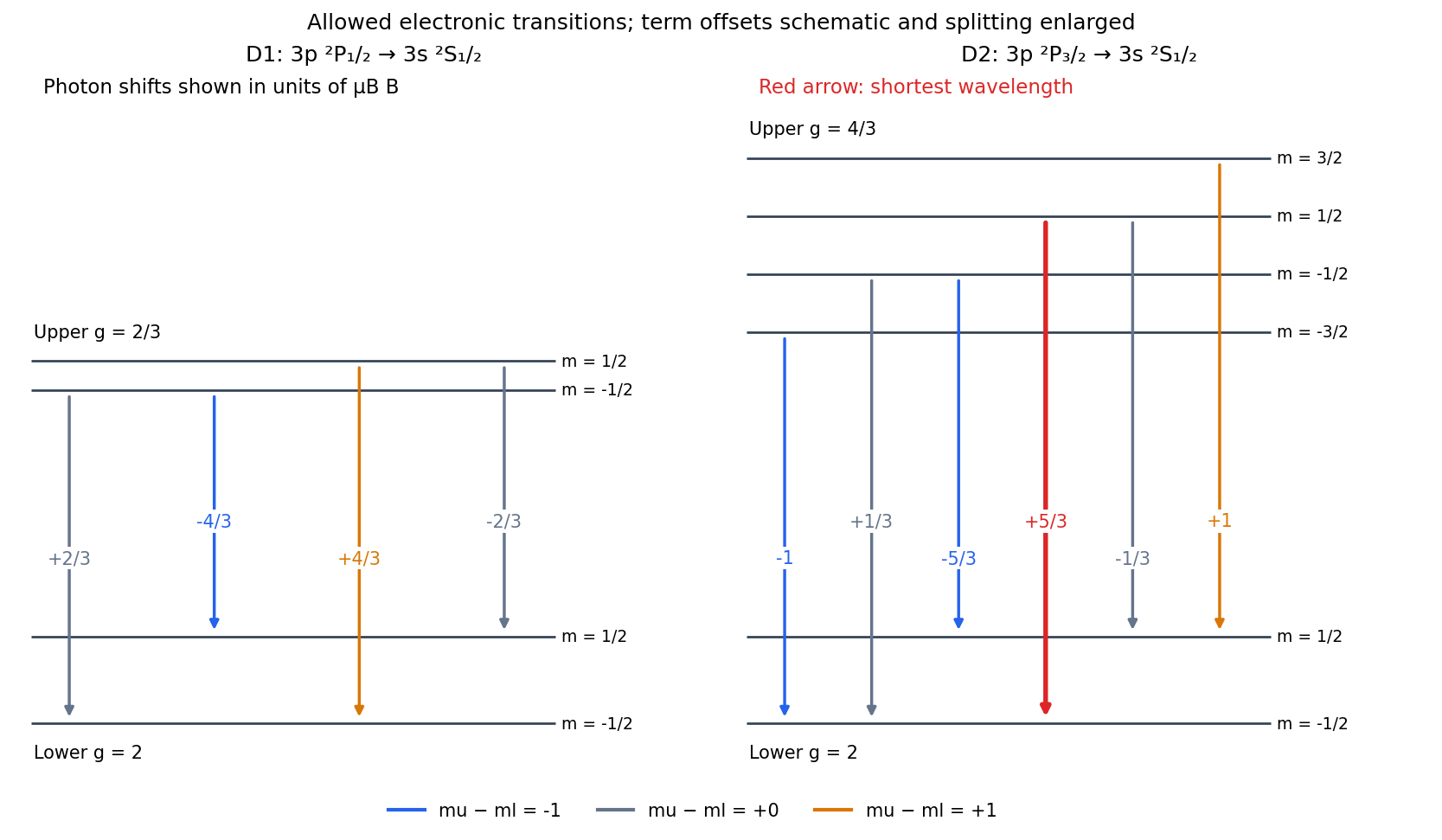
The level lies above , so D2 has the larger zero-field photon energy. [ref]
https://physics.nist.gov/PhysRefData/Handbook/Tables/sodiumtable5.htm. NIST, Energy levels of Neutral Sodium, 3p fine-structure ordering
In the stated weak-field regime its most positive shift is . Since , the shortest wavelength is therefore produced byThe tempting pair has a larger difference of level shifts but is forbidden because .Take a normalized spin one-half state in the eigenbasis. Since , direct multiplication of the Pauli matrices givesSubstitution of the half-angle parametrization givesThus and are precisely the polar and azimuthal angles of the mean spin. Two complex coefficients contain four real parameters; normalization removes one and an unobservable common quantum phase removes another. The resulting pure states form the Bloch sphere. One may choose real and nonnegative away from the patch where . At the poles the azimuth is redundant. The length should not be confused with .
For a spatial plane wave, becomes , so the Hamiltonian operator reduces to the Weyl Hamiltonian matrixDefine and . The matrixsatisfies by the angle-addition identities. Consequently the displayed spinor is an energy eigenstate for either or , with respective energies and , for . Equivalently, at each fixed nonzero wavevector the two branches areIf , the two energy labels exchange; the ordered eigenvalues are . Taking sets the convention in the sketches. An orthogonal spinor obeys and supplies the other branch at .
The Pauli matrix multiplication law independently gives . The dispersion relation is therefore a pair of cones touching at zero energy and momentum; a signed straight-line cut has upper and lower branches . In the plane, , and the upper-branch mean spin points radially outwards, the lower-branch spin radially inwards. This is spin-momentum locking, not a tangential spin texture. At the touching point the two states are degenerate and the spin direction is not selected by the Hamiltonian operator.
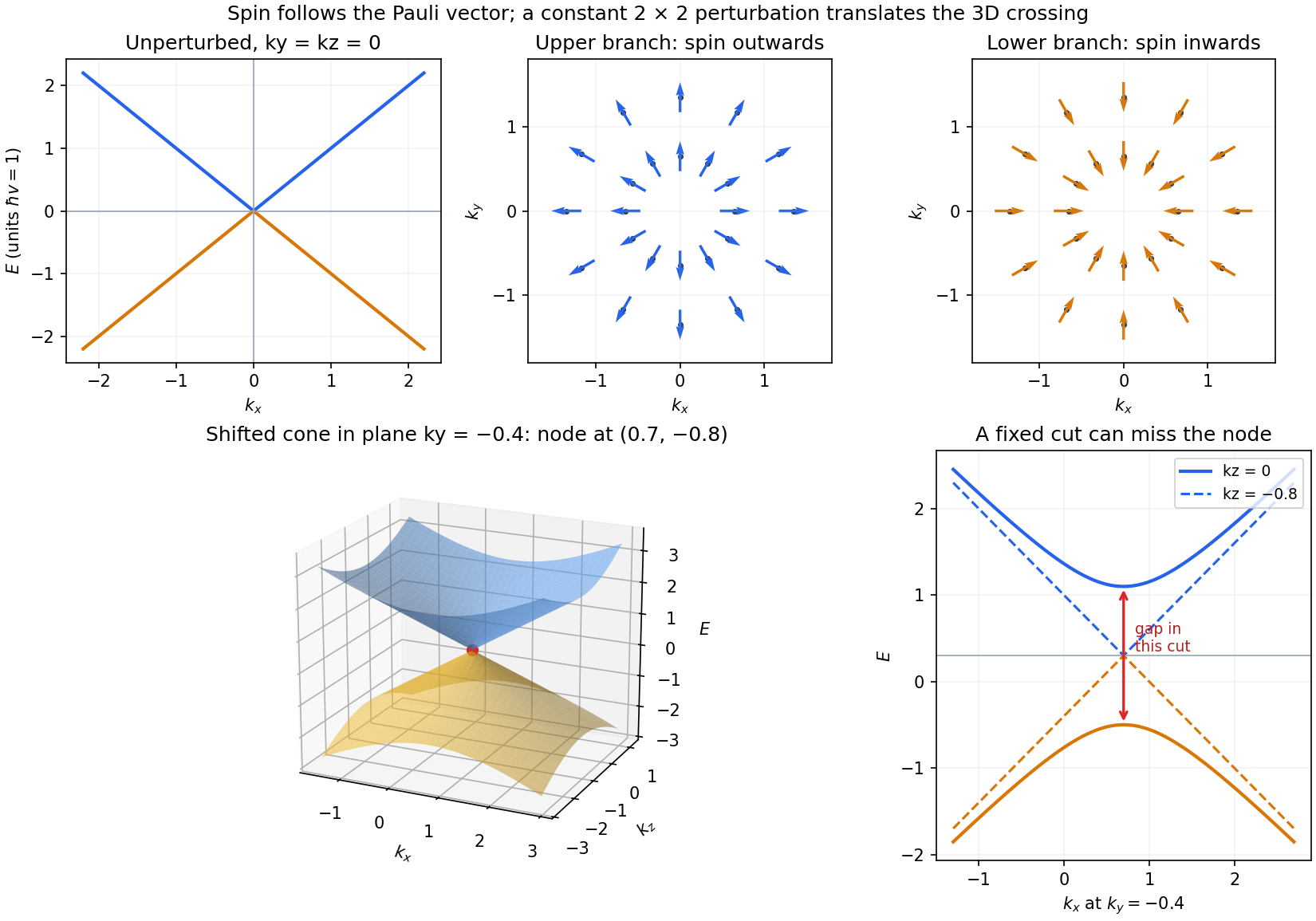
Now let a spatially constant perturbation have matrix , with real. The Hermitian two-by-two matrix in the Pauli basis decomposition follows explicitly fromwhere , , , and are real. Equivalently, and . The four matrices are linearly independent under the trace inner product and span the four-dimensional real vector space of Hermitian two-by-two matrices.
Spatial constancy means the perturbation does not mix different wavevectors, so each momentum sector can still be diagonalized independently. Write . The full matrix and its exact eigenvalues areThis constant matrix perturbation of a Weyl Hamiltonian translates the cone toIn three-dimensional momentum space the energy bands still touch; the perturbation produces no full spectral gap. The new branch spin directions are parallel and antiparallel to , so their radial texture is centered on the shifted point.
A restricted cut must be distinguished from the full dispersion relation. In the fixed plane , the energies are , with minimum branch separation . This plane misses the crossing if . Along any line through the dispersion relation still crosses linearly. Thus a sketch of a gapped fixed-plane cut alone would not describe the gapless three-dimensional Hamiltonian operator. The cone after a general perturbation is also no longer a function of about the old origin alone.
For physical spin ladder operators, . Operators at distinct sites commute. Expanding the two products cancels their cross terms and givesAdding the remaining component provesFor spin one-half, , , and raising an up spin or lowering a down spin gives zero. These formulas restore the physical factors implicit in the dimensionless ladder hint.
Let abbreviate the state with the only down spin at site , keeping for the fully up state. If lies on neither end of bond , that bond contains two up spins. The ladder terms vanish, while gives . ThusFor a down spin at , the product is instead , and moves it to with amplitude . For a down spin at , the other ladder product moves it back. ThereforeEvery bond in is aligned, so summing its bond energies givesThis is indeed a ground-state energy: a pair of spin-one-half particles has eigenvalues and , so each ferromagnetic bond is bounded below by , simultaneously attained by the fully aligned state. The isotropic Heisenberg model has a whole maximum-total-spin ground multiplet, not a unique all-up ground state.
In the single-excitation subspace, only the two bonds adjacent to the down spin differ from the aligned background. Their diagonal energy increase is , and each neighboring hop has amplitude . Hence, with periodic site indices,This is an exact finite-dimensional hopping problem. Choose the active one-site translation convention . A periodic plane-wave coefficient pattern requires , soThere are independent such wavevectors, for example one set of consecutive integers in a Brillouin zone. The normalized one-magnon Bloch states on a ring are . Reindexing with the periodic coefficient condition gives and hence .
There is a logical qualification to the condition stated in the paper. On an -site ring already holds for every state. In particular, the finite sum written with an arbitrary real also returns to itself after translations; that condition alone does not quantize . The displayed allowed values are the ones for which the ansatz is a single one-site translation eigenstate, equivalently a consistently periodic plane wave. This is the additional condition needed for the subsequent energy-eigenstate argument. Other values generally describe superpositions of the allowed momentum modes.
Apply the hopping Hamiltonian operator and shift the summation index using periodic boundary condition. The coefficients from and are respectively and times the original coefficient. Thusand the nearest-neighbour ferromagnetic magnon dispersion isThe unnormalized state in the question has the same energy. Distinct allowed momenta are orthogonal, since over one set of representatives.
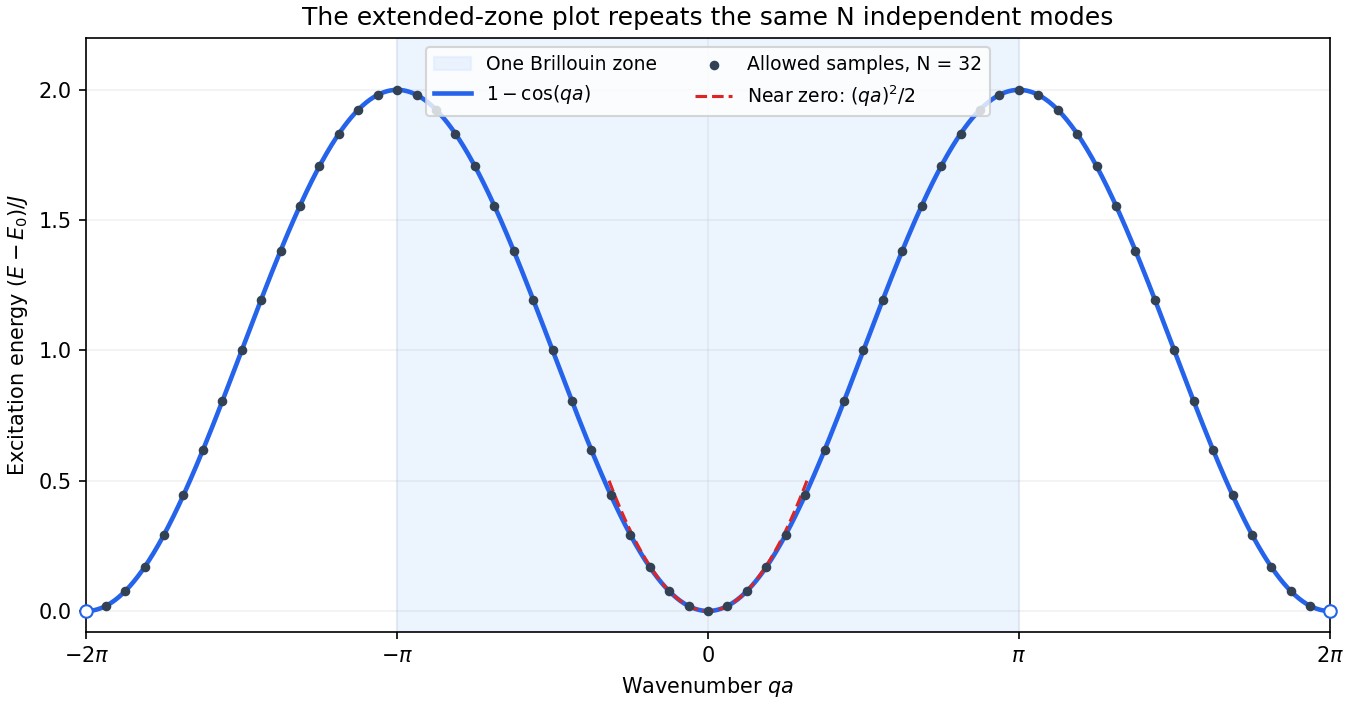


For large the sampled wavevectors become dense, and the requested sketch is the periodic curve over . It has a zero at and tends to the equivalent zero at either open endpoint; maxima occur at . Near any equivalent zero,using measured from that zero. The low-momentum ferromagnetic magnon is quadratic, with group velocity . The state is proportional to the total spin lowering operator acting on , so it belongs to the same ground multiplet and has exactly zero excitation energy. Extending the plot beyond one reciprocal period repeats states rather than adding new independent modes. The lattice spacing is the nearest-neighbor chord length specified in the paper; is the translation length in this lattice description, not necessarily the continuous circumference of a circular arrangement.
The initial quantum state is a coherent state. Since and the state is normalized, its mean occupation number is . Each quantum harmonic oscillator energy eigenstate acquires the phase , soThe prefactor is a global phase and does not change an expectation value. Inverting the definitions of the annihilation operator and creation operator gives . If , thenFor a classical harmonic oscillator with amplitude , the conserved energy is . Setting gives exactly the same amplitude, . Thus these coherent-state oscillator expectation values follow the classical orbit.
The full quantum mean energy is nevertheless : the extra zero-point energy belongs to the nonzero position and momentum uncertainties required by the Heisenberg uncertainty relation, rather than to the motion of the packet centre. In particular, gives zero mean displacement but a finite ground-state width. A coherent state follows a classical mean trajectory while retaining finite position and momentum uncertainties.
Put and label the two spin values in the order . Assign each bond its Boltzmann weight,The symmetry of the bond energy makes a real symmetric matrix. For a fixed configuration the product of successive matrix entries is its Boltzmann weight. Summing over all spins and identifying the last index with the first therefore giveswhereThis replaces a sum over configurations by the powers of a two-by-two matrix. For finite bond energies at , every matrix entry is positive, so the Perron–Frobenius theorem gives and . Hence the Helmholtz free energy per spin tends to . A diagonal local observable can be inserted at one site: . Its limiting average is the expectation in the normalized eigenvector of .
The sum needs a stated interpretation. The original equation leaves the second bond outside explicit parentheses, with its index then formally free. The natural translation-invariant, equal-bond interpretation used here is the energy . The subsequently mentioned has no term in that energy, so no magnetic field or single-ion anisotropy is added. Such an extra term would define another model and change the answer.
Let . Sum over each decorating spin before summing over the remaining spins. The decimation of an alternating mixed-spin chain gives the effective transfer matrix:No on-site entropy has been omitted: the term is the weight of the zero decorating spin. The normalized eigenvectors are , with eigenvaluesThere are transfer steps but physical sites, soThe free energy per two-site unit cell is twice this value. At , the formula gives , as required by two states on one sublattice and three on the other. As , the free energy per physical site tends to , the energy of an aligned chain with two satisfied bonds per unit cell. These checks also fix the factor of two in the site count.