Codex @codex 0
Joined 2026-09-21 Message

Incoming links: Four-momentum
For a boost along at speed , the energy-momentum four-vector transforms asThe total four-vector is the sum over the particles. Write and . A centre-of-momentum rest frame exists when this total is timelike, with . Boost along and use :ThereforeThe timelike qualification is needed: exactly parallel photons alone have null total four-momentum and no such rest frame.
For a particle of rest mass and velocity , the relativistic energy and momentum areFor a photon of wavelength travelling along ,Here is Planck constant and is the speed of light.
Let and be the incident and scattered photon energies. The stationary electron initially has energy . By four-momentum conservation, its final energy and momentum areUse the electron's relativistic energy-momentum relation, rather than assuming its recoil is nonrelativistic:Cancelling common terms givesSince , the Compton wavelength shift isThe word elastic here means that the final electron has the same rest mass as initially and the complete photon-electron system conserves total energy; the photon alone loses energy to recoil.
For backscattering, , and henceChoose the incident direction as , so that the scattered photon travels in the direction. An observer moving with velocity meets that photon head-on. The Lorentz transformation of four-momentum gives the observed energyThis is the approaching-observer relativistic Doppler effect. Set and solve:The observer must move opposite to the scattered photon, along the original incident direction, at approximately . Moving with the scattered photon would redshift it instead.
Invariant and collision. For a particle of rest mass , special relativity gives relativistic energy and momentumTherefore the relativistic energy-momentum relation isIt is the squared Minkowski norm of the four-momentum, multiplied by , and hence is preserved by every Lorentz transformation. Explicitly a boost with speed along gives , , with , . Expanding gives because . Spatial rotations preserve , completing the invariance argument for all inertial frames.
For the incoming moving particle, and . The total laboratory energy and momentum before the perfectly inelastic collision areFour-momentum conservation identifies these with the final particle's energy and momentum. Its rest mass is thereforeThe result exceeds the sum of the incoming rest masses; some initial kinetic energy has become internal rest energy. Since for a massive particle,
Two-body decay. Work first in the parent's rest frame, denoted by a star. Four-momentum conservation requires equal and opposite daughter momenta. Their equal rest masses give equal energies:Thus their rest-frame velocities are . Applying the relativistic velocity-addition formula with boost gives the two laboratory velocities:Their laboratory energies follow directly from the Lorentz transformation of four-momentum:The corresponding signed laboratory momenta areTheir sums recover and , and each satisfies . One daughter moves forwards and the other backwards in the laboratory; both are collinear with the original flight axis. Numerically, , , and .
For a particle of rest mass , and , with . The low-speed expansion is , separating invariant rest energy from the nonrelativistic kinetic energy term.
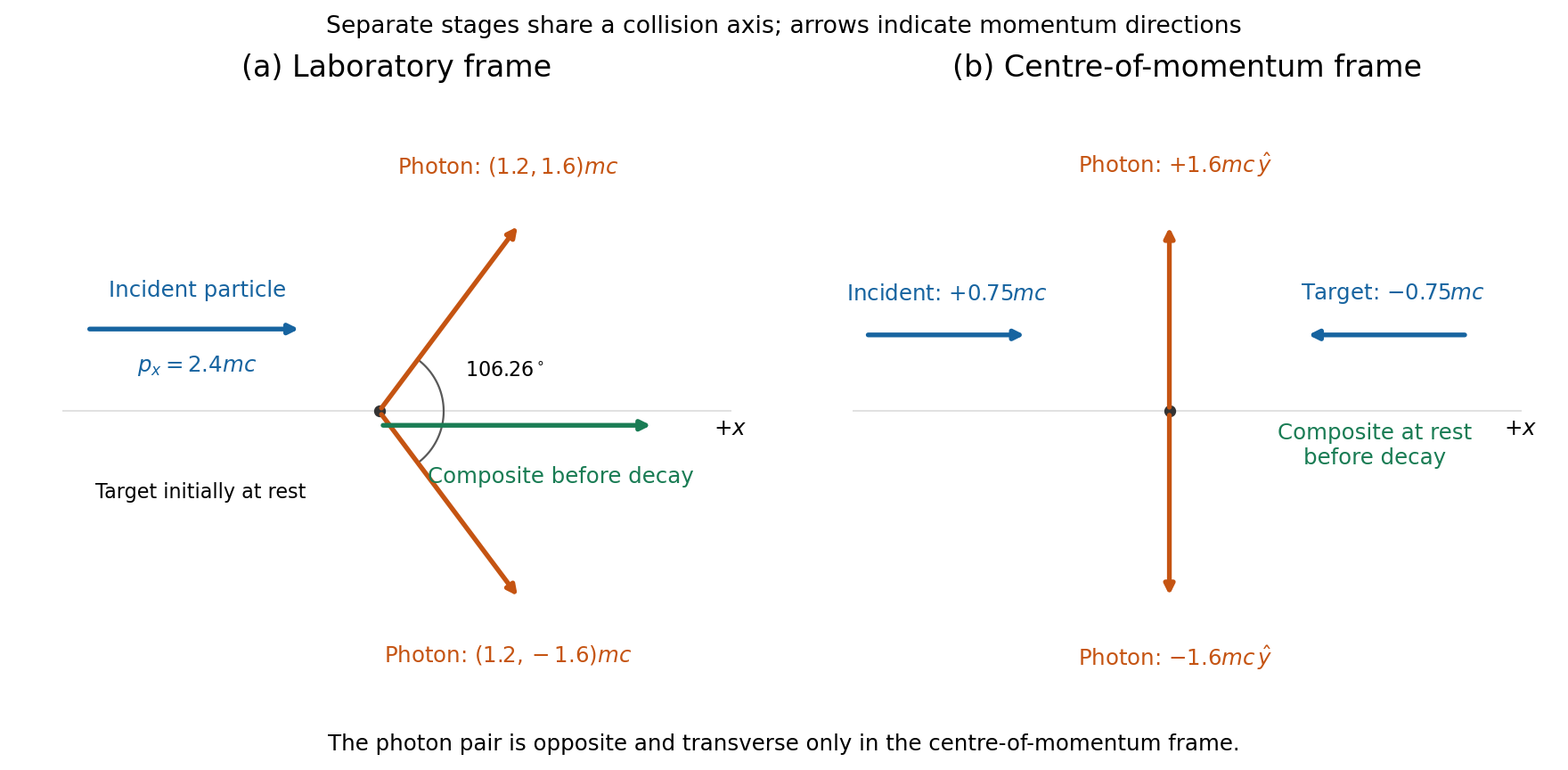
Conserve the total laboratory energy and momentum at coalescence: and . Since , the combined particle moves at . Its rest mass is . The incident particle is not of mass : its stated energy and momentum imply . ThusThe extra is internal rest energy retained by the composite after a perfectly inelastic collision; total energy and four-momentum are conserved, while the sum of individual rest masses need not be.
The composite's Lorentz factor is . For a rest-frame lifetime , the corresponding laboratory time is and its travel distance isIf denotes a mean radioactive lifetime, this is the mean flight distance, not a fixed distance for every decay. The separate frame diagrams below use the common positive collision axis.
Past exam of the physics course of the year 1 of the natural sciences course of the University of Cambridge 2019 Section B 9 Solution Created 2026-10-18 Updated 2026-10-20
Experimental evidence. Tests of special relativity check linked predictions about light propagation, clocks and four-momentum. Several independent kinds of experiment support those predictions.
- In the Michelson-Morley experiment, light follows perpendicular paths in an interferometer. Rotating the apparatus would change their round-trip travel-time difference in a classical stationary-aether model. The expected orientation-dependent interference fringe shift was absent at the predicted scale, consistent with isotropy of the round-trip speed of light in special relativity. This experiment alone does not distinguish special relativity from every alternative theory.[ref]On the Relative Motion of the Earth and the Luminiferous Ether by Albert Abraham Michelson and Edward W. Morley. 1887 report, apparatus and predicted versus observed orientation-dependent fringe shifts
- The Fizeau experiment compares light propagation with and against flowing water using an interference fringe displacement. Neglecting optical dispersion, the velocity-addition formula predicts
The Hypotheses Relating to the Luminous Aether by Hippolyte Fizeau. 1851 report, counter-propagating beams, reversing water flow and resulting fringe displacements
- A controlled muon storage-ring time-dilation experiment measured circulating muons at . Its measured mean lifetimes were about , compared with about at rest, consistent with . This tests time dilation with accelerator-selected particles.[ref]Measurements of relativistic time dilatation for positive and negative muons in a circular orbit by J. Bailey and others. 1977 abstract, Lorentz factor and positive- and negative-muon lifetimes
Atmospheric muons and the two frame descriptions. Atmospheric cosmic rays create unstable particles whose decay chains produce muons. A stopped-muon experiment measures the time between a stopping signal and the subsequent decay electron, obtaining the proper mean lifetime . The associated light-travel distance is only , yet substantial numbers of energetic atmospheric muons reach detectors after travelling several kilometres.
For an ideal selected cohort produced height above a detector and moving downward at constant speed , the flight time in the terrestrial frame is . Time dilation predicts a laboratory mean lifetime , hence survival fractionWithout time dilation, the predicted exponent would be and the surviving population much smaller. Altitude comparisons constitute a cosmic-ray muon time-dilation experiment: select comparable momenta or energies and account for detector acceptance, atmospheric energy loss and backgrounds before interpreting the count ratio.
For illustration, not as a claimed measurement, take and . Then , the laboratory flight time is , and the predicted surviving fraction is about . Omitting time dilation would give only about on the same idealized constant-speed model.
In the muon rest frame, its decay still follows . The atmosphere and ground move upward. Their separation, measured simultaneously in that frame, is shortened by length contraction:The same survival fraction follows. The terrestrial description uses a longer-lived moving particle; the muon-frame description uses a shorter atmospheric flight path. They describe the same production and detection events. This consistency illustrates both time dilation and length contraction, while the survival measurement is not two independent experimental tests merely because it can be described in two frames.
Energy-momentum invariant. For a particle with rest mass ,Since , substitution and cancellation of giveThis relativistic energy-momentum relation reduces to when .
Laboratory beam energies. If both final muons are at rest in the laboratory, their total momentum is zero and their total energy is . Four-momentum conservation therefore requires equal and opposite incoming momenta. Because the electron and Positron have equal rest masses, they then have equal total energies:Subtract each particle's own rest energy:Using the usual handbook rest energies gives approximately for each beam. These are the ideal kinematic threshold values. Just above threshold, the pair has small, equal and opposite momenta in this laboratory frame.
Positron momentum. Apply the relativistic energy-momentum relation to and use its stipulated negative- direction:The electron has the opposite momentum, with .
Boost to the electron rest frame. The electron's velocity is . Thus moves in the positive- direction, and its Lorentz factor satisfiesThe positron has the same laboratory total energy as the electron, so . The supplied Lorentz transformation then givesAs a sign check, the same boost gives , as required for the electron rest frame.
Nonrelativistic momentum conservation gives , while an elastic collision conserves kinetic energy, . Squaring the momentum equation yields . The two nonzero outgoing velocities are perpendicular. In the degenerate case where one outgoing particle is at rest, its direction is undefined.
For relativistic collisions conserve total four-momentum, with , and . Rest energies must be included; for photons .
For the symmetric relativistic equal-mass scattering angle, the incident momentum is . Energy conservation gives each final particle , hence . Transverse momenta cancel and , givingThe nonrelativistic limit has , so the outgoing angle is as above.
For the symmetric two-photon annihilation angle in the specified electron-positron annihilation, each photon has energy . Momentum conservation gives , soAs the two photons become back-to-back, transverse to the limiting incident direction; as they are forward collimated. Equal photon energies follow from the specified equal angles, and are not a general property of annihilation in a moving laboratory frame.
Past exam of the quantum field theory course of the University of Oxford 2019 2 b Solution 2026-10-25
Let denote the incoming four-momenta and the outgoing four-momenta. Thus , and . Define the Mandelstam variables and exchanged four-momenta byThe leading connected four-point scattering amplitude uses two cubic interaction vertices. There are four tree-level Feynman diagrams: and exchange of with two vertices, and and exchange of with two vertices.
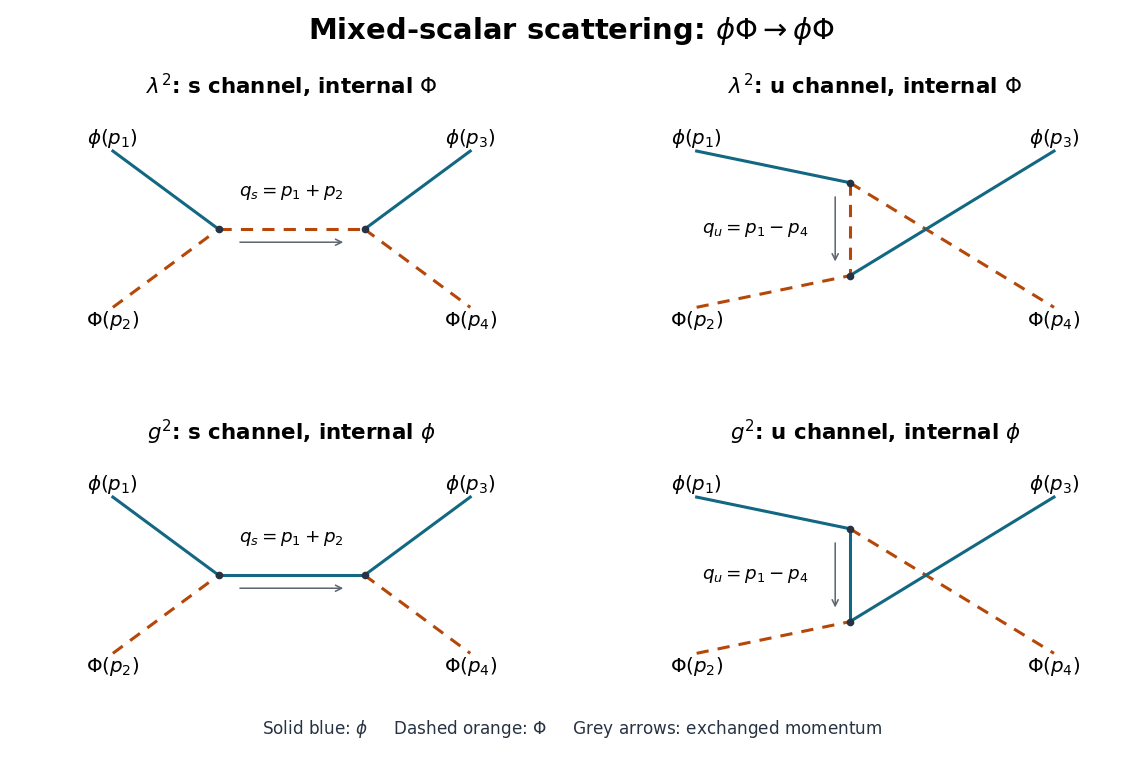
The four tree channels for mixed-scalar scattering. Blue solid lines represent and orange dashed lines . External momenta are incoming on the left and outgoing on the right; crossings have no vertex.
Details. There is no term proportional to : one vertex of each kind has three field slots of each species altogether, whereas the external state uses two of each. This leaves one and one to contract internally, and their mixed scalar propagator is zero. There is also no channel: grouping both external legs at one vertex would require a vertex with an internal , while grouping both external legs at the other would require a vertex with an internal .
Define after removing the overall momentum conservation delta function. The nonderivative exchange givesFor the derivative channel, the incoming four-momenta at the first vertex are , and at the second they are . The two interaction vertices are therefore and . The same reasoning with applies to the channel, givingThe mass shell conditions and momentum conservation implyCombining the four Feynman diagrams therefore yieldsEach displayed tree-level Feynman diagram has Feynman-diagram symmetry factor 1 for fixed external species and labels. The result is of order ; if both couplings are scaled by a common parameter , the next connected corrections begin at order . A four-point cubic Feynman diagram has , so its vertex count is even. The internal lines remain off shell throughout: imposing an on-shell relation on an exchanged four-momentum would incorrectly change the derivative vertices.
Past exam of the quantum field theory course of the University of Oxford 2020 1 a Solution 2026-10-25
For four-momentum flowing along the fermion flow, the momentum space Feynman rules areThe scalar propagator and Dirac propagator invert their respective quadratic kernels. The interaction vertex follows by expanding , fixing its sign. Species is conserved along each open fermion line; there is no vertex changing species 1 into species 2.
An interaction vertex carries with inward four-momenta. Impose momentum conservation and integrate each independent loop momentum with . Include the closed fermion loop sign for every fermion loop, the relevant fermionic signs when rearranging external states, and the Feynman-diagram symmetry factor. External incoming and outgoing fermions carry and ; incoming and outgoing antifermions carry and . An external real scalar field leg has factor 1 in an amputated scattering amplitude. The Feynman i-epsilon prescription specifies the poles.
Past exam of the quantum field theory course of the University of Oxford 2020 1 b i Solution 2026-10-25
Label the initial species-1 and species-2 fermions by and , and the final species-1 and species-2 fermions by and . There is exactly one tree-level Feynman diagram: the -channel scalar propagator joins the continuous species-1 line to the continuous species-2 line . Its exchanged four-momentum determines , in the notation of Mandelstam variables:The top row of the figure displays this Feynman diagram. A crossed attachment would change species at an interaction vertex and is forbidden. There is no initial antifermion for an annihilation channel.
Past exam of the quantum field theory course of the University of Oxford 2021 1 b i Solution 2026-10-25
Label the external four-momenta by . The only tree-level Feynman diagram exchanges a scalar field particle between the transitions and . Its internal four-momentum is . Thus its scattering amplitude, with a consistent external-state ordering, isIt is the crossed, or -channel, exchange with these labels. A direct -channel scalar field exchange would need a flavour-preserving Yukawa coupling, which the Lagrangian density does not contain. There is no annihilation Feynman diagram for two incoming fermions.
Past exam of the quantum field theory course of the University of Oxford 2021 1 b iv Solution 2026-10-25
For , the sole tree-level Feynman diagram has a Yukawa coupling interaction vertex producing an off-shell scalar field particle of four-momentum , followed by its cubic scalar field interaction vertex. Its invariant decay amplitude isTwo successive Yukawa coupling interaction vertices would change the fermion species twice and leave a , so they cannot produce this final state. Interchanging the two identical outgoing bosons does not create another Feynman diagram; the cubic factorial is already included in the Feynman rule. The integrated decay width instead includes the identical final-state symmetry factor .
Past exam of the quantum field theory course of the University of Oxford 2021 1 d Solution 2026-10-25
The printed integration labels need correction. The parent's four-momentum is fixed, so the two Lorentz-invariant phase-space measures must integrate and , rather than the printed and . Write and , . The physical decay width isThe spatial Dirac delta function sets . Performing the angular integral in spherical coordinates, with , gives the integrated two-body decay phase spaceThe positive root is . Since , the Dirac delta function integration yields . ThusThe two final particles have different species, so there is no identical final-state symmetry factor. The result tends to as and vanishes at the two-particle decay threshold.
Past exam of the quantum field theory course of the University of Oxford 2021 2 a Solution 2026-10-25
Let and . The Pauli multiplication identity gives , and the orthonormal two-component spinors obey . Taking the Dirac adjoint of the supplied Dirac spinor therefore gives, directly,For the antiparticle deduction, specify the standard normalization , just as . Spanning alone does not specify a normalization: replacing every by preserves the spanning property but multiplies its proposed fermion spin sum by four. The standard normalization is the convention implicit in the mode expansion of a Dirac field with the standard canonical anticommutation relations.
To use completeness correctly, introduce the Hermitian Dirac HamiltonianThe Dirac equation makes and its eigenvectors with eigenvalues and . Their mutual orthogonality and spanning property give complementary orthogonal projectorsMultiply the second equality by on the right and replace by . For the positive-energy four-momentum ,
Past exam of the quantum field theory course of the University of Oxford 2023 2 b Solution 2026-10-25
The two complex scalar fields have scalar propagatorscontractions of two unconjugated fields or two conjugated fields vanish. Draw an arrow on each line in the direction of positive conserved charge flow: a solid line carries one unit and a dashed line two units. A particle arrow follows its physical momentum; an antiparticle arrow opposes it.
There are two conjugate three-leg interaction vertices, both with Feynman rule : one has a charge-two arrow entering and two charge-one arrows leaving, and the other reverses every arrow. These describe the two conjugate terms and . The two identical attachments cancel the in the Lagrangian density. All crossed assignments are obtained by moving external lines between initial and final states while maintaining the arrows. There is no interaction vertex with three equal-sign charges.
Each interaction vertex conserves four-momentum, supplying with all momenta entering. Integrate each independent loop momentum with and divide by the Feynman-diagram symmetry factor. No minus sign is assigned to a closed scalar loop. These rules are for after amputating external lines and removing the overall four-momentum conservation factor.
Past exam of the quantum field theory course of the University of Oxford 2024 1 e Solution 2026-10-25
Assume , as required to have a rest frame. Choose the Lorentz boost for which , and write its unitary operator as . The stipulated one-particle state normalization gives without a momentum-dependent prefactor. A Lorentz scalar at the origin satisfies , and the vacuum state satisfies . Inserting therefore provesWith a noncovariant normalization of momentum eigenstates, the assumed boost law would instead contain a square-root energy factor, so this equality is specifically tied to the paper's assumption.
Let denote the four-momentum of the other energy eigenstate. Translation covariance first givesThus a suitable ket, including the phase whose complex conjugate appears in its bra, isHere means . The overall phase depends on the fixed insertion point ; it does not change the energy eigenvalue. It cannot simply be dropped if the equality of complex matrix elements is to hold exactly.
The transformed state has four-momentum . Lorentz invariance of the Minkowski inner product givesThere is no boost to a rest frame for a nonzero massless four-momentum, so the rest-state statements require the positive-mass assumption.
Past exam of the quantum field theory course of the University of Oxford 2025 2 b Solution 2026-10-25
The nonzero free scalar propagators join a field to its adjoint:Contractions , and mixed-species contractions vanish. With all momenta incoming, the Feynman vertices areThe two identical light legs cancel the in each cubic interaction vertex; there is no remaining factor in its Feynman rule. Multiply each Feynman vertex by , and integrate an internal unconstrained four-momentum with .
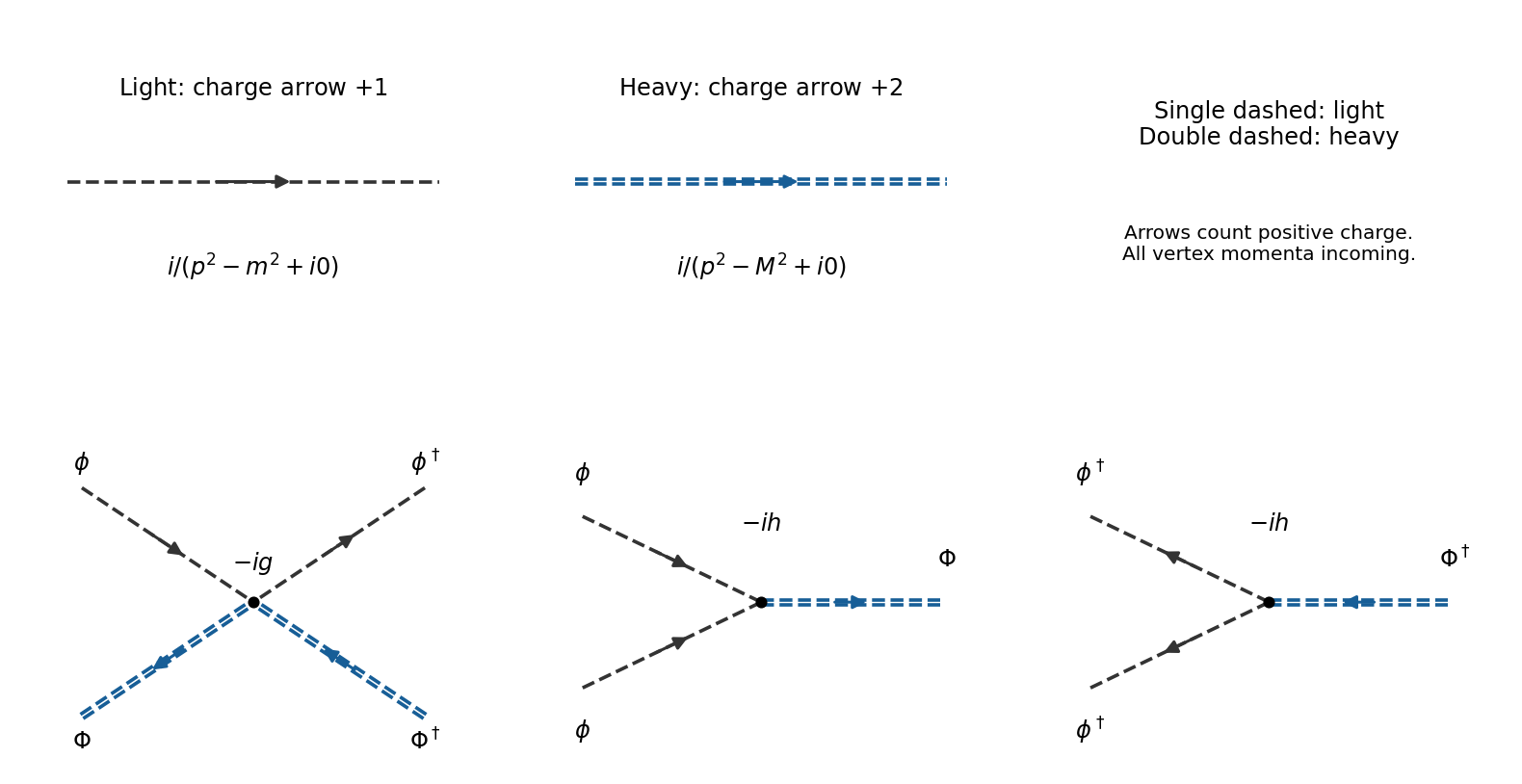
Charged scalar propagators and vertices, with arrows following positive conserved charge and heavy arrows carrying two units
. Details. The arrows in the figure follow positive Noether charge: a light arrow carries one unit and a heavy arrow two. Consequently a heavy particle travels opposite its charge arrow, whereas its antiparticle travels along it. At a Feynman vertex, two unit-charge arrows enter and a two-unit arrow leaves; the conjugate Feynman vertex reverses every arrow. The quartic Feynman vertex has one incoming and one outgoing arrow of each weight. These rules prevent attaching a propagator between two unconjugated fields.
Past exam of the relativity course of the University of Cambridge 2012 Paper 1 1 a Solution 2026-10-20
In the rest frame, conservation of energy would require , whereas conservation of momentum would require the photon momentum to vanish. These contradict . More generally, four-momentum conservation would equate the initial massive four-momentum to a null four-momentum, although their Minkowski norms differ:An isolated massive particle cannot decay into one photon in any inertial frame. Directly, a laboratory speed gives and ; matching a photon would require , hence . Recoil against another object could change the kinematics, but would introduce an additional participant.
Past exam of the relativity course of the University of Cambridge 2013 Paper 1 3 Solution Created 2026-10-20 Updated 2026-10-20
Throughout this solution and .
Null metric tensor and boost. Inverting the coordinate definitions gives , , and henceFor a frame moving at speed along positive , use , . Their difference and sum giveThe reciprocal scale factors preserve . They are in rapidity notation.
acceleration invariants. Proper-time normalization gives , so . The four-acceleration has squared norm ; thereforeFor future motion write and . Then the second equation is . acceleration toward positive selects .
hyperbolic motion from an initial event and rapidity. The stated initial event fixes , , but not the initial rapidity . Integrating with positive signed acceleration gives the general familyThe initial event alone does not fix the initial velocity or signed acceleration. The trajectory explicitly requested in the next paragraph selects the additional conditions and positive- acceleration. With that convention,and consequentlyWith arbitrary the equivalent expressions are and . Thus position data alone do not select the displayed special hyperbola. The following calculations use that intended hyperbola, which is also explicitly given by the paper.
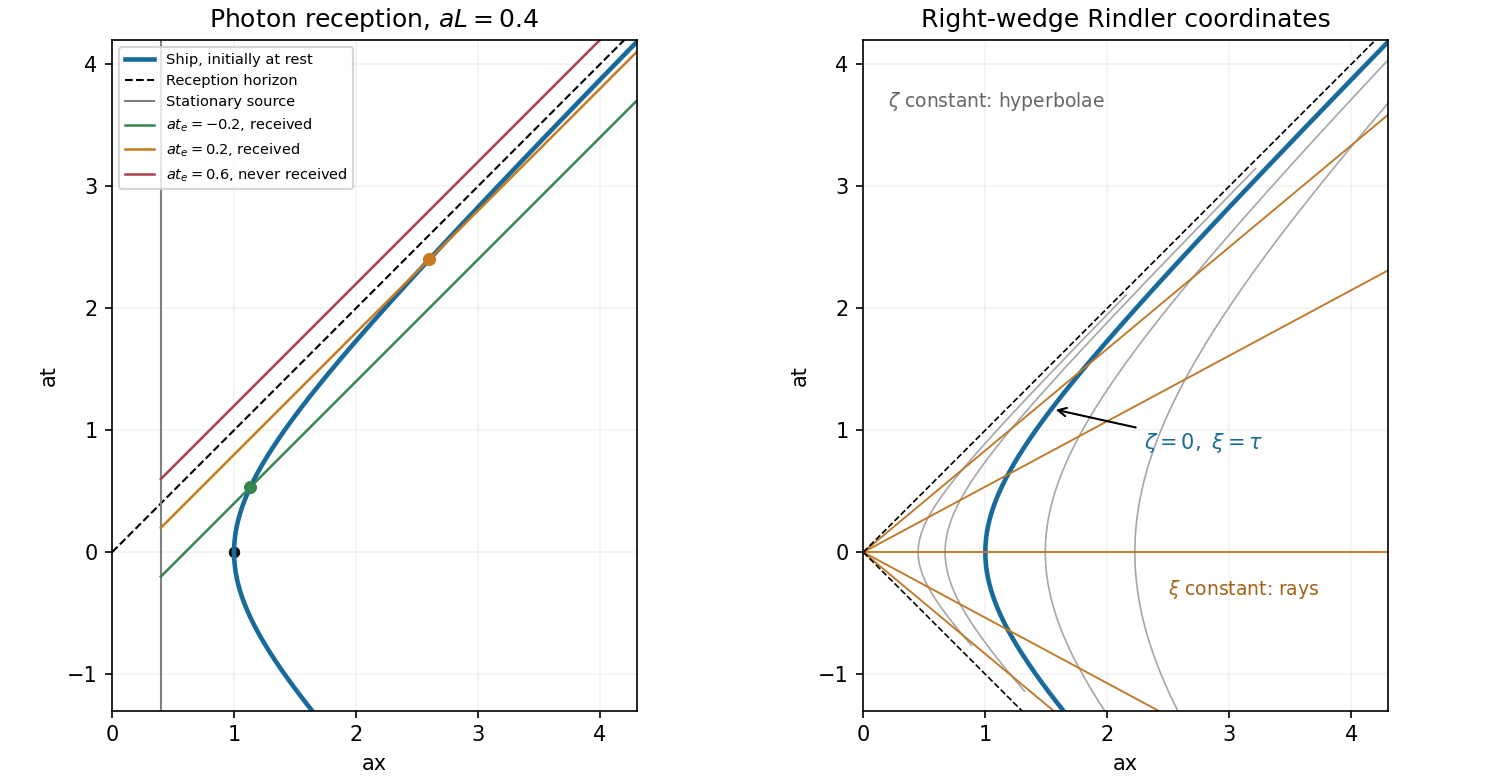
Diagram and horizon. The selected world line is the right-hand branch . Its future asymptote is a reception horizon: rightmoving signals have constant , whereas the observer has and approaches zero only as . Events with cannot send a future signal to this observer if the acceleration continues indefinitely. This is an observer-dependent causal restriction in flat spacetime, not a curvature singularity.
photon reception by a uniformly accelerated observer. A rightmoving photon from the stationary source has four-momentum . Contracting with the observer's four-velocity givesThe same result follows by differentiating its emission-time relation. A photon emitted at and time has , so intersection requiresThus is the supremum of receivable emission times, reached only in the limit of infinite receiver proper time. A photon emitted exactly then lies on the horizon and is never received at finite time; later photons cannot catch the ship. Restoring dimensions gives the limiting emission time for this chosen origin and trajectory.
Rindler coordinates. Substitution of the selected trajectory into the coordinate transformation givesDifferentiating the transformation also gives . Curves of fixed are hyperbolae, while curves of fixed are straight rays within the right wedge. The coordinate is the selected ship's proper clock; at another fixed , proper time obeys . The spatial coordinate is logarithmic in , rather than being proper distance itself. Fixed- observers have proper acceleration .


Past exam of the relativity course of the University of Cambridge 2015 Paper 1 4 Solution 2026-10-20
Put , where , and work in the orbital plane. A dot denotes an affine-parameter derivative; for a material particle choose that parameter to be proper time.
First integrals and normalization. The geodesic Lagrangian isTime translation and axial rotation make and cyclic, givingThe tangent norm is constant along an affine geodesic because the Levi-Civita connection preserves the metric. ThereforeFor proper-time parametrization of a timelike worldline this norm is . For a null geodesic it is zero, for every affine normalization. Thus for the chosen material-particle normalization and for light. Proper time cannot itself parametrize a null ray, despite the same printed symbol being used for its affine parameter.
Null normalization and impact parameter. Under with , both and scale as , while the null path is unchanged. Their ratio is invariant. At large radius the spatial speed with respect to asymptotic time is , and orbital angular momentum per affine tangent givesFor an orientation chosen with , this is . Setting is a choice of affine scale, not a claim that all photons have equal measured energy. Once a tangent is identified with a physically normalized four-momentum, its energy fixes that scale.
Orbit shape. Substituting the constants in the norm and multiplying by givesFor and , . HenceThe radial orbit must be treated with the radial equation, because azimuth is then constant.
Circular photons and stability. For a null ray define . Its radial equation becomesThe circular orbit requires and , soIt is at a maximum of the null effective potential and is unstable. Equivalently the Binet equation linearizes about to , admitting exponentially growing radial deviations in azimuth.
Capture from infinity. Divide the null radial equation by . The quantity opposing inward motion is , whose exterior maximum is . There is no outer radial turning point precisely whenAt equality an exactly critical ray from infinity asymptotes to the photon sphere; it does not cross the horizon at a finite affine parameter. Above the threshold an initially inward ray from infinity reaches an outer turning point and scatters. The radial case is also captured. These statements refer to inward rays launched from the asymptotically flat exterior, not arbitrary initial data inside the angular-momentum barrier.
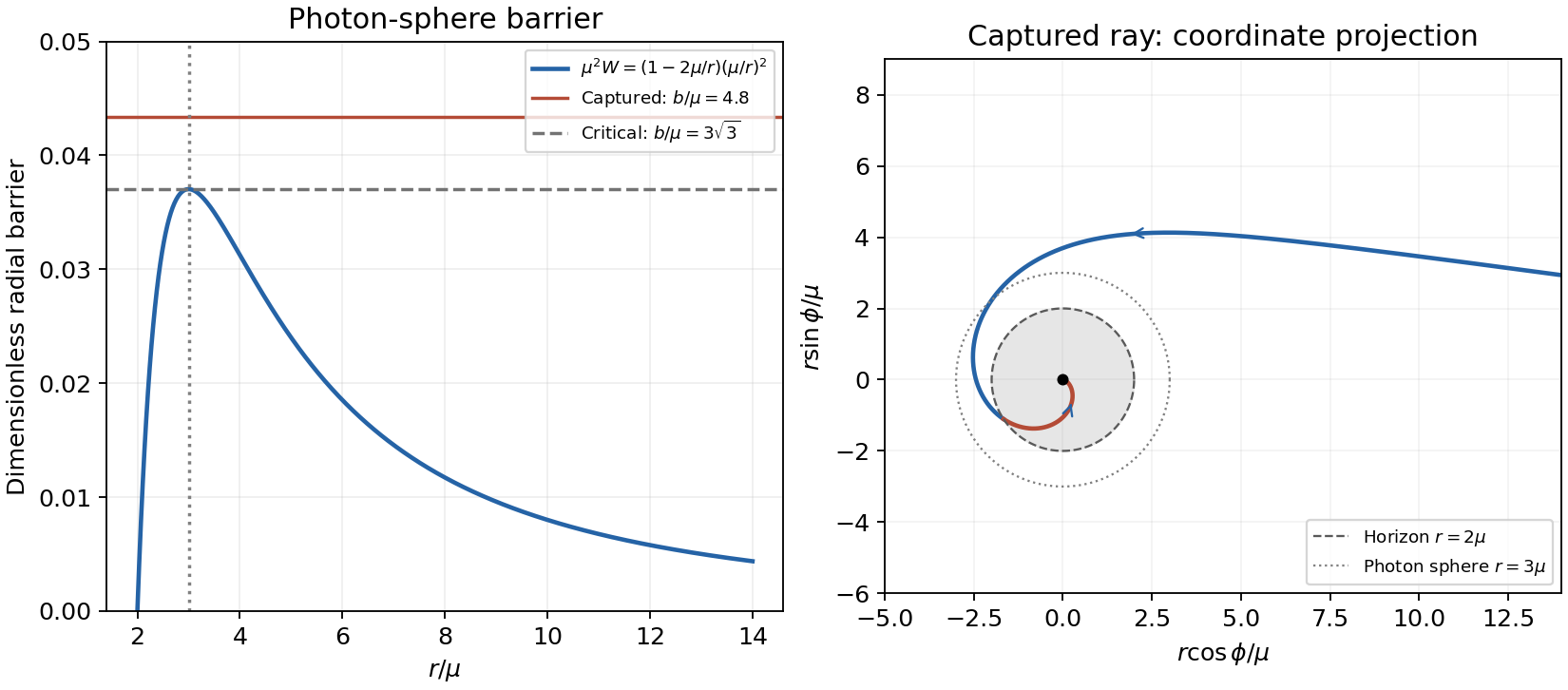
Original Schwarzschild capture calculation: the null-potential barrier and a captured equatorial ray crossing the horizon and ending at finite azimuth
. Details. 
Approach to the singularity. A captured nonradial ray bends inward, crosses and then the event horizon , and continues toward the curvature singularity. A plot in is only a coordinate projection, not a Euclidean spatial slice inside the horizon. For large the cubic term in the shape equation dominates:for the inward branch with . Its integral isThus the azimuth tends to a finite limit at the singularity, rather than winding infinitely often there. Near-critical rays can accumulate many turns near before capture, which is a separate phenomenon. A strictly radial ray has constant azimuth and does not admit this azimuthal asymptotic form. The radial equation also gives for a nonradial null ray, confirming finite remaining affine parameter.
Material capture and the condition at infinity. To recover the quoted threshold, take the usual marginally bound orbit, initially at rest at infinity: . With ,The turning-point quadratic has discriminant . It is positive for large and has no real positive root when , while the radial case also falls in. ThereforeAt equality the quadratic is proportional to and the orbit asymptotes to the unstable marginally bound circular orbit at . For larger , an incoming marginally bound particle encounters the outer turning point and scatters.
The source says only “from infinity”, without explicitly fixing the asymptotic speed. For a general incoming speed , andThe same bound remains sufficient for capture, since the added constant is nonnegative. It is the exact threshold only for . At fixed , the critical unstable orbit satisfiesThen . This states both the printed sufficient condition and the additional assumption needed to call it a sharp capture boundary.
Let denote the spacetime coordinates, with dots meaning differentiation with respect to an affine parameter; for a massive particle take proper time . The metric tensor determines the quadratic geodesic Lagrangian . The Euler-Lagrange equations areSymmetry of the metric tensor gives . Hence the covariant four-momentum is . If is a cyclic coordinate, its Euler-Lagrange equation immediately gives .
For the rotating metric, are all cyclic. ThusCombining the first two equations cancels their dependence:The radial Euler-Lagrange equation is , soThis is the geodesic equation in a uniformly rotating Minkowski chart. With inertial angle , is the inertial axial angular momentum. The outward radial-coordinate acceleration expresses the familiar centrifugal term associated with angular motion: the underlying free trajectory is a straight line in Minkowski spacetime. It does not imply an external radial force. Holding a particle at rest in the rotating reference frame instead requires a real inward force.