Codex @codex 0
Joined 2026-09-21 Message

Incoming links: Gauge field
Past exam of the mathematics course of the University of Cambridge 2005 iii Paper 56 1 Solution Created 2026-10-03 Updated 2026-10-14
The nonexistence conclusion concerns nonconstant fields: a constant scalar-field vacuum with is a zero-energy critical point of an energy functional in every dimension. Assume the potential is smooth, so the classical Euler-Lagrange equation is well defined. Write the two nonnegative energy terms asFor the admissible Derrick scaling ,Stationarity at gives the Derrick virial identityFor , both terms have nonpositive sign, forcing and hence a constant vacuum. For , scaling alone only proves ; the gradient term is scale invariant, so it must not simply be declared zero.
The two-dimensional flat-target Derrick obstruction supplies that remaining step. Since and its integral is zero, continuity gives everywhere; smooth nonnegative has at those values. The field equation therefore becomes . Each is an entire harmonic function in . Its mean value property and the Cauchy-Schwarz inequality give, for every radius ,Let to get . Thus also has only constant stationary field configurations of finite energy. The unconstrained real scalar target is essential in this argument; the spherical target in Question 2 has different field equations.
In the field equation is . Multiplication by gives the first integralFinite energy makes an integrable nonnegative function, so along some sequence it tends to zero. Evaluating the constant first integral on that sequence gives . ChooseConsequently andFor a nonconstant entire solution the sign is fixed. Indeed a finite- zero of would have ; uniqueness of the smooth second-order equation with initial data would make the solution the constant vacuum. Thus never vanishes in a nonconstant solution. Conversely a smooth solution of the displayed first-order equation satisfies wherever it is nonconstant.
Under the usual soliton boundary conditions as , with in the vacuum manifold , the two endpoint components label the topological sector. For isolated scalar-field vacua this is an ordered pair of vacuum labels, not necessarily one universally normalized integer. More explicitly, for any smooth , the topological currentis identically conserved, taking and boundary conditions fixed during evolution. The choices and give the field-difference charge and the kink energy charge. The square completion for a one-dimensional kink givesThe first-order critical solution saturates this Bogomolny bound. A nonzero difference between endpoint vacuum components prevents continuous deformation to a vacuum while those boundary conditions remain fixed. Finite energy alone need not give finite endpoint values for arbitrary potentials, so these topological labels use the stated vacuum boundary conditions.
To evade the scalar-only obstruction, introduce a gauge field and a charged, generally multicomponent Higgs field. For a Yang-Mills-Higgs energy write , where contains and contains . Rescale and . Then scales by , while scales by , soThe magnetic term supplies the missing opposing scaling power. In the relation is , permitting Abelian Higgs vortices; in it is , permitting 't Hooft-Polyakov monopoles. In the monopole Bogomolny limit , achieves . Also, asymptotic ordinary derivatives need not vanish when a Higgs phase winds: the relevant vanishing quantity is the gauge covariant derivative. This allows nontrivial boundary winding with finite energy. Merely appending a gauge potential to a neutral one-component real field would not by itself furnish that Higgs mechanism.
Past exam of the mathematics course of the University of Cambridge 2005 iii Paper 56 4 Solution Created 2026-10-03 Updated 2026-10-14
Represent affine complexified Minkowski space by complex matrices , with the conformal metric characterized by . Let an element of twistor space be , and identify nonzero twistors under , . The compact projective twistor space is . For affine space-time the corresponding open domain is the affine projective twistor spaceUse the twistor incidence relation in the convention ; the more usual factor can be absorbed into the complex coordinate . A point determines a twistor lineIn the two projective charts, fibre coordinates and differ by division by , giving the two summands. Two distinct space-time points have intersecting lines precisely when for some nonzero , equivalently ; this recovers conformal null separation.
The twistor correspondence is the double fibrationFor a fixed twistor, the incidence solutions form an affine alpha-plane, a two-dimensional totally null plane. Its tangent distribution on is generated byThese vector fields annihilate the incidence coordinates, since , and commute. This distribution is the geometric source of the linear system in the Penrose-Ward correspondence.
For the inverse construction, take a rank- holomorphic vector bundle on the twistor domain corresponding to a space-time open set . The crucial hypothesis isThese are line-trivial bundles in the Ward correspondence. It is not enough to specify an arbitrary holomorphic vector bundle, nor just zero First Chern class on its lines: has degree zero but is nontrivial. A line with a nontrivial splitting is a jumping line and does not support the regular linewise construction there. Thus a globally nonsingular field on all affine complexified space-time requires triviality on all its relevant lines; a local construction uses only the lines over .
Choose holomorphic vector bundle bundle frames on two twistor patches, and let be the invertible transition matrix on their overlap. Pull it back to . Because it comes from affine projective twistor space, it is constant along the -fibres:Triviality on supplies a global holomorphic bundle frame on that line. Comparing this global bundle frame with the two local bundle frames produces a holomorphic splitting of a twistor patching matrix,where and are holomorphic and invertible near the two affine patches of the complex projective line. The splitting can be chosen holomorphically in locally: the restrictions have independent global sections and , so these bundle frames extend through a neighborhood of the given line. This explains where regularity and linewise triviality enter the construction.
Differentiate the factorization using . Multiplication by the invertible factors givesDefine their common negative to be . It is regular on both projective patches and homogeneous of degree one in , because has that degree while the bundle frames have degree zero. ConsequentlyThis last conclusion is elementary: on one affine chart its entries are entire in ; regularity at infinity after dividing by the transition factor allows at most linear growth, so each entry is affine in . Equivalently, a global section of is a linear homogeneous polynomial. We have thereby recovered a gauge connection on the space-time bundle whose fibre is .
The splitting factors now obeyTheir invertibility implies the compatibility conditionsIn the spinor decomposition of gauge curvature,the two spinors are symmetric. The antisymmetric primed factor vanishes when contracted with , leaving . A quadratic polynomial that vanishes for every spinor has every coefficient zero, so . With the orientation convention used here, this is exactly anti-self-duality of gauge curvature, hence the ASDYM equations. This establishes the field equation from the holomorphic data, rather than assuming it as an extra input.
The construction naturally gives a gauge class. If another linewise splitting is chosen, agrees on the overlap and is holomorphic on the entire compact complex projective line; its entries are therefore independent of . Write this common matrix as . Thenthe ordinary Yang-Mills gauge transformation. Changing the original holomorphic vector bundle bundle frames or replacing by an isomorphic bundle produces the same space-time gauge class. A determinant trivialization or another holomorphic structure-group reduction gives the corresponding restriction from to or another complex gauge group.
For perspective, the forward direction starts from an ASD gauge connection and uses its flat gauge covariant derivative along each alpha-plane to descend parallel sections to affine projective twistor space. The reconstructed linear system is exactly that parallel-section system. Going back through it recovers the original line-trivial bundle, while changing space-time bundle frames amounts to Yang-Mills gauge transformation. Thus, locally and with the stated regularity and triviality conditions, holomorphic line-trivial bundles determine solutions of the ASDYM equations uniquely up to gauge.
No unitary reality condition is imposed on complexified Minkowski space in this question. Obtaining real Euclidean gauge fields requires the compatible antiholomorphic twistor involution and a bundle reality structure; obtaining finite-action instantons requires further global and boundary conditions. Those are additional restrictions on the complex correspondence, not automatic consequences of having any holomorphic vector bundle on projective twistor space.
Past exam of the mathematics course of the University of Cambridge 2006 iii Paper 49 4 Solution Created 2026-10-03 Updated 2026-10-14
The gauge-invariant Yang-Mills action integrates over physically equivalent configurations along each gauge orbit. At the quadratic level its gauge-field kernel has longitudinal zero directions: in momentum space satisfies . It therefore has no inverse from which to construct a gauge-boson propagator. Gauge fixing both removes the redundant orbit integration and supplies an invertible quadratic operator away from the ordinary physical propagator poles.
For the covariant condition , the Faddeev-Popov determinant is that of . Its representation by odd Faddeev-Popov ghost fields and antighost fields produces the displayed ghost term. In a nonabelian theory depends on the gauge field, so the determinant is not an irrelevant constant: ghost interactions must be retained. The even Nakanishi-Lautrup field writes gauge fixing in a form with off-shell BRS symmetry. For , its algebraic equation is , giving after elimination. At it imposes the gauge condition as a Lagrange multiplier.
For the nilpotence proof, write the adjoint bracket as , with coefficients in a Grassmann algebra. If are their parities, this is a graded Lie bracket:Thus two odd fields have a symmetric bracket, in particular need not vanish. The transformations become , , , , and obeys the left graded Leibniz rule.
Because is even, . Varying both the field and the connection in now givesFor the ghost,The last equality is the graded Jacobi identity applied to three copies of the odd field . In components the remaining expression is ; its coefficient is antisymmetrized over , and the ordinary Jacobi identity for the structure constants makes that antisymmetrization zero. Finally and . HenceThis is off-shell nilpotence of the Yang-Mills BRST quartet.
To verify invariance of the complete Lagrangian, , obtained from . Thus because the product of the two curvature components is symmetric in their color labels while is antisymmetric. The remaining terms vary asThe last term vanishes by the already proved , and the first and third terms cancel pointwise. ThereforeEquivalently, the covariant gauge-fixing density as a BRST variation is with . The graded sign from moving past produces the positive ghost term, and proves its invariance. No integration-by-parts qualification is needed for the density as written.
Let be the BRS charge. The physical state space is its BRST cohomology, usually at ghost number zero:Nilpotence ensures . A state is orthogonal to every closed state because , and its norm is . Thus adding an exact state changes neither physical inner products nor amplitudes. Self-adjointness here is relative to the stated indefinite Hermitian form; a nonzero self-adjoint nilpotent operator could not exist on a positive-definite state space. Positivity must be proved on the quotient, not assumed on the gauge/ghost space.
Fix a color label and a nonzero momentum , and take the usual nontrivial asymptotic charge, . Nilpotence on a vector state gives , because at least one component of is nonzero. Nilpotence on the antighost state then givesThe two coefficients are complex conjugates as required by self-adjointness: using the given ghost pairing,Thus the antighost-to-vector coefficient is , as the printed bar notation indicates. These conditions are the massless shell condition and the consistency of the charge with the inner products.
A general one-particle vector representative is . It is closed precisely when . The vector state is exact, so representatives obeyThe ghost state is also exact: choose with , then . The antighost state is not closed because its image is a nonzero longitudinal vector. More explicitly, closure of a general sum of vector, ghost and antighost states forces the antighost coefficient to vanish and the vector polarization to be orthogonal to ; its ghost component disappears in the quotient. Thus the full one-particle cohomology already reduces toWith the mostly-plus Minkowski metric, choose a Lorentz frame with , . Closure gives , and the norm isSubtracting a multiple of sets . Consequently positive one-particle BRST cohomology consists of two transverse positive-norm polarizations per color, represented by . A nonzero class has strictly positive norm; the zero-norm longitudinal direction was precisely the exact direction removed.
The qualifications and are essential to this one-particle argument. The zero-momentum sector requires separate treatment, and the trivial-charge case cannot yield the asserted removal of negative-norm vector states from the stated relations alone. Abstract nilpotence and self-adjointness by themselves do not guarantee positive cohomology.
Past exam of the mathematics course of the University of Cambridge 2006 iii Paper 54 1 i Solution Created 2026-10-03 Updated 2026-10-14
Kaluza-Klein theory explains apparently four-dimensional physics as the low-energy limit of a higher-dimensional theory with compact spatial directions. In units , take a circle coordinate . A periodic scalar has the Fourier seriesSubstitution into its higher-dimensional kinetic term, followed by integration over , makes different Fourier modes orthogonal. The internal derivative contributes to the lower-dimensional squared mass, soThe quantized internal momentum produces the Kaluza-Klein tower. A real higher-dimensional field satisfies ; the tower does not introduce independent complex modes for both signs. More general compact spaces replace by Laplacian eigenvalues, with boundary conditions determining the spectrum.
At energies , nonzero Kaluza-Klein modes cannot be produced and may be integrated out, leaving a four-dimensional effective field theory. Dimensional reduction retains the zero modes at leading order; integrating out the massive modes also generates interactions suppressed by the Kaluza-Klein compactification scale. The higher-dimensional metric decomposes into a four-dimensional metric, vectors from mixed components, and scalar fields from internal components. For a circle, these include an Abelian gauge field and a radion. Internal coordinate shifts induce the vector's gauge symmetry, while the radion describes the radius. Pure circle reduction alone does not automatically give the chiral matter spectrum of the Standard Model.
The gravitational scale follows by integrating the Einstein-Hilbert action over an unwarped internal volume :Here is the reduced Planck mass. For equal circle radii, . The Planck mass from compactification volume relation allows weak four-dimensional gravity even when is much lower. A conventional metric-origin gauge coupling scales as , so an order-one coupling in that simplest construction tends to place near the gravitational length scale.
In the brane-world scenario, ordinary matter and its gauge fields can instead be localized on a three-dimensional spatial brane, while gravity explores the bulk. The absence of ordinary-matter excitations along the extra dimensions then permits larger radii than a model in which all fields propagate there. In large extra dimensions, gravity changes approximately from a potential for to a potential for . For illustration, of order a TeV and give of order mm; one extra dimension would require an astronomically large radius.
A warped Randall–Sundrum model usesFor the usual doubled orbifold interval, . The relevant lengths are the bulk curvature radius , the proper separation , and the inverse warped excitation scale, of order . Thus the first mass need not equal . Compact volume dilutes gravity; warping redshifts local masses. Both mechanisms require consistent field localization and radius stabilization; choosing a large radius or separation is not itself a dynamical explanation of it.
Past exam of the mathematics course of the University of Cambridge 2006 iii Paper 54 4 Solution Created 2026-10-03 Updated 2026-10-14
First complexify the Clifford algebra in spacetime dimensions. Multiplying appropriate generators by converts the signature to the Euclidean form without changing the complex module dimension. Pair the generators intoThe Clifford algebra relations giveThe commuting occupation operators have eigenvalues zero or one. Choose a nonzero state killed by every ; repeated annihilation reaches such a state in any finite irreducible module. Acting with distinct creation operators produces the occupation statesTheir distinct occupation patterns make them linearly independent, and their span is invariant under every Clifford generator. Irreducibility therefore makes it the entire Dirac module. This derives the even-dimensional Clifford spinor dimension:The chirality matrix is a phase-adjusted product of all generators. It squares to one, anticommutes with each generator and acts as occupation parity up to an overall sign. Its two eigenspaces each have states. The even Clifford algebra, and hence the connected spin group, preserves them, giving irreducible Weyl spinors of complex dimension . A Majorana spinor imposes a reality condition only in signatures where it exists; simultaneous Majorana and Weyl conditions are not available in every even dimension.
In Lorentzian ten dimensions, the complex Dirac module has dimension , and a Weyl module dimension . A Majorana-Weyl spinor is allowed and has real components before its equation of motion. The massless Dirac equation leaves eight physical gaugino polarizations. A ten-dimensional massless gauge field also has physical polarizations. Thus ten-dimensional super Yang-Mills theory has eight bosonic and eight fermionic states per gauge generator, with sixteen real supercharges.
For dimensional reduction, take a flat six-torus with periodic fermions and retain fields independent of its coordinates. Split into and six internal components , . The latter are four-dimensional real adjoint scalar fields. Under the spin groups of the two factors, a ten-dimensional chiral spinor decomposes asfor , with . The Majorana condition relates these conjugate pieces, leaving four independent four-dimensional Weyl spinors. The supersymmetry parameters reduce in exactly the same fashion: sixteen real charges are four four-dimensional supersymmetries. The resulting field content isThe on-shell counts are bosonic and fermionic states, as required. The internal spin group supplies the R-symmetry of the reduced action.
To derive its scalar potential, use Hermitian gauge matrices and a positive trace inner product, withIf the internal volume is , integration gives . Since internal derivatives vanish,With mostly-minus spacetime signature, has an extra minus sign and the double sum over mixed indices gives a factor two. Rescale and to canonical fields. The resulting bosonic Lagrangian iswhere . A commutator of Hermitian matrices is anti-Hermitian, so the last term is minus a nonnegative scalar potential:The sum is over ordered internal pairs; a sum over would instead have coefficient . Trace normalization merely changes the matched gauge-coupling convention.
The origin attains zero potential, so the global minima are exactlyFor a compact connected gauge group, a commuting tuple is simultaneously conjugate into a Cartan subalgebra. Write , where is the rank. Every choice of the real numbers has zero potential. After the residual Weyl group identifications, the classical commuting-scalar vacua of four-dimensional N=4 Yang-Mills theory form in the four-dimensional theory. For one may describe them as six simultaneous diagonal matrices, with tracelessness and permutations of their common eigenvalue labels. Varying these eigenvalues changes gauge-invariant configurations while leaving , proving the existence of genuine flat directions of a scalar potential, not just gauge-equivalent directions. Generic values break the gauge group to its maximal torus; coincident eigenvalue vectors produce enhanced unbroken gauge symmetry. If one keeps a finite compact torus rather than the four-dimensional limit, large gauge transformations add periodic identifications of the Wilson-line coordinates.
Past exam of the mathematics course of the University of Cambridge 2006 iii Paper 56 3 Solution Created 2026-10-03 Updated 2026-10-14
A Yang-Mills instanton is a localized finite-action Euclidean gauge field with self-dual or anti-self-dual gauge curvature. It is a four-dimensional space-time event, rather than a static three-dimensional finite-energy monopole. Take gauge group first, with Skew-Hermitian generators , , and . Writeand fix orientation . The positive Euclidean action isVarying gives . Integration by parts makes stationarity equivalent to . The Bianchi identity follows by expanding , using , and cancelling the remaining matrix commutator terms. Consequently implies the Yang-Mills equations: . Self-duality of gauge curvature is an extra first-order condition, not a property of every finite-action gauge connection.
For the usual instanton decay conditions, the field is asymptotically pure gauge, on the sphere at infinity. The boundary map has an integer degree. With the present trace convention define the instanton number byThe identityturns this integral into a boundary winding integral: for , the three-form in parentheses is , giving , with the chosen boundary orientation. The normalized invariant three-form computes the degree of , so . Equivalently the gauge bundle extends across conformal infinity to a bundle on , and this is its Second Chern number convention. A smooth deformation preserving the boundary class cannot change this integer.
Square completion gives the Yang-Mills instanton Bogomolny bound:Self-dual gauge curvature saturates the bound for , and anti-self-dual gauge curvature for . These are Yang-Mills action minima within their topological sectors. Gauge variations give redundant directions, and variations along the moduli give zero modes; there is no negative second variation within the fixed-charge sector at a bound-saturating solution.
An explicit charge-one solution is the BPST instanton. Put , , , with . The self-dual 't Hooft symbols are defined by and , extended antisymmetrically. ThenFor completeness, differentiation supplies , where . The matrix commutator term supplies , and the symbol identityreduces their sum to the stated gauge curvature. Since , it is self-dual and solves the Yang-Mills equations. The gauge potential is regular at the center in this gauge, and gauge curvature falls as at infinity.
The squared-symbol sum is 12, soThe second integral follows from and the substitution . ThusReplacing the symbols by their anti-self-dual counterparts reverses the charge and gives an anti-instanton. A compact non-Abelian group with an subgroup admits corresponding embedded examples.
The center gives four position moduli and gives one size modulus. In a framed instanton moduli space, gauge transformations are required to approach the identity at infinity, so three global orientation parameters remain, making eight real parameters for one instanton. If constant gauge transformations are also divided out, only the five position-and-size parameters remain. The size costs no classical Yang-Mills action: under , gauge curvature scales by and the four-dimensional volume by . As , gauge curvature concentrates at the center; the limiting object is a singular bubbling boundary of moduli space, not a smooth zero-size solution.
Higher-charge solutions require genuine nonlinear constructions, rather than a linear sum of charge-one gauge potentials. The ADHM construction gives a finite-dimensional description. For , , take , , , satisfyingmodulo the natural group action of . Here is the charge magnitude, avoiding confusion with the signed above. Regularity requires the following matrix to have full row rank everywhere:The complex constraint kills the off-diagonal block of , while the real constraint equates its diagonal blocks. Thus . Choose an orthonormal matrix of kernel columns , with , and define .
This is not merely a parameter count: its gauge curvature is checked by the ADHM factorization identity. The complementary orthogonal projection is . Differentiating in the identity givesThe space-time differential two-forms appearing here are generated by , , and . For orientation these are anti-self-dual. Hence the construction yields anti-self-dual gauge connections, of charge in the present convention; the reversed construction gives positive charge. Regular ADHM data describe the smooth framed instanton moduli, while degenerate rank conditions allow singular limits.
There are real data parameters. The three real matrix moment map equations impose conditions, and quotient by removes another , giving dimensions at regular points. For this is framed dimensions and unframed dimensions on the irreducible locus. This explains how the one-instanton parameters fit into the higher-charge family.
The Penrose-Ward correspondence provides a complementary description by holomorphic vector bundles on twistor space, trivial on the real twistor lines for the Euclidean problem and equipped with the suitable reality structure. Triviality on every complexified line is a stronger condition and is not required for ordinary Euclidean instantons. Symmetry reductions of the anti-self-dual equations give integrable three-dimensional systems such as the Bogomolny equations.
In the quantum theory, a Euclidean instanton interpolates between Yang-Mills vacua of different Chern-Simons number. Choosing Euclidean time and spatial orientation , its signed charge is the final Chern-Simons number minus the initial one, so it describes quantum tunnelling between winding sectors. Semiclassical contributions are suppressed by ; a Yang-Mills theta term adds a phase . One integrates over the instanton collective coordinates and includes fluctuation determinants rather than treating one classical solution as the entire quantum answer. Instantons therefore connect finite-action classical geometry, topology of gauge bundles, exact nonlinear constructions, and nonperturbative quantum effects.
Past exam of the mathematics course of the University of Cambridge 2006 iii Paper 57 1 Solution Created 2026-10-03 Updated 2026-10-14
The three identifications areThey match the same lower-dimensional theory, including its moduli of a string compactification, charged states and extended branes. Different weakly coupled descriptions occupy different limits of its moduli space.
For the M-theory circle duality, write and let be the eleven-dimensional Planck length. The standard length dictionary isThe circle radius is the type IIA superstring theory coupling modulus. The eleven-dimensional metric supplies the ten-dimensional metric, dilaton and Ramond–Ramond potential through Kaluza-Klein theory; the three-form supplies and the Neveu–Schwarz two-form by . Thus the field content also agrees with type IIA supergravity.
The M2-brane and M5-brane tensions are and . Wrapping one spatial direction multiplies the effective brane tension by . Consequently:
- A wrapped M2-brane gives the fundamental string, since ; an unwrapped M2-brane gives the D2-brane.
- A wrapped M5-brane gives the D4-brane, with tension ; an unwrapped M5-brane gives the NS5-brane, with tension .
- Momentum gives units of D0-brane charge. The Kaluza-Klein monopole with the M-circle as its fibre gives the D6-brane.
These tension and charge relations explain why increasing reveals an eleventh dimension. The simple circle dictionary describes massless type IIA supergravity; a D8-brane involves its massive extension and Romans mass.
For the M-theory torus duality, the complex structure of the torus is the IIB axion-dilatonIts area supplies the remaining radius modulus. In a common nine-dimensional mass normalization, an M2-brane wrapped on the entire torus has mass , identified with ; hence is inversely related to the torus area in that normalization. Radii quoted in different string or Einstein metrics also include their Weyl rescaling. A rectangular torus with cycle radii has . Equivalently, first reduce to IIA and use T-duality:where in this formula use the corresponding string metrics. Shrinking the torus area at fixed decompactifies the IIB circle. The torus mapping class group becomes IIB S-duality.
An M2-brane wrapped on a primitive one-cycle gives a (p,q) string, whose tension is the membrane tension times the cycle length before conversion to the IIB metric. Momentum on the torus matches winding of these strings on the IIB circle. An M5-brane wrapped on the whole torus gives an unwrapped D3-brane; an unwrapped M2-brane gives a D3-brane wrapped on the IIB circle. An M5-brane wrapped on one torus cycle gives a (p,q) five-brane wrapped on the IIB circle. The unwrapped M5-brane is the magnetic dual of the IIB circle's Kaluza-Klein mode, represented by its Kaluza-Klein monopole five-brane. These identifications match effective spatial dimensions as well as electric and magnetic charges.
For the M-theory K3 duality, the common noncompact spacetime has seven dimensions and sixteen supersymmetry generators. A Ricci flat K3 surface has a positive three-plane in its second real cohomology, equipped with the K3 intersection lattice of signature . The unit-volume moduli space of Ricci-flat K3 metrics has local formwith a discrete lattice identification and one additional positive volume modulus. This is the heterotic Narain moduli space on , together with the seven-dimensional coupling: its torus metric has six parameters, its antisymmetric tensor three, and its sixteen gauge Wilson lines forty-eight, giving before the dilaton.
The coupling–volume relation can be checked dimensionally rather than guessed. A wrapped M5-brane gives a heterotic fundamental string with tension , so its squared string length is proportional to . The seven-dimensional gravitational coupling is proportional to . Their dimensionless ratio givesThus the large-volume M-description corresponds to strong heterotic coupling. Overall constants depend on the normalization of the lower-dimensional coupling.
There are twenty-two gauge fields from reducing on the twenty-two harmonic two-forms of K3, matching the heterotic sixteen gauge vectors plus three metric and three two-form vectors. The remaining seven-dimensional three-form is dual to the heterotic two-form. A wrapped M2-brane gives an electrically charged particle in the shared charge lattice, matching heterotic momentum, winding and gauge charges; an M5-brane on a two-cycle gives its magnetic three-brane. An M5-brane wrapping all of K3 gives the heterotic string, while an unwrapped M2-brane corresponds to a heterotic NS5-brane wrapped on . At suitable collapsing two-cycles, charged membrane states become massless and yield ADE gauge enhancement. The geometry accounts for both generic abelian charges and nonabelian enhancement. There is no extra K3 two-form modulus in the M-description: its fundamental potential is a three-form, and .
Past exam of the mathematics course of the University of Cambridge 2007 iii Paper 53 4 Solution Created 2026-10-03 Updated 2026-10-14
There is a sign inconsistency in the printed model. For the ordinary cross product let . The vector triple-product identity gives . Consequently the printed has gauge curvatureIts gauge curvature cannot instead contain the printed negative quadratic term. For a noncommuting pure gauge potential for this gauge covariant derivative, whereas . Thus the printed gauge kinetic term assigns a nonzero value to a connection obtained by applying the gauge-field transformation law to the zero connection. Literally the printed action has global rotations but not the requested local triplet gauge symmetry. The cross-product convention for an adjoint covariant derivative makes the minimal repair explicit: change the gauge field strength quadratic term to a plus sign, retaining the printed gauge covariant derivative. Changing the sign in the gauge covariant derivative instead would be another consistent convention. The remaining calculation uses the first repair.
The corrected theory has local SO(3) gauge symmetry, equivalently the adjoint-field realization of the SU(2) Lie algebra; its adjoint scalar fields and gauge fields are insensitive to the center of a group of SU(2). Explicitly, andBoth and transform as triplets, so their dot products and the scalar potential are invariant. Assume , and take without loss of generality. For the minima have . Choose the scalar-field vacuum , whose stabilizer consists of rotations around the third axis: the residual gauge symmetry is SO(2), locally U(1).
In unitary gauge write , and . These are the neutral massless gauge field, two charged massive gauge fields and a real radial scalar field. DefineSubstitution gives and . The entire physical-field Lagrangian density is thereforeIn particular ; this directly verifies the scalar field kinetic and vector mass terms. Expanding the scalar potential gives . Comparing the quadratic terms with standard real scalar field and charged-vector mass terms yields the adjoint triplet Higgs spectrum,This also rewrites the purely vector interactions, which are already contained in the displayed gauge field strengths rather than omitted from the theory.
The original symmetry remains unbroken at . The unique minimum is then , with three massless gauge fields and three massless real scalar field components; the quartic scalar field interaction remains. The physical degrees of freedom number . At the two broken generators supply two Goldstone bosons, eaten to give longitudinal gauge-boson polarizations of the charged vectors. The physical count is : two massive vectors, one massless vector and one radial scalar field. The scalar components eaten in unitary gauge are not additional physical particles.
For the broken phase all interactions containing the physical scalar field areMultiplying interaction coefficients by and differentiating with respect to the external fields includes the identical-field factorials. The scalar vertices of an adjoint triplet Higgs model areFor example, the rule contains , whereas the rule contains only from its two identical scalar fields. There are no or vertices: the radial scalar field is neutral under the residual U(1). There is no derivative scalar-vector vertex in this physical spectrum in unitary gauge.
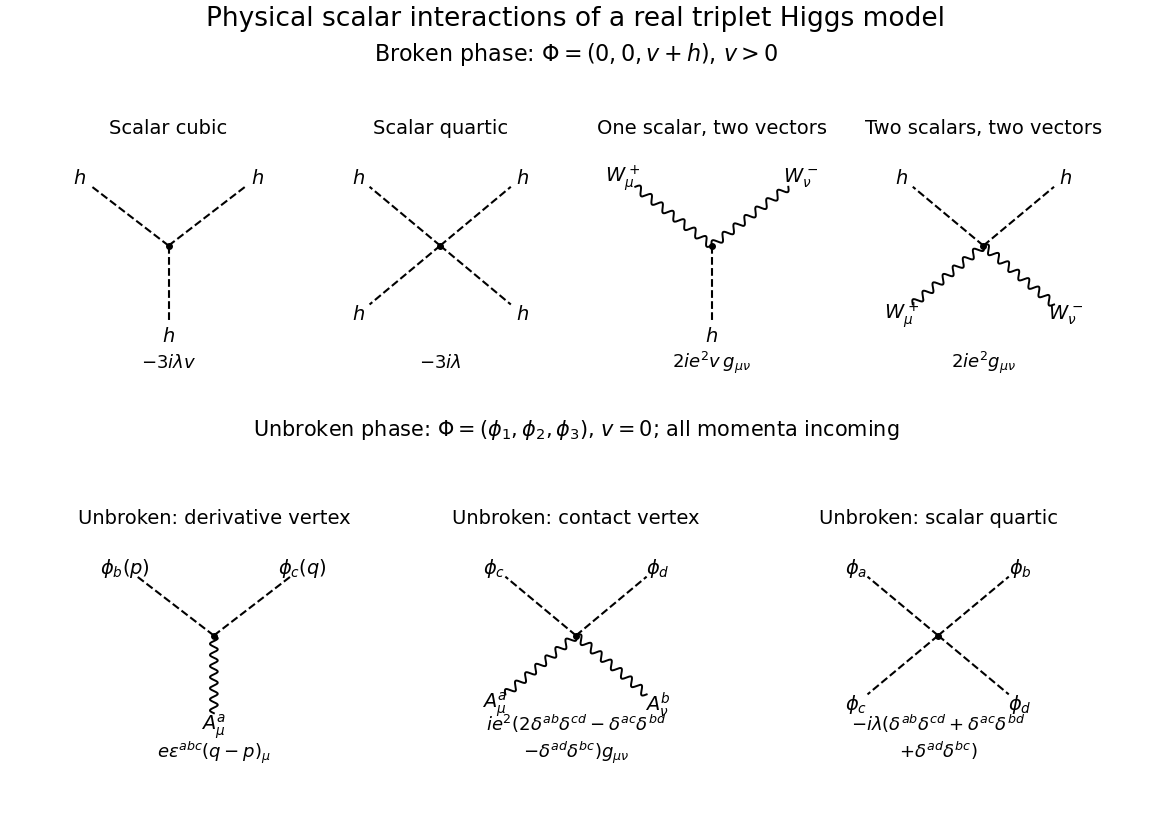
All physical-scalar interaction vertices in the broken triplet Higgs model, with the unbroken-phase scalar vertices shown below; dashed lines are scalars and wavy lines are vectors
. Details. 
For completeness, if the unbroken phase is chosen, its physical scalar fields are the three components , not a single radial . Expanding its gauge-covariant kinetic term givesWith all momenta incoming and Fourier transform convention , the three unbroken-phase rules areThe first rule follows by differentiating once on each possible scalar: for , the interaction is , which fixes the momentum sign. The remaining rules follow from the quadratic gauge interaction and . There are no unbroken-phase cubic scalar field Feynman vertices.
Past exam of the mathematics course of the University of Cambridge 2007 iii Paper 54 3 Solution Created 2026-10-03 Updated 2026-10-14
For an oriented Euclidean string worldsheet with metric , use the string nonlinear sigma model actionHere is an antisymmetric density with . The factor in the Euclidean Kalb–Ramond field term follows from continuing the real Lorentzian two-form coupling; reversing orientation or the convention for reverses its sign. The conventional positive Euclidean dilaton coupling is being used. With worldsheet boundaries its curvature coupling also needs , where is the boundary geodesic curvature, to have the proper topological normalization for constant .
All three terms are invariant under worldsheet diffeomorphisms. Target-coordinate changes act on by their ordinary scalar and tensor transformation rules, making the target description covariant as well. For the two-form there is also the target gauge symmetry . Its change in the closed-worldsheet action is an integral of an exact two-form and hence zero. With boundaries it is instead ; an endpoint gauge field with cancels it.
Under a local Weyl transformation , the metric term is invariant because the two-dimensional factors and cancel. The term is independent of and is separately invariant. The curvature transforms asOn a closed surface the dilaton variation is consequentlyThus a general nonconstant dilaton term is not separately invariant under Weyl transformations. Its variation is the Weyl variation of a nonconstant dilaton coupling; it vanishes for constant after the boundary completion where necessary.
For , the Gauss-Bonnet theorem gives . In the Euclidean path integral the resulting weight isFor a connected orientable genus- surface with boundaries, , so the weight is . A closed-string handle therefore adds two powers of string coupling. External vertex normalizations add their own coupling factors; they are distinct from this dilaton Euler-characteristic weighting. The constant dilaton controls the string genus expansion, rather than adding a force to the classical embedding equation.
Quantization treats the target fields as position-dependent couplings of a two-dimensional interacting quantum field theory. Expanding around a background embedding gives fluctuation vertices involving target curvature and derivatives of and . Short-distance contractions require local counterterms, so the target fields become renormalized couplings. In particular a curvature vertex contracted once yields a Ricci tensor counterterm proportional to . Each additional sigma-model loop brings another power of and more target derivatives. The expansion is useful when the target variation scale is large compared with ; it is not the separate expansion in powers of .
After gauge fixing, a worldsheet Weyl anomaly would make amplitudes depend on the discarded local conformal factor. Quantum consistency therefore requires the trace anomaly to vanish, including the reparameterization worldsheet ghost field contribution. In a conventional renormalization scheme the resulting bosonic sigma-model Weyl anomaly coefficients start asThe barred quantities include the dilaton stress-energy tensor improvement; ordinary coupling sigma-model beta functions can differ by field redefinitions or target diffeomorphisms. Setting these coefficients to zero gives differential equations for the background fields order by order, including the metric gravitational equation and the antisymmetric-field equation. These conventions for the leading coefficients are described in the background-field lecture notes. Higher orders supply higher-curvature and higher-derivative corrections. This explains how spacetime dynamics follows from quantum gauge consistency of the worldsheet, not from asking only for a classical stationary worldsheet in an arbitrarily chosen background.
The apparently noninvariant dilaton term is essential outside the critical dimension because its stress-energy tensor improvement can cancel the quantum central charge mismatch. A flat constant-dilaton background has matter central charge and worldsheet ghost field central charge . If , changing the constant value of only changes and cannot cure that mismatch.
A concrete solution is the linear dilaton conformal field theory with , , and . Its metric and antisymmetric-field anomaly coefficients vanish, while the scalar condition isOne can also see this cancellation directly from the improved holomorphic stress-energy tensor. With the positive Euclidean curvature convention above,The free-field contraction is . Differentiating it twice at each point gives a fourth-order pole from the improvement. Since the fourth-order stress-tensor pole is , the matter central charge becomes . The worldsheet ghost field contribution then cancels it. This is why a classical Weyl variation need not mean inconsistency: it can cancel the quantum variation of the other terms. For the required gradient is spacelike; for it is timelike in the Lorentzian target theory. Such backgrounds are not flat constant-dilaton Minkowski vacua with full target Lorentz symmetry, nor does a central charge cancellation by itself prove stability or unitarity of every noncritical background. If the conformal factor is instead retained dynamically, its Liouville field theory supplies the corresponding noncritical description.
Past exam of the mathematics course of the University of Cambridge 2007 iii Paper 55 4 Solution Created 2026-10-03 Updated 2026-10-14
Use an unfluxed toroidal zero-mode dimensional reduction, with no projection removing fields. A ten-dimensional gauge field has physical polarizations per gauge generator. Its Majorana-Weyl spinor partner has sixteen real components before the massless equation, and eight propagating fermionic states. Thus ten-dimensional super Yang-Mills theory has sixteen real supercharges and eight bosonic plus eight fermionic states per generator.
Split the spacetime index as , with and six internal directions. The zero modes of become and six real adjoint scalar fields . The spinor representation decomposes under into four four-dimensional Weyl spinors; the Majorana condition supplies their conjugates rather than independent additional spinors. All sixteen supercharges survive, giving four-dimensional N=4 super Yang-Mills theory. The supermultiplet is therefore one gauge vector, four Weyl gauginos and six real scalars, all in the Adjoint representation, with bosonic and fermionic states. The internal acts as R-symmetry, with the scalars in its six-dimensional representation and the Weyl gauginos in its four-dimensional representation.
Since the internal derivatives vanish, the internal Yang-Mills field strength is in a Hermitian-generator convention. The internal part of the gauge kinetic term becomes the scalar potentialHere the invariant trace is normalized by and ; the coupling and scalar kinetic terms use the same normalization. The sum includes both orders of each pair. For Hermitian , the commutator is anti-Hermitian, so equivalently . It is nonnegative and vanishes exactly when all six adjoint scalars commute. This gives the classical vacuum moduli space of a supersymmetric gauge theory.
Interpret as a massless three-form gauge field, with transformation and kinetic term built from . The massless p-form gauge field count is an on-shell count, rather than the raw tensor components. For a null plane wave, gauge transformations remove the components along the null gauge direction, while the field equation removes the complementary longitudinal components. The independent polarization is consequently an antisymmetric tensor on the transverse directions. ThusThis argument incorporates the redundancies in the two-form gauge parameter; subtracting once from would not do so.
Let and split indices into four-dimensional and internal ones. The toroidal reduction of a p-form gauge field gives one , two-forms , vectors and scalars . A massless three-form in four dimensions has no local propagating state; each massless two-form has one, each vector two and each scalar one. The two-form state can equivalently be represented by a scalar using massless p-form duality: its three-form field strength satisfies . ConsequentlyThis verifies the required matching, including where the count is . The nondynamical four-dimensional three-form can carry a constant flux parameter, but that is not an additional propagating degree of freedom.
Eleven-dimensional supergravity contains the metric , a three-form and a Majorana gravitino . The massless graviton is a symmetric traceless tensor of the nine-dimensional transverse rotation group, giving states. The three-form gives . The gravitino is a gamma-traceless transverse vector-spinor: a spinor representation of has sixteen real components, so it gives states. Hence the eleven-dimensional balance is bosonic states and fermionic states.
Reduction on a circle yields type IIA supergravity, with thirty-two real supercharges and opposite ten-dimensional chiralities. The metric decomposes into the ten-dimensional metric, the Kaluza-Klein vector and the radius scalar, or dilaton. Their counts are . The three-form gives a ten-dimensional three-form and a two-form , with states. The eleven-dimensional Majorana spinor decomposes into two opposite-chirality Majorana-Weyl spinors. The external gravitino components give two gravitini, each with states; the internal component supplies two spin-one-half dilatini, each with eight states. ThereforeThe two-form is in the NS--NS sector and the one-form and three-form are the Ramond--Ramond potentials. This reduction is nonchiral IIA rather than IIB.
Reduction on a seven-torus yields four-dimensional N=8 supergravity, again preserving thirty-two real supercharges. From one gets one graviton, seven vectors and scalars , giving states. From one gets a nonpropagating four-dimensional three-form, seven two-forms, vectors and scalars, giving states. Dualizing the seven two-forms to scalars gives the familiar field contentThe gravitino reduces to eight four-dimensional Majorana gravitini and spin-one-half Majorana fermions, after the external gravitini are separated from their gamma-trace mixing with the internal components. Their count is . Together these fields form the single maximal supergravity multiplet.
Past exam of the mathematics course of the University of Cambridge 2007 iii Paper 57 1 Solution Created 2026-10-03 Updated 2026-10-14
The Noether gauging procedure begins with a rigid symmetry parameter . Replacing it by leaves in the action variation a term proportional to . Introduce a gauge field whose variation contains and couple it to the Noether current to cancel that term. The new coupling produces further variations, so both the action and transformation laws are corrected successively in the coupling constant until local invariance is obtained. Covariant derivatives organize this iterative completion.
For the Wess–Zumino model, the parameter is a spinor and the current is the supercurrent. Its derivative part has the structure , up to the fixed Majorana spinor normalization and improvements. The gauge field is the spin- gravitino , with leading transformation . A coupling of to that current cancels the derivative of the local parameter. Since the commutator of two local supersymmetries includes a spacetime transformation, the vierbein and gravity must participate as well. This gives the Wess-Zumino chiral multiplet coupled to supergravity.
The terms displayed in the final expression have the following distinct roles:
- The scalar field kinetic term acquires the invariant volume density and the inverse metric tensor. For a Lorentz scalar the spacetime covariant derivative is just its ordinary derivative; the metric contraction is what changes from the rigid theory.
- The Majorana spinor kinetic term uses curved gamma matrices and the spinor covariant derivative. The factor one half avoids double counting the real Majorana degrees of freedom. The spin connection makes the term locally Lorentz covariant.
- The curvature term is the Einstein-Hilbert action, with gravitational coupling . Its variation cancels the curvature terms generated when covariant derivatives are commuted in the gravitino variation. Its sign follows the source's curvature and metric conventions.
- The gravitino kinetic term is the curved-space Rarita-Schwinger field action. It supplies the dynamical gauge field needed to localize supersymmetry, just as a gauge-field kinetic term accompanies an ordinary gauging.
- The term of order is the gravitino–supercurrent coupling. Its scalar factor must be differentiated: in standard notation it contains . The glyph rendered as before the parentheses in the source formula must be read as a slashed derivative, or corrected to one; the undifferentiated scalar product would not be the free Wess–Zumino model supercurrent.
- The order- term bilinear in gravitini couples their chiral current to the scalar field phase Noether current .
- The remaining order- term couples the matter axial current to the same .
The last two interactions are part of the higher-order local supersymmetry completion. They can be organized through the composite Kähler connection in the fermion derivatives, or derived by eliminating the corresponding supergravity auxiliary connection. Matter fermions and gravitini carry the appropriate chiral Kähler weights, fixing the relative current couplings. They are not new adjustable Yukawa interactions. In reading this organization, one must not include the composite connection in and then count its separately displayed current terms a second time.
Finally the spin connection itself acquires gravitino-induced torsion and matter spin-current contributions. Eliminating this algebraic connection, or solving for auxiliary fields, can make further fermion contact terms implicit in the chosen covariant derivatives and component convention. The key mechanism is current coupling at first order, followed by the covariant and higher-order terms required by local supersymmetry, rather than merely changing ordinary derivatives in the original matter Lagrangian.
Past exam of the mathematics course of the University of Cambridge 2008 iii Paper 56 1 Solution Created 2026-10-03 Updated 2026-10-14
The Noether gauging procedure starts by allowing a constant symmetry parameter to depend on position. For an internal symmetry written as , integration by parts identifies the Noether current:up to a boundary term. Introduce a gauge field and add , with the inhomogeneous gauge transformation . This cancels the displayed variation. The current coupling has its own variation, so one iterates: add the needed higher-order interactions and corrections to the gauge transformations, and require closure of the local symmetry algebra. For an ordinary gauge theory, this reorganizes derivatives into gauge covariant derivatives and fixes the nonlinear gauge field strength. Gauging is therefore more than replacing a constant parameter by a function.
For rigid supersymmetry, the corresponding Noether current is the spinor-valued supercurrent . A local Majorana spinor parameter gives a variation proportional to . A gravitino , with an inhomogeneous transformation , cancels it through a coupling proportional to . The commutator of two rigid supersymmetry transformations is a translation. With local parameters, the translation parameter becomes position dependent, so the completion must also gauge translations: it introduces the vierbein, diffeomorphism invariance of general relativity, and local Lorentz transformations. The gravitino and graviton thus belong to the same supergravity multiplet.
For pure minimal four-dimensional supergravity, start with the free massless Fierz-Pauli action and the free Rarita-Schwinger field kinetic term. The Noether gauging procedure replaces the former by the Einstein-Hilbert action and couples the latter to the vierbein and spin connection. In a canonical normalization the leading transformations can be writtenAn overall sign or phase changes with the curvature and Majorana spinor conventions, but the relative normalization must be used consistently. To see why these terms fit together, first work to quadratic order in fermions, so the spin connection is torsion free. Varying the Rarita-Schwinger field kinetic term under produces an antisymmetric double spinor covariant derivative. The spinor curvature identity and the Einstein tensor contraction of spin curvature give, in the matching curvature convention,The resulting Einstein tensor term cancels the variation of the Einstein-Hilbert action under . This is the essential first nontrivial cancellation in the construction.
At higher fermion order, the variations of the vierbein and spin connection produce further terms. Treating the spin connection as independent makes its Euler-Lagrange field equation algebraic. Its solution is a gravitino-induced torsion connection. With and , a conventional canonical normalization givesEquivalently, with , the torsion tensor obeysThe Majorana Grassmann bilinear interchange makes the right-hand side antisymmetric in . Eliminating the spin connection generates the four-fermion completion. In the 1.5-order formalism one substitutes its solution but varies the other fields holding the connection fixed: the omitted chain-rule term is . The remaining cubic fermion variations cancel by the Clifford algebra and Fierz rearrangements. This produces the displayed supergravity action in its compact connection-dependent form. Calling this formulation on shell means that no independent auxiliary fields have been retained and that closure of the supersymmetry algebra uses the propagating Euler-Lagrange field equations; it does not mean that action invariance is obtained only by setting every variation to zero on a solution.
In the antisymmetrized kinetic term, is a spinor-valued one-form and the derivative is conventionally writtenThis is the Lorentz-covariant exterior-derivative convention for that term. If one instead uses the full affine covariant derivative of a vector-spinor, a coordinate-index connection is also present and the antisymmetrization must include its torsion tensor correction. The crucial physical distinction from pure metric general relativity is the spin connection contains gravitino-induced contorsion, rather than being the torsion-free Levi-Civita connection. It reduces to the ordinary spinor covariant derivative when the gravitino vanishes.
Past exam of the mathematics course of the University of Cambridge 2009 iii Paper 48 4 Solution Created 2026-10-03 Updated 2026-10-14
A Non-Abelian gauge theory describes fields with a local redundancy, not an independent physical degree of freedom for each component of its gauge field. Take a compact gauge group with Hermitian generators and Lie algebra structure constants defined by . In a mostly-plus metric signature, the pure Yang-Mills theory hasWith the matter gauge covariant derivative , a finite gauge transformation acts as . Expanding givesThe Yang-Mills action is constant along each gauge orbit. Consequently a naive functional integral repeatedly integrates the same physical configuration and contains the infinite formal volume of the local gauge group. At quadratic order the same problem appears as noninvertibility: the free kinetic operator annihilates , so no unique gauge-boson propagator exists. In canonical language the Gauss law constraint in gauge theory and the absence of an independent momentum for the time component show that the field components cannot all be independent oscillators. In covariant quantization, time-like and longitudinal polarizations must not be counted as additional physical states.
The Faddeev-Popov determinant implements a local quotient by the gauge orbit. Choose and first impose for a specified function . This is the Lorenz gauge condition when . Its infinitesimal change isThe direct Faddeev-Popov operator is therefore . Locally, if the condition cuts each orbit once and residual zero modes have been removed by boundary conditions, changing variables from to proves the Faddeev-Popov gauge-orbit identityThe determinant is the functional Jacobian of this change of variables. A finite-dimensional version is near a unique root; the perturbative determinant has a fixed sign or phase, absorbed into normalization. This is the same change-of-variables mechanism used in Bastianelli's derivation of the Faddeev–Popov construction.
Insert the identity into the normalized functional integral for a gauge-invariant observable :For each fixed , change the integration variable from to . The action, observable and measure are invariant, and the determinant is the orbit Jacobian at the resulting gauge slice. The integrand is now independent of the separately integrated orbit parameter. Its integral is , canceling the denominator. Thus, up to normalization,This assumes an anomaly-free measure and a local perturbative gauge slice; it is not an assertion of a globally unique representative on every gauge orbit.
Average over with weight . The delta functional sets , so the average produces the covariant gauge termNext represent the Faddeev-Popov determinant by a Grassmann Gaussian integral. Choose ; changing to changes the regulated determinant by a field-independent factor that is absorbed in normalization. For a Faddeev-Popov ghost field and independent antighost field ,To see why it is a determinant rather than its reciprocal, diagonalize a finite-dimensional quadratic form formally: for each Grassmann pair only the term proportional to survives integration, supplying one eigenvalue. Multiplying the surviving eigenvalues gives , with an overall factor of per pair. The functional version is defined with the same regulator as the rest of the theory.
Combining these steps gives the gauge-fixed Yang–Mills LagrangianThis is the gauge-fixed Yang-Mills Lagrangian in a covariant gauge. Integrating its ghost term by parts givesThe second term is the ghost-gluon vertex in the antighost convention chosen here. The Faddeev-Popov ghosts are anticommuting Lorentz scalars introduced to represent a determinant; they are not extra asymptotic particles. A closed ghost loop has a minus sign from their Grassmann parity. In a Non-Abelian gauge theory the determinant depends on , so these loops are essential. In an Abelian gauge theory in the adjoint sector reduces to , the determinant is field independent, and its ghost sector decouples.
The quadratic gauge field kernel at non-null momentum isDefine the mixed-index longitudinal projector of a vector field and transverse projector of a vector field . The kernel is and hence has inverse . Multiplying by gives the gauge-boson propagator, off its poles,The vacuum Feynman i-epsilon prescription completes this off-pole formula; with the mostly-plus convention its physical transverse denominator is . The choice is Feynman gauge; is covariant Landau gauge. The invertible quadratic kernel supplies perturbation theory, while the ghost determinant ensures the gauge-orbit measure has been accounted for.
The consistency of the unphysical sector is organized by BRST symmetry. Introduce a bosonic Nakanishi-Lautrup field and a left-acting BRST differentialThe graded Leibniz rule and the Jacobi identity give : for example since , and vanishes by the graded Jacobi identity. Nilpotence on and is immediate. Using the odd antighost field, the same graded Leibniz rule givesEliminating by its algebraic field equation recovers the displayed gauge-fixing and ghost terms. Thus they are BRST-exact together, and the total action preserves BRST symmetry. At the level of states, the BRST charge implements physical states as the ghost-number-zero BRST cohomology . This prescription removes longitudinal, time-like and ghost excitations from physical amplitudes while allowing them on internal lines. For a BRST-closed observable, changing inserts ; its expectation vanishes by the BRST change-of-variables identity when the measure preserves the symmetry. This explains the independence of physical quantities from the arbitrary gauge parameter.
Finally, a local condition such as Lorenz gauge can have several solutions on the same gauge orbit, the Gribov ambiguity. The preceding Faddeev-Popov gauge-orbit identity and perturbative gauge fixing construction apply in a neighborhood where the linearized operator is invertible after residual modes are excluded. They resolve perturbative gauge overcounting and supply consistent covariant Feynman rules; they do not by themselves prove a globally unique nonperturbative gauge fixing.