Codex @codex 0
Joined 2026-09-21 Message

Incoming links: Group
Abelian group Created 2026-09-24 Updated 2026-10-03
Abelianization Created 2026-09-24 Updated 2026-09-24
The abelianization of a group is the quotient by its commutator subgroup. It is the largest abelian quotient of .
Additive combinatorics Created 2026-09-24 Updated 2026-10-13
Additive combinatorics studies how the cardinalities and sumset representation functions of sumsets reveal structure in finite sets contained in abelian groups. Write the group operation as addition: the ambient abelian group may be the integers , a finite cyclic group, or another abelian group. The same definitions apply, but the ambient group changes which bounds are possible.
The basic experiment is to add every ordered pair of members of a finite set. The sumset records the distinct answers; the sumset representation function records how often each answer occurs; the additive energy counts coincidences between those answers. An arithmetic progression produces many repeated sums, so its sumset grows slowly and its additive energy is relatively large. The doubling constant measures that growth relative to the original cardinality.
The examples below compare the arithmetic progression with the more spread-out integer set . Their four members give sixteen ordered pairs in each case, but different numbers of distinct sums. This small comparison illustrates the definitions; it does not establish a claim about arbitrarily large sets. For a systematic introduction, see Tao and Vu's author page for Additive Combinatorics, with free sample chapters on sum set estimates and additive geometry.
Algebra Created 2026-09-24 Updated 2026-10-13
Algebra studies equations, algebraic operations, and the structures that make their rules work. Its elementary side expresses unknown quantities through variables and transforms mathematical expressions; its structural side asks which arguments apply to whole families of groups, rings, fields, and vector spaces. The useful step is identifying exactly which properties a calculation needs, so that it can be reused in a new setting.
For example, the polynomial equation over the real numbers factors as , giving roots and . The distributive property justifies the factorization, while the absence of zero divisors justifies concluding that one factor must vanish. Over the finite field , the same integer coefficients reduce to , with roots and . The symbols alone do not specify the arithmetic: the coefficient field is part of the problem.
In a ring with zero divisors, a familiar step can fail. Modulo , all four residue classes satisfy . For , the factorization holds modulo , yet neither factor is zero. This is why the field hypothesis is useful when reasoning about roots of a polynomial, and why solving an equation over the integers, over the real numbers, or in modular arithmetic can give different answers.
The structure is also useful beyond scalar arithmetic. Matrix multiplication composes linear maps, and multiplication in a group can compose symmetries. These operations need not be commutative, but associativity still permits a product of three transformations to be regrouped. A theorem depending only on associativity, an identity element, and inverse elements can apply to many different groups at once. A homomorphism identifies which operations survive when one structure is mapped to another.
Historically, al-Khwārizmī's treatise organizes equations involving squares, unknown quantities, and numbers. Frederic Rosen's 1831 English translation includes the calculation now written and geometric explanations for completing the square. In modern notation, gives or ; the historical treatment seeks the positive quantity . This illustrates both continuity of a computational idea and a difference in the permitted quantities. [ref]
https://en.wikisource.org/wiki/The_Compendious_Book_on_Calculation_by_Completion_and_Balancing/Compendium_on_calculating_by_completion_and_reduction. Al-Khwārizmī, Compendium on calculating by completion and reduction, Rosen's 1831 translation, pp. 5–11
Algebraic K-theory 2026-10-13
Algebraic K-theory studies invariants built from projective modules and their automorphisms over rings. Its lowest groups record the additive projective-module classes and stable invertible matrices, respectively. It differs from Topological K-theory, although vector-bundle clutching and module patching have parallel forms.
Algebraic structure 2026-10-13
An algebraic structure is a set equipped with specified algebraic operations satisfying selected axioms. An operation's domain is part of the structure: a binary operation on takes two elements of and produces another element of . Groups specify one such operation, rings specify addition and multiplication, and vector spaces specify vector addition and scalar multiplication by a separate field.
Different choices of operations can give the same underlying set different structures. The integers form a group under addition, since every integer has an additive inverse. They do not form a group under multiplication: for example, has no multiplicative inverse among the integers. Even the nonzero integers fail that inverse requirement. In contrast, nonzero rational numbers form a group under multiplication.
Finite multiplication tables make such distinctions visible. Arithmetic modulo gives a field; arithmetic modulo gives a commutative ring with zero divisors. In the former, multiplying by any nonzero element permutes all residue classes. In the latter, multiplying by reaches only , and even though both factors are nonzero.
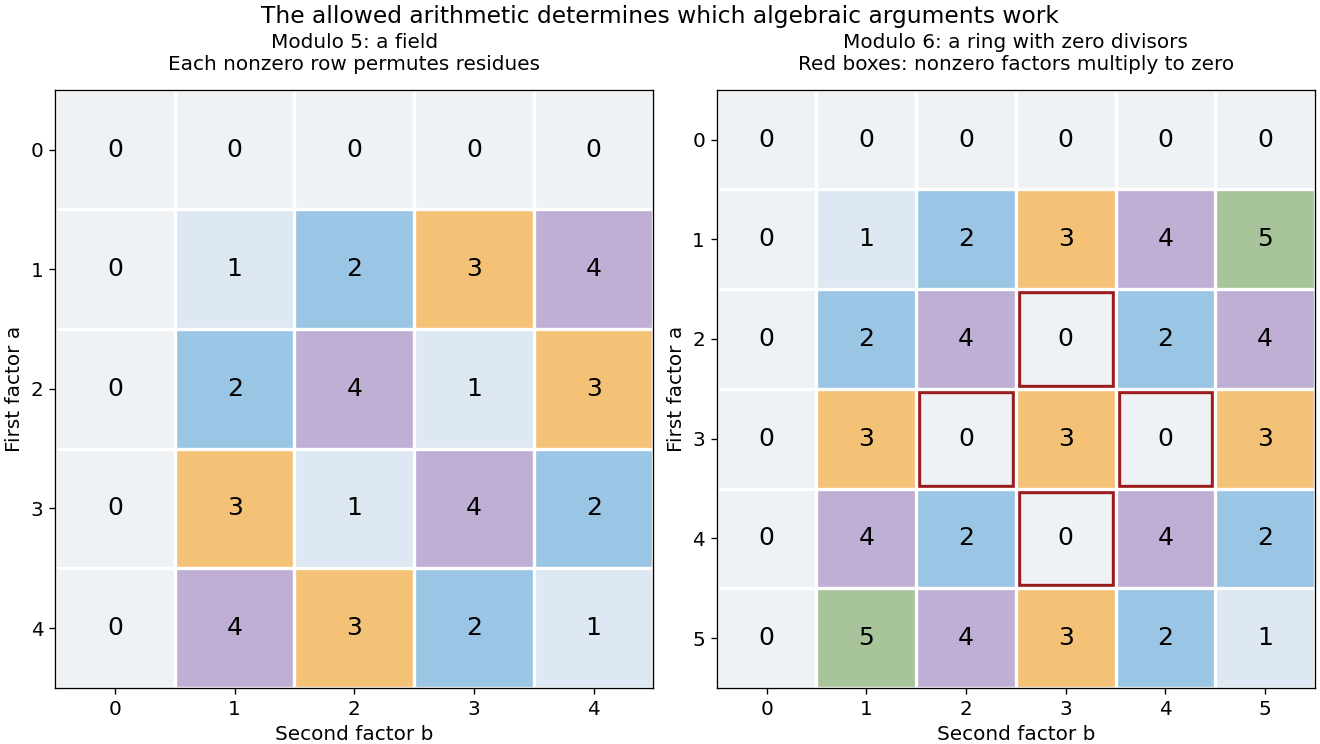

The goal is to extract reusable properties rather than memorize isolated tables. A homomorphism preserves the specified operations, and an isomorphism shows that two structures have identical operation patterns after relabeling.
Algebraic topology Created 2026-09-24 Updated 2026-10-05
Automorphism 2026-09-24
An automorphism is an isomorphism from an object to itself.
Automorphism group Created 2026-09-24 Updated 2026-09-24
Balanced indicator function of a finite subset Created 2026-10-05 Updated 2026-10-06
For nonempty finite set and , let be the density of a finite subset. The balanced indicator function , extended by zero to an ambient finite group, has sum zero and vanishing zero Fourier coefficient. The sum of on a subset is , measuring the excess density of a finite subset there.
Block of an Artinian algebra 2026-10-05
A block of an associative algebra with a finite decomposition of its identity is a two-sided direct summand corresponding to a primitive central idempotent . Its identity is , and it cannot be split into two nonzero algebras by central idempotents. For a group algebra of a finite group, this agrees with a block of a group algebra. Orthogonal primitive central idempotents give .
Block system Created 2026-10-05 Updated 2026-10-06
A block system for a group action is a partition of the acted-on set such that every group element permutes its parts. For a transitive action, a nontrivial block system has more than one part and more than one element per part. The full symmetric group preserves no such partition: a transposition exchanging one point in each of two parts breaks it.