A bounded operator on a real or complex Hilbert space is Hermitian, or self-adjoint, when . Equivalently,Its directional values are real, since this identity makes equal its complex conjugate. Reality allows either sign; a positive operator additionally requires nonnegative values in every direction.
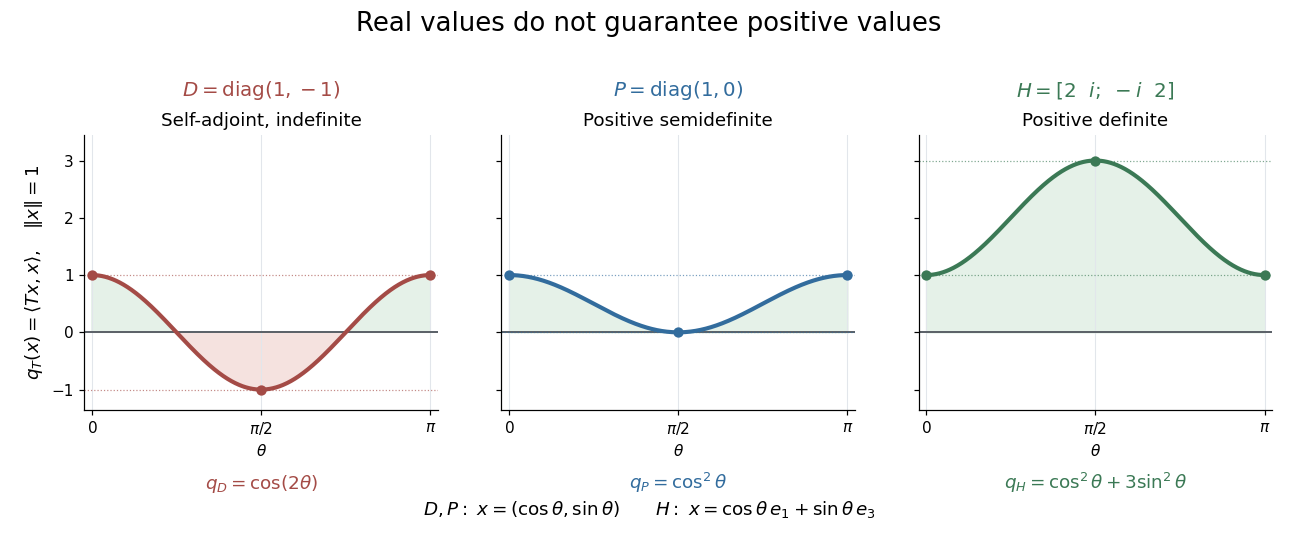
Self-adjoint directional values may change sign, touch zero, or stay strictly positive
. Details. The diagram compares Hermitian quadratic forms along paths of unit vectors. The Hermitian matrix takes the values and on the standard basis vectors; takes the values and ; andsatisfies and . These eigenvectors form an orthonormal basis, and every has . Thus is a positive operator, with eigenvalues and operator norm .
Three conditions describe different geometry. A Hermitian operator satisfies ; a normal operator satisfies ; a unitary operator satisfies , where is the identity operator. Every Hermitian operator and every unitary operator is a normal operator. Concrete matrices separate the conditions:
- The Hermitian matrix above is a normal operator and a positive operator, but not a unitary matrix, because .
- is a unitary matrix and normal matrix, but not a Hermitian matrix, since .
- is a normal matrix, but neither a Hermitian matrix nor a unitary matrix: its first standard basis vector doubles in norm.
- is not a normal matrix, since and .
The spectrum of a bounded Hermitian operator is real. In finite dimension, the spectral theorem supplies an orthonormal basis of eigenvectors, turning its action into independent real scalings. This makes the geometry easy to interpret: each eigenvalue records a signed response along an orthogonal direction. An arbitrary bounded Hermitian operator in infinite dimension need not have any eigenvectors; the general spectral theorem uses a projection-valued measure. MIT's lecture 21 develops the real spectrum and the orthogonality of eigenspaces.[ref]
https://ocw.mit.edu/courses/18-102-introduction-to-functional-analysis-spring-2021/345c4a5141559a4069aeb3105acd8ef3_MIT18_102s21_lec21.pdf. Rodriguez, notes by Andrew Lin, MIT 18.102, lecture 21, Theorems 223 and 227, 2021
A historical connection is the study of forms with conjugate variables. In his 1901 account of Charles Hermite's work, Camille Jordan describes these forms and emphasizes their role in reducing forms with real or complex coefficients. In today's notation, is the diagonal value of a Hermitian form; the conjugate variables make a real-valued expression possible even with complex coefficients.[ref]
https://www.numdam.org/item/JMPA_1901_5_7__91_0.pdf. Jordan, Notice sur M. Ch. Hermite, Journal de mathématiques pures et appliquées 7, pp. 92 and 95, 1901
For a densely defined operator outside this bounded setting, the displayed pairing identity alone defines a symmetric operator. A self-adjoint operator must also have the same operator domain as its adjoint operator.
A bounded Hermitian operator determines a Hermitian form and its real-valued diagonal expression . On a complex Hilbert space,Thus it is a quadratic form on the underlying real vector space; it is generally not a quadratic form over the complex field, whose scaling rule would involve . This distinction explains why replacing by loses the geometry of a complex inner product.
For a finite-dimensional Hermitian operator with an orthonormal basis of eigenvectors and corresponding eigenvalues , the spectral theorem givesFor a unit vector, this is an average of the eigenvalues with nonnegative weights summing to one. It is also the Rayleigh quotient, so its minimum and maximum are the smallest and largest eigenvalues.
In the Hermitian operator diagram, take for , and for . The computed curves areThese paths illustrate the extremal values; the spectral theorem supplies the bounds for every complex unit vector, including those outside the plotted paths.
The Hermitian part of a square matrix is half its sum with its conjugate transpose. It is a Hermitian matrix and satisfies . Its largest eigenvalue is the numerical abscissa, controlling instantaneous growth of the Euclidean norm under .
For a complex matrix , the real linear map on the -dimensional real vector space of Hermitian matrices has determinant . A real basis of Hermitian matrices is also a complex basis of all matrices, so the matrix of this restriction equals the matrix of the complex-linear congruence map. Left and right multiplication separately have determinants and .
A bounded Hermitian operator on a Hilbert space is positive, also called a positive semidefinite operator, whenThe value must be real as well as nonnegative. This permits zero values on nonzero vectors: the zero linear operator is positive. For a bounded Hermitian operator, positivity is equivalent to its spectrum being contained in ; in finite dimension, this is the condition that all eigenvalues are nonnegative.[ref]
https://ocw.mit.edu/courses/18-102-introduction-to-functional-analysis-spring-2021/345c4a5141559a4069aeb3105acd8ef3_MIT18_102s21_lec21.pdf. Rodriguez, notes by Andrew Lin, MIT 18.102, lecture 21, Corollary 225, 2021
The Hermitian operator diagram separates three cases. is self-adjoint but not positive, because . The orthogonal projection is positive semidefinite, with , but is not strictly positive on every nonzero vector. The complex Hermitian matrix is positive definite because whenever . For real symmetric matrices, MIT's lecture 27 relates these tests to the geometry of quadratic forms and their minima.[ref]
https://ocw.mit.edu/courses/18-06sc-linear-algebra-fall-2011/d163e012754258d3b374548504d8a18a_MIT18_06SCF11_Ses3.3sum.pdf. Strang, MIT 18.06SC, lecture 27 summary, Positive definite matrices and minima, pp. 1–2, 2011
A fundamental source of positive operators is for a bounded linear operator :For the complex matrix used above,Its eigenvalues are and , both positive. Positivity organizes the squared error minimized by a least-squares solution: the same occurs in the normal equation for a linear inverse problem. The positive square root of an operator gives the converse squared-length description, for every bounded positive operator .
On a real Hilbert space, nonnegativity of alone does not imply self-adjointness, so the Hermitian operator hypothesis is part of the definition. On a complex Hilbert space, real-valuedness of all these expressions already forces self-adjointness by the polarization identity.
Strict positivity and a uniform positive lower bound also differ in infinite dimension. On the l2 sequence space, the bounded Hermitian operator satisfiesConsequently no satisfies for every . Compare the positive definite symmetric operator and uniformly positive definite symmetric operator conditions.
For bounded positive operators , membership gives . Both terms are nonnegative, so both vanish. The Cauchy-Schwarz inequality for a positive operator makes . The reverse inclusion is immediate. Commutativity is not required.
For a bounded positive operator , the form is positive semidefinite and Hermitian. Expanding for complex and minimizing its quadratic polynomial gives the displayed inequality. If , varying along the negative direction of forces , covering the degenerate case. In particular implies , by testing against arbitrary .
A symmetric operator on a real Hilbert space is strictly positive definite when for every nonzero in its operator domain. Strict positivity proves uniqueness of a solution of , but in infinite dimension it need not prove existence for every . A uniformly positive definite symmetric operator additionally has a positive lower bound independent of . Symmetry must be stated separately when positivity is defined only by a real quadratic expression: adding a skew-symmetric matrix changes the operator without changing that expression.
For a symmetric bounded bilinear form that is strictly positive on nonzero vectors, and a bounded linear functional , set . The first variation is . A weak solution of satisfies , so it is the unique minimizer. Conversely, any minimizer solves the weak equation. A coercive bilinear form gives existence by the Lax-Milgram theorem; strict positivity alone does not.
For a bounded operator on a real Hilbert space, with . Consequently the Euler-Lagrange equation of is . It is only when is self-adjoint or when the relevant solution also annihilates the skew part. For example has positive quadratic form , but that form contains no information about its skew part.
A positive definite symmetric operator is uniformly positive definite if for some . For a bounded linear operator defined on a whole Hilbert space, this is a symmetric coercive operator, and the Lax-Milgram theorem supplies a unique solution to for every . For a differential operator, the corresponding bounded coercive form is used on its form space.
A positive contraction is a positive operator whose operator norm is at most one. Its spectrum lies in , so the spectral theorem for normal operators gives . Positive contractions are the effects in a POVM and occur in the pure-state gentle measurement bound.
The support of a positive operator is the orthogonal complement of its kernel. In finite dimension it is the span of eigenvectors with positive eigenvalues, equivalently the operator's image. Quantum relative entropy is finite only when the first state's support lies in the reference state's support.
Every bounded positive operator has a unique positive operator satisfying . The spectral theorem for normal operators on a separable Hilbert space constructs it by applying the scalar square-root function to the spectrum.
For bounded positive operators satisfying the hypotheses, , so vanishes on the closure of the range of . The kernel of a sum of positive operators identity shows that it also vanishes on . Self-adjointness and the Hilbert projection theorem decompose the whole Hilbert space as that closed range plus that kernel. Thus . This proves the commuting case of uniqueness of a positive square root without using a spectral representation.
The spectral theorem for normal operators gives a unique decompositionwhere and their supports are orthogonal. They are called the positive and negative parts of . If , then .
The negative part of a Hermitian operator is . In this convention is itself a positive operator, and . Its support is orthogonal to that of the positive part of a Hermitian operator.
For a Hermitian operator with spectral decomposition , its positive part is . It is a positive operator supported on the positive spectral subspace. Together with the negative part of a Hermitian operator it satisfies and .
For Hermitian operators and , one writes when is positive semidefinite. This partial order is also called the semidefinite order.
For bounded positive self-adjoint operators, implies . Thus the nonnegative square-root function is operator monotone.
Articles by others on the same topic


This is the possibly infinite dimensional version of a Hermitian matrix, since linear operators are the possibly infinite dimensional version of matrices.
There's a catch though: now we don't have explicit matrix indices here however in general, the generalized definition is shown at: en.wikipedia.org/w/index.php?title=Hermitian_adjoint&oldid=1032475701#Definition_for_bounded_operators_between_Hilbert_spaces