An electron hole is an unoccupied electron quantum state in an otherwise nearly full energy band, often the valence band. “Filled” refers to occupation of the allowed quantum states, not to filling all space with a continuous fluid of electrons. Each state, including its spin label, can hold at most one electron by the Pauli exclusion principle. The almost full energy band and its few missing occupants are therefore simpler to describe as a background plus a few electron holes. The electron hole is a quasiparticle, not a Positron inserted into the crystal.
Removing an electron of electric charge changes the background's electric charge by . Thus an electron hole carries positive electric charge relative to that background. Promoting an electron into the conduction band creates an electron hole without changing the whole crystal's electric charge: . An unbound pair still consists of two separate charge carriers; only a bound state of their relative motion is an exciton.
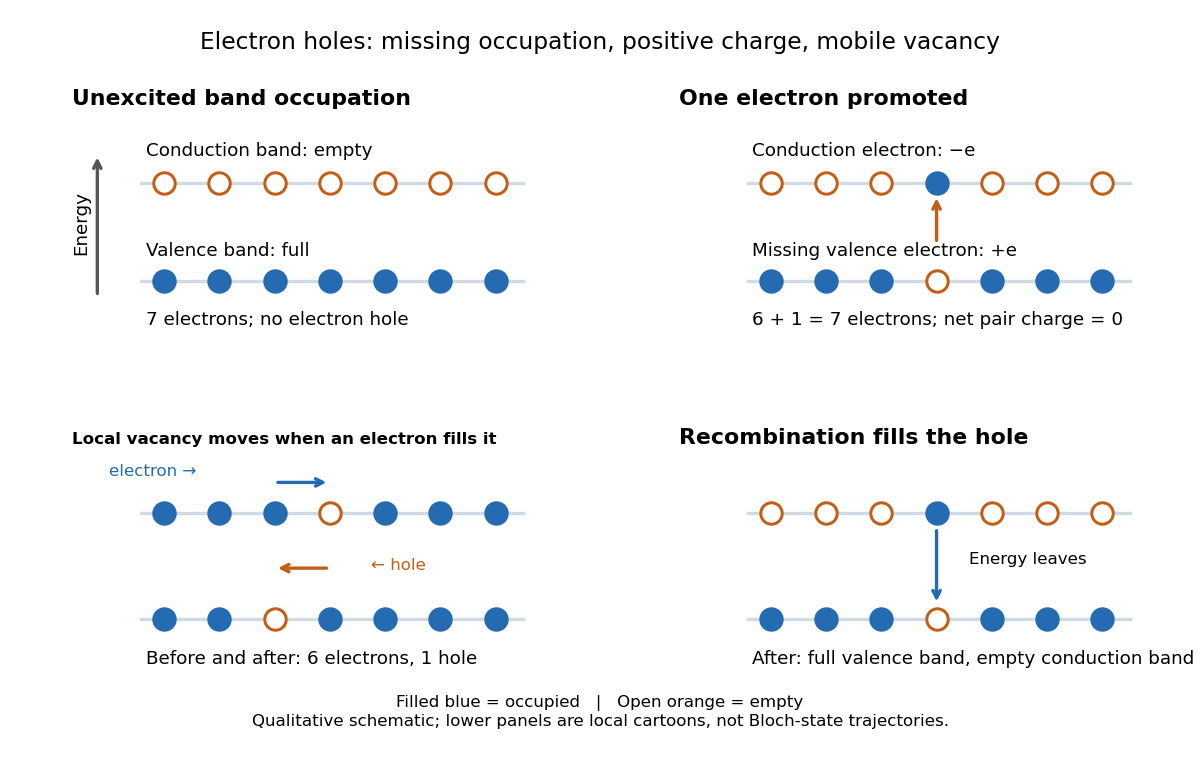
The local cartoon explains why a vacancy can move: when a neighboring electron fills it, another vacancy appears where that electron was. The vacancy has moved opposite to that particular transfer of an electron. In an extended Bloch state, use crystal momentum instead of imagining a permanently empty atomic site. For a completely filled energy band the summed electric current vanishes. Omitting one electron with group velocity removes its contribution , leaving a contribution . This fixes both the positive electric charge and the velocity convention of the electron hole.
More precisely, near a parabolic valence band maximum, set its energy as reference and define the electron hole wave vector by . ThenThe occupied electron branch has negative curvature there, while the electron hole branch has positive effective mass . The velocity equality compares the electron hole with the missing Bloch state's group velocity; it does not contradict the opposite vacancy motion in a local transfer cartoon. The sign conventions are listed in Phys 460 Lecture 17.
A hole in the , valence branch near a specified axis. Its curvature and effective mass differ from those of the heavy-hole branch; confinement and strain can split branches that are degenerate at the bulk zone centre.
A hole in the upper valence manifold associated near a chosen propagation axis with the , branch. Its band curvature is relatively small, hence its effective mass relatively large. The label is direction dependent in a general anisotropic band structure.
An electron-hole pair consists of an excited electron and the unoccupied valence state described as an electron hole. Promoting a valence electron across a semiconductor band gap creates such a pair without changing the total electric charge. The carriers can separate under an electric field, or undergo electron-hole recombination. A bound electron-hole pair is an exciton; an arbitrary unbound pair need not be an exciton.
An electron filling an electron hole removes both excitations relative to the filled-band background. Their electric charges cancel, consistent with charge conservation; the remaining electrons are still present. The released energy can leave through photon emission or other channels, including phonons. Formation of an exciton instead retains the excited electron and electron hole as a bound pair; recombination removes the pair. A valence band electron filling a nearby vacancy merely moves the electron hole and does not remove the total vacancy count.
In a weak-injection regime where the majority population is nearly fixed, a small excess minority charge carrier population often relaxes exponentially with time constant . This lifetime describes carrier removal by recombination. It differs from the momentum relaxation time governing charge carrier mobility: many momentum-scattering events can occur before a carrier recombines. Traps and spatial transport can make a single exponential inadequate.
In a semiconductor, a conduction electron fills a vacant valence state and emits a photon. In a simple nondegenerate model the recombination rate is , while the equilibrium reverse generation rate is ; their difference gives the displayed net pair-loss rate. This subtraction enforces detailed balance at thermal equilibrium. Photon momentum is small on the scale of a Brillouin zone, so a direct band gap permits a direct transition while an indirect band gap generally requires a phonon or another source of momentum.
In Auger recombination an electron-hole pair annihilates while transferring its energy to another electron or hole rather than to an emitted photon. The hot recipient subsequently loses energy, commonly to phonons. In a simple nondegenerate carrier-density model the rate is , with electron and hole number densities and material-dependent coefficients. This makes the process especially important at high carrier injection. It is the reverse type of energy transfer to impact ionization, although detailed thresholds and matrix elements depend on the bands.
In the simple semiconductor description, the highest occupied energy band of the unexcited crystal at zero temperature. A missing occupant is an electron hole.
Spin-orbit coupling separates the valence states from the upper manifold at the zone centre in common cubic semiconductors. If its maximum lies below the upper valence band edge, its thermal electron hole population is suppressed by apart from effective density of states factors. Neglect requires ; it is not valid at every temperature or in every material.
Near the zone centre of many cubic semiconductors, the upper valence bands have different curvatures and hence different band effective masses. In the isotropic approximation, the states with angular-momentum projection magnitude along the propagation direction form the heavy-hole branch; projection magnitude gives the light-hole branch. A flatter downward electron dispersion corresponds to a larger positive electron hole effective mass. Crystal anisotropy, strain and confinement can mix these branches, so the labels do not imply direction-independent exact masses.
The initially empty energy band above the band gap in the simple semiconductor description. Excited electrons in it can carry electric current; they can also bind to valence band electron holes as excitons.
An electron occupying an extended state in a conduction band. Its response to an applied electric field depends on its band group velocity, occupation and scattering. Merely counting such electrons does not by itself determine electrical conductivity.
Articles by others on the same topic


An electron hole, often simply referred to as a "hole," is a concept in semiconductor physics and solid-state physics. It represents the absence of an electron in a semiconductor's electronic band structure, particularly in the valence band where electrons are normally present. Here's a more detailed explanation: 1. **Electron Abundance**: In a semiconductor, electrons occupy energy states in the valence band. When an electron gains sufficient energy (e.g.