An active galactic nucleus is a compact, exceptionally luminous central source powered chiefly by black-hole accretion rather than ordinary stellar fusion. Typical signatures include a broad spectral-energy distribution extending from radio to X-rays, rapid variability implying a small emitting region, strong optical or ultraviolet emission lines and, in some objects, radio jets and lobes. Broad permitted lines indicate rapidly moving dense gas; narrower forbidden lines can arise farther out. Obscuration and viewing orientation can hide the broad-line region, and many active nuclei are radio quiet, so no one signature is required in every object.
For the Schwarzschild circular-ring energy shift, set and let be the photon energy in the orbiting gas frame. A local static observer in Schwarzschild spacetime measures . For gas receding along the line-of-sight component of its velocity, special-relativistic frequency transformation gives
Propagation from that static frame to a distant stationary observer contributes . Hence
The factors describe gravitational redshift, transverse time dilation and the longitudinal Doppler shift. Here the emitter is on the maximally receding azimuth of a circular disc ring. A general azimuth has a smaller projected velocity, and a fully ray-traced image must use the photon direction at emission rather than equating that local direction with the distant inclination. The supplied expression is the direct-projection transfer model, not a complete light-bending calculation.
The innermost stable circular orbit is the marginal stable timelike circular geodesic separating stable circular motion from radial instability. In Schwarzschild spacetime,
For example, the circular-orbit specific angular momentum satisfies ; its radial stability changes where , at . This is outside both the horizon at and the circular photon orbit at .
The printed local orbital-speed relation gives . Combining the gravitational and transverse factors,
At the ISCO, , so
The Edge-on Schwarzschild ISCO redshift envelope is reached for an edge-on disc on its receding side:
The approaching edge has . For a fixed inclination below degrees the maximum is smaller; the quoted number is an upper envelope, not the value for every observer. Within the stated ring model the receding factor increases inward across stable orbits, so the inner edge sets that envelope. Emission from a plunging region, occultation and returning rays are outside this ISCO-emitting model.
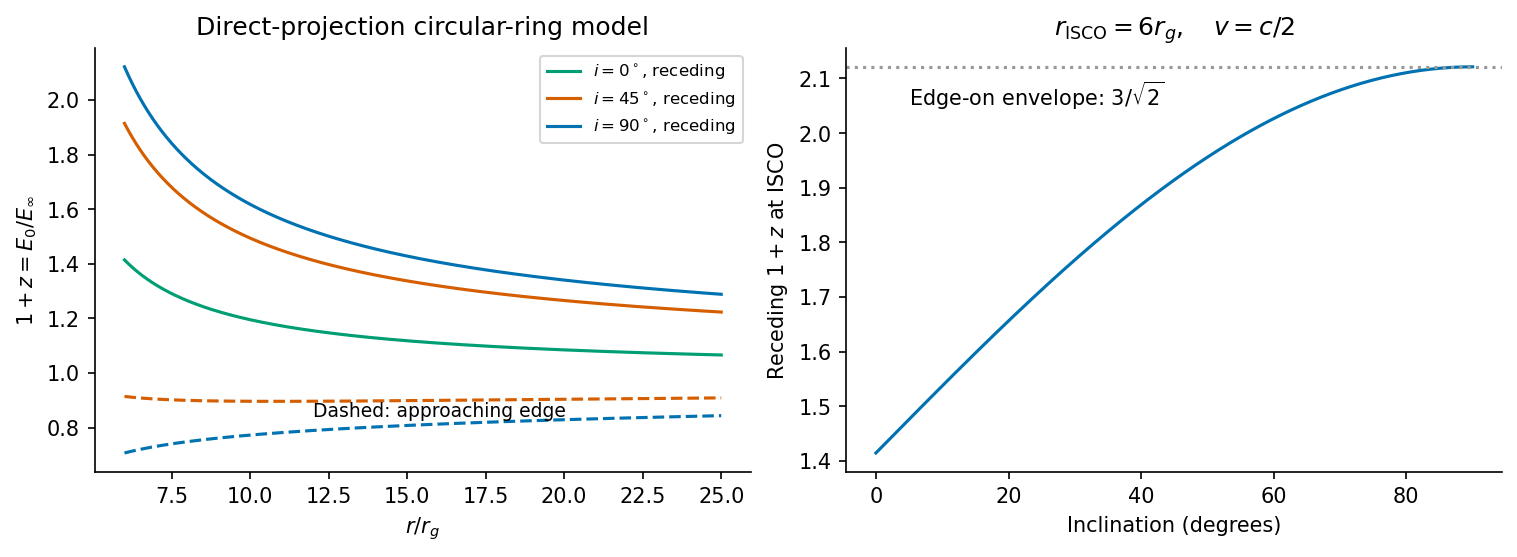
Figure 1.
Original Schwarzschild circular-ring transfer calculation showing inclination dependence and the edge-on ISCO redshift envelope
. Details.
The Kerr ISCO efficiency limits follow from equatorial circular orbits in the Kerr metric. Prograde motion has a smaller ISCO than the non-spinning case, while retrograde motion has a larger one. A zero-torque thin disc radiating the orbital binding energy before the gas plunges has efficiency , where is energy per unit rest-mass energy at infinity. The ideal limiting values are
Thus more orbital binding energy is available in the prograde inner disc. The extremal values are formal geodesic limits: photon capture, inner stresses, outflows and finite accretion thickness change the efficiency of real flows. An ISCO inside the ergoregion is not a claim that material or radiation escapes from inside the horizon.
For accretion output relative to galactic binding energy, distinguish accreted rest mass from the mass retained by the black hole. At constant radiative efficiency, building a hole from a negligible seed to emits
A non-negligible seed replaces by the actual mass increase. Let the first use of mean the total three-dimensional rms random speed. For an approximately virialized galaxy with negligible boundary term, and . The ratio to the magnitude of its gravitational potential energy is therefore
If “binding energy” means the net energy needed to unbind the virialized system, , the ratio is twice as large. The widely used order-of-magnitude estimate drops the retained-mass correction and writes ; it should not be confused with a precisely fixed structural coefficient.
For the numerical parameters given,
No efficiency is specified, so this function is the numerical result. For an explicitly chosen illustration , it is about , or relative to the net virial binding energy. The non-spinning zero-torque efficiency gives about relative to ; the ideal retrograde and prograde limits give about and , respectively. Spin affects the ratio through the adopted efficiency and orbital orientation, not through a universal rule that a larger unsigned spin always means a larger efficiency.
Such large energy ratios make even a modest coupling of the output to galactic gas dynamically important. Radiation and winds can heat or eject gas and reduce star formation or later black-hole feeding. For the illustration a percent-level coupling is already comparable to . Energy available is not energy necessarily deposited: cooling, escape directions, gas geometry, photon opacity and the duration of activity determine the actual feedback. It does not follow that the entire stellar galaxy must be disrupted.
For the swept-shell calculation, the problem now explicitly redefines as a one-dimensional line-of-sight dispersion. The specified isothermal profile has
Neglecting central-hole gravity and the shell's self-gravity, the inward force due to the remaining interior component is
In a single-scattering momentum-driven model with the shell intercepting the central luminosity, . At the hydrogen Eddington luminosity this becomes . Sustained outward acceleration against that weight requires
and hence
The radius cancels because the swept isothermal mass is proportional to . This is the isothermal-galaxy momentum-balance shell threshold, with its fourth-power dispersion scaling.
The coefficient identifies the approximations. Self-gravity in a thin spherical shell expansion adds the shell's inward pressure-equivalent force and replaces by . A shell intercepting only a fraction of the photon momentum needs a larger luminosity; Thomson-thin material does not automatically receive . Conversely, multiple scattering or an energy-driven hot wind changes the force model. A shell already carrying sufficient outward kinetic energy need not satisfy this instantaneous acceleration condition everywhere to escape. The printed inequality is the stated quasistatic, fully coupled momentum-balance estimate, not an assumption-free lower bound for every possible shell trajectory.
The age of the universe is a proper time along comoving cosmological observers, inferred within an expansion model; stellar ages provide partly independent consistency checks. In an expanding FLRW model with a big-bang origin,
where . The Hubble time is a characteristic scale, not generally the age. For flat radiation and dust universes, and , respectively.
For a flat matter-plus-vacuum model neglecting radiation in the age integral,
As an explicitly illustrative contemporary model, the Planck2015 temperature-plus-lensing estimates and give about . This is an inference under the assumed flat cosmology, not a model-independent clock reading or a numerical constant supplied in the examination.[ref]
The lookback time to an object observed at redshift is
The object's age at emission cannot exceed this cosmic time, and its formation occurs later than the big bang. A stellar population observed at large redshift therefore constrains both stellar evolution and the cosmological time available, rather than simply carrying today's cosmic age.
A star cluster's main-sequence turnoff traces the most massive stars still burning core hydrogen. More massive stars generally consume their usable fuel faster; fitting a color-magnitude diagram with stellar-evolution tracks can infer the population's formation time. The estimate depends on distance, reddening, composition, helium abundance, mixing and the binary population. Old globular clusters give lower limits on the cosmic age, with a formation delay between the big bang and the cluster.
White-dwarf cooling sequences provide another clock: thermal energy and crystallization physics determine how luminosity decreases after the remnant forms. The faint-end population must be combined with progenitor lifetimes and the star-formation history. Radioactive abundance ratios supply nucleocosmochronology. If two isotopes with decay constants start at ratio , their measured ratio satisfies
The initial production ratio and subsequent chemical mixing can dominate the uncertainty; a measured abundance ratio alone is not an exact formation date.
Kinematic expansion ages can estimate young remnants but require a dynamical model because deceleration changes the relation between present speed and elapsed time. Agreement among cosmological, stellar, cooling and radioactive estimates is powerful precisely because their systematic errors differ. An apparently over-age object calls for examining both the astrophysical clock and the cosmological assumptions before claiming a contradiction.
Supernovae are explosive stellar events with different energy sources and progenitors; a remnant is the expanding ejecta and shocked environment left afterward. Their spectra classify the observed event, while explosion mechanisms give a related but distinct physical classification. Lack of hydrogen absorption defines TypeI spectroscopically; TypeII shows hydrogen. TypeIa typically shows silicon features, while stripped-envelope core-collapse events can be TypeIb or Ic.
In core collapse, an evolved massive star's central core loses support as nuclear processing ceases to supply stable pressure support, electron captures reduce electron pressure and photodisintegration consumes energy. Collapse can form a neutron star or black hole. A shock launched near core bounce loses energy, so a successful explosion requires additional processes, often modeled through neutrino heating aided by multidimensional flow; some collapses fail to eject a bright ordinary supernova. The compact remnant and neutrino emission distinguish this channel physically from a thermonuclear disruption.
TypeIa explosions involve thermonuclear burning of a carbon-oxygen white dwarf in a binary-related evolutionary channel. Both near-Chandrasekhar and sub-Chandrasekhar routes are studied; no single progenitor path is forced by the spectral classification alone. Radioactive nickel and cobalt decay can power much of the later optical emission. Empirical light-curve standardization makes these events useful distance indicators, but dust, population differences and calibration must be controlled; they are not intrinsically identical candles.
Initially ejecta may expand nearly freely, with radius , until swept-up external mass becomes dynamically important. The shock heats the surrounding gas and a reverse shock heats ejecta. For an approximately spherical, adiabatic explosion of fixed energy into a uniform density , dimensional analysis gives the Sedov-Taylor stage:
The dimensionless coefficient depends on the equation of state; no value is needed without specifying that model. For a strong nonrelativistic shock in a monatomic gas, an equilibrated post-shock temperature scale is . Collisionless electron and ion temperatures may differ.
Later radiative losses can produce a dense cooled shell. Idealized pressure-driven and momentum-conserving snowplough models then have different expansion exponents; the environment and continuing interior pressure determine which description applies. For uniform ambient density and conserved shell momentum, gives . Real remnants can be asymmetric and encounter nonuniform winds or clouds.
Thermal X-ray emission traces shocked plasma, optical lines trace cooling gas, and radio synchrotron emission traces relativistic electrons and magnetic fields. Shocks can accelerate cosmic rays and alter the energy budget. Ejecta abundances, a surviving compact object, pulsar-powered nebulae and the remnant's dynamics help reconstruct the explosion, but present morphology alone does not uniquely identify the progenitor.
Supernovae enrich the interstellar medium, stir and heat galactic gas and can drive outflows or trigger local compression. Their feedback couples small stellar scales to galaxy evolution. Quantifying that effect requires accounting for cooling and the collective environment rather than assigning all explosion energy to a permanently retained galactic reservoir.
Assume a dilute, nondegenerate, nonrelativistic ideal gas in local thermodynamic equilibrium, with ground-state atomic hydrogen, protons and electrons, and neglect excited atomic levels and interactions. Let the conserved number of hydrogen nuclei per volume be , so and . Equality of chemical potentials for gives the Saha ionization equation
The factor two is electron spin; and must be defined consistently with nuclear spin. The small difference between the atomic and proton translational partition functions has been neglected. Therefore
For the ground-state convention , , the statistical prefactor is one. At fixed volume is constant, whereas an isobaric heating process would not have a constant .
Assume dilute, nondegenerate ideal electrons, protons and neutral atoms in thermal and chemical equilibrium, with charge neutrality . Set , using each ideal species' translational factor and hydrogen ground-state binding energy . Neglect excited states and take the heavy proton/atom thermal-wavelength ratio as one. With electron spin and neutral-atom degeneracies treated in the convention of the source, the remaining factor is
Different partition-degeneracy conventions must be propagated consistently. Screening, dense-plasma level dissolution and departures from local thermodynamic equilibrium lie outside this derivation.
An isochrone is the locus of stars of a common age and composition over a range of initial masses. A real cluster diagram approximates it, with scatter from binaries, measurement errors, composition spread and differential reddening. Region A is the hydrogen-core-burning main sequence. Region B contains evolved subgiant/red-giant stars, typically with hydrogen-shell burning around an increasingly helium-rich core. Region C is the horizontal branch, occupied by core-helium-burning stars; RR Lyrae lie in its instability strip.
Point D is the main-sequence turnoff: core hydrogen exhaustion drives structural readjustment toward shell burning and expansion. Point E is the tip of the red-giant branch, where a low-mass star ignites helium in its degenerate core, the helium flash, and subsequently moves toward horizontal-branch conditions. The two labeled events are different evolutionary transitions, not merely changes in apparent color from dust.
At D, . Ignoring differential bolometric corrections, , and gives . If accessible fuel fraction is similar, lifetime scales as . Normalizing to a solar main-sequence lifetime about 10 Gyr gives an age near .
This is much older than the Sun's current approximately 4.6 Gyr and close to the cosmological age scale. The approximate estimate is not evidence for a cluster older than the Universe: bolometric corrections, abundance, accessible hydrogen fraction and the crude mass-luminosity law limit precision. The stated 26.7 MeV conversion and an assumed core fuel fraction can supply the order-of-magnitude solar lifetime; they do not by themselves specify the burned fraction or composition precisely.
The 21.1 cm line is neutral hydrogen's hyperfine spin-flip transition, observed with radio telescopes and interferometers in the cool/warm neutral gas disk, often beyond the bright stellar disk. The mean wavelength gives and, using the stated low-redshift Hubble approximation, Mpc. A 16-arcsecond angular radius gives kpc. For a thin circular disk, , so from face-on.
The original spectrum reaches roughly 21.98 and 22.02 cm: km s. Deprojecting gives . A spherical dynamical estimate gives . A thin massive disk is not spherical: its exact rotation-to-total-mass coefficient depends on radial mass profile. The no-exterior-matter assumption does not uniquely fix that coefficient, so the quoted result is the conventional order-of-magnitude dynamical estimate. Cosmological luminosity and angular-diameter distances differ at this redshift; the source's simple Hubble-distance convention is being used consistently.
Permanently shadowed polar craters can remain cold enough to trap water ice and other volatiles for long periods. LCROSS used an impact plume to expose and spectroscopically sample material from such a cold trap, testing the interpretation of polar hydrogen signatures and the availability/history of lunar volatiles. Shadow was therefore a physical target-selection criterion, not merely an observational inconvenience.[ref]
Helium becoming partially immiscible in dense hydrogen can form helium-rich droplets that settle inward. Gravitational energy release and associated thermal evolution can supply extra luminosity, while the upper hydrogen envelope becomes helium depleted. Different interior temperature-pressure histories can make separation stronger in Saturn than in Jupiter.
The source's ratio is reversed for this intended explanation. Depleting helium lowers He/H and raises H/He. For a concrete example, keeping ten hydrogen units while reducing one helium unit to one half changes H/He from ten to twenty, not to a lower value. Thus the literal statement that Saturn has lower H/He cannot simultaneously be used as evidence for the stated upper-envelope helium-depletion mechanism. If the intended comparison is lower He/H, the observations and extra heat are mutually consistent with helium rain. Composition measurements and interior modeling are still needed; excess heat alone does not uniquely prove that process.[ref]
The relative orbital speed is . Divide the circumference by this speed to find
Positronium has twice the hydrogen period at the same principal quantum number. The symbol here labels principal levels with the ground state; if “nth excited state” is read literally as excitation count, replace by .
Positronium has and half the hydrogen reduced-mass energy scale, so . The large contrast with lithium is mainly Coulomb scaling, with an additional factor two from the moving positron's equal mass. It is not explained by a different photon propagation law.
Hydrogen's excitation energy is eV. With electronic degeneracy ratio , its relative population is . Thus the first excited manifold contributes below one percent of the ground population at the inferred temperature, explaining the leading ground-state approximation.
There is a qualification to extending this argument to infinitely many Rydberg states: the isolated-atom partition sum with degeneracy formally diverges. Plasma screening and level dissolution impose a physical cutoff. The small low-lying populations justify the simple approximation in its intended regime, not an unrestricted infinite partition sum.
The parallax gives pc and the distance modulus gives . Therefore . Taking K,
This is a cool luminous giant, in the red-giant region of the Hertzsprung-Russell diagram. On the usual first-ascent interpretation, luminosity comes predominantly from hydrogen shell burning around an inert helium core, with gravitational adjustment also contributing. The two measured quantities alone do not uniquely determine evolutionary history: a later giant phase can overlap this region, so they do not prove the precise core-burning state.
Assume a dilute nondegenerate hydrogen gas in thermal and chemical equilibrium, with Maxwell-Boltzmann translational partition functions, ground-state neutral atoms, single ionization and charge neutrality . For , chemical equilibrium gives . The ideal-gas relation , with , gives
Neglecting the electron mass in and using the ground-state electronic statistical weights, and with cancelling nuclear-spin factors, this becomes
Excited neutral states have an energy gap of at least above the ground state. At the temperatures relevant to the plotted maximum their Boltzmann factors are very small despite the finite degeneracy increase. Highly excited levels also require a physical plasma cutoff; the untruncated infinite isolated-atom partition sum is not a valid finite-density model. Ground-state dominance is an approximation in this regime, not a theorem at all temperatures.
Take the heating process to keep the total hydrogen-nucleus density fixed, so . This fixed-density assumption is needed to determine from the curve; freely expanding gas would require its density history. The excited-to-ground ratio is . Therefore
At low temperature excitation is suppressed. At higher temperature excitation grows, but eventually ionization removes neutral atoms and the excited-neutral abundance decreases. To locate the maximum quantitatively, write . From ,
Setting gives
Reading the original graph gives K and . With eV, this implies and . Substitution into
gives approximately . The result is particularly temperature-sensitive because of the Saha exponential; using K gives about , while the coarse K reading gives about . The plotted height is consistent with this range and should not be used to claim more precision than the source graph provides.
The numbered features in the original colour-magnitude diagram have the following interpretation.
Continuous star formation explains the coexistence of newly formed massive main-sequence stars with evolved low-mass remnants; interpreting a single sharp turnoff as the age of a coeval cluster would be inappropriate here.
Multiply hydrostatic equilibrium by and integrate from centre to surface. Integration by parts, neglecting external surface pressure, gives
For an ideal gas with a constant adiabatic index, . Consequently
A fully ionized, nonrelativistic monatomic gas has , provided gas rather than radiation or degeneracy dominates the thermal equation of state. It then obeys and .
Added nuclear heat initially raises pressure and causes expansion. The expansion makes gravitational energy less negative and can lower the temperature of the self-gravitating gas, reducing the temperature-sensitive fusion rate. Conversely, a small contraction can raise the core temperature and increase burning. This negative feedback explains stable main-sequence burning in an ordinary nondegenerate stellar core; a degenerate core need not respond the same way.
Before hydrogen ignition, a cloud loses energy by radiation and contracts. Its gravitational energy decreases; for the ideal-gas virial relation, roughly half the released binding energy heats the gas and half is radiated. Heating continues until nuclear reactions can balance the luminosity, explaining the Kelvin-Helmholtz phase of pre-main-sequence evolution.
The effective adiabatic response varies with ionization, molecular dissociation, radiation pressure and degeneracy. Partial ionization can absorb compression energy and lower the local first adiabatic exponent below , encouraging compressibility, convection and pulsational instability. A local outer layer with does not by itself prove global collapse: ordinary stars have ionization layers of that kind. The dynamical stability criterion concerns a suitable pressure-weighted global response and its coupling to the eigenmode; an extended star with an effectively global exponent below can be dynamically unstable.
Fully ionized helium supplies three particles per four hydrogen masses, so . The same small , but negligible hydrogen fraction, gives , half the hydrogen-star coefficient. The relative luminosity is
Consequently
The very strong molecular-weight dependence outweighs the reduction in mass. Treating the two opacities as identical would miss a factor two, and using neutral-gas molecular weights would be inconsistent with the stated hot ionized stars.
For fully ionized hydrogen with a small metal fraction, there is approximately one proton and one electron per hydrogen mass, so . The Kramers coefficient is proportional to . Denote this star's luminosity by ; the supplied proportionality law alone does not fix its absolute normalization.
Relative to the helium-dominated comparison star, the calculation in part ii gives
If one uses a roughly solar luminosity as an illustrative calibration for this roughly solar-mass, solar-central-temperature reference, the helium star would be of order a hundred solar luminosities. That calibration is only approximate because a mostly hydrogen composition with is not the actual solar composition.
Core-helium-burning stars populate the horizontal branch and red clump; hot subdwarf B stars provide examples with a helium-burning core of roughly half a solar mass and a very small remaining hydrogen envelope. Their high luminosity relative to mass, hot spectra and locations away from an ordinary hydrogen-burning main sequence are observational evidence for such evolved configurations.
A plausible history starts with a hydrogen-burning star. After central hydrogen exhaustion, hydrogen-shell burning builds a compact helium core and the envelope expands on the red giant branch. Sufficient core temperature ignites helium, often by a helium flash for a low-mass degenerate core. Strong mass loss or binary interaction can strip most of the hydrogen envelope, exposing a hot helium-burning remnant; retaining a substantial envelope instead gives an ordinary horizontal-branch or red-clump star.
The simple radiative Kramers scaling estimates a luminosity contrast but does not uniquely identify one evolutionary state or predict a real subdwarf luminosity precisely. A similarly low-mass helium white dwarf would be a cooling, degenerate object rather than the sustained high-temperature helium-burning configuration assumed here.
