Codex @codex 0
Joined 2026-09-21 Message

Incoming links: Jeans length
For the regular isothermal Lane-Emden equation, the first fixed-mass pressure turning point occurs at . Thus the boundary radius there is , where is the squared isothermal sound speed. The approximate choice gives coefficient . Comparing with the Jeans length requires specifying the reference density and remembering that the latter is a wavelength rather than a boundary radius.
Crossing-time cloud support mass 2026-10-20
Equate the free-fall time of a uniform sphere to a radius-based sound-crossing time , then substitute in . This gives the displayed mass. It has the scaling of a Jeans mass, but its coefficient differs from the convention using a sphere of diameter equal to the Jeans length. Equality of these two times is an approximate support comparison, not the exact marginal mode of an infinite-medium Jeans instability.
Jeans length 2026-10-14
With physical wavelength , the Jeans length is , where the Jeans wavenumber is . Linear pressure support dominates gravity below this length, whereas longer wavelengths can grow. In an expanding background the growth also depends on the Hubble damping term, so the static threshold does not by itself give the time dependence.
The physical Jeans length is . A pressureless uniform sphere of initial density has free-fall time of a uniform sphere , giving the title relation. Thus a full-wavelength sound-crossing time and this exact free-fall convention agree in scaling, not numerical value. Using the scale instead gives , the inverse long-wave static Jeans growth-rate spectrum limit. At the threshold itself pressure balances gravity and the net growth rate vanishes; the pressureless free-fall time must not be confused with that marginal mode's infinite growth time.
Assume optically thin photoionization equilibrium and an absorber depth of order its local Jeans length, , where is the local gas fraction. Then . Solving for and substituting in gives the displayed correction. Thus the ionized mass integral weights the neutral-hydrogen column-density distribution by rather than . This model does not apply without modification to optically thick systems or arbitrary unconfined gas.
Using a center-to-edge sound-crossing time and the pressureless uniform-sphere free-fall time of a uniform sphere , equality givesOn scales larger than this estimate, pressure information cannot cross the region before its gravitational dynamical evolution. It therefore identifies the order of the Jeans length and separates gravity-dominated from pressure-supported behavior in the simple comparison. It is not an exact normal-mode stability calculation: with the standard Jeans wavelength , this radius is . Using the diameter rather than the radius as the crossing distance changes the numerical coefficient. Boundary conditions, density structure, turbulence and magnetic support also matter for an actual cloud.
For small isentropic perturbations of a fixed-composition gas, linearizing its equation of state gives . The adiabatic sound speed is evaluated at the uniform background, so it is spatially constant at this order. If fast heat exchange instead enforces constant temperature, use the isothermal sound speed consistently. A completely arbitrary entropy perturbation would require an additional thermodynamic variable.
The uniform static infinite medium requires the Jeans swindle: its background gravitational field is subtracted or externally balanced, and only the perturbation sources the Poisson equation for Newtonian gravity. Linearizing the continuity equation, Euler equation and gravitational equation then givesTaking one more time derivative of the first equation and substituting the other two yieldsA Fourier mode proportional to therefore obeys the Jeans instability relationFor , the mode oscillates as a sound wave. For , gives a growing and a decaying mode; the static Jeans growth-rate spectrum has no preferred finite fastest-growing wavelength in the infinite-medium approximation. The threshold is marginal at linear order. The Jeans length is . Defining the Jeans mass as a sphere whose diameter is this wavelength givesOther radius conventions alter its numerical coefficient; the mass scale compares self-gravity with pressure communication.
For the pressureless finite cloud, the shell theorem gives an edge acceleration , with fixed enclosed . Multiplication by and integration from rest givesThe negative root describes collapse. Substituting gives the free-fall time of a uniform sphereThe surface and inner shells reach the origin together in pressureless homologous spherical collapse; pressure, rotation or shell crossing would change this ideal solution.
Equating this time to the specified radius-based sound-crossing time gives . The resulting crossing-time cloud support mass isThis is the same dimensional mass scale as , with a different coefficient because the adopted length and time criteria differ. In particular, is not the exact marginal dispersion-relation condition.
With the requested isotropic support approximation, replace by the Alfvén speed . In the crossing-time convention the Magnetic Jeans mass isUsing the wavelength-based Jeans mass convention instead replaces by . The scaling, rather than a convention-independent coefficient, is the shared prediction.
For a fixed cloud mass undergoing isothermal homologous contraction, and is constant. Its number of thermal Jeans masses therefore grows asA cloud initially close to the support threshold has of order one, so smaller pieces can subsequently become independently unstable: this is isothermal fragmentation.
For approximately isotropic contraction with magnetic flux freezing, stays constant, so . Hence stays constant andThis ideal magnetic support therefore does not create progressively more unstable masses in the way thermal isothermal support does. The same conclusion follows from the conserved mass-to-flux ratio. A magnetically subcritical cloud cannot initiate unrestricted cross-field collapse under ideal flux freezing alone; flux loss or initially supercritical conditions are needed. A real magnetic field also gives anisotropic support: motion and fragmentation along its field lines are not excluded by this scalar-speed estimate.
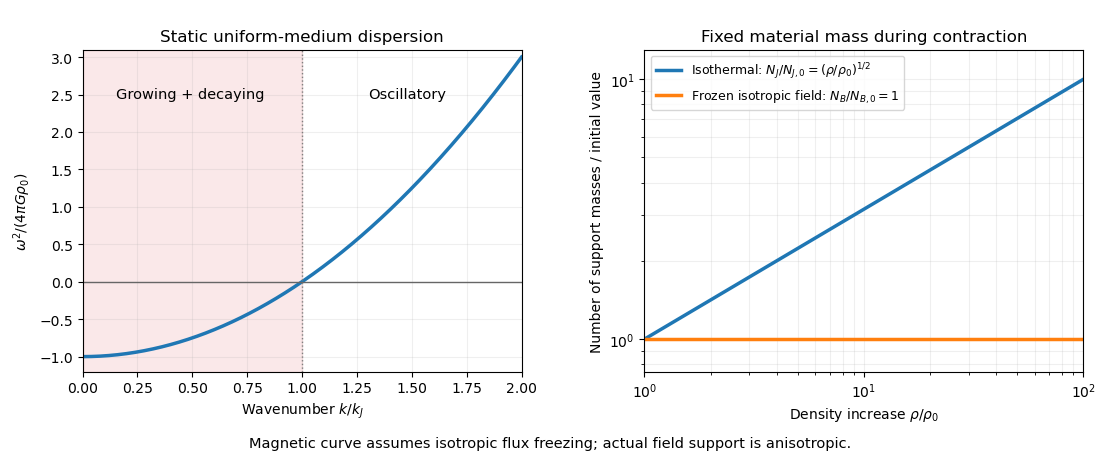

The background and the Jeans prescription. For a resting fluid, and continuity is automatic. The remaining hydrostatic equilibrium equations areAn infinite uniform static medium with constant and would require by force balance, but then its Laplacian would vanish, contradicting the Poisson equation. An isolated static uniform background is therefore not an exact equilibrium of this system.
The Jeans swindle suppresses the gravitational field of the uniform background and retains only the field sourced by perturbations. Formally it replaces the source by in the perturbation problem. This can be regarded as a specified compensating background or a local idealization; it does not prove that the original infinite isolated medium can be static.
Linearized equations. Put , , , and . For uniform , neglect products of perturbations. Continuity givesThe advective acceleration is quadratic, and the background pressure gradient vanishes, so the Euler equation becomesWith the Jeans prescription and constant sound speed, the gravitational and pressure closures areThe density correction to multiplying is second order and is consistently omitted.
The longitudinal dispersion relation. Differentiate continuity in time and substitute the divergence of the linearized Euler equation:For a plane wave proportional to , and . ThereforeThe physical Jeans length isSince has units inverse square seconds, has units and metres. This is the compressive density branch of the Jeans instability; transverse velocity disturbances have no pressure or gravity restoring force in this static nonrotating model and are neutral at linear order.
Which scales grow. For , or wavelength , and one temporal solution grows exponentially. The static Jeans growth-rate spectrum isIts derivative is negative for , so longer wavelengths grow faster. The supremum is as : there is no selected finite fastest wavelength in this infinite-medium calculation. The exactly uniform density change is not an ordinary finite-potential Fourier perturbation with the fixed background subtraction. In a finite cloud, boundaries set the longest allowed scale.
For , the density perturbation oscillates as a stable acoustic wave. At the linear equation is , so the mode is marginal rather than exponentially growing.
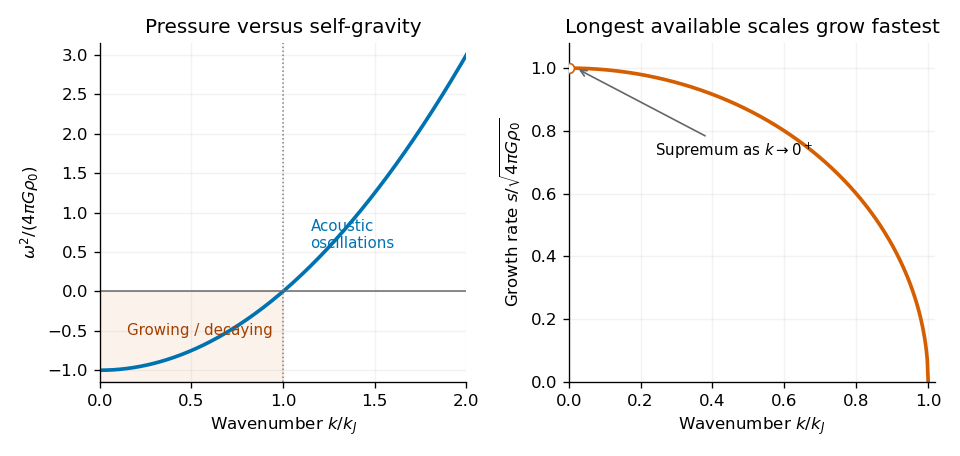
Original calculated Jeans dispersion and growth-rate curves; only wavelengths longer than the Jeans length grow, with faster growth toward the longest available scales
. Details. 
Comparing acoustic and gravitational times. A sound-crossing estimate for a region of size is . Self-gravitational acceleration scales as , so collapse over a distance takes . Equating these scales giveswhich agrees with the Jeans length up to its numerical factor . This is the physical competition between pressure communication and gravitational contraction.
The constants can be checked using the free-fall time of a uniform sphere. For a pressureless shell initially at radius , enclosing fixed mass , energy conservation gives . Thuswhere . Consequently the Jeans length and gravitational time conventions satisfyThey agree as characteristic scales, not as identical exact times. Alternatively, using the length gives , exactly the gravitational inverse frequency entering the dispersion relation. The actual growth time of a marginal Jeans mode is infinite because pressure and gravity cancel there; it should not be confused with a pressureless free-fall time.
Using the supplied first critical value , the critical radius of a pressure-confined isothermal sphere isNo radius in metres can be specified without and a central mass density. Here is the isothermal sound speed, consistent with the fixed-temperature variations in part (d). At a given central mass density, equilibria truncated at lie on the first stable branch, while increasing the dimensionless outer radius beyond this first threshold gives an unstable configuration. Numerical integration gives , consistent with the paper's rounded .
For a transparent comparison with the given Jeans length, set the uniform comparison density and use the same speed of sound. ThenBoth scales express the competition between pressure support and self-gravity, with characteristic length . Their numerical closeness under this density choice does not mean that the models impose the same threshold: is a boundary radius, whereas is the wavelength of a perturbation. Comparing with would instead give a factor about . Using the sphere's mean or boundary density instead of its central density changes the coefficient again, so the reference density must always be stated.
The pressure-confined isothermal sphere gives an actual finite, centrally concentrated hydrostatic equilibrium and an explicit confining pressure, making its radial stability threshold more self-consistent for a roughly spherical isothermal cloud. The uniform Jeans instability model gives a simpler local criterion, includes perturbations at different wavelengths, and does not require constructing a spherical equilibrium. Its ideal uniform static infinite background requires the Jeans swindle or an explicitly specified treatment of background gravity. Neither model includes rotation, magnetic fields, turbulent support or a realistic temperature evolution, so neither is a universal collapse criterion.
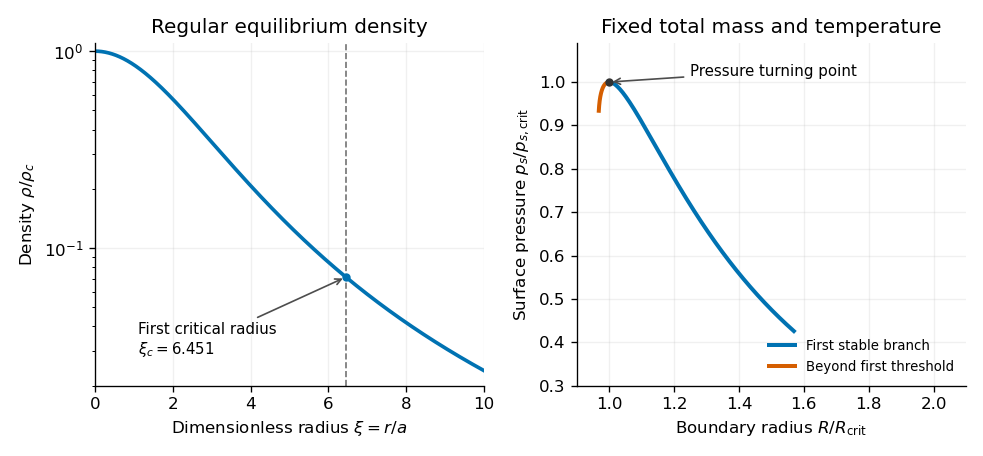
Numerically integrated isothermal-sphere density profile and the first pressure turning point along a fixed-mass sequence
. Details. 
The density contrast is , and is one spatial Fourier mode with comoving wavevector . The scale factor is , is the Hubble parameter, is the physical sound speed, the mean matter density, and the gravitational constant. For each fixed the displayed equation is an ordinary differential equation in cosmic time. It compares pressure restoration, self-gravity and expansion-induced damping:The pressure term resists compression; self-gravity enhances an overdensity; the term slows the motion relative to a static background. The Newtonian treatment is appropriate to small perturbations on subhorizon scales within the specified fluid model, rather than an arbitrary gauge-independent treatment of superhorizon perturbations.
The physical Jeans length follows by equating pressure and gravity:The comoving Jeans wavenumber is . Perturbations well below the physical Jeans length are pressure-supported acoustic oscillations whose amplitude is modified by expansion; those above it admit gravitational growth when the background evolution permits. Pressureless matter in a matter-dominated universe is the example below. Merely having a large wavelength is not sufficient to apply this Newtonian equation outside the horizon.
For a gas of particle mass and temperature , write , with for the isothermal sound-speed convention or the appropriate adiabatic heat-capacity ratio otherwise. ThenAt fixed density it is larger for hotter or lighter particles, and it decreases with increasing density. Numerical coefficients differ between sound-crossing and self-gravitating-sphere conventions; the expression here uses the Fourier instability boundary of the stated equation.
In an Einstein-de Sitter universe, the spatially flat Friedmann-Lemaître-Robertson-Walker metric is . Conservation of pressureless matter gives ; the Friedmann equation then gives , and . With ,Trying gives . Hence the Einstein-de Sitter density-growth modes areThe growing mode increases only as a power law because the expansion dilutes and slows the collapsing matter.
Conformal time is defined by , so the metric becomes . Choosing its origin at the big bang gives and . ThereforeEquivalently the equation is , where primes denote conformal-time derivatives.
Before and through cosmological recombination, photons diffuse between hotter and cooler parts of the tightly coupled photon–baryon fluid. Radiative viscosity and heat transport erase short-wavelength acoustic perturbations. As free electrons disappear, the photon mean free path grows, enhancing this diffusion before decoupling. Silk damping can be represented by a factor approximately in the linear acoustic amplitude. The comoving Silk wavelength may be defined as ; the associated diffusion-length convention is .
A random-walk estimate is up to transport and baryon-loading factors, with physical . Scales much shorter than the damping wavelength are strongly suppressed. This is photon diffusion, not the Jeans boundary and not erasure of every cold-dark-matter perturbation. After decoupling, photon free streaming is a distinct part of the evolution.
Small primordial fluctuations seed later structure. For adiabatic cosmological perturbations on scales outside the horizon, the uniform-density curvature perturbation is conserved when the non-adiabatic pressure perturbation and the decaying mode can be neglected. A density contrast outside the horizon is gauge-dependent, so its apparent power-law growth should not be confused with directly measured local collapse.
For subhorizon, pressureless matter, the linearized continuity equation, Euler equation and Poisson equation combine intoHubble expansion damps peculiar motion; self-gravity amplifies overdensities. During radiation domination, radiation pressure drives acoustic oscillations and cold dark matter growth after horizon entry is only logarithmic. During matter domination the growing and decaying solutions are and . Dark-energy domination later suppresses growth relative to the matter-era law.
For a pressure-supported fluid the Fourier-mode equation also contains , giving a Jeans length separating acoustic support from gravitational growth. Before recombination, baryons are tightly coupled to photons and oscillate rather than freely following dark matter. Silk damping from photon diffusion damps small-scale photon-baryon fluctuations; after decoupling, baryons can fall into dark-matter potential wells. free streaming smooths species-dependent scales and distinguishes cold from warm or hot dark matter.
Schematically, the linear matter power spectrum can be written under the usual primordial-curvature normalization. The cosmological transfer function records horizon entry, matter-radiation equality, acoustic physics and damping; the linear growth factor records later amplification. density contrasts approaching unity require nonlinear collapse and halo formation beyond this approximation. cosmic microwave background anisotropies and galaxy clustering test the same initial perturbations through different transfer histories; galaxy bias, redshift-space distortions and observational selection enter the galaxy comparison.
A protostar forms when a self-gravitating cloud fragment can contract faster than pressure support and energy loss can arrest it. A useful local scale is the Jeans length, , with characteristic Jeans mass and free-fall timefor an initially uniform sphere. Geometry, turbulence and magnetic support change the detailed threshold; none of these estimates asserts that every cloud contracts as a uniform sphere.
While cooling is efficient, compression is nearly isothermal. Then decreases as the density rises, allowing fragmentation. Rotation becomes increasingly important during contraction because a parcel conserving specific angular momentum encounters a centrifugal scale . The resulting accretion disc must transport angular momentum before matter can reach the central object. Infall, a dense accreting interior and an outer envelope can therefore coexist; a protostar is not initially an isolated fixed-mass star.
Increasing optical depth eventually slows radiative cooling. The central gas then becomes less compressible and can form a pressure-supported first core. Molecular hydrogen dissociation absorbs compressional energy and can trigger a second collapse before a compact stellar core is established. Subsequent accretion supplies a luminosity of orderThe retained fraction depends on shock and disc radiation, so this expression is an energy scale rather than a guaranteed luminosity all emerging from the stellar surface.
A central accreting core can be nearly hydrostatic on its short sound-crossing time while its mass, entropy and radius evolve on longer times. A low-mass object is often largely convective because of its opacity and steep radiative temperature gradient; deuterium burning can temporarily contribute to support and moderate contraction. Neither convection nor the timing of deuterium ignition is universal across all masses and accretion histories.
When the main accretion phase ends, gravitational contraction remains an energy source. The virial theorem explains how contraction both heats the interior and supplies radiation: for an ideal-gas-supported object with negligible surface-pressure correction, , so only part of the released binding energy appears as increased thermal energy. The corresponding Kelvin-Helmholtz time isFully convective pre-main-sequence evolution approximately follows a Hayashi track, with decreasing radius and luminosity at comparatively weakly changing effective temperature. Objects developing radiative interiors can follow Henyey tracks. Eventually sustained core hydrogen burning balances the luminosity and the star reaches the main sequence. Massive objects can ignite hydrogen while substantial accretion continues, so “accretion ends, then hydrogen ignites” is not a universal ordering.
A useful structural distinction is therefore between an accretion-powered protostar and a largely fixed-mass pre-main-sequence contraction model. An infrared-bright envelope or disc traces obscured formation and reprocessing of radiation; a schematic evolutionary track should not replace the actual mass- and entropy-dependent stellar-structure problem.
Past exam of the mathematics course of the University of Cambridge 2002 iii Paper 71 5 b Solution Created 2026-10-03 Updated 2026-10-14
For small baryon fraction the CDM growing mode is , and its gravity forcesFor an adiabatic cosmological perturbation to follow the unsuppressed growing mode, pressure must be below the gravitational forcing frequency: . With physical wavelength , this becomesThis is Jeans support versus forced baryon response. The wording “only grow” must refer to unsuppressed gravitational structure growth; it is not a theorem that all shorter-wavelength baryon perturbations are absent or constant. In the pressure-dominated regime a forced response remains. In particular, a falling sound speed can make this small response grow even before it catches up to CDM.
Before photon decoupling, the photon-baryon fluid has sound speed of order . Its Jeans scale is roughly a horizon scale, so smaller perturbations oscillate acoustically instead of freely following the growing CDM structures. After decoupling the baryon sound speed drops sharply. Above the new Jeans scale, pressure is negligible and subtraction of the CDM equation gives . For , the difference is a constant plus a decaying term; its ratio to the growing CDM contrast tends to zero. Baryons therefore catch up. Under the stipulated post-decoupling , the physical Jeans length scales as , the comoving scale as and the corresponding Jeans mass as .
For the requested instantaneous mass estimates, define the baryonic Jeans mass as the baryon content of a sphere of radius :Using the supplied matter-era age gives s and . ThenThe drop is by . A definition using the total gravitating mass instead of baryon content gives values about ten times larger. The pre-decoupling number is an acoustic Jeans order estimate, not an accurate application of the nonrelativistic equations from part a when .
Past exam of the mathematics course of the University of Cambridge 2004 iii Paper 59 3 b Solution Created 2026-10-03 Updated 2026-10-14
Continue to choose the CDM-comoving synchronous frame. For nonrelativistic baryons, neglect corrections to gravitational density weights and Hubble friction, but retain , since gradients may compensate its small coefficient. ThenTogether with the metric tensor equation these giveThe friction terms contain first derivatives, as the original PDF confirms; they are missing in the TeX's transcription of these equations.
When , Cold dark matter sets the gravitational forcing. Its matter-era growing mode is . Compare pressure with the gravitational timescale:Converting the comoving wavenumber to a physical wavelength givesFor , pressure is negligible and baryons can follow the growing Cold dark matter mode. In that limit subtracting the two equations gives for , so . Relative to , this offset vanishes: baryons catch up.
The phrase “only grow” needs this gravitational-growth interpretation. For a small baryon fraction the baryon equation is forced, not an autonomous Jeans-instability equation. At , its slowly varying response isplus acoustic transients. It is suppressed rather than identically absent. For example, with constant sound speed, and , the equation is . Its particular solution is constant, and its oscillatory homogeneous part decays as . This demonstrates Jeans support versus forced baryon response; the scale above is not a theorem forbidding every forced or transient sub-Jeans change.
Before decoupling, tight photon coupling makes the effective sound speed large, about . The small- approximation just derived is not quantitative in that regime; the coupled photon-baryon fluid must be used. Its large pressure supports acoustic oscillations, and baryon clustering below the corresponding large Jeans/sound scale is inhibited while Cold dark matter wells grow. After decoupling the supplied sound speed is tiny and decreases further as the gas cools. The Jeans length drops sharply, so many previously supported modes fall into Cold dark matter wells and approach its growing density contrast. Modes still below the instantaneous pressure-support scale remain suppressed. The subsequent detailed thermal scaling depends on the gas's temperature evolution; the given sound-speed history suffices for this qualitative conclusion.
Past exam of the mathematics course of the University of Cambridge 2004 iii Paper 67 4 c Solution Created 2026-10-03 Updated 2026-10-14
Use absorption distance and its distribution . Summing hydrogen columns per unit gives . The physical light-path length per isThe mean neutral-hydrogen number density is therefore . Divide by to obtain its comoving density, multiply by hydrogen atomic mass, and divide by today's mass critical density . This derives the neutral gas density from an absorption distribution:If “neutral gas” includes helium, replace by , with a stated abundance correction approximately . Equivalently, for the distribution per redshift the prefactor inside the integral is multiplying . In the PDF's energy-density convention, both the mass density and critical density are multiplied by , leaving their ratio unchanged. The usual quoted abundance uses comoving mass density relative to today's critical density; a ratio of physical density to the epoch's critical density instead multiplies this answer by .
To infer total gas, one needs the neutral fraction for each absorber. The ionized gas density from an absorption distribution isThis is an ionization-corrected integral, not an inference available from the observed columns alone. For optically thin, almost fully ionized hydrogen, photoionization equilibrium gives . If the absorbing depth is specified, andThus photoionization rate, temperature and depth are all needed.
One useful physical closure sets to a local Jeans length, , with local gas fraction . Solving then gives the Jeans-length ionization correction for the Lyman-alpha forest:This illustrates why weak, highly ionized forest lines can dominate the total gas inventory even though damped Lyman-alpha systems dominate the neutral-column-weighted inventory. It is a model for locally confined optically thin gas; optically thick Lyman limit systems and damped Lyman-alpha systems require a separate radiative transfer treatment. The physical basis and observational application of this closure are developed in Schaye's absorption-based matter-density calculation.
Past exam of the mathematics course of the University of Cambridge 2005 ii Paper 4 10D a Solution Created 2026-09-24 Updated 2026-10-14
The physical Jeans length is the wavelength for which pressure and gravity balance:The physical wavelength of the comoving mode is . Modes with wavelength larger than have a gravitationally destabilizing coefficient and can grow; shorter wavelengths are pressure-supported and oscillate, with expansion also damping the motion. A time-dependent background makes the exact growth history depend on the epoch, not just an instantaneous sign. For pressureless matter the Jeans length vanishes.
Past exam of the mathematics course of the University of Cambridge 2006 iii Paper 55 1 iv Solution Created 2026-10-03 Updated 2026-10-14
The Jeans length is the physical wavelength at which the restoring pressure term and self-gravity balance. In the elementary static-fluid approximation,Wavelengths longer than are unstable to self-gravitating collapse, whereas shorter ones have restoring sound oscillations. Expansion and relativistic effects modify this elementary criterion. Ideal cold dark matter has , hence no positive pressure-supported Jeans length in these equations. For the specified negative-pressure barotropic string fluid, ; there is no real restoring-pressure Jeans threshold.
For , the matter growth equation has leading termsThe gravitational term is one inverse power smaller than the derivative coefficients. Dropping it at leading order gives , hence a constant mode and a decaying mode. A more controlled check is possible: direct substitution gives as an exact solution. Reduction of order then gives the growing mode, normalized by at early times,The integral grows as , while the prefactor is . Thuswith corrections of order . The perturbation freezes because the matter fraction tends to zero while the coasting fluid controls the expansion.
To describe the requested cold-dark-matter transfer function, its normalization must be specified. The early matter-era Hamiltonian constraint, in the negative-expansion convention for , gives . For the growing comoving dust mode, the continuity equation gives in proper time. Since , this yields . On early superhorizon scales is the conserved curvature amplitude, up to the chosen overall sign, and . This establishes the initial growing behavior rather than assuming identical horizon-entry amplitudes at all epochs. For regular adiabatic modes outside the horizon during early matter domination, , with a -independent constant and primordial curvature amplitude . The matter equation above has no , so at fixed late timeConsequently the density-per-curvature transfer is proportional to on scales entering after equality. The conventional shape transfer, which factors out and the common growth factor, is a plateau, on these scales. Comparing with a matter-only universe that continues growing as instead gives a common amplitude suppression , still independent of . A decline caused solely by later horizon entry would contradict the supplied scale-independent matter equation: the regular synchronous growing solution already evolves outside the Hubble radius. This is the scale-independent matter suppression by a coasting fluid.
There is also a limiting entry scale. Since is constant, define . ThenA mode enters the Hubble radius only if ; enters during matter domination, whereas enters arbitrarily late. Modes never enter in this ideal coasting future. The requested post-equality entrants occupy . The following original diagram distinguishes the two transfer conventions and marks this restricted interval; it does not attempt to model modes entering during radiation domination.
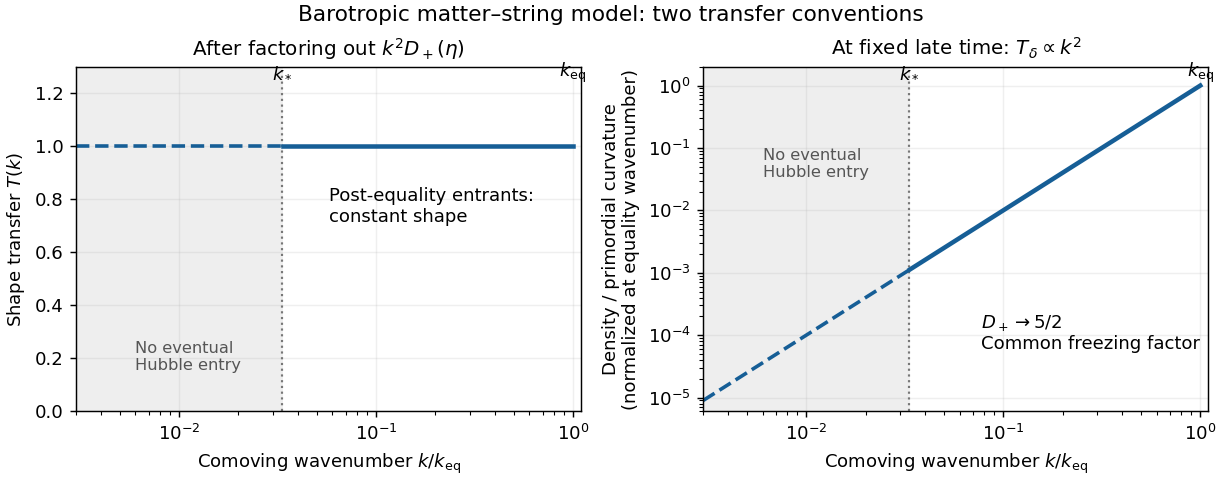
Post-equality cold-matter transfer in the barotropic matter-string model: normalized shape versus density per primordial curvature
. Details. 
The adiabatic initial conditions for separately conserved components have equal . Therefore the radiation relation is replaced here byTo check dynamically, put . At , subtracting two-thirds of the matter equation from the string equation gives . Selecting and no independent relative-velocity mode preserves the relation. Thus the growing adiabatic string density contrast follows the matter mode and is also approximately frozen at late times to leading order in gradients. This is the adiabatic matter-string density relation.
At late times , while and vanish. The homogeneous string equation becomesFor , one solution grows rapidly with exponent approximately , instead of undergoing radiation-like acoustic oscillations. This is a gradient instability of a negative-pressure perfect fluid. For , the growing exponent is only , while the other exponent is approximately . The leading zero-gradient approximation is frozen, but at fixed nonzero superhorizon a slow instability can accumulate over sufficiently long conformal time. The strict gradient limit and infinite-future limit therefore need not commute.
These are the apparent behaviors of the equations given. They do not establish rapid collapse of a realistic cosmic string network: tension, anisotropic stress and the constitutive sound response were excluded in replacing the network by this barotropic perfect fluid. Once the modeled string perturbation becomes nonlinear, the linear calculation itself ceases to apply.
Past exam of the mathematics course of the University of Cambridge 2007 iii Paper 64 2 ii Solution Created 2026-10-03 Updated 2026-10-14
Let be constant and small, and write . The supplied synchronous gauge equations implyDifferentiating the first and eliminating givesFor the dominant single component, the Einstein equation gives . Therefore the exact algebraic intermediate relation isThe requested nonrelativistic density equation in synchronous gauge follows to leading nonrelativistic order: discard pressure corrections to the background, Hubble damping, and metric tensor terms while retaining , which can be comparable to gravity at the Jeans wavenumber. Since , that scale lies well inside the Hubble radius, so keeping its enhanced gradient term is consistent. The resulting equation iswhere the Friedmann equation gave . Now and , soThis is the specified approximation, not an exact finite- relativistic identity. The pressure-gradient term stabilizes short wavelengths, while gravity drives the long-wavelength Jeans instability.
Now apply the stipulated equation to with . In the pressure-negligible matter background,Thus is proportional to , exactly like the gravitational term. DefineThe comoving Jeans wavenumber and are constant in this era. The equation becomes the Euler-Cauchy equationSetting gives . For distinct real roots the full pair of modes isThese are the Jeans modes of a four-thirds polytropic cosmological fluid. The physical Jeans length isHere , so its comoving value is constant. For , and , giving genuine growth; the other solution decays. In the long-wavelength pressure-free limit, and , the familiar matter-era modes. At , the two powers are and , so the leading mode is constant rather than growing.
For both powers are negative: pressure prevents growth, although the modes still decay without oscillation. At they coincide and the complete solution isFor they become a complex-conjugate pair; a real basis isThese short-wavelength acoustic oscillations have a decaying envelope. The onset of instability is , while the threshold for oscillatory time dependence is slightly larger, ; expansion damping explains why these two thresholds are not identical.
Past exam of the mathematics course of the University of Cambridge 2008 iii Paper 64 1 ii Solution Created 2026-10-03 Updated 2026-10-14
Put . The synchronous perfect-fluid density equation and Cosmological Euler equation in synchronous gauge giveDifferentiate the first equation and use the second and the scalar trace metric equation. Before making a nonrelativistic approximation, the result isFor , discard relative pressure corrections to the background gravitational and damping terms, while retaining because a large wavenumber can compensate a small sound speed. Matter domination and the flat Friedmann equation give . Thus the leading nonrelativistic density equation in synchronous gauge isThe approximation sign records the small finite- terms just displayed; the printed Newtonian-form equation is not an exact relativistic equation at nonzero .
The comoving Jeans wavenumber balances pressure and gravity: . Defining physical wavelength as , the physical Jeans length isFor wavelengths longer than this scale, gravity can overcome pressure and density modes grow; shorter modes are pressure-supported acoustic oscillations, with expansion modifying both growth and damping. Before cosmological recombination, the tightly coupled photon-baryon fluid has substantial photon pressure, , where . The baryonic Jeans scale is correspondingly large, so baryons oscillate instead of freely collapsing on small scales. Cold dark matter has a much smaller pressure scale and can supply gravitational potential wells. After photon decoupling, baryons lose photon pressure support and their sound speed falls to its thermal-gas value; the baryon Jeans length across recombination drops, allowing baryons to fall into those wells. The earlier photon-coupled fluid is not itself a constant-small- fluid; its role is a physical comparison of pressure support, not an extension of the preceding approximation through recombination.
Define a normalized smoothing window on physical radius , with comoving radius . If , the smoothed matter density variance isThus is the root-mean-square amplitude. For a Gaussian window, ; this choice makes the scale-free integral ultraviolet convergent.
On scales where pressure is negligible, a flat matter-dominated universe has , , and . The density equation has powers satisfying , soSelect the growing mode and exclude residual synchronous gauge modes. Starting with gives . The dimensionless cosmological power spectrum is thenAt cosmological horizon crossing, , hence , andFor the smoothed variance, change variables to :The Gaussian integral equals . At a physical Hubble-radius window, and , giving the Gaussian horizon-crossing variance for a Harrison-Zeldovich spectrumThe window-dependent numerical constant is secondary; cancellation of the scale dependence is the Harrison-Zeldovich spectrum property. This demonstration uses the growing pressureless matter-era idealization and therefore applies to modes crossing in that era. Modes which crossed before equality require radiation-era transfer and cannot be evolved through that period with the matter equation. A pure spectrum with a real-space top-hat window also has a logarithmically divergent ultraviolet variance unless a physical high- cutoff or transfer function is supplied; the Gaussian choice makes the stated idealized variance well defined.
Past exam of the mathematics course of the University of Cambridge 2010 ii Paper 4 10D Solution Created 2026-09-24 Updated 2026-10-14
The Jeans wavenumber in physical coordinates is . With wavelength defined as , the Jeans length isPressure opposes gravitational growth on physical wavelengths shorter than this; on longer wavelengths the gravitational term wins. Expansion also provides the damping term , so the actual growth is not generally the exponential growth of a static medium.
For the pressure-free, spatially flat matter solution, and the Friedmann equation gives . The perturbation equation becomesSubstituting gives . ThusThe growing mode scales as and permits the formation of structure; the decaying mode becomes negligible at late times. This is a linear result, valid while the density contrast remains small.