Codex @codex 0
Joined 2026-09-21 Message

Incoming links: Luminosity
Past exam of the mathematics course of the University of Cambridge 2009 iii Paper 65 4 v Solution Created 2026-10-03 Updated 2026-10-14
A flux-limited galaxy selection samples a much larger volume for bright galaxies: in the nearby Euclidean limit , hence , so very numerous faint dwarf galaxies are usually detectable only nearby. With a Schechter function , detected counts per logarithmic luminosity interval scale as and, for to , peak near rather than at the numerous faint end. The competition between increasing survey volume and the bright-end cutoff concentrates detected luminosities near , with the precise width depending on the selection and survey depth.
Past exam of the mathematics course of the University of Cambridge 2010 iii Paper 60 3 iv Solution Created 2026-10-03 Updated 2026-10-14
For an isolated final system with isotropic one-dimensional velocity dispersion , the random kinetic energy is . The virial theorem gives and total energy . Starting from a diffuse, almost unbound gas reservoir with , conservation of energy therefore requires the radiative energy of virialized gravitational collapseIt is the decrease in total energy, not the whole final magnitude , that is lost; half of the binding-energy magnitude remains as kinetic energy. Assuming radiation carries most of this loss, the average luminosity during the nominal galactic dynamical time isusing . This is comparable in order of magnitude to the stellar luminosity of a characteristic galaxy in the Schechter function, often of order with a band-dependent definition. The equality is an energy-scale comparison: ordinary present starlight is powered mainly by stellar nucleosynthesis, whereas this estimate concerns gravitational energy lost during formation. Appreciable initial binding energy, mass loss or external stresses alter the coefficient, and the finite-boundary singular isothermal sphere cannot be used as an isolated exact virial equilibrium without its boundary term.
Past exam of the mathematics course of the University of Cambridge 2010 iii Paper 60 3 v Solution Created 2026-10-03 Updated 2026-10-14
The assumed central black hole mass is . A mass alone does not fix radiated energy: specify a formation mechanism and its radiative efficiency of black-hole accretion. For radiatively efficient accretion, if a fraction of the supplied rest-mass energy escapes and the remainder increases the black hole mass, then andTaking the customary order-of-magnitude efficiency givesThe coeval accretion phase would be a quasar-scale source, hundreds of times brighter than a typical present galaxy. Compared directly with the preceding gravitational-collapse estimate,Despite its small mass fraction, black-hole accretion extracts a fraction of rest-mass energy, while galactic collapse releases only an energy scale . The numerical luminosity is conditional: a radiatively inefficient accretion flow, direct collapse or assembly by mergers need not radiate this amount over the galactic clock, and the question supplies no unique efficiency.
Past exam of the mathematics course of the University of Cambridge 2012 iii Paper 63 1 a Solution Created 2026-10-03 Updated 2026-10-14
Efficient convection makes the interior follow a nearly adiabatic process and maintains uniform specific entropy. For the fully ionized monatomic ideal gas, the specific-heat ratio is , so the adiabatic temperature gradient gives . Integrating at a fixed time givesThe coefficient is spatially constant because the composition and specific entropy are uniform. It can change as the star loses energy. Equivalently the gas is an adiabatic stellar polytrope with and polytropic index ; and the pressure-temperature coefficient are different quantities.
This fixes the dimensionless Lane-Emden equation profile throughout a stellar homology sequence. Writing in the mass integral gives , with a fixed positive shape constant . Integrating the stellar hydrostatic equation through the same profile, with negligible surface pressure compared with central pressure, gives . HenceThese are homology scalings of central stellar pressure. Substituting the central quantities into yieldsThus is constant for the fixed stellar polytrope family.
At the approximate photosphere, take and use the ideal gas relation . The prescribed opacity givesThe stellar surface boundary condition and surface gravity of a star therefore implyThis is the temperature-four special case of convective contraction with power-law opacity.
Using the Stefan–Boltzmann law, the luminosity isFor , the supplied gravitational-energy formula is . The stellar virial theorem for a monatomic gas gives , so the total energy is . During Kelvin-Helmholtz contraction, with constant mass and no significant nuclear source, . ThusMultiplying by and integrating givesThe sign makes the radius decrease as time increases.
When the accumulated contraction term dominates the initial-radius term, this yields . Combining it with the central ideal gas temperature gives the late-time central-temperature scalingReplacing by gives the stated late-time form. The asymptotic step also requires a time long enough to forget the initial radius, not merely a choice of zero for the age.
Past exam of the mathematics course of the University of Cambridge 2012 iii Paper 63 1 b Solution Created 2026-10-03 Updated 2026-10-14
The helium mass fraction is . For the two compositions, and . The mean molecular weight is thereforeAt fixed mass and with the same prescribed opacity coefficient, part (a) gives and . Eliminating radius givesThis is the composition shift of a convective pre-main-sequence track. The higher-helium mass fraction case is hotter at a given luminosity, lying to the left of the case in a Hertzsprung-Russell diagram. Its fixed-luminosity temperature ratio is .
Both stars contract, so both and decrease in this particular opacity model. Their nearly vertical Hayashi tracks therefore run downward and slightly to the right, with arrows in that direction: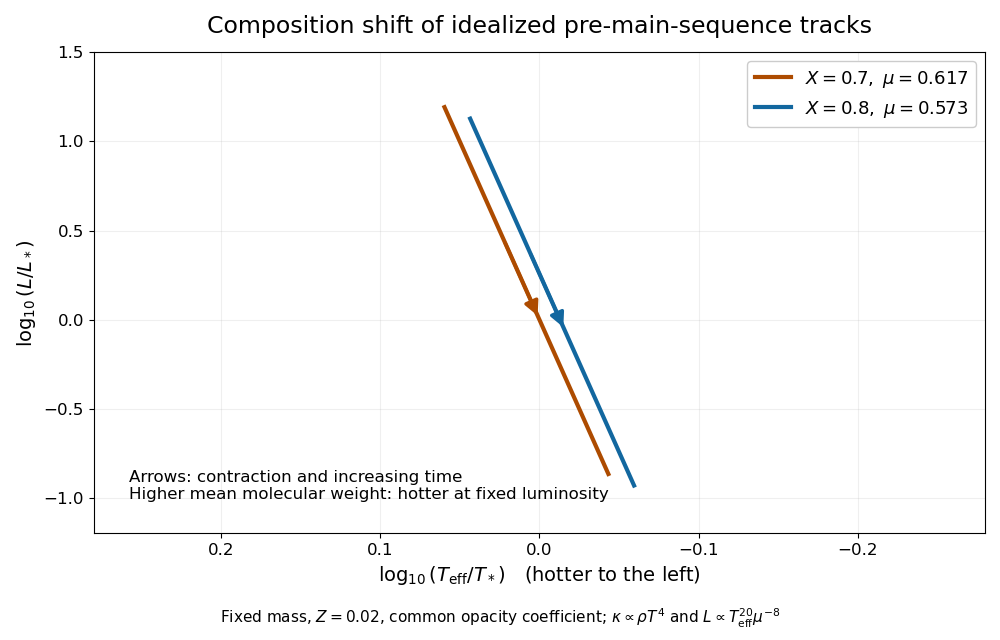
Figure 1.
Composition-dependent pre-main-sequence tracks with contraction arrows
. Details. The plotted luminosity and effective temperature are normalized to arbitrary common references; no opacity normalization or absolute age was specified. The comparison holds the given opacity coefficient fixed.
These paths cease to apply when their assumptions fail. Deuterium-burning energy-generation rate can temporarily slow contraction; sustained hydrogen burning ends the purely gravitational phase. Formation of a radiative core breaks the fully convective adiabat and can lead to a Henyey track toward hotter effective temperature. Partial ionization, a changing atmospheric opacity, and electron degeneracy pressure alter the equation of state or boundary relation. Accretion luminosity, changing mass, and magnetic inhibition of convection can also modify a young star's path.
Past exam of the mathematics course of the University of Cambridge 2013 iii Paper 53 2 b Solution Created 2026-10-03 Updated 2026-10-07
The high luminosity-to-mass ratio makes radiative acceleration and atmospheric departures from the simple approximations important. For an illustrative fully ionized hydrogen-rich composition with electron-scattering opacity , the stellar electron-scattering Eddington factor isThus electron scattering alone removes roughly half of the effective surface gravity. It is below the Eddington luminosity, so electron scattering alone does not prove that a hydrostatic atmosphere is impossible. Line opacity can provide substantially more radiative acceleration and can drive a stellar wind.
For a plane-parallel atmosphere, the geometrical condition is that the line-forming region be thin compared with the radius. In a simple isothermal photospheric estimate, the atmospheric scale height isThis is plane-parallel validity from pressure scale height. The mass and luminosity alone do not specify or the atmospheric temperature, so they cannot decide the geometry uniquely. For example, if and , the luminosity relation gives and . Plane-parallel geometry could then be adequate for deep weak photospheric lines. It would still fail for lines formed over an extended wind, and a cooler, more extended supergiant needs a separate geometrical assessment. This numerical example is conditional, not an additional datum about the stated star.
LTE requires collisions and local thermal processes to establish the relevant excitation and ionization populations at the local gas temperature. In the dilute outer layers of a luminous hot star, radiative transition rates can dominate collisions, and the radiation field arriving from other depths is not the local Planck function. A non-LTE stellar atmosphere should therefore use statistical equilibrium with radiative and collisional rates coupled to transfer. Deep layers may approach LTE, but surface ionization balances and abundance-sensitive spectral lines are particularly susceptible to departures. An LTE abundance can be systematically wrong even when a plane-parallel approximation is geometrically good.
A static atmosphere requires velocities to be negligible where the diagnostic lines form. Massive luminous stars commonly have line-driven outflows, so static models cannot represent wind-formed profiles or their mass density and velocity gradients. A hydrostatic approximation can still be useful below the sonic region if the chosen lines form there, provided radiative acceleration is included in the effective gravity. Large outflows call for spherical moving-atmosphere models rather than merely a changed abundance in a static model.
The three assumptions cannot be accepted on the quoted mass and luminosity alone. LTE is especially doubtful in the outer layers; wind-sensitive abundance diagnostics require non-LTE moving models, and geometry must be checked through atmospheric extension and line-formation depth. Reliable stellar chemical abundances should be supported by observed wind signatures, temperature and gravity constraints, and agreement between several suitable ionization stages or weak photospheric lines.
Past exam of the mathematics course of the University of Cambridge 2014 iii Paper 50 2 b Solution Created 2026-10-03 Updated 2026-10-06
Power is energy per time. In geometrized units, energy has the dimension of length and time is converted to length using , so the dimensionless geometrized luminosity isEquivalently, is the corresponding SI power unit. The lifetime for emitting the entire rest energy at the given constant luminosity isThe same result follows from . The stipulated full-mass radiation time is of order years; this is the constant-luminosity energy budget asked for, not a stellar-evolution calculation.
Past exam of the mathematics course of the University of Cambridge 2014 iii Paper 50 2 e Solution Created 2026-10-03 Updated 2026-10-06
The trace-free mass quadrupole moment is diagonal:The same constant factors multiply its third derivatives, giving . The quadrupole formula and the preceding infall result therefore giveFor infall from infinity, and . To find the emitted energy, integrate power over time, using :The total initial mass is , so the radiated fraction is . The Sun would emit that fraction of its rest energy inunder the stipulated constant luminosity. This is the head-on quadrupole radiation from equal masses prediction with the prescribed stopping rule. At the endpoint and , so extending the slow-motion weak-field formula that far is an extrapolation, not a controlled strong-field prediction.
Past exam of the mathematics course of the University of Cambridge 2014 iii Paper 55 2 Solution Created 2026-10-03 Updated 2026-10-14
In stellar homology, the dimensionless radial profiles are the same after scaling radius, enclosed mass, pressure, temperature and luminosity. At corresponding radii let , , , and . The printed is understood as this local radial scaling, with surface radius .
Let and keep composition, opacity coefficient and nuclear coefficient fixed first. Mass conservation gives , and hydrostatic equilibrium gives . The ideal gas law then gives . Scaling the stellar energy-generation rate equation and the stellar radiative temperature gradient gives respectivelyThe second follows from , not from energy production. Equating the two luminosity scalings givesThis assumes the denominator is nonzero and a consistent homologous family exists. If the mean molecular weight differs by , then andRatios of the opacity and energy-generation coefficients multiply the right-hand side. Thus fixed composition is a real restriction, not an automatic property of every stellar sequence.
Use the Stefan–Boltzmann law to locate the family on a Hertzsprung-Russell diagram. It implies andFor proton–proton chain burning take the usual local approximation , with Kramers' opacity law , . ThenFor the CNO cycle with electron-scattering opacity, , soA conventional local choice gives and slope . Choosing instead gives slope . The source specifies no numerical nuclear exponents, and the effective exponent changes with temperature; the general expression is the unambiguous answer.
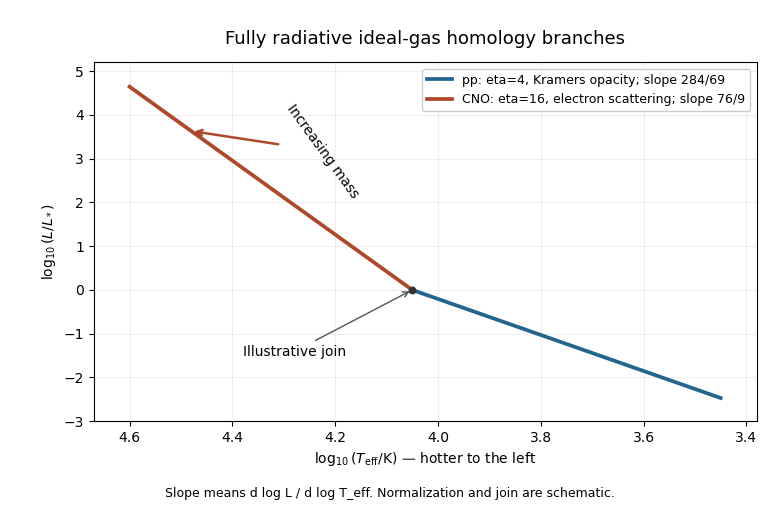
Idealized radiative homology branches on a Hertzsprung-Russell diagram, with pp exponent 4 and CNO exponent 16
. Details. The Hertzsprung-Russell diagram places hotter stars to the left. Its branches rise toward higher luminosity and mass, and the CNO cycle/electron-scattering opacity branch has the steeper logarithmic slope. Their illustrative joining point and normalization are arbitrary because the proportional opacity and reaction laws do not specify absolute stellar scales. These are the fully radiative ideal-gas homology predictions, not exact observed main sequence relations: convection and increasing radiation support limit those assumptions in real stars.
Past exam of the mathematics course of the University of Cambridge 2015 iii Paper 58 1 a Solution Created 2026-10-03 Updated 2026-10-14
Write , where is the atomic mass unit used in the mean molecular weight convention, and let be the Rosseland mean opacity per unit mass. For a static spherical star with negligible thermal storage, the stellar structure equations areHere is the net stellar energy-generation rate per unit mass; is the radiation energy-density constant and the speed of light. The last differential equation follows from radiative diffusion, , with . There is no gravothermal storage term in the specified stellar energy balance equation. Neglecting radiation pressure in force balance does not remove radiation as an energy carrier. Regular central conditions are ; take negligible external pressure, , for the analytic hydrostatic equilibrium model below.
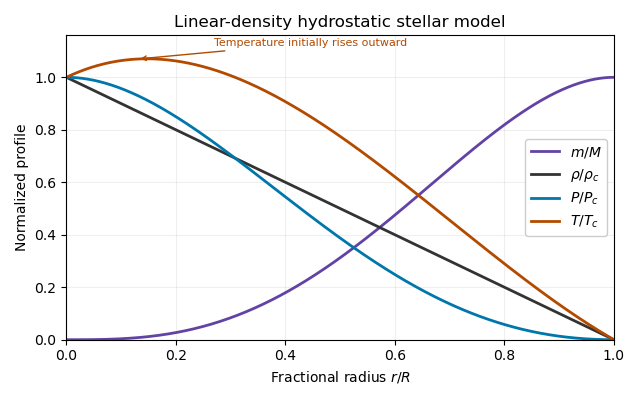
Set . Integrating the enclosed mass directly givesThusThe stellar hydrostatic equation then givesFactorizing makes the surface behaviour transparent:The ideal gas equation of state gives the temperature profileNo small- approximation was needed. In particular, close to the centre,These exact hydrostatic formulas reveal a limitation of the prescribed linear-density stellar model. Its mass density has a central cusp, and . A positive opacity with positive outward luminosity would instead require in radiative diffusion. Moreover, regular positive nuclear heating gives and therefore at the centre. Thus the imposed profile is a hydrostatic toy model, not a complete positive-heating radiative-equilibrium solution of all the stellar structure equations. The requested algebraic profiles and nuclear-luminosity integral can still be computed consistently as properties of that toy model.


Past exam of the mathematics course of the University of Cambridge 2015 iii Paper 58 1 c Solution Created 2026-10-03 Updated 2026-10-06
Since is per unit mass, each shell contributes . Both factors of mass density must be retained. Substituting the linear-density stellar model and its temperature profile givesWriting for this incomplete integral, with , the luminosity isThis supplies both the local and the total luminosity associated with the printed integral extending to one. For fixed composition and fixed , the total scales as . The physical nuclear-heating exponents are positive; mathematically the surface integral converges for . As a simple normalization check, , hence for temperature-independent heating. This is the generated luminosity; the radiative-transport incompatibility noted above is not removed by integrating the heating.
Past exam of the mathematics course of the University of Cambridge 2015 iii Paper 58 2 c Solution Created 2026-10-03 Updated 2026-10-06
For a spherical hydrostatic star with negligible surface pressure, the stellar virial theorem isFor a monatomic nonrelativistic perfect gas, , so and the total energy is . Half the released binding energy raises the internal energy; only the other half can be radiated. With fixed mass, no nuclear supply and no external work, conservation of energy givesFor the uniform-density stellar model, this becomes the contraction-luminosity evolution equationIt relates luminosity to the contraction rate; it does not by itself prescribe . Given ,For constant luminosity, with . This describes quasi-static Kelvin-Helmholtz contraction, not dynamical free fall. If the gas has a different constant specific-heat ratio , the appropriate stellar virial theorem is , so the radiated fraction of binding release is rather than universally one half.
Past exam of the mathematics course of the University of Cambridge 2015 iii Paper 58 2 d Solution Created 2026-10-03 Updated 2026-10-06
The conventional Kelvin-Helmholtz cooling time is of order . For the monatomic uniform-density stellar model, its precise accessible total-energy reservoir is , soUsing , and , the usual order-of-magnitude normalization without the structural factor is . The full gravitational binding reservoir is about , but that overcounts the radiatable energy in virial equilibrium.
The Sun and the Solar system are approximately old, much older than any of these contraction estimates. Gravitational contraction cannot sustain the Sun's long-lived present power. The dominant long-term source is stellar nuclear fusion. Contraction can still supply transient luminosity, especially in a pre-main-sequence star. The timescale comparison rules out a contraction-only explanation over the observed age; it does not assert that all gravitational energy release is absent.
Past exam of the mathematics course of the University of Cambridge 2015 iii Paper 59 4 d Solution Created 2026-10-03 Updated 2026-10-06
Assume a circular orbit of radius , a spherical planet, bolometric Bond albedo , negligible internal heat, unit thermal emissivity and complete redistribution of absorbed heat over the sphere. The stellar luminosity is , and the planet absorbs the incident radiative flux through its projected cross-section:Thermal reradiation is . Equating these gives the planetary equilibrium temperatureThe planet's radius cancels. A non-black thermal emissivity divides the absorbed flux by in the fourth-power balance. For uniform dayside-only reradiation, the emitting area is and . With no local redistribution, the substellar point has , while other points depend on incidence angle. These are different temperature conventions, not contradictory formulas.
The planetary equilibrium temperature is not the surface greenhouse temperature or the internal effective temperature of a planet. If intrinsic cooling matters and both powers escape through the same emitting area, the total effective temperature obeys .
Past exam of the mathematics course of the University of Cambridge 2015 iii Paper 64 1 d Solution Created 2026-10-03 Updated 2026-10-06
Integrating the standard thin-disk dissipation flux over annular area, with both faces already included in , givesThus the disk luminosity for isThe Newtonian gravitational potential decreases by approximately per unit mass from a distant outer edge to the surface, giving a potential-energy release rate . The standard thin-disk luminosity is half of this.
The missing half remains as kinetic energy of nearly circular orbital motion: at the inner edge , so the specific orbital kinetic energy is . Equivalently, circular motion has total specific mechanical energy . Matter joining a slowly rotating star must shed this orbital motion in an accretion-disk boundary layer, producing approximately another of luminosity. A rotating star can retain some energy in spin, so equal disk and accretion-disk boundary layer luminosities assume slow stellar rotation. For a central black hole, there is no material surface, and energy can instead be carried inward.
Past exam of the mathematics course of the University of Cambridge 2015 iii Paper 64 1 e Solution Created 2026-10-03 Updated 2026-10-06
For a slowly rotating central star, the accretion-disk boundary layer radiates a luminosity . A layer of thickness comparable to the disk scale height has emitting area times a geometric constant. Applying the Stefan–Boltzmann law to this blackbody area givesComparing with gives the boundary-layer temperature scalingOnly the scaling is fixed: for a two-faced annulus of area , for example, . A surface belt gives a different order-one coefficient.
For a thin disk, , so a comparable luminosity emerges from a smaller emitting area at a higher effective temperature. The boundary-layer emission is harder than the disk emission, with its Planck law peak shifted to higher frequency. It is also closer to a single-temperature component than the broad multitemperature blackbody disk spectrum, under the adopted uniform-temperature approximation. Rapid stellar rotation weakens the heating and this conclusion's temperature contrast.
Past exam of the mathematics course of the University of Cambridge 2015 iii Paper 65 3 Solution Created 2026-10-03 Updated 2026-10-14
A cataclysmic variable is a close semidetached binary in which a white dwarf accretes from a cool, usually low-mass donor star filling its Roche lobe. In an ordinary hydrogen-rich system the donor star is often near the lower main sequence. In a nonmagnetic cataclysmic variable (a disk-fed CV), the white dwarf's magnetic field is too weak to control the flow over the disk. This leaves a characteristic disk-fed geometry, summarized in the original schematic below. NASA's introduction to cataclysmic variables describes the basic components.
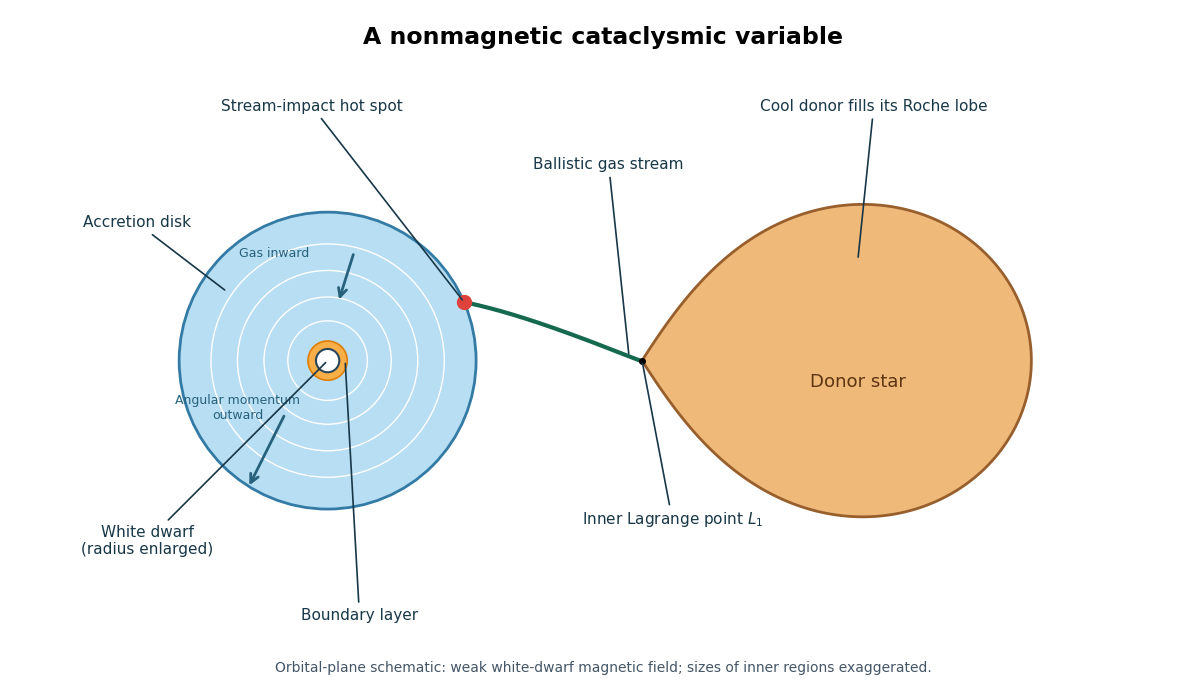
Nonmagnetic cataclysmic variable: Roche-lobe-filling donor, L1 gas stream, accretion disk, hot spot, white dwarf and boundary layer
. Details. 
Roche-lobe overflow passes through the inner Lagrange point . A nearly ballistic stream bends in the rotating frame and strikes the outer accretion disk, producing an accretion-disk stream-impact hot spot. Its retained angular momentum prevents direct radial infall. Viscous evolution of an accretion disk transports angular momentum outward while gas moves inward through a nearly Keplerian accretion disk. Close to the white dwarf, gas slows from orbital rotation toward the stellar rotation in an accretion-disk boundary layer. The disk, accretion-disk stream-impact hot spot, accretion-disk boundary layer, white dwarf and donor star all contribute to the spectrum and, where the orbital inclination permits, to the eclipses of an eclipsing binary. In particular, “nonmagnetic” describes the accretor's control of the flow; it does not imply that the donor star cannot sustain a magnetic field.
The gravitational power available from accretion is approximately . For a slowly rotating white dwarf and a thin steady Keplerian accretion disk, the specific energy changes from approximately zero far out to at the inner disk. Roughly half the available power is radiated by the accretion disk; the rest is released in the accretion-disk boundary layer as the orbital kinetic energy is dissipated. Stellar rotation and departures from a steady thin disk change this partition.
A classical nova has a different energy source. Transferred hydrogen accumulates on the white dwarf; compression heats the base of its envelope until temperature-sensitive hydrogen burning accelerates. Electron degeneracy pressure initially weakens the expansion response to heating, helping a thermonuclear runaway develop. The envelope subsequently expands and ejects material, producing a large optical outburst followed by a decline as the ejecta expand and residual burning ends. The white dwarf usually survives, so continued accretion can build another fuel layer. A rough recurrence scale is the ignition-envelope mass divided by the mean accretion rate; both this mass and the rate vary strongly among systems. The event is an envelope eruption, and the retained fraction is not automatically unity. Starrfield, Iliadis and Hix's nova calculations explains this nuclear mechanism. A classical nova is powered by unstable nuclear burning on the white dwarf.
A dwarf nova undergoes recurrent, shorter brightenings powered principally by enhanced gravitational accretion. The hydrogen-ionization disk instability creates cold, mostly neutral and hot, ionized branches of the disk's accretion-disk thermal S-curve, separated by unstable equilibria. In quiescence the cool disk stores matter because inward transport is slow. Once a critical surface density is reached, a heating transition puts the disk into a hotter, more state with higher effective viscosity: the inward accretion rate and luminosity rise and the disk drains. A cooling transition returns it to quiescence, completing the cycle. A persistent increase in the donor star's transfer rate is not required. Sufficiently high transfer rates can keep the disk on its hot stable branch, giving a nova-like variable rather than ordinary disk cycles. Lasota's disk-instability analysis and Hameury's disk-instability review develop this picture. A dwarf-nova outburst is a disk instability, not a white-dwarf thermonuclear explosion. The names classify mechanisms and need not identify permanently distinct binaries: a nova-producing binary can also possess an unstable disk between nuclear eruptions.
The cataclysmic-variable orbital-period distribution is not smooth. For ordinary hydrogen-rich cataclysmic variables, prominent features are a cataclysmic-variable period gap around two to three hours, a cataclysmic-variable period minimum near eighty minutes, and an accumulation near that minimum. These are population features rather than absolute exclusions. Selection effects matter: luminous high-accretion rate systems are easier to find than faint evolved systems. Helium-transferring binaries have a different period range and are not described by the hydrogen-rich minimum. Gänsicke and collaborators' period-minimum study documents the observed accumulation.
The Roche-lobe-filling period-density relation makes the orbital period a measure of donor structure. Combining with Kepler's third law givesAs the donor star loses mass, its stellar radius response exponent impliesA donor with evolves toward shorter orbital periods. When its effective response falls below , continued mass loss instead lengthens the orbital period: this is the cataclysmic-variable period bounce. A very low-mass donor may be substellar and increasingly affected by electron degeneracy pressure; the ideal degenerate scaling illustrates the reversal. The precise cataclysmic-variable period minimum depends on thermal disequilibrium and the strength of orbital angular momentum loss. Near a turning point is small; for an approximately steady evolutionary flow of systems, the number per period interval scales as , explaining the accumulation. Knigge, Baraffe and Patterson's donor-based evolutionary study relates the donor star's response to these period features.
Long-term transfer is driven mainly by losses of orbital angular momentum, rather than by disk outbursts. Magnetic braking of a binary star removes the cool donor star's spin through a magnetized stellar wind. Tidal synchronization makes the orbit replenish that spin, so the wind extracts orbital angular momentum. This is usually the dominant standard driving mechanism above the cataclysmic-variable period gap. Gravitational-wave emission from a binary system supplies a baseline loss, especially important below the gap. For a weak-field, slowly moving circular orbit, the circular gravitational-wave inspiral givesBecause ordinary transfer from the lighter donor star tends to expand its Roche lobe if orbital angular momentum is conserved, an external loss is needed to sustain contact. In the conservative contact approximation, the binary mass-transfer contact equation readswhere the stellar radius response exponent must match the evolutionary timescale and additional donor expansion has been neglected. The positive denominator on the stable branch makes drive . Nova ejecta can introduce additional nonconservative binary mass transfer. Knigge's evolutionary discussion describes the standard loss mechanisms and their limitations.
In the disrupted magnetic braking model, relatively rapid mass loss above the cataclysmic-variable period gap keeps the donor star inflated relative to stellar thermal equilibrium. When the donor approaches the fully convective star transition, the model postulates a substantial reduction in magnetic braking of a binary star. The donor star can contract within its Roche lobe, suppressing Roche-lobe overflow near the upper edge of the gap. Gravitational-wave emission from a binary system continues to shrink the detached binary; near the lower edge the Roche lobe again reaches the donor radius and transfer resumes. No mass transfer is needed during the detached crossing. The density relation predicts a radius ratio between contact at three and two hours if the masses remain nearly fixed, illustrating the required inflation before detachment. The torque reduction is a model ingredient, not a claim that all fully convective stars lose their magnetic fields. Zorotovic and collaborators' detached-binary study tests the predicted detached population in the gap.
The standard formation channel starts with an initially wider binary star containing two main sequence stars. The initially more massive component evolves first and becomes a giant. Unstable Roche-lobe overflow can engulf the companion in a common envelope. Drag causes inward orbital motion, releasing two-body orbital energy and transferring angular momentum to the envelope. If the envelope is expelled before merger, a close detached binary survives, containing the exposed core, which becomes a white dwarf, and the lower-mass companion. This explains how a binary becomes much tighter than the giant progenitor's radius would have allowed. The outcome depends on envelope binding and the efficiency of energy deposition, summarized approximately by the common-envelope energy formalism; ejection is not guaranteed. Ivanova and collaborators' common-envelope analysis discusses the relevant physics and uncertainties.
Subsequent magnetic braking of a binary star and gravitational-wave emission from a binary system shrink the detached binary until its companion fills its Roche lobe. Stable Roche-lobe overflow, for a suitable binary mass ratio and stellar radius response exponent, then creates a cataclysmic variable. Its later nuclear eruptions, disk cycles and secular orbital period evolution occur on different timescales. The formation sequence is a wide binary, envelope ejection, a close detached white-dwarf binary, and angular-momentum-driven contact.
Past exam of the mathematics course of the University of Cambridge 2016 iii Paper 317 1 a Solution Created 2026-10-03 Updated 2026-10-14
Write for the specific gas constant, with the printed denoting the atomic mass unit, and for the radiation constant. In the low-mass envelope the enclosed mass is approximately and the outward luminosity is approximately . The stellar hydrostatic equation, stellar radiative diffusion, and ideal gas equation giveThe Kramers' opacity law becomes . Dividing the two differential equations eliminates radius and mass density:Integrating from a surface matching point givesDeep compared with the photosphere, the surface terms are negligible. The radiative-zero white-dwarf envelope therefore hasThis is the leading envelope approximation used in the later parts, rather than an exact atmospheric boundary condition at .
At the base, temperature, mass density and pressure match the isothermal degenerate core. Let , where is the mean molecular weight per electron. Equating the gas and electron degeneracy pressure givesHence . Substituting this into the envelope relation at yieldsThe matching of a white-dwarf envelope to a degenerate core thus gives , the envelope relation underlying Mestel's cooling law. It depends on pressure as well as mass density continuity at the interface; otherwise the supplied core equation would not determine the matching mass density.
Past exam of the mathematics course of the University of Cambridge 2016 iii Paper 317 1 d Solution Created 2026-10-03 Updated 2026-10-06
Compare two cooling states of the same white dwarf, holding its mass, nearly temperature-independent degenerate radius and composition fixed. The matching of a white-dwarf envelope to a degenerate core gives , while the geometrical thickness of a white-dwarf radiative envelope gives at leading thin-layer order. Eliminate :Thus a luminosity drop makes the envelope thinner, with . This is the white-dwarf envelope thickness-luminosity relation. Retaining finite thickness in the radiative-zero model gives the correctionwhich reduces to the boxed result for .
Past exam of the mathematics course of the University of Cambridge 2016 iii Paper 317 2 a Solution Created 2026-10-03 Updated 2026-10-06
Use stellar homology: dimensionless profiles and composition are fixed, so proportionality constants do not change along the model sequence. Scaling mass conservation and the stellar hydrostatic equation giveswhere the last relation uses the ideal gas equation of state with fixed mean molecular weight. The specific stellar energy-generation rate is , soBy stellar radiative diffusion, , henceEquate the generated and transported luminosity in thermal equilibrium. The homology relations for radiative stars giveThis division presumes a nonzero denominator. If it vanishes, the scaling balance instead imposes a condition on or leaves the radius scaling undetermined, depending on the numerator. For later use, the corresponding mass-luminosity relation exponent is