Nephrin 2026-10-20
A cell-surface protein whose phosphorylated intracellular region can recruit signalling adaptors.
Nuclear pore complex Created 2026-10-14 Updated 2026-10-18
A nuclear pore complex is an assembly of proteins spanning the nuclear envelope and regulating passage between the cell nucleus and cytosol. It is a selective gateway, not simply an unregulated hole: messenger RNA export and import of nuclear proteins require appropriate transport machinery. See Alberts et al.: nuclear pore complexes.
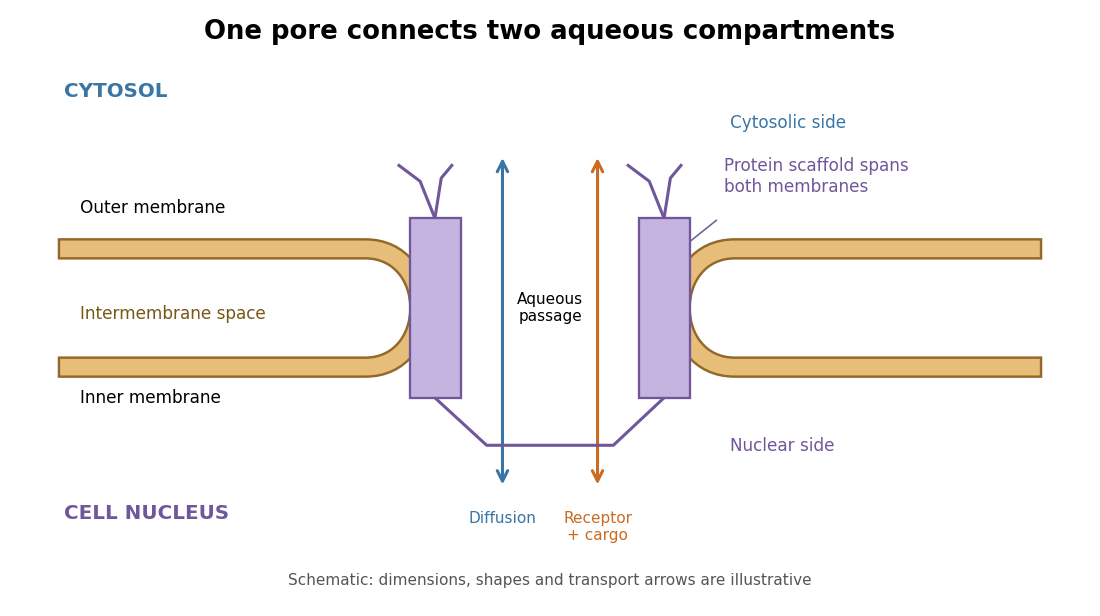
The nuclear pore complex occupies a junction of both nuclear envelope membranes. Its protein scaffold surrounds an aqueous passage connecting cytosol to the cell nucleus, rather than the intermembrane space. Diffusion permits small soluble cargo to pass; selective receptors transport other cargo. Molecular mass alone is not a universal cutoff.[ref]
Figure 1.
The nuclear pore complex bridges both membranes of the nuclear envelope
. Original topology schematic, not a measured structure. The central passage connects cytosol and cell nucleus; cargo does not enter the intermembrane space. Shapes, distances and arrows are illustrative. Details.
OPA1 2026-10-20
An inner-mitochondrial-membrane-associated regulator contributing to inner-membrane fusion and organization.
The outer mitochondrial membrane separates the surrounding cytosol from the intermembrane space. Channels permit passage of many small molecules, while the inner mitochondrial membrane supplies the main selective barrier between them and the mitochondrial matrix.[ref]
Small-solute access does not imply unrestricted access for proteins. The cytochrome c addition in the isolated mitochondria respiration experiment tests a consequence of damage to this boundary. Organelle protein import describes purposeful delivery across mitochondrial boundaries.
Oxidative phosphorylation Created 2026-10-14 Updated 2026-10-20
Oxidative phosphorylation couples respiratory redox conversion to ATP formation through chemiosmosis. ATP synthase uses inward proton flow to join ADP and inorganic phosphate.[ref]
The intermediate electrochemical gradient explains why respiratory uncoupling can preserve oxygen consumption while reducing ATP formation. An electron ledger alone cannot determine the recovery of useful free energy.
PAR-3 2026-10-20
A polarity scaffold associated with epithelial junction organization. Its fly counterpart is Bazooka.
Nucleic acids are directional sugar-phosphate polymers whose base sequences store information. Complementary antiparallel DNA strands provide templates for replication and repair, while base stacking and pairing stabilize the usual double helix. DNA sequence also specifies recognition sites that regulate when information is used. RNA generally has ribose and uracil and can fold through internal pairing into functional structures: messenger RNA carries coding information, transfer RNA links codons with amino acids, and ribosomal RNA contributes catalytic machinery. Not all RNA is a passive messenger.
Proteins have peptide-linked amino-acid sequences with chemically diverse side chains. Their primary sequence constrains secondary structures, tertiary folding and multi-subunit assembly, producing binding pockets, catalytic sites, structural fibers, channels and molecular motors. Function depends on conformational dynamics, chemical context and interactions; a linear sequence is not itself a complete account of an active structure. Folding errors and modifications illustrate the need to connect multiple organizational levels.
The central dogma concerns directional transfer of sequence information. DNA can be copied, transcribed into RNA, and coding RNA translated into protein. Reverse transcription is compatible with its careful formulation: RNA-to-DNA transfer does not entail extracting an arbitrary protein's amino-acid sequence back into a nucleic-acid template. RNA replication also occurs. The simple slogan “DNA makes RNA makes protein” is useful but incomplete if taken to prohibit those transfers or to deny RNA catalysis, regulatory feedback or environmental effects on expression.
Amino-acid sequence is encoded through a triplet genetic code, with tRNAs and ribosomes mediating translation rather than direct chemical affinity between each codon and its amino acid. Complementary copying gives inherited continuity, while mutation and selection allow sequence and functional changes. Thus molecular structure supports both stable heredity and adaptable biochemical machinery without making every cellular process a one-way causal chain.[ref]
The chemical mismatch types are A–C and G–T, with either strand acting as template. In the fixed ring alignment shown, A–C has no correct hydrogen bonds while G–T retains one. Relative probabilities must specify the template: template A loses two bonds versus A–T, giving ; template G loses two versus G–C, giving ; template C loses three versus C–G, giving ; template T loses one versus T–A, giving . Equal incoming activities and per bond give approximate relative weights respectively.
For roughly equal template frequencies the mean error probability is order , or several million errors across copied base pairs. Restricting the estimate to purine templates instead gives order errors; neither is an accurate replication model. Both greatly exceed the source's order-one surviving mutation input. Polymerase kinetic discrimination, proofreading and mismatch repair suppress errors, and a transient mismatch need not become an inherited mutation. Ring relaxation, stacking, solvent and rare tautomers are missing from this simple hydrogen-bond calculation. Real G–T wobble geometry can form additional bonds. The source's mutation rate is illustrative, not a universal measured human rate.[ref]
DNA is a directional polymer with a sugar-phosphate backbone linked by phosphodiester bonds. Its deoxyribose sugars carry adenine, thymine, guanine or cytosine. In the usual cellular duplex, antiparallel strands form a double helix with complementary A–T and G–C pairing, stabilized by base stacking as well as hydrogen bonding. The sequence can vary without changing the basic backbone, allowing a large information capacity. Complementarity provides a template for copying and repair; the two strands are not merely two redundant lists stored without a copying mechanism. Major and minor grooves permit proteins to recognize sequence-dependent chemical patterns. Eukaryotic chromosomes package DNA around histones, while bacterial chromosomes are usually supercoiled and associated with other proteins; not all cellular DNA is nuclear or linear.
RNA uses ribose with a reactive 2-prime hydroxyl and usually uracil in place of thymine. It is often a single chain, but intramolecular complementary segments form stems, loops and elaborate three-dimensional folds. Messenger RNA conveys coding information to ribosomes; transfer RNA combines an anticodon with an amino-acid attachment site; ribosomal RNA has structural and catalytic roles in translation. Regulatory and catalytic RNAs show why it is inadequate to describe RNA solely as a transient DNA copy. RNA's local pairing and folding let sequence encode both information and molecular machinery. DNA's chemical stability and duplex repair make it especially suitable for long-term inheritance.
Replication is highly faithful but imperfect. Heritable sequence changes, recombination and gene duplication create variation, and selection, Genetic drift and population history determine its spread. Thus the same chemistry explains both continuity of lineages and their divergence; mutation is not directed toward what an organism needs. Conserved genes, homologous sequences and the widely shared genetic code support common ancestry. RNA catalysis makes an early RNA-based stage of evolution a plausible hypothesis, not a direct historical observation or a deduction that all modern RNA preceded DNA in a demonstrated sequence. Structure constrains function and evolutionary possibilities without uniquely determining a species' history.[ref]
An electron-transport chain couples favorable redox transfers to pumping protons outward, producing the voltage and concentration terms of the protonmotive force. The membrane's low proton permeability prevents immediate equilibration. The membrane-embedded part of ATP synthase provides a controlled return pathway: protonation and deprotonation of rotor sites couple proton flow to rotation of the c-ring and central shaft. The soluble catalytic head has sites that change affinity and conformation as this shaft turns. ADP and phosphate bind, ATP forms, and the conformational cycle permits ATP release; the mechanical coupling is essential because ATP synthesis is thermodynamically uphill under cellular concentrations.
If protons traverse the machine per ATP, reversibly available work requires , with extra dissipation and transport costs in a real cell. Ring stoichiometry makes organism dependent, rather than a universal integer inferred from the membrane voltage alone. ATP synthase is reversible: sufficient ATP chemical potential can drive reverse rotation and proton pumping. Uncoupling agents dissipate the gradient without corresponding ATP production, illustrating that respiration alone does not guarantee phosphorylation.[ref]
Perforin 2026-10-20
A cytotoxic-lymphocyte pore-forming protein supporting delivery of granzymes during target-cell killing.
Peroxisome Created 2026-10-20 Updated 2026-10-31
A membrane-bounded organelle with pathways including oxidative metabolism. Many matrix proteins are imported after cytosolic synthesis, including folded substrates.
Peter Walter Created 2026-10-13 Updated 2026-10-24