
Action potential 2026-10-13
An action potential is a brief regenerative excursion of membrane potential, produced by changing electrical resistance and conductance through voltage-gated ion channels. In a typical fast neuronal action potential, sodium entry raises membrane potential, activating further sodium channels. This feedback produces the rapid rising phase. Inactivation of sodium channels and increased conductance to potassium then lower membrane potential again; persisting potassium conductance can produce an undershoot below the resting level. See Purves and colleagues: the ionic basis of action potentials.
For an illustrative electrical calculation, write inward sodium electric current as . At , taking and gives inward. A potassium current with and gives , outward. These illustrative values expose opposing driving forces; a waveform requires the conductances to evolve with membrane potential and time, as in the Hodgkin-Huxley model.
An action potential propagates along an axon because local electric currents bring neighboring regions of cell membrane into the regime where their voltage-gated ion channels regenerate the signal. It is a traveling pattern of excitation, not a packet of sodium ions traversing the entire axon. Regeneration allows an action potential to travel without the passive attenuation of a small local voltage change. See Ion Channels and the Electrical Properties of Membranes.
The neuronal refractory period constrains how soon another action potential can follow. Under comparable conditions, successive action potentials have roughly stereotyped shapes, making event count and timing useful for neural coding; waveform details can nevertheless change with channel state and conditions. The leaky integrate-and-fire model abstracts each action potential to a threshold event and reset. Its reset jump is a mathematical rule, not the actual regenerative waveform produced by sodium and potassium currents.
Ion channel 2026-10-13
An ion channel is a membrane protein that provides a selective pathway for ions across a cell membrane. An open pore permits passive transport down the relevant electrochemical gradient; it does not supply the free energy for uphill transport as a pump involved in active transport does. Two things are needed for a net electric current: an available pathway and an electrochemical potential difference. Opening a pore alone need not produce a net electric current. See Ion Channels and the Electrical Properties of Membranes.
The selective permeability of an ion channel depends on interactions between its pore and the passing ions, not simply on a hole's diameter. Some ion channels strongly favor potassium over sodium; others admit several kinds of positively charged ions. Thus selective does not necessarily mean exclusive to one ion species. See Purves et al., Neuroscience, 2nd edition (2001): molecular structure of ion channels and the mixed-channel example in Purves et al.: principles derived from studies of the neuromuscular junction.
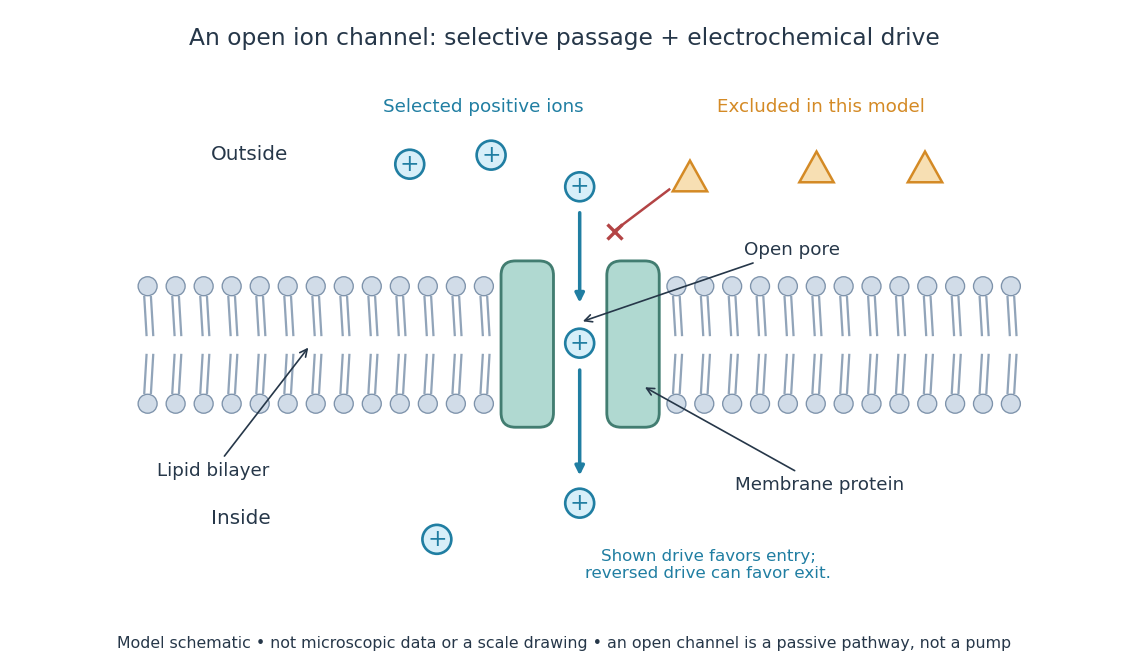
An open ion channel supplies a selective passive pathway
. Original model schematic: selected positive ions can traverse a pore in a membrane protein, while the differently shaped particles are excluded from this modeled pore. The arrow shows one possible net direction when the corresponding electrochemical gradient favors entry; the pore does not enforce that direction. Shapes, particle counts and dimensions are illustrative, not physical microscopic data or a universal selectivity rule. Details.
Gating is the opening and closing of an ion channel's pathway. A voltage-gated ion channel responds to membrane potential; an ionotropic receptor can respond to a bound ligand. Gating changes the available electrical conductance, while the electrochemical gradient supplies the drive for passive transport. For a fixed reversal potential in the simple model below, opening more identical ion channels increases the magnitude of the electric current at a fixed nonzero drive, without choosing its sign independently of membrane potential. The two-state ion-channel gating model describes how the open fraction can change. See the Alberts reference above.
For a worked approximation, hold an open population's electrical conductance at and its reversal potential at . Use for membrane potential and inward-positive conventional current:At , respectively, the electric currents are , since . Positive electric current means net positive electric charge entering, or net negative electric charge leaving; it does not mean that every ion moves inward. For a pore passing only positive ions, the three results mean net inward passage, no net passage, and net outward passage. These stipulated values describe an illustrative Ohmic approximation, not measured properties of a particular ion channel; see reversal potential for the current plot and limitations.
The useful connection is between a molecular gate and a controllable electric current. A ligand can change electrical conductance through an ionotropic receptor, or membrane potential can change it through a voltage-gated ion channel, connecting recognition and electrical signaling. In a historical landmark, Erwin Neher and Bert Sakmann reported currents from individual ion channels in frog muscle membranes in 1976. See Neher and Sakmann, Single-channel currents recorded from membrane of denervated frog muscle fibres, Nature 260, 799–802 (1976).
Ionotropic receptor 2026-10-13
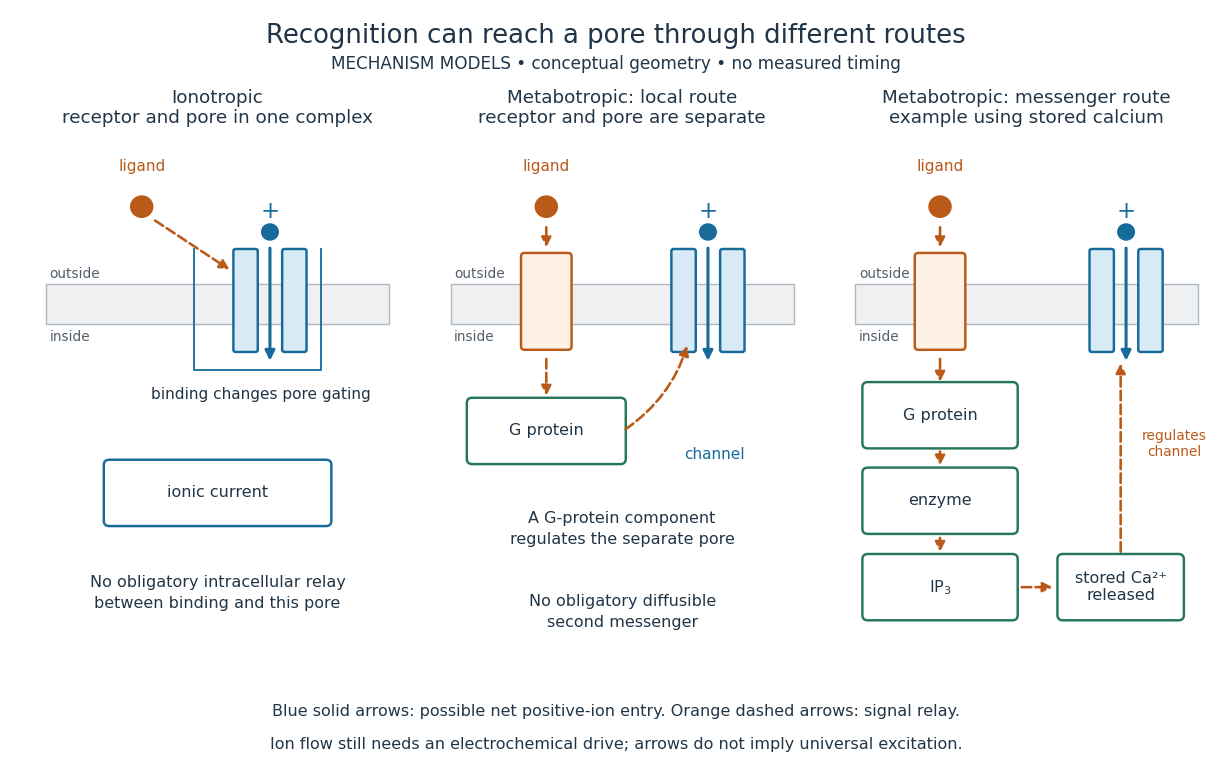
An ionotropic receptor is a receptor in which binding of a ligand directly gates an ion channel within the same protein complex. The binding site detects the chemical signal; the pore supplies a path across the cell membrane. At a chemical synapse, a neurotransmitter therefore changes synaptic conductance without an obligatory intervening G protein or second messenger. [ref]
A familiar example is the nicotinic acetylcholine receptor of skeletal muscle: acetylcholine binding opens a pore passing cations, including sodium and potassium. The muscarinic acetylcholine receptor instead uses intracellular signal transduction; the same neurotransmitter can engage different mechanisms. Direct gating does not mean that an ionotropic receptor pumps ions: electrochemical gradients drive passage through the open ion channel. Nor does “ionotropic” specify excitation. The reversal potential, initial membrane potential and other conductances determine whether the effect favors an action potential, causes hyperpolarization, or supplies shunting inhibition. [ref]
A concrete electrical approximation separates opening from drive. Let identical ion channels each have open-channel electrical conductance and opening probability . At fixed membrane potential , with common reversal potential , the expected value of inward-positive electric current isFor stipulated values , , , and , the mean open count is , the population electrical conductance is and . One open ion channel carries . These are illustrative values, not measurements. At , the net electric current vanishes despite open ion channels; neither binding nor opening alone determines the readout. The approximation omits changes in ion concentrations and voltage-dependent open-channel electrical conductance.

A motivating experiment made the elementary electrical events visible. As Bert Sakmann recounts, chronically denervated frog muscle fibers had acetylcholine-sensitive receptors spread beyond the original nerve contact. Mild enzyme treatment exposed the cell membrane; a polished glass pipette sealed over a small patch to reduce background noise. Two intracellular electrodes held the local membrane potential through voltage clamp, while the patch pipette recorded tiny electric currents. Applying suberyldicholine, a ligand that activates the acetylcholine receptor and prolongs openings, revealed abrupt, approximately rectangular current events. Their amplitudes agreed reasonably with estimates from whole-membrane current fluctuations. This established discrete opening and closing events; it did not make every ligand response instantaneous. Background noise and finite recording bandwidth concealed sufficiently small or brief events.[ref]
Recording an intact membrane patch alone does not exclude intracellular relays. Tank, Huganir, Greengard and Webb supplied a complementary isolation test in 1983: they purified nicotinic acetylcholine receptors from an electric ray's electric organ, incorporated them into artificial lipid membranes, and fused small vesicles into larger vesicles by freezing and thawing. Sealed glass-pipette recordings from isolated membrane patches resolved functional ion channels with properties resembling those in muscle. Removing the intact cytoplasm and its signaling machinery supports the sufficiency of the receptor complex for channel function; an artificial lipid environment still cannot reproduce every native regulatory interaction.[ref]
Direct gating supports millisecond communication at many chemical synapses. Response duration also depends on neurotransmitter clearance, binding and channel-state transitions. Continued ligand exposure can prolong activity. Classify an ionotropic receptor by its direct connection between recognition and pore gating, rather than a universal duration cutoff. [ref]
Synapse 2026-10-13
A synapse is a signaling junction between a neuron and another biological cell. The sending side is presynaptic and the receiving side postsynaptic. At a chemical synapse, released neurotransmitter acts on a receptor in the receiving cell membrane. At an electrical synapse, gap junctions provide a direct path for electric current between cells. See 1.1 Elements of Neuronal Systems.
In a common sequence at a chemical synapse, an arriving action potential opens voltage-gated ion channels selective for calcium. Calcium entry triggers fusion of synaptic vesicles with the presynaptic cell membrane, releasing neurotransmitter into the synaptic cleft. Binding to a receptor changes postsynaptic electrical resistance and conductance, directly through an ion channel or through an intracellular signaling pathway. The resulting change in membrane potential is a synaptic potential. See Ion Channels and the Electrical Properties of Membranes.
A useful conductance approximation writes the inward-positive synaptic electric current aswhere describes the activated electrical resistance and conductance, is the postsynaptic membrane potential, and is the reversal potential, the voltage at which this current vanishes. Opening these channels tends to pull toward ; it does not prescribe a current of fixed sign independently of .
For a worked example, let and . A reversal potential of gives , an inward electric current that raises membrane potential. A reversal potential of instead gives , which lowers membrane potential. These are illustrative calculations, not measurements. A reversal potential of can raise from yet oppose reaching a threshold of : a depolarizing input need not be excitatory.
An excitatory synapse favors a subsequent action potential, whereas an inhibitory synapse opposes it. The effect depends on the receptor, the permeating ions, their gradients and the reversal potential; a neurotransmitter does not have one fixed excitatory or inhibitory sign in every context. Even with , an added conductance can reduce responses to other inputs by lowering effective electrical resistance, an effect called shunting inhibition. See Purves and colleagues: excitatory and inhibitory postsynaptic potentials. This dependence matters when translating a biological synapse into a signed weight or an imposed electric current in computational neuroscience.