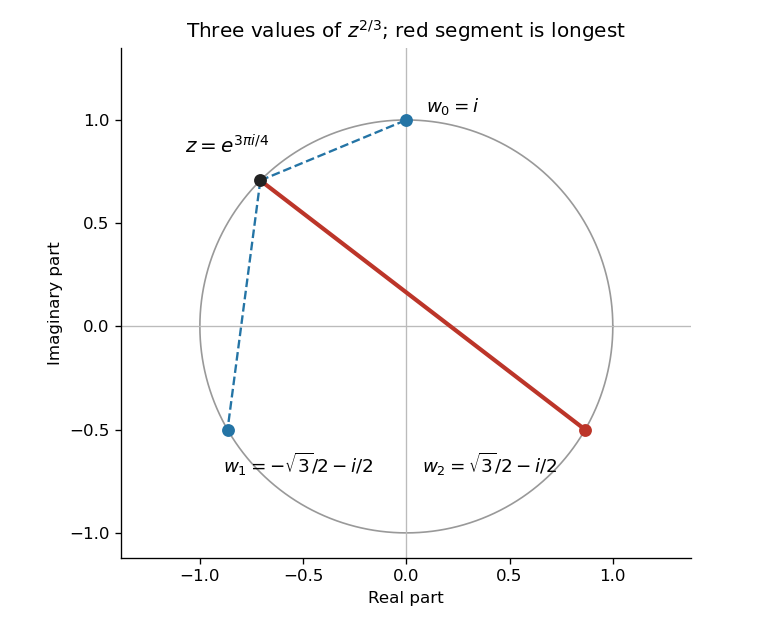
The polar form is . Interpreting the fractional complex exponentiation as all its values, a candidate satisfies . The three roots of a complex number areThey have arguments , and , respectively. Since all have modulus one, their squared distances from in the complex plane are , givingThe last is strictly largest, so the required root of a complex number isRestricting complex exponentiation to its principal value would give only ; the request to choose among roots requires all three values.

Multiply numerator and denominator by the denominator's complex conjugate:Thus the real part and imaginary part are
Using Euler's formula, the difference of the two complex exponentials is . HenceThese are the real part and imaginary part, respectively.
The normal vectors are and . Their dot product is , and their norms are and . The usual angle between two planes is the smaller, unoriented angle, soFor the particular signed normal vectors printed above, the angle is the supplement . Reversing either normal vector exchanges these two angles without changing either plane.
A parallel plane has the same normal vector, so write . Substitution of the given point gives . ThusA displacement between the two planes has a component of magnitude along their common unit vector normal. The distance between parallel planes is consequently
The parallelepiped volume is the absolute value of the scalar triple product of its edge vectors, equivalently the absolute determinant of the matrix with those columns. Expansion along the first row givesTherefore
Multiplying a three-dimensional matrix by a real multiplies its determinant by , whereas multiplicativity of the determinant gives . Therefore equality of the two parallelepiped volumes meansBoth real signs are allowed:A negative value reverses the oriented volume while preserving the ordinary volume. If a positive scale factor is intended, select the positive sign.
The characteristic polynomial isThus the eigenvalues are and . There is no real diagonalization, because a real diagonal matrix would have real eigenvalues. Over the complex numbers, the two distinct eigenvalues give linearly independent eigenvectors, so the matrix is diagonalizable.
For , the first row gives . Choose , giving . Its standard complex norm is ; the conjugate eigenvector belongs to . Hence normalized eigenvectors and a suitable change of basis areDirectly, and , soNormalization does not assert that these eigenvectors are orthogonal.
An invertible matrix is a square matrix admitting a matrix inverse with , where is the identity matrix. Equivalently, its associated linear map is bijective.
Let with eigenvector . The eigenvalue cannot be zero: otherwise applying gives . Apply to the eigenvector equation:Thus is an eigenvalue of with the same eigenvector.
An exact differential is for a scalar potential function , so and . Equality is necessary, and is sufficient on a simply connected space when these partial derivatives are continuous.
Here, after multiplying the ordinary differential equation by ,On either half-plane or , integrate with respect to :Comparison of with gives , hence up to a constant. The solution is therefore the family of level setsLocally these define differentiable graphs wherever , by the implicit function theorem. When , on this domain, so a finite derivative cannot satisfy there; such points are vertical tangents of the implicit curves, rather than additional classical graph solutions.
Differentiation satisfies for constant scalars , so it is a linear map on suitable vector spaces of differentiable functions. An arbitrary set need not even be a vector space, and an endomorphism interpretation also requires .
For a noninvertible example, take . Then and the kernel of a linear map is the nonzero linear span of , so is not injective. The matrix in this basis is .
For an invertible example, take . In this basis, has matrix , andThus differentiation is not always invertible; the domain and codomain determine the answer.
For an invertible matrix whose columns give the new basis in old coordinates, the new matrix is . Multiplicativity of the determinant givessince .
To justify the cyclic property of the trace directly, for two square matrices ,Apply it with and :Thus both the determinant and trace are invariant under change of basis.
Write the ordered basis as . Differentiation givesThe corresponding coordinate vectors form the columns of the representing matrix:This is an example of differentiation on an exponential-polynomial space.
Choose , and denote the new ordered basis by . The change of basis matrix, with columns expressed in , isThis nonzero determinant proves that the proposed fourth function completes a basis. Express the derivatives in that basis:Reading off columns therefore gives
Yes. The old matrix is triangular, with determinant zero and trace . The upper-left two-by-two block of the new matrix has determinant zero, so the whole determinant remains zero. Its trace isThusThis verifies both change of basis invariants from part (b).
Use and bilinearity and antisymmetry of the cross product:Consequently,If are linearly independent, this linear span is the plane through the origin with normal vector . If they are dependent, all three nonzero vectors lie on one line through the origin, and their linear span has dimension one. For example, and obey the hypothesis but span only a line. Nonzero vectors alone do not force a two-dimensional linear span.
Label opposite , opposite , opposite and opposite . Since the tetrahedron is nondegenerate, its scalar triple product is nonzero. Put to handle either orientation of a vector space. Then the required outward vectors areEach cross product has magnitude twice the area of its triangular face. The signs are fixed geometrically: , so points away from the opposite vertex; the same test with and handles and . For the remaining face, the displacement toward its opposite vertex is , and , again outward.
Expand the first cross product:ThereforeThis is closure of outward face area vectors, with every face area multiplied by the same factor two. Omitting would orient all four faces inward when .
Expand the dot product and cross product in Cartesian components:The two expressions are the same scalar triple product, or determinant with columns :The equality also holds when this determinant is zero.
Write . The displayed definitions require , equivalently linear independence of the original vectors. The vector triple product identity givesHere the first scalar triple product is by cyclic permutation, and the second is zero because a cross product is orthogonal to both its factors. ThusThis is the reciprocal basis involution identity. When , the proposed reciprocal basis is undefined; for example, three vectors in the plane cannot be inserted into the printed quotients.
For a genuinely second-order linear ordinary differential equation, assume . Substituting the exponential function into the homogeneous linear differential equation gives . Oscillations arise precisely when its two roots of a polynomial have nonzero imaginary parts, namelyIn that case, writing , the real complementary function isEvery nonzero such solution has an oscillatory factor; the oscillation may decay, grow, or keep constant amplitude according to the sign of . This is the oscillatory-root criterion for a real second-order equation; decay is not a prerequisite for oscillation.
For completeness, if and , only real exponential functions occur. If and , only is allowed. If all three coefficients vanish, every twice-differentiable function is allowed, including oscillatory ones; the second-order criterion does not apply to this degenerate identity.
Use the method of undetermined coefficients with the polynomial . Substitution into givesMatching successive coefficients with the forcing gives , , and . Hence a particular integral isIndeed and give . The complementary function, if wanted, is .
The differential operator is , with . Because already occurs in the complementary function with a repeated root of a polynomial, an unmodified trial gives zero. Put . The product rule yieldsThus , and we may choose , givingThe other terms arising on twice integrating give , exactly the complementary function, so they need not be included in the particular integral.
The homogeneous linear differential equation has roots , so its complementary function decays:For a particular integral, set . Substitution givesThe two coefficient equations are and , so and . Consequently every solution obeysThe limiting behaviour is a periodic steady oscillation with amplitude , the long-time response of a forced harmonic oscillator. Unless , there is no finite numerical limit: at and , the two limiting values are and . For , .
On an interval with , this is a homogeneous first-order differential equation. Put , so . Substitution and division by giveThe constant choices and give and . Otherwise the separable differential equation givesAbsorbing the sign and the exponential integration constant yields . Relabelling the arbitrary constant then givesThe first family already includes at . Choose any interval where its denominator is nonzero. These give all solutions on intervals avoiding . Both families extend through with , as required by the original ordinary differential equation. Because it is singular there, differentiable continuations of the nonzero family may use different on the two sides: both one-sided derivatives at zero equal .
For real solutions work on . Dividing by puts the linear ordinary differential equation into the formIts integrating factor isThe product rule therefore givesTwice using integration by parts, or differentiating the proposed antiderivative, gives . HenceThe endpoint is singular. A finite continuous extension would require , but then, with , . Its derivative diverges, so even this choice has no differentiable extension to that endpoint.
The zero function is a solution on any interval avoiding . For a nonzero solution, the Bernoulli differential equation substitution gives andAn integrating factor is on either side of zero. ThusThe full solution set isUse connected intervals with and, in the nonzero family, . The separate zero solution would be lost by dividing by .
Articles by others on the same topic
There are currently no matching articles.