Choose a positive common denominator so that and with nonzero integers . Put . Every element of the generated subgroup has the form , so it lies in . Conversely, Bezout identity gives integers with , so belongs to the generated subgroup. ConsequentlyThis map is a bijective additive group homomorphism. It is the two-generator instance of a finitely generated subgroup of the rational additive group being an infinite cyclic group.
For the real example, take and . The group homomorphism from onto the generated subgroup is injective because is an irrational number. Thus this subgroup is isomorphic to . More directly, if a single real number generated it, then and for integers , giving , a contradiction. The choice generates a noncyclic additive subgroup.
For a finite group, the conjugacy classes partition the group, and a class is a singleton exactly when its element belongs to the centre of a group. Since the centre is trivial, the class equation becomeswhere the are all the nonidentity conjugacy classes. If the prime number divided every , reduction modulo would give , because . Therefore at least one of these class sizes is not divisible by . Primality now givesIts size is greater than one because the centre is trivial. This proves the prime-to-p conjugacy class lemma.
The conclusion requires to be prime. The printed question does not explicitly impose this hypothesis. If arbitrary composite divisors are allowed, take the symmetric group and : its centre is trivial, its two nonidentity conjugacy classes have sizes and , and neither is coprime to . Thus the argument proves the intended prime case and also identifies why the unrestricted literal reading is false.
Away from the origin, differentiate using Einstein notation:HenceThis gradient is the radial unit vector. Division by is legitimate on the punctured domain; the distance function is not differentiable at the origin.
Apply the product rule and the preceding gradient formula to the vector field . Summing over the repeated index givesHere for the Kronecker delta. Thus the divergence and curl of a radial vector field give, in any dimension,
In three dimensions the curl can be written with the Levi-Civita symbol:Both terms contract an antisymmetric array with a symmetric one, and therefore vanish. Every differentiable radial field of this form has zero curl away from the origin. This is the three-dimensional part of the divergence and curl of a radial vector field.
The divergence formula reduces the problem to the ordinary differential equation on . Multiplication by makes it an exact derivative:Since the interval is connected, is a single constant . Conversely, substituting into the divergence formula gives zero. ThusThis proves both existence and uniqueness up to the constant within the specified radial class. For , the two punctured half-lines still share this same constant because the stipulated coefficient is one function of .
Parametrize the smooth path by . The chain rule turns the line integral of the gradient into a one-variable derivative:This is the fundamental theorem for line integrals; in particular the integral has path independence.
For a twice continuously differentiable potential of a conservative vector field, the curl of its gradient vanishes because mixed partial derivatives commute:A smooth gradient field is necessarily curl-free.
A sufficient condition is that be an open simply connected domain, with continuously differentiable. Under this condition a curl-free vector field has a global potential of a conservative vector field and hence path independence by the fundamental theorem for line integrals. One way to see the global step is to deform the closed loop formed by two paths into a point inside : the integral is unchanged during the deformation because the curl is zero, as expressed by Stokes theorem. Therefore simple connectivity is a sufficient domain hypothesis. It is not a claim that every particular curl-free field needs such a domain; a given field can have a global potential on a domain with holes.
Use for . On this path , so its line integral isThe first two components of the curl vanish because the field is independent of and has zero third component. Writing , its third curl component isThus this azimuthal inverse-radius vector field is a curl-free vector field on , but its line integral is not path independent. This domain is not simply connected: the circle links the removed axis. A spanning disk through the axis is inadmissible for Stokes theorem, since the vector field is undefined there. Zero curl alone does not force global path independence.
Conjugation in the symmetric group sends to . Hence commutes with exactly when it preserves the unordered pair . It can independently swap that pair and arbitrarily permute the remaining points. Therefore the centraliser of a transposition isLet . The orbits of a group action generated by are its two-point blocks. Any centraliser element must permute those blocks, and can choose independently whether to swap the two points in each image block. Conversely every such choice commutes with , since it preserves the partner relation. This centraliser of a fixed-point-free involution is the permutation wreath product , with
Place the cube at the origin with face normals , and label opposite faces by . Every cube symmetry is a signed permutation matrix: there are choices. Its group action on faces is faithful because fixing all faces fixes all their normal directions. Central inversion exchanges every opposite pair and therefore acts as . Since commutes with every linear cube symmetry, the face-action image lies in . The preceding count gives , so the faithful face action is onto this centraliser:For the remaining isomorphism, let be the rotational symmetry group of a cube. Half the signed permutation matrices have determinant , so . Central inversion has determinant , and every orientation-reversing symmetry is for a unique . Since is central and , multiplication gives a direct product of groups:The group action of on the four body diagonals is faithful. To prove this, choose direction vectors . They span , and their only linear relation is that their sum is zero. A rotation fixing all four diagonal lines sends each listed vector to itself or its negative. Applying the relation forces all four signs to agree. The all-negative choice is , which is not in , so the rotation is the identity. Thus embeds in ; both have order , giving . Finally from part (i). ConsequentlyThe direct-product decomposition of the cube symmetry group supplies the second isomorphism, while the first comes from the specified face action.
We first prove the needed instance of Cauchy theorem for groups, rather than invoke it. Let a prime number divide and consider the setThere are such tuples: choose the first entries freely, and the last is forced. Cyclic rotation preserves this set, because moving the first entry to the end conjugates the product, which remains . Each rotation orbit of a group action has either one or elements. Indeed a nontrivial shift fixing a tuple generates all shifts, since its step has an inverse modulo the prime . The fixed tuples are precisely with .
Counting nonfixed orbits in multiples of , and using , shows that the number of solutions of is divisible by . The identity supplies one solution, so there is a nonidentity solution. If its order of a group element is , divide by : the remainder would give a smaller positive exponent producing the identity, so . Hence . This proves the required prime-order existence result by the cyclic-tuple proof of Cauchy theorem.
Our hypothesis says that this nonidentity element has order , so . Every prime divisor of is therefore , which givesThus a finite group of prime exponent has prime-power order. The case includes the trivial group. No group-theoretic counting theorem was assumed in the tuple argument.
If a nonidentity power belongs to , reduce modulo so that . There is an integer with , and therefore , a contradiction. ThusNow suppose that is abelian and finite. Start with , and whenever , choose . The multiplication mapis a group homomorphism because all elements commute. It is surjective by construction and injective because the intersection of its two factors is trivial: implies lies in that intersection. Hence , and its order is times the previous order. Strict growth and finiteness ensure that the construction ends at . Thereforewhere is the number of factors, possibly zero. This is an elementary abelian group, obtained by an explicit direct product of groups construction.
Write a matrix in the upper unitriangular group as . Here , and its only potentially nonzero entry in is . The binomial theorem therefore gives the unitriangular matrix power formulaFor an odd prime number , both and vanish in the finite field . Thus . A nonidentity has order dividing the prime (by the same exponent-division argument as in part (i)), and so has order exactly .
For , take and . Then , while . This element has order , not . Hence every nonidentity element has order exactly for odd . The counterexample at accounts for the quadratic term in the matrix power formula.
Identify the projective line with one-dimensional subspaces of : use for finite , and . This convention turns the matrix action into the stipulated Möbius transformation.
Since and are distinct projective points, are a basis. Write . Both and are nonzero, because is different from . The matrix with columns and is invertible and sends the lines of to those of , respectively. This constructs the requested map without separate exceptional formulas at infinity.
A matrix fixing and is diagonal, say with . To fix it must also satisfy , so the stabilizer subgroup of is precisely . Any two solutions differ on the right by one of these matrices. ThusEquivalently, after dividing out scalar matrices the projective general linear group action on the projective line is sharply three-transitive on a projective line.
The Möbius transformations are bijections, so they preserve which coordinates of a triple are equal. Conversely, part (i) implies transitivity within each equality pattern. For a pattern with fewer than three distinct entries, extend the chosen distinct points to a triple before applying part (i); this works also for , when the projective line has exactly three points. There are therefore five orbits of a group action.
We first count . Its first column can be any nonzero vector, giving choices. The second must be outside the first column's one-dimensional span, giving choices. HenceFor the all-equal pattern take . Its stabilizer subgroup consists of upper triangular matricesof order . Its group orbit has order .
The three exactly-two-equal patterns have representatives , and . Each stabilizer subgroup fixes and individually, so it is the diagonal subgroup of order . Each group orbit has order ; their repeated-coordinate positions keep these three orbits distinct.
For the all-distinct pattern use . Its stabilizer subgroup is the scalar subgroup of order , and the group orbit has order . Stabilizers of arbitrary triples are conjugates of the displayed representative stabilizers. In summary the equality-pattern orbits of projective triples haveThe sizes add to , and each orbit size times its stabilizer order is , as in the orbit-stabilizer theorem.
A subgroup is a normal subgroup of if for every . Define multiplication on its left cosets byTo check that this is well-defined, replace by with . Thenbecause normality gives . Thus the product depends only on the two cosets. Associativity follows from that of , the identity is , and the inverse of is . These are all the group axioms, so is a group under coset multiplication. The natural projection is a surjective group homomorphism with kernel .
Take and . Both are nontrivial, and is normal because is abelian. The second-coordinate projection identifies the quotient group with . Swapping the two coordinates identifies with , soThis is a direct product of groups with its first factor as the specified normal subgroup.
Use additive notation and take , . Its quotient group is . A group homomorphism from sends its generator to an element annihilated by , so the image must be either or . Both project to the identity coset , and neither can project to the nonidentity generator of . Therefore this quotient projection has no homomorphic section. It is a nonsplit group extension, despite both and being nontrivial finite groups.
Take and its normal subgroup , where . Normality follows either from the sign of a permutation or directly from conjugation sending to or . The quotient group has order two, and provides a section because and is its nonidentity coset.
However, the map from the direct product of groups is not a group homomorphism. In its domain commutes with , whereas their images and do not commute: . This is a split group extension giving a genuine semidirect product instead of a direct product. The pair supplies the required split but non-direct example.
For the general bijectivity assertion, let be the quotient projection and assume is the identity. Given , put and . Then , so and . This proves surjectivity of . If , applying gives , after which cancellation gives . ThusThis section normal form for a split group extension does not require finiteness. The obstruction to its being a homomorphism is the nontrivial conjugation action of the section on .
Away from the vertex, use the defining function . Its gradient is normal to the smooth part of the double circular cone, andon the surface. Hence the field is tangent at every regular point of the cone. At the origin the cone has no unique tangent plane, but , which belongs to its tangent cone. An equivalent argument, valid also at the vertex, uses the integral curves of a vector field: has solution , and these dilations preserve . This is an example of radial dilation tangency to homogeneous zero sets.
At every regular point of the double circular cone, its normal is perpendicular to by part (a). Therefore the integrand of the flux integral vanishes pointwise:The vertex, if included, is a single point of zero surface area and does not alter the surface integral. The answer is independent of both the subset and its orientation. Tangency, rather than a cancellation between different parts of the surface, explains the zero flux.
In cylindrical coordinates , the bounded solid enclosed by the two conical sheets and the circular cylinder isIts meridional section consists of two triangular regions; revolving them about the -axis gives the solid. The two conical sheets meet at the origin and meet the circular cylinder in its circles at .
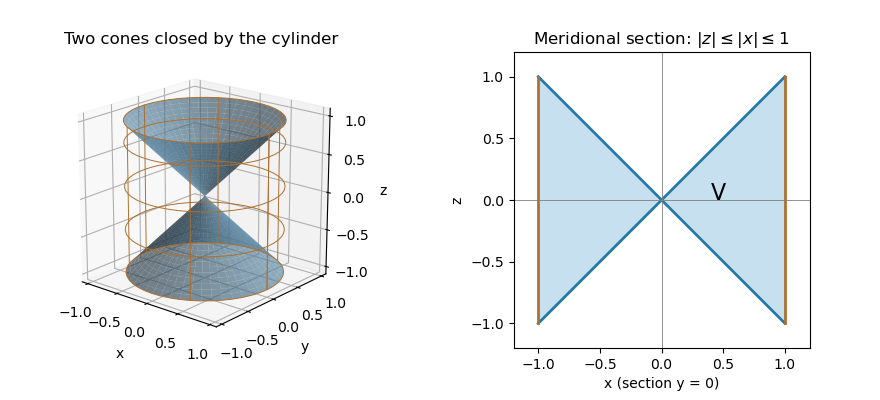
Since , its divergence is . Integrate directly with the cylindrical coordinates volume element :The same calculation gives .
Close the truncated two-sheet double circular cone by the lateral circular cylinder , . Together these form the boundary of the solid in part (c); no planar caps are required because the cone meets the circular cylinder along both end circles. On the circular cylinder the outward unit normal is , so , and . Its flux integral isThe divergence theorem now gives , using the volume integral from part (c). Henceagreeing with tangency. The isolated vertex can be handled by excising a ball of radius and passing to the limit: since there and the added area is , its extra flux is and tends to zero.
For an oriented piecewise smooth surface and a continuously differentiable vector field on a neighborhood of it, Stokes theorem statesThe oriented surface element and boundary direction must agree by the right-hand rule. Every boundary component is included; for an upward-oriented graph over an annulus the outer boundary is anticlockwise and the inner boundary clockwise when viewed from above.
Use the positive graph . The printed PDF bounds are , so its projection is the annulus . The surface is the corresponding band of the upper sheet of a two-sheeted hyperboloid, bounded by circles of radii and at heights and .

The upper hyperboloid band between heights square root of two and square root of five, with annular projection
. For the parametrization , its tangent vectors are and . Their cross product gives the upward vector surface element of a graph:Its magnitude gives the scalar surface area of a graph:Both formulas apply on . Reversing the orientation changes only the sign of the vector element.
Direct use of partial derivatives givesWith the upward oriented surface element found in part (b), the curl flux integrand over the annulus becomesEvery term in the numerator is odd in or , so its integral over the symmetric annulus is zero. Thus the surface integral isEach boundary circle has constant , hence . Its line integral is therefore , with no contribution from the third field component. An anticlockwise radius- circle gives . The outward boundary orientation is anticlockwise at and clockwise at , soThe two computed values agree, verifying Stokes theorem with both boundary components. A downward choice would give on both sides.
For , the definition of the Laplacian gives . Integrating over and applying the divergence theorem yieldsThis is the flux form of Poisson equation, for an outward-oriented piecewise smooth boundary and the usual smoothness of on a neighborhood of the volume. In particular, a singularity cannot be ignored when applying this identity.
On the outward-oriented sphere of radius , , so . HenceAway from the origin, the divergence and curl of a radial vector field with giveIf the enclosed volume excludes the origin and its boundary avoids it, this field is smooth throughout the volume. The divergence theorem then gives . The nonzero sphere flux is compatible with zero divergence away from the origin because the enclosed singularity prevents applying that smooth-volume theorem directly to the full ball.
The electric field of this point charge is a translated and scaled version of the radial field in part (ii). If and , its divergence vanishes throughout , so the divergence theorem gives zero flux integral.
If lies inside , remove a small ball centered at . On the remaining volume the divergence is zero. Its boundary is together with the small sphere, whose outward normal for the punctured volume points towards . That inner sphere contributes , by the sphere flux computed in part (ii). Thus the exterior flux must be :This is Gauss's law for a point charge. The assumption that the charge is not on the boundary is essential to these alternatives.
Rotational symmetry of the vector field means : rotations fixing force the field to be parallel to , and rotations between directions make its magnitude depend only on . Its flux integral over the radius- sphere is . Applying the flux identity from part (i) to the ball, with the spherically symmetric source, givesTherefore the origin-regular spherical Poisson flux law isOnly source values at occur. Changing the exterior source can change the scalar potential by an interior constant, but cannot change this radial gradient. Regularity on all of , inherited from the Poisson equation setting, matters: on a punctured domain alone an additional would have zero divergence away from the origin and would not be fixed by the local source. It is excluded here by the origin regularity needed for the ball flux identity.
DefineThey sum to , with and . Interchanging two slots of a tensor still produces a tensor, so these are a symmetric second-rank tensor and an antisymmetric second-rank tensor, not merely symmetric and antisymmetric arrays in a selected frame.
For uniqueness, if , then . The common difference is both symmetric and antisymmetric, so each of its components equals its own negative and vanishes over . Thus the decomposition is unique. These are the symmetric and antisymmetric parts of a matrix, with their tensor transformation law preserved.
Under a proper rotation matrix , invariance of a Cartesian second-rank tensor reads , equivalently . The half-turn forces all entries mixing the direction with the plane to vanish. Thus consists of a planar block and the entry .
Commutation with the planar quarter-turn gives . This block already commutes with every planar rotation. Now use the half-turn : on the planar block its conjugation fixes and sends to , so invariance forces . ThereforeThe formula uses the Kronecker delta and is sufficient as well as necessary: rotations preserving the unoriented -axis fix both and . This is an axially invariant second-rank tensor with the planar antisymmetric part removed by the horizontal half-turn.
Let be rotation through about , and let be rotation through about . These generate the order-six dihedral group with relationsnamely . We specify its order explicitly because dihedral notation has two conventions. It is a proper finite subgroup of the full axial rotation group.
To see that it is sufficient, write a general matrix in blocks . Commutation with forces , since a nontrivial planar -degree rotation fixes no nonzero planar vector. Its planar part is , with nonzero sine, so must commute with and has the form . Commutation with again kills . Hence this six-element subgroup has precisely the required invariant tensors.
It is also smallest by order. Groups of orders are cyclic: a nonidentity element has order dividing the prime group order by Lagrange theorem. For a cyclic rotation subgroup, the nonzero antisymmetric tensor representing cross product with its rotation-axis direction is invariant, so it cannot force the symmetric form above. The trivial subgroup plainly imposes no constraint. A group of order four is either cyclic or has three nonidentity elements of order two; in the latter case they commute, since and also equals . Commuting distinct half-turns in three dimensions have perpendicular axes: conjugation by one half-turn must preserve the other's axis, and a distinct preserved axis lies in its perpendicular plane. In the specified axial group, their three axes are consequently and two perpendicular horizontal directions. In coordinates along them every diagonal matrix is invariant, including one with unequal horizontal entries. Such a group again does not force the required form.
Thus the smallest subgroup has six elements, generated by the axial -degree rotation and one horizontal half-turn. It is the smallest axial rotation group forcing second-rank transverse isotropy; conjugating the horizontal axis gives equally valid choices.
Split the array in its first two slots:For every symmetric second-rank tensor , antisymmetry gives . Hence the stipulated vector equals .
Let change the orthonormal frame, so . The vector transformation law givesfor every symmetric test . Both coefficient arrays in are symmetric, so equality against every symmetric matrix forces equality of the coefficients; one may test the individual diagonal entries and the symmetric off-diagonal basis matrices. Multiplying by and using orthogonality yieldsThis is exactly the rank-three tensor law. It is the symmetric-test criterion for a third-rank Cartesian tensor, a form of the quotient theorem for Cartesian tensors. Equivalently one may test for arbitrary vectors and apply the quotient theorem twice.
The antisymmetric part need not be a tensor. Its contraction with every symmetric test is zero, so the premise imposes no transformation law on it. This is the blindness of symmetric contraction tests to antisymmetric arrays, now with a third free index.
For a concrete example, prescribe the same numerical array in every orthonormal frame, with onlynonzero, and take . Every contraction vanishes, and the zero result is a genuine vector in every frame. But under the rank-three tensor transformation law would send the component to , whereas our framewise prescription leaves it equal to . Thus the array is not a tensor despite satisfying every stipulated contraction test. An antisymmetric part could be a tensor if an additional transformation law were supplied; it is simply not forced to be one.
Articles by others on the same topic
There are currently no matching articles.