Set . The exponential function identity reduces the problem to the quadratic equationPositivity excludes , so . Since the exponential function is strictly increasing, the unique answer is .
Join the centre of the unit circle to adjacent vertices of the regular polygon. Each of the resulting triangles has two sides of length and included angle . Bisecting one gives a right triangle, so each polygon side, a chord of a circle, has length . Thus the perimeter is .
Adding the vectors component by component givesConsequently . The requirement that the vectors be nonzero then implies .
Since and , the vectors point in opposite directions. More explicitly, their dot product givesHence their angle is .
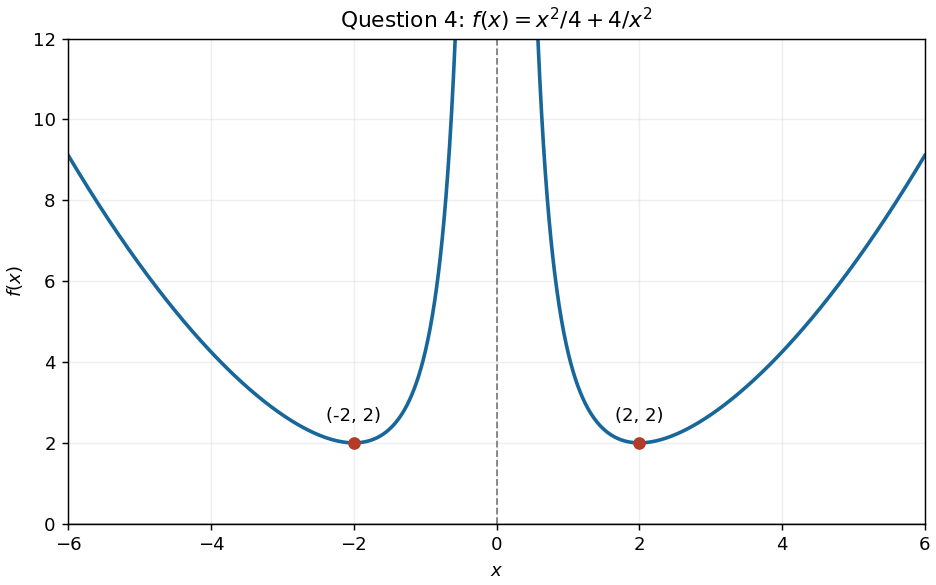
For the requested parameter value , the function graph has two branches, symmetric about the vertical axis because is an even function. Its derivatives areThe stationary points are , both local minima and also the lowest points of their respective branches. The function tends to as , so is a vertical asymptote; it also tends to as . The negative branch decreases to and then rises towards the vertical asymptote; the positive branch falls from the vertical asymptote to and then rises.

The double-angle identity for the cosine gives . Termwise integration therefore givesHere is an arbitrary constant in the antiderivative.
The derivative of the tangent is , and the order of the endpoints must be retained. Thus the definite integral is
Group consecutive terms in pairs. The th pair, for , isThere are such pairs in this finite sum, so the answer is .
This geometric series has first term and common ratio , whose absolute value is below one. Consequently its sum is
Writing turns the first-order linear differential equation into . Its general solution is , so . The initial condition gives , hence
The general solution of the first-order linear differential equation is . The initial condition gives , so the solution of this initial value problem is the constant function . Thus .
For the partial fraction decomposition, multiply by to obtain the polynomial identityComparing the coefficients gives . Substitution of gives , while gives . ThereforeThe original identity holds for ; evaluating the multiplied polynomial identity at those values is valid.
Subtracting the two circle equations cancels the common terms and gives . With , either circle equation gives . Thus the unique common point isThe two circles touch externally there.
The two throws are independent, giving equally likely ordered outcomes in the sample space. A total strictly below occurs only for , and . Hence the probability is
The favourable outcomes are and for . These are ten distinct ordered outcomes among the equally likely elements of the sample space, so the probability is
This is a plane through the origin in three-dimensional Euclidean space, with nonzero normal vector :
For example, chooseBoth vectors satisfy the plane equation. They are linearly independent vectors: in , the second coordinate gives and the third gives .
No. Every vector in the plane can be written asThe two linearly independent vectors in part (ii) therefore form a vector space basis for this vector subspace. Its dimension is , so any three vectors in it have linear dependence.
The dot product with the given unit vector is . Subtracting the corresponding orthogonal projection givesTaking its squared Euclidean norm yields the equivalent Cartesian equation
The removed vector is the orthogonal projection of onto the line through the origin in direction . The remaining vector measures the perpendicular displacement from that line. Fixing its Euclidean norm at therefore describes an infinite circular cylinder of radius , with axis , .
The plane equation has normal vector . Thus its normal vector is parallel to the cylinder's axis and the plane is perpendicular to that axis. It passes through the origin, so the intersection is a circle of radius centred at the origin in that plane.
Indeed, with the orthonormal basis and of the plane, write . The cylinder equation becomes . Equivalently, the intersection has the parametric equation
Use the distance from a point to a plane formula with the unit normal . Since the plane passes through the origin, the distance isFor a direct check, the closest point on a plane is , whose displacement from has Euclidean norm .
Let and . The assumed linear independence gives . Every displacement joining one line to the other isIts dot product with is always . The component in that direction is therefore fixed, so orthogonal decomposition gives .
The two linearly independent vectors span the plane perpendicular to . Suitable cancel the component of in that plane, attaining the lower bound. Thus the distance between skew lines formula, also valid when the lines intersect, gives
The nonzero direction vectors now have linear dependence, so the lines are parallel or coincident. Subtract from its orthogonal projection along ; the remaining component is the shortest joining displacement. The distance between parallel lines isThe second expression follows from the relation between the cross product and the perpendicular component. It includes distance zero for coincident lines.
For the stipulated linearly independent vectors , the denominator in part (i) is nonzero. ThusEquivalently, belongs to the linear span of . Geometrically the lines lie in one plane, and, since their direction vectors are not parallel, they intersect at a unique point. The linear combination expressing gives the two parameters of that intersection.
Use the exponential series to obtain the Maclaurin series of the hyperbolic sine and hyperbolic cosine:Dividing these power series gives the hyperbolic tangent expansionThe displayed remainder uses Big O notation as .
Set . Applying the exponential series and the Maclaurin series of the sine givesMultiply the two power series, retaining every contribution through degree four:Since , the coefficient of is nonzero, so these are indeed the first two nonzero terms. The remainder is in Big O notation.
Write . Direct differentiation, using the chain rule, givesThe stated parameter restrictions ensure that the logarithm is defined near , and that and . With , the Taylor series beginsIf , the constant term is nonzero, and the first two nonzero terms areThis covers both and ; the constant term is respectively positive or negative.
If , which is possible precisely with and , the constant term vanishes. The first two nonzero terms are thenNo further case is needed, since the linear and quadratic coefficients cannot vanish under the given restrictions. All remainders use Big O notation.
Apply integration by parts twice. Taking an antiderivative of to be givesand the second application gives . Therefore the required definite integral is
The factor is an even function and is an odd function, so their product is an odd function. Its definite integral over the symmetric interval vanishes:Indeed the substitution rule changes the integral over into the negative of the integral over .
A partial fraction decomposition givesFor the second term the substitution rule , gives a logarithm. ThusThe constant in the antiderivative may be chosen independently on the two intervals separated by .
Split the integral intoThe first is the standard antiderivative from the inverse hyperbolic functions. For the second, the substitution rule gives . HenceThe logarithm's argument is positive for every real .
Use the tangent half-angle substitution , so and . ThenThe inverse tangent antiderivative givesThis expression applies on each interval for an integer . Although everywhere, the chosen inverse tangent expression jumps at the endpoints because the substitution has a pole there. A global continuous antiderivative is obtained by adding on that interval, using one common , and extending by continuity at the endpoints.
A probability density function must have total integral one. Put . The term is an odd function, soThus .
With , nonnegativity of the probability density function at both and requiresThis is equivalent to . The derivativeshows that this infimum occurs at . Therefore the necessary and sufficient restriction isSufficiency follows from the same decreasing-ratio argument at every interior point. The endpoint values of are allowed: the probability density function merely vanishes at one endpoint.
For , the expected value isbecause is an odd function. Comparing with the specified expected value gives , which lies in the permitted parameter range.
Here , so the probability density function is the even function on , where . Hence by oddness, and the variance is just . Two applications of integration by parts giveThus
Keep general initially, since the final part does not explicitly fix it. For , where , the cumulative distribution function isThe normalization constant in the probability density function of must beEquivalently, the integrated cumulative distribution function on a bounded interval identity gives . If the assumption from part (c) is retained, the requested special case is . For the value in part (b), it is .
Where , the separable differential equation is . Separating and taking antiderivatives gives , for nonzero . Including the zero solution, the explicit general solution ison any interval with . It can also be obtained without dividing by : the product rule gives .
Articles were limited to the first 100 out of 165 total.
Articles by others on the same topic
There are currently no matching articles.