Options I, Honour School of Mathematics Part A, Trinity Term; Wednesday 23 June 2010, 9.30am–12.30pm. The complete ten-page source was supplied through the past-papers disclosure, in original Part A bundle pages 203–212. The private editable transcription retains the cover and all nineteen questions. No exact worked-answer advertisement was found in the bounded availability check.
In characteristic , the binomial theorem gives . HenceIterating shows that all , with , are roots. They are distinct, since the prime-field elements are distinct. There are of them, equal to the polynomial's degree. Thus if ,splits into distinct linear factors in . Equivalently, its derivative is , so no repeated roots are possible.
Interpret the displayed factorization as a proper factorization, with ; that restriction is necessary for the conclusion. In a splitting field, the monic degree- factor has of the distinct roots of the original polynomial. Comparing its coefficient of givesfor an -element subset . Both and the final sum lie in . Since , the element is invertible in , soPart (1) then gives complete splitting into distinct linear factors. Thus an Artin–Schreier polynomial of this form either is irreducible or splits completely; a trivial factorization with or would not imply a root in .
Reduce the monic integer polynomial modulo the prime . For every , , soIf the reduction were reducible, a proper monic factorization would, by part (2), force a root in , a contradiction. Its reduction is therefore irreducible of degree . The monic reduction criterion, obtained from Gauss lemma for polynomials by reducing a hypothetical integer factorization, now proves
Burnside's lemma gives the number of orbits asFor , the polygon symmetry group contains the rotations through angles , , and reflections. Each reflection axis passes through a vertex and the midpoint of the opposite edge. These are all the symmetries, so .
For the pentagon, apply the same group element simultaneously to vertex colours and edge colours. The identity fixes colourings. Each of the four nonidentity rotations is a 5-cycle on vertices and also on edges, fixing colourings. Each of the five reflections has one fixed vertex and two swapped vertex pairs, and one fixed edge and two swapped edge pairs. It therefore fixes colourings. Averaging yieldsThe two colour palettes are chosen independently, but rotations and reflections act on both parts of the same pentagon.
The Legendre symbol is
Write . If , the claimed identity has both sides zero. Otherwise let . Applying the Euler criterion givesBoth sides are in , which are distinct residue classes because is odd. Therefore the modular congruence is an equality:
Again set . The Euler criterion applied to gives , as an equality of signs. If , the exponent is even and the result is ; if , it is odd and the result is . Hence
For every real ,Each set on the right is measurable by hypothesis. Closure of a sigma-algebra under countable unions proves the assertion.
For every real ,Part (1), applied to measurable , makes the set being complemented measurable. Its relative complement in measurable is measurable too. The permitted half-line criterion therefore proves is measurable.
If is measurable, then for a threshold , , while for , . The half-line criterion makes measurable. By part (2), is measurable, and is therefore measurable as well.
Conversely, if and are measurable, part (2) and the permitted closure under sums show that is measurable. Thus measurability is equivalent to measurability of both parts.
The converse is false. Let be a non-Lebesgue-measurable set and define on and on its complement in . Then is measurable, but is not. Taking absolute values can conceal a nonmeasurable sign choice.
Both functions are integrable on . The oscillatory function is measurable and bounded by in absolute value, on an interval of finite measure. For the other function,In particular its singularity at the right endpoint is of integrable inverse-square-root type.
For , , soThus is integrable on this interval. But for , , hence . The integral of diverges at infinity, so is not integrable. Defining changes only a null set and has no effect on this conclusion.
A topology on contains and , is closed under arbitrary unions, and is closed under finite intersections. Its members are the open sets. A subset is closed precisely when its complement in is open.
The subspace topology on isIf is open in , every such intersection is open in . Conversely, every ambient open set contained in equals its intersection with . Thus the relatively open sets are exactly the ambient open subsets contained in .
The closure of is the smallest closed subset of containing it:Equivalently, a point belongs to exactly when every open neighborhood of it meets .
For , suppose with open and closed. Since , also . Therefore , showing that is relatively open in its closure.
For , set and . The assumed condition makes open; is closed and . Thus the three conditions are equivalent. They characterize a locally closed subset.
A space is Hausdorff if any two distinct points have disjoint open neighborhoods: for , there are open and with .
The map is continuous ifThis condition concerns inverse images of open sets; images of open sets need not be open.
Let send a point to its equivalence class. The quotient topology isIt is the finest topology on the quotient making continuous.
For each continuous map to a Hausdorff target, equality of its values is reflexive, symmetric and transitive. The relation requires all these equalities simultaneously. Explicitly, gives reflexivity; implies ; and gives . These arguments apply to every map in the defining family, proving is an equivalence relation.
If and , then , so . Thus contains every equivalence class it meets: it is a saturated subset. Always ; conversely, a point of the latter set is equivalent to some and hence belongs to . Therefore
Take distinct classes . The points are not related by , so by the defining negation there is a Hausdorff space and a continuous map with . Choose disjoint open neighborhoods and of those two values. Their inverse images and are disjoint open subsets of and are saturated by part (ii).
Hence and , making and open in the quotient topology. They contain the chosen classes and are disjoint: an equivalence class meeting both would contradict saturation and . Thus is Hausdorff. This quotient is the Hausdorff reflection by continuous maps; every continuous map from to a Hausdorff space factors uniquely through it.
The inverse function theorem states that a map on an open subset of has a local inverse near a point where its derivative is invertible; the inverse derivative at the image point is the inverse matrix of the original derivative.
Put . Quotient differentiation givesThe entries are smooth and the determinant is nonzero everywhere on the stated domain, so the theorem supplies the required local inverse at every point. The point is the image of , whereConsequentlyDirectly solving the two rational equations also gives on , consistent with the derivative calculation.
For each fixed , the function is continuous, strictly increasing because its derivative is , and tends to opposite infinities at the two ends of the real line. The intermediate value theorem therefore gives exactly one zero.
For , its partial derivative never vanishes. The implicit function theorem gives a local solution near every point of the solution set. Uniqueness makes these local solutions agree, producing a global . Implicit differentiation givesAt the root is , so
For fixed endpoint values, independent variations of and give the Euler-Lagrange equationsThe sphere parametrization has metric , obtained by differentiating its position vector and taking its Euclidean squared length. The displayed functional is therefore one half the integral of squared speed, the geodesic energy. Its fixed-endpoint extremals are affinely parametrized geodesics; energy stationarity chooses a constant-speed parametrization.
Its explicit equations, after dividing by , areThe second gives . Since the Lagrangian has no explicit time dependence, its energy is conserved. ThusThe same second identity follows by differentiating it and substituting the two equations. These polar-coordinate formulas hold on a nonsingular coordinate patch; the geodesic curve itself can pass through a pole in another chart.
Expand about the equilibrium and keep only terms quadratic in displacement and velocity. Writing and , the linearized Lagrangian is , up to a constant. Its equations are . With positive-definite mass matrix , the normal frequencies and mode vectors solveFor a nondegenerate stable equilibrium, is positive definite and all these frequencies are positive. A zero eigenvalue indicates a zero-frequency linearized mode requiring higher-order analysis if nonlinear stability is in question.
The three spring extensions are , and . HenceThe matrices are and . The two independent modes areIn the first mode both masses move together with equal displacement, leaving the middle spring unchanged. In the second they move in opposite directions with equal magnitude; the midpoint stays fixed and the middle spring changes length by twice either displacement. Arbitrary small motion is a superposition of sinusoidal motions in these two modes.
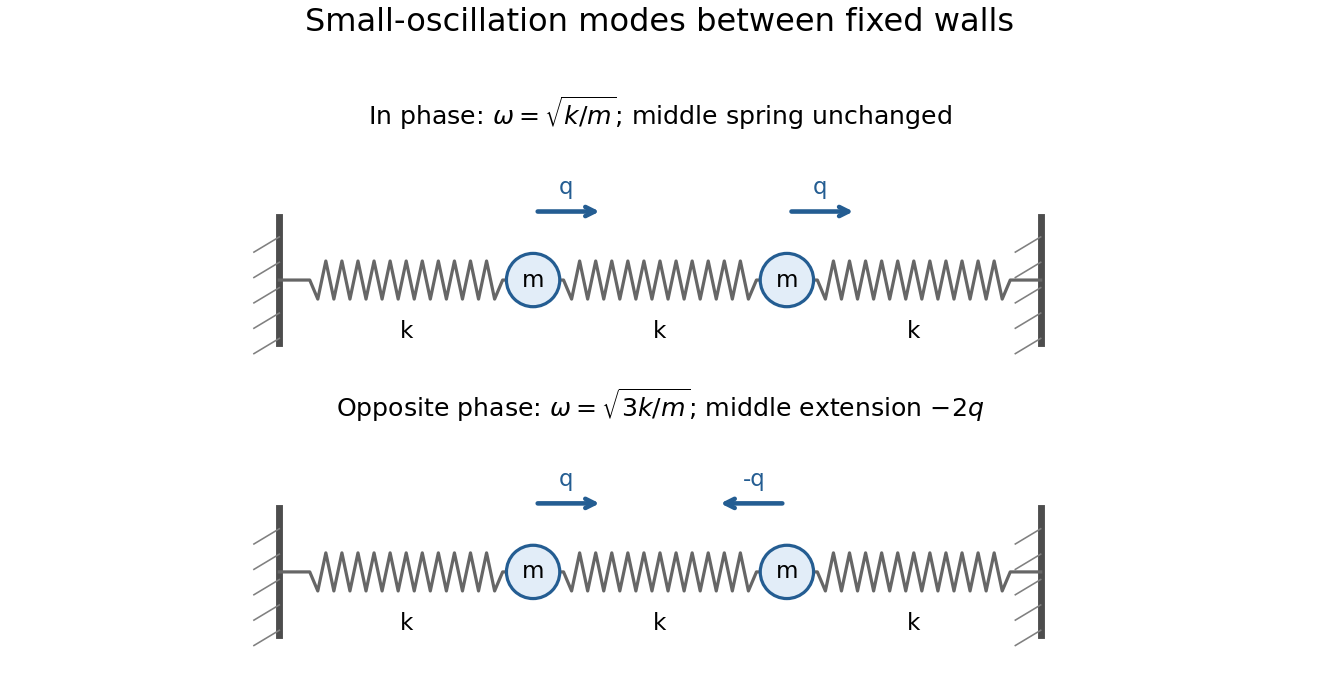

These are the normal modes of two equal masses between three springs.
For a real potential, the time-dependent Schrödinger equation isMultiply it by , combine with its conjugate multiplied by , and note that the real-potential terms cancel. This giveswhere the probability current isThe product rule gives the divergence identity because the gradient cross terms cancel.
For , the supplied radial identity gives for . The time factor gives , so the free equation holds forThe apparent origin singularity is removable: and , so the equation extends smoothly there as well. Since the spatial factor is real and its time dependence is a common phase, is real. Thus , while is independent of time. Both terms in the continuity equation vanish separately. This is a standing spherical wave; the real spatial factor carries no net radial probability current.
For a material volume , Newton's second law equates the rate of change of momentum to pressure and body forces:Apply the supplied Reynolds transport theorem to each component of , and apply the divergence theorem to the pressure force. The result isSince the material volume at the chosen time is arbitrary, the integrand vanishes pointwise for smooth fields. Dividing by positive density gives the Euler equationsAt a fixed time , a streamline is a curve tangent everywhere to the instantaneous velocity. Parametrize it by . Thenso is constant along it when the displayed directional derivative vanishes. Here time is held fixed: streamlines need not coincide with particle paths in an unsteady flow.
For , tryThe potential satisfies Laplace's equation, and its derivative with respect to vanishes at . The surface kinematic condition givesThe dynamic condition gives . Eliminating the nonzero amplitudes yieldsThus choosing either frequency sign satisfying this relation and produces the required harmonic wave.
For rate ,This function is finite near zero, so its third derivative there equals the third moment. Therefore
Let be an independent copy of and take . ThenIndependence of the copy is essential. The variable would instead have moment-generating function .
Take , where is uniform on and independent of . Conditional expectation givesFor in a sufficiently small neighborhood of zero, finiteness follows from finiteness of the original moment-generating function in such a neighborhood.
Rewrite the function asThese are equal mixture weights on the moment-generating functions of exponential distributions of rates and . Moment-generating functions finite near zero determine the distribution, so has that mixture law. Consequently
Write the stationary probabilities as . The equation reduces to . Together with , this givesThe positive transition probabilities make the two states communicate, so the stationary distribution is unique.
Articles were limited to the first 100 out of 130 total.
Articles by others on the same topic
There are currently no matching articles.