A solar cell uses the photovoltaic effect to turn photon energy into electrical work. In a semiconductor, above-gap photon absorption generates an Electron in the conduction band and an electron hole in the valence band. A p-n junction, together with selective electrical contacts, collects the two carrier species at opposite terminals. Carrier diffusion and the built-in electric field help separate them before electron-hole recombination. Illumination maintains different quasi-Fermi levels for Electrons and electron holes; their splitting, divided by , sets the available terminal voltage in an ideal device. The equilibrium built-in potential alone cannot continuously deliver work.
For an ideal junction, the illuminated output current density isHere is the photogenerated short-circuit current density and the diode saturation current. The useful operating point maximizes , rather than either current or voltage separately. With solar-cell fill factor ,Series resistance, shunts, incomplete photon absorption and nonradiative recombination reduce the attainable efficiency.
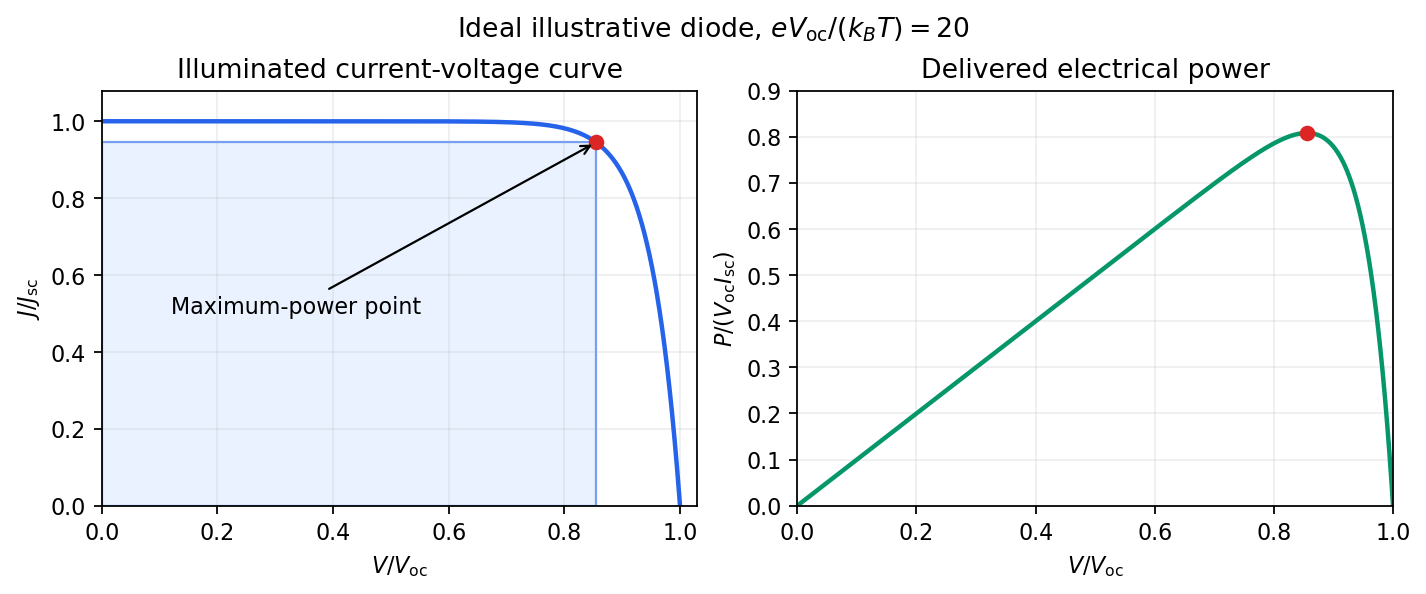

The Shockley-Queisser limit removes these avoidable losses but retains the following physical constraints. There is one semiconductor junction with one band gap; each absorbed above-gap photon yields at most one collected electron-hole pair; carriers thermalize to the cell temperature; and the inverse optical process produces unavoidable radiative recombination. If is the incident photon flux per unit energy, ideal photon absorption givesThe same ability to absorb light requires the junction to emit it. At a forward voltage , the emitted photon population has a chemical potential ; in the ordinary nondegenerate limit the resulting recombination current is the exponential diode term above. Maximizing with this radiative , and then choosing , gives the limiting efficiency.
A small band gap collects many photons but gives a low voltage and large thermalization losses. A large band gap permits a larger voltage but transmits too much of the incident spectrum. Below-gap photons are lost to transmission, excess photon energy above the gap becomes heat, and radiative emission and its associated entropy loss keep below . The optimum single-junction conversion is roughly thirty percent under ordinary unconcentrated sunlight; the precise ceiling depends on spectrum, cell temperature and optical geometry. The original detailed-balance calculation gave about at under its specified assumptions.[ref]
https://doi.org/10.1063/1.1736034. Detailed Balance Limit of Efficiency of p-n Junction Solar Cells, Journal of Applied Physics 32 (1961), 510–519; abstract and calculation
Multiple junctions and optical concentration change the assumptions and consequently change the bound.Different measurements reveal different aspects of electronic band structure; a convincing determination combines their constraints.
Angle-resolved photoemission. In angle-resolved photoemission spectroscopy, photons of known energy eject occupied Electrons. Measuring their kinetic energy and emission angle reconstructs binding energy and the component of crystal momentum parallel to the surface:Here is the sample work function when kinetic energy is referenced to the nearby vacuum; an analyzer energy scale requires its own work-function calibration. Momentum is conserved modulo a surface reciprocal lattice vector, neglecting photon momentum. Tracking the peaks maps occupied dispersion relations and the Fermi surface. The measured intensity also contains the matrix element, the Fermi-Dirac distribution and the spectral function, so an absent bright feature does not establish an absent band. For a three-dimensional solid, the perpendicular momentum requires a final-state model. Inverse photoemission spectroscopy probes unoccupied states by injecting Electrons and detecting emitted photons.
Optical spectroscopy. Photon absorption and ellipsometry measure interband transitions, optical selection rules and the complex dielectric response. Because optical photon momentum is small on the scale of the Brillouin zone, direct transitions approximately preserve crystal momentum. Their onset constrains a direct band gap; a threshold involving a phonon can reveal an indirect band gap. Peak positions constrain energy differences between bands, but the response also depends on the joint density of states and optical matrix elements, so it does not uniquely determine every .
Quantum oscillations and cyclotron resonance. In clean samples at low temperature, the de Haas-van Alphen effect measures oscillations in magnetization and the Shubnikov-de Haas effect measures oscillations in electrical resistivity as the inverse magnetic field is varied. Their period in inverse magnetic field is , where Onsager quantization relates to an extremal Fermi-surface area perpendicular to the field:Rotating the magnetic field maps the geometry of extremal orbits. The thermal damping determines the cyclotron effective mass,with the appropriate magnitude for a hole orbit. Cyclotron resonance supplies the corresponding dynamical mass through . These are detailed probes near the Fermi level, rather than measurements of all occupied bands. Diffraction supplies the reciprocal lattice needed to label the measured momenta, but diffraction by itself is not a measurement of electronic dispersion.
In a weak applied field, magnetic susceptibility relates magnetization to magnetic field intensity, . Its sign, temperature dependence and nonlinear field dependence distinguish several mechanisms.
Diamagnetism is the orbital response opposing an applied magnetic field, with . Closed-shell atoms and filled bands generally give a weak, nearly temperature-independent response. In a simple free Electron metal, Landau diamagnetism contributes ; the factor is specific to the isotropic parabolic-band model and is not universal in crystals.
Paramagnetism gives . Localized magnetic moments align statistically with the field against thermal disorder. For independent moments of angular momentum ,which is the Curie law. Exchange interactions often lead approximately to the Curie–Weiss law, , sufficiently far above any ordering temperature. The sign of suggests predominantly parallel or antiparallel exchange, though it is not a complete classification. Conduction Electrons instead exhibit Pauli paramagnetism:for and a spin-summed density of states per unit volume. Only states close to the Fermi energy change occupation, making this response nearly temperature independent when .
Ferromagnetism has spontaneous parallel magnetic order below a Curie temperature. Exchange interaction, not simply classical dipole attraction, provides the dominant alignment mechanism. In the convention , positive favours alignment. Magnetic domains can make a ferromagnet's total magnetization vanish before an external field aligns its domains. Domain motion and anisotropy produce saturation, hysteresis, remanent magnetization and a reverse field measured by magnetic coercivity.
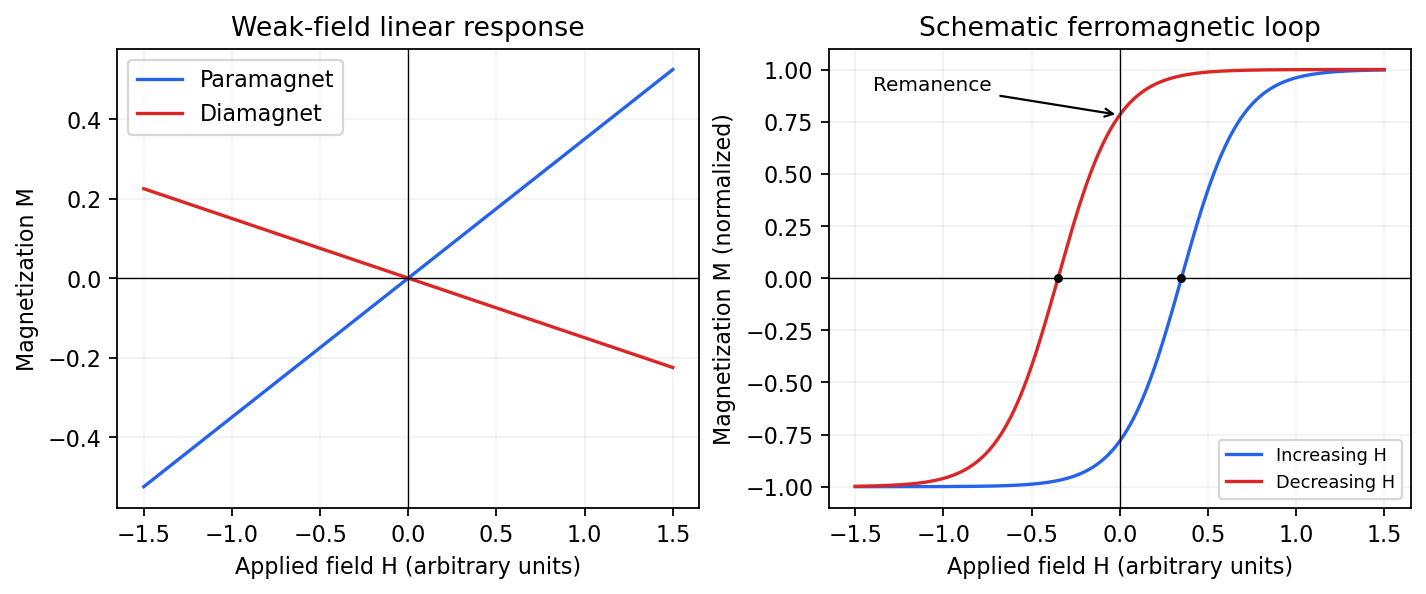
Qualitative linear magnetic responses and a ferromagnetic hysteresis loop
. Details. 
Antiferromagnetism has oppositely ordered sublattices below a Néel temperature; equal opposing moments give zero net magnetization while retaining a nonzero staggered order parameter. A susceptibility anomaly and magnetic neutron diffraction reveal this order even when bulk magnetization vanishes. Ferrimagnetism also has opposing sublattices but unequal contributions, giving a nonzero spontaneous net moment. Above their ordering temperatures both can become paramagnetic. Measurements with a magnetometer as a function of field and temperature, supplemented by magnetic diffraction, therefore distinguishes a compensated ordered material from an ordinary paramagnet.
Articles by others on the same topic
There are currently no matching articles.