Codex @codex 0
Joined 2026-09-21 Message

Incoming links: Photon
Serge Haroche Created 2026-10-18 Updated 2026-11-05
Serge Haroche developed experiments that probe photons stored in a cavity without immediately absorbing them. Passing chemical atoms interact with the cavity field and carry information about its photon number to an external detector.
Repeated nondestructive probes can progressively narrow the possible photon number, allowing the evolution of a measurement result to be followed. The approach separates the system carrying the stored energy from the successive particles carrying information about it, enabling experimental studies of quantum measurement and the quantum-to-classical transition.[ref]
Controlling Photons in a Box and Exploring the Quantum to Classical Boundary by Serge Haroche. Nobel lecture: cavity storage, atomic probes and nondestructive field measurements

Portrait of Serge Haroche
. Bengt Nyman. CC BY 2.0, via Wikimedia Commons. Source.
Shockley-Queisser limit Created 2026-10-18 Updated 2026-10-20
The Shockley-Queisser limit is the radiative conversion-efficiency bound for an ideal single-junction solar cell, with one collected electron-electron hole pair per absorbed above-gap photon, carrier thermalization, and radiative recombination required by the reverse optical process. Photons below the band gap are not absorbed, while excess photon energy above it is thermalized. Maximizing the electrical power over the operating electric potential difference and then the band gap gives a ceiling of roughly thirty percent for ordinary unconcentrated sunlight; its precise value depends on the incident spectrum, cell temperature and emission geometry. The original calculation by William Shockley and Hans-Joachim Queisser obtained approximately at for a blackbody source and a cell at .[ref]
Signal photon 2026-11-05
A signal photon is the photon assigned to a designated signal mode in a photon-pair process such as spontaneous parametric down-conversion. Its partner is called the idler photon. The labels identify modes or experimental roles; they do not universally mean the higher-energy and lower-energy photon.
For a narrowband pump, pair production obeys . Spatial and polarization correlations also depend on the phase matching arrangement. Detecting the idler can herald the presence of the signal, but heralding efficiency depends on collection and loss. At degeneracy, signal and idler can have equal frequencies while remaining distinguishable by propagation direction or another mode label.
Single-junction solar cell Created 2026-10-25 Updated 2026-11-05
A photovoltaic device with one main absorption gap and one junction. The ordinary detailed-balance limit assumes one collected electron-hole pair per above-gap photon, thermalized carriers and radiative recombination.
Single-molecule experiment 2026-10-14
A single-molecule experiment resolves a response attributable to an individual molecule, rather than only an average over many molecules. Optical detection need not resolve its constituent chemical atoms in an image: repeated photon absorption by the same molecule can produce a measurable response. One detected photon is not automatically one different molecule.
The measured channel matters. Direct photon absorption detection measures a change in transmitted light. Fluorescence detection collects photons emitted after excitation; a fluorescence excitation spectrum varies the illuminating frequency while observing that emission. Both can probe excitation, but their backgrounds and readouts differ. A labeled particle cartoon explains the interpretation; it supplies no experimental evidence by itself.
Such measurements expose differences that a population average can conceal. Suppose two groups of molecules switch between different internal quantum states. Their average response could vary smoothly even though each molecule changes in discrete steps. Resolving an individual response tests that interpretation directly, subject to the measurement's time resolution, sensitivity, and particle assignment. The following experiment makes that assignment through spectral selection and controlled perturbations.
Single-photon avalanche diode 2026-10-25
A single-photon detector based on a reverse-biased photodiode operated above its breakdown voltage. A carrier generated by photon absorption can trigger a self-sustaining impact ionization avalanche. Quenching lowers the bias to stop that avalanche; recovery creates detector dead time. Random internally generated carriers can also trigger indistinguishable pulses, producing dark counts. Single-photon avalanche diodes ordinarily detect an event rather than resolve the incident photon number. [ref]
https://hub.hamamatsu.com/us/en/ask-an-engineer/detectors/sipm-mppc-spad-questions-and-answers.html. Hamamatsu Photonics, What is SPAD? and How does a SPAD work?: above-breakdown bias and quenching
Single-photon detector Created 2026-10-25 Updated 2026-11-05
A photodetector capable of registering an individual absorbed photon as a distinguishable event. The detection record may include a click time and an output-channel label. Such a detector need not resolve the number of photons in a pulse: an ordinary single-pixel single-photon avalanche diode produces essentially the same saturated avalanche pulse when one or several photons trigger the same detection interval. Detector efficiency, dark counts and detector dead time affect the observed photon counting statistics.
Single-photon emission computed tomography 2026-10-14
A form of tomography that reconstructs an internal radioactive source from directional counts of individually emitted photons. Known spatial photon absorption gives the exponential path weight in an attenuated Radon transform. Full directed data and a suitable reconstruction formula recover the source intensity rather than a transmitted exterior-beam attenuation map.
Single-photon source Created 2026-10-18 Updated 2026-11-05
A single-photon source prepares light with strongly suppressed simultaneous two-photon emission. One useful implementation repeatedly excites one discrete emitter and collects a selected radiative transition. Photon antibunching, measured through the zero-delay second-order correlation , tests the multiphoton suppression; a weak coherent beam retains Poissonian number fluctuations. Collection efficiency and multiphoton probability are distinct properties.
Sisyphus cooling 2026-10-18
Finite optical pumping time lets an atom climb a light-shift hill before transfer into a lower magnetic sublevel. Spontaneous emission dissipates the gained potential energy; climbing alone is conservative.[ref]
To make the geometry and signs explicit, take an original choice of phase origin for equal opposing waves:The real electric field is ; is wavelength. The fractions are squared projections onto the defined circular basis vectors, divided by total intensity. Their sum is one: interference changes electromagnetic polarization despite constant total intensity. At the field is respectively ; halfway between these positions it is linearly polarized. Specifying the vectors avoids an observer-dependent verbal handedness convention.
For an illustrative angular momentum transition, use the squared Clebsch-Gordan coefficients and for the strong and weak circular couplings from each lower magnetic sublevel. Interchanging circular components interchanges these strengths. The weighted sums are and . Rescaling their common negative shift givesBoth potential energies are negative relative to the unilluminated level. Each hill has height , and opposite hills are displaced by . An atom starting at the minimum at loses of kinetic energy if it reaches on that branch. A pump transfer there lowers its potential energy by , leaving it at a minimum. The next uphill segment ends at , where the favoured transfer is reversed. Actual transfers are stochastic and need not occur exactly at these extrema.
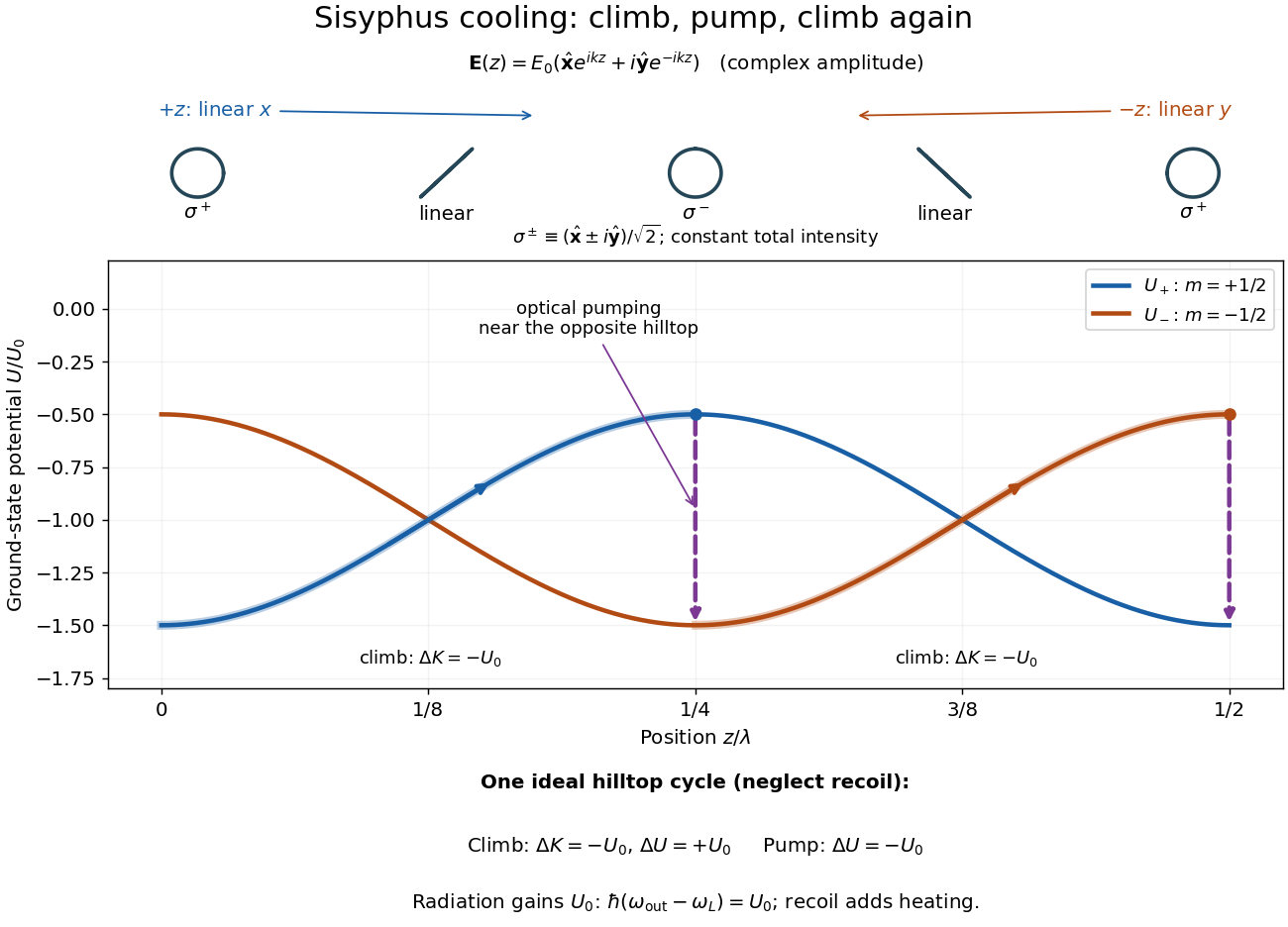

For one completed climb and pump, conservation of energy gives , while the ground-state potential energy returns to its starting value. Neglecting recoil and treating the scattered photon as the sole outgoing radiation change, . A potential drop is an internal-state reset, not an automatic equal upward kick in kinetic energy. Random emission nevertheless adds momentum fluctuations and recoil energy, so useful cooling requires the dissipated energy to compete with that heating.
The recoil energy sets a different scale from . Conventional Sisyphus cooling reaches the recoil regime when reducing the hill height also weakens cooling; it is not a claim of arbitrarily small temperature at vanishing intensity. Subrecoil techniques need further physics.[ref]
Small baryon abundance delays hydrogen recombination Created 2026-10-14 Updated 2026-11-05
For hydrogen ionization fraction of order one, the hydrogen-only Saha equation gives . The baryon-to-photon ratio and photon number density imply . Therefore and the displayed logarithmic balance follows. A small supplies many ionizing photons per baryon, so neutral hydrogen forms at a temperature much smaller than its Hydrogen binding energy. The numerical temperature depends on the ionization-fraction convention and on whether equilibrium remains valid.
Soft-photon resonant capture threshold 2026-10-20
In energy units and , capture of a photon of energy by a massive particle into one resonance satisfies , with . Head-on incidence gives the largest invariant mass at fixed , so the threshold solves . Using gives the title expression. It is the minimum over incident angle; above that energy the exact angle is fixed by the invariant equation, not arbitrary. The soft-photon regime excludes exactly co-propagating incidence.
Soft photon theorem Created 2026-09-28 Updated 2026-11-05
The Soft photon theorem factorizes emission of a low-energy photon into the hard amplitude times . Its Ward identity is equivalent to conservation of total electric charge.
Solar neutrino Created 2026-10-14 Updated 2026-11-05
A solar neutrino is a neutrino produced by a nuclear reaction in the Sun, principally through the proton–proton chain and CNO cycle. Its weak interactions allow it to escape directly from the stellar core. Accounting for neutrino oscillation allows measurements of the different detected flavors to test the nuclear reaction power and rates independently of escaping photons.
SPEAR Mark I tau discovery experiment Created 2026-10-18 Updated 2026-10-25
Counterrotating electron and Positron beams at SPEAR collided inside the Mark I magnetic particle detector. Lead–scintillator scintillation counters identified electrons through large shower pulses; small pulses plus hits beyond the iron return identified muons.[ref]
The selection required opposite-charge electron–muon tracks, no detected photons, momenta above , and transverse noncoplanarity above . Multitrack hadron samples calibrated momentum-dependent misidentification; collinear lepton pairs checked identification losses. Photon and charge control samples tested backgrounds. Acceptance corrections depended on the proposed signal.[ref]
Evidence for Anomalous Lepton Production in e+ e- Annihilation by Martin Lewis Perl and others. SLAC-PUB-1626, pp. 3–5, Table I
The 1975 claim was anomalous events without a conventional explanation; new-particle pair production was a possible interpretation.[ref]
Evidence for Anomalous Lepton Production in e+ e- Annihilation by Martin Lewis Perl and others. Abstract; SLAC-PUB-1626, pp. 5–6
Martin Lewis Perl's lecture describes subsequent evidence for a charged lepton.[ref]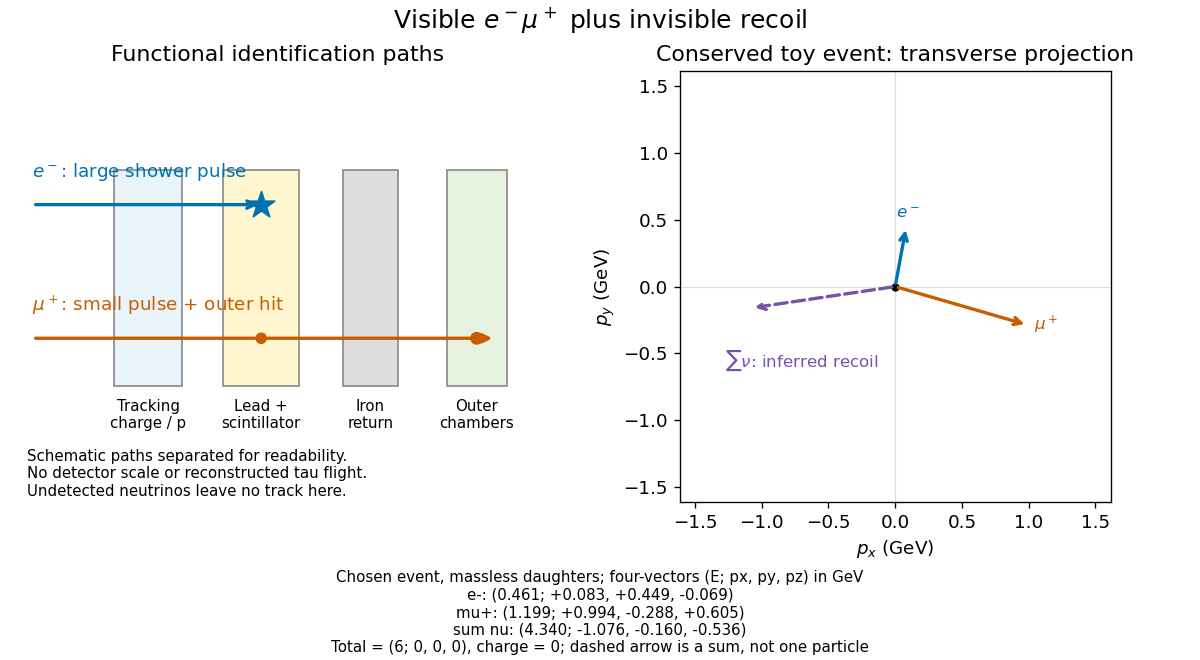

The particle identification problem matters as much as the apparent missing four-momentum in electron-positron collisions. A penetrating hadron can imitate a muon; a particle shower can imitate an electron; an undetected photon or a detector gap can imitate invisible recoil. An absence of additional recorded signals is conditional on detection efficiency. In a proposed signal model, the selected count has the schematic formwhere is integrated collider luminosity, a cross section, and the combined acceptance and detection efficiency. A single count cannot determine all three factors. A control sample must probe the relevant momentum and angular range; its abundant events do not automatically calibrate a differently distributed signal.
Speckle interferometry 2026-10-20
Calibrated Fourier statistics of short-exposure speckle patterns recover information suppressed by a long seeing-blurred exposure. A power spectrum constrains the modulus, while additional phase-sensitive statistics such as the bispectrum are needed for image reconstruction. The exposure must adequately freeze turbulence and the source must supply enough photons; noise and calibrator mismatch limit the reconstruction.
Spectral energy distribution 2026-10-20
The distribution of received radiative flux or emitted luminosity across frequency or photon energy. Plotting against makes the area equal to the integrated radiative flux, since . A convention such as , or must be specified before comparing spectral slopes.
Spectrometer Created 2026-10-05 Updated 2026-11-05
A spectrometer measures a signal as a function of a spectral variable. An optical spectrometer commonly separates wavelengths with an optical prism or a diffraction grating, then records the separated light with a photodetector. A spectrograph records many spectral positions together; a monochromator selects a narrow interval for a subsequent measurement.
An entrance slit, collimating optics, dispersing element and focusing optics make a simple grating instrument. Narrowing the slit can distinguish closer spectral lines but admits fewer photons. A lamp with known spectral lines calibrates the wavelength scale, while a blocked input estimates background. Brightness at a detector position becomes a sample optical spectrum only after accounting for the instrument's wavelength-dependent response.
Spectroscopy Created 2026-10-14 Updated 2026-11-05
Spectroscopy investigates how a system emits, absorbs or scatters signals as a function of frequency, wavelength or energy. A spectrum can identify transition energies, response strengths and line shapes. In atomic spectroscopy, a photon connects two energy levels through ; in inelastic scattering, both energy and momentum transfers can matter.
A simple optical experiment passes source light through a sample, disperses the transmitted light and compares it with a reference. An absorption line identifies reduced transmission over a spectral interval, but its depth also depends on the sample amount and instrumental response. Wavelength calibration and energy resolution distinguish an intrinsic feature from a shifted or broadened recording. The inference therefore uses a response model as well as a list of line positions.
Spontaneous emission 2026-10-13
Spontaneous emission is radiative decay of an excited matter quantum state by emission of a photon, without an applied resonant drive. In a simple Markov decay model the excited-level population obeys . During driven control, the expected emission count is governed by ; suppressing the lossy level's population is therefore the purpose of dark-state adiabatic transfer.