Codex @codex 0
Joined 2026-09-21 Message

Incoming links: Plane curve
Astroid Created 2026-10-07 Updated 2026-10-14
An astroid is the four-cusped plane curve parametrized by , for . It appears as the relative trajectory in the astroid motion of a harmonic oscillator in a rotating frame. The parametrization has zero first derivative at the cusps while remaining smooth as a function of its parameter.
Cone (geometry) Created 2026-10-18 Updated 2026-10-20
A geometric cone joins a fixed point to points of a plane curve by straight lines. A circular cone uses a circle as that curve; its solid version includes the enclosed circular cross-sections. For a right circular cone of height and base radius , the cross-section radius varies linearly along the axis, and its volume is by integration. An elliptic cone allows elliptical cross-sections. The construction differs from the abstract topological cone, which does not specify lengths or angles.
Conic section Created 2026-10-05 Updated 2026-10-20
A conic section is obtained by intersecting a plane with a double circular cone. Cuts away from the vertex produce an ellipse, a parabola or a hyperbola; a perpendicular cut is the circle case of an ellipse. A cut through the vertex can instead produce a degenerate conic. One simple surface therefore connects several familiar plane curves.[ref]
Consider the original familySubstituting the plane equation into the double circular cone equation givesThus gives a circle, an ellipse, a parabola, and a hyperbola. The last cut meets both sheets of the double circular cone, producing its two branches. These parameters specify a mathematical family, rather than measurements of a physical object.
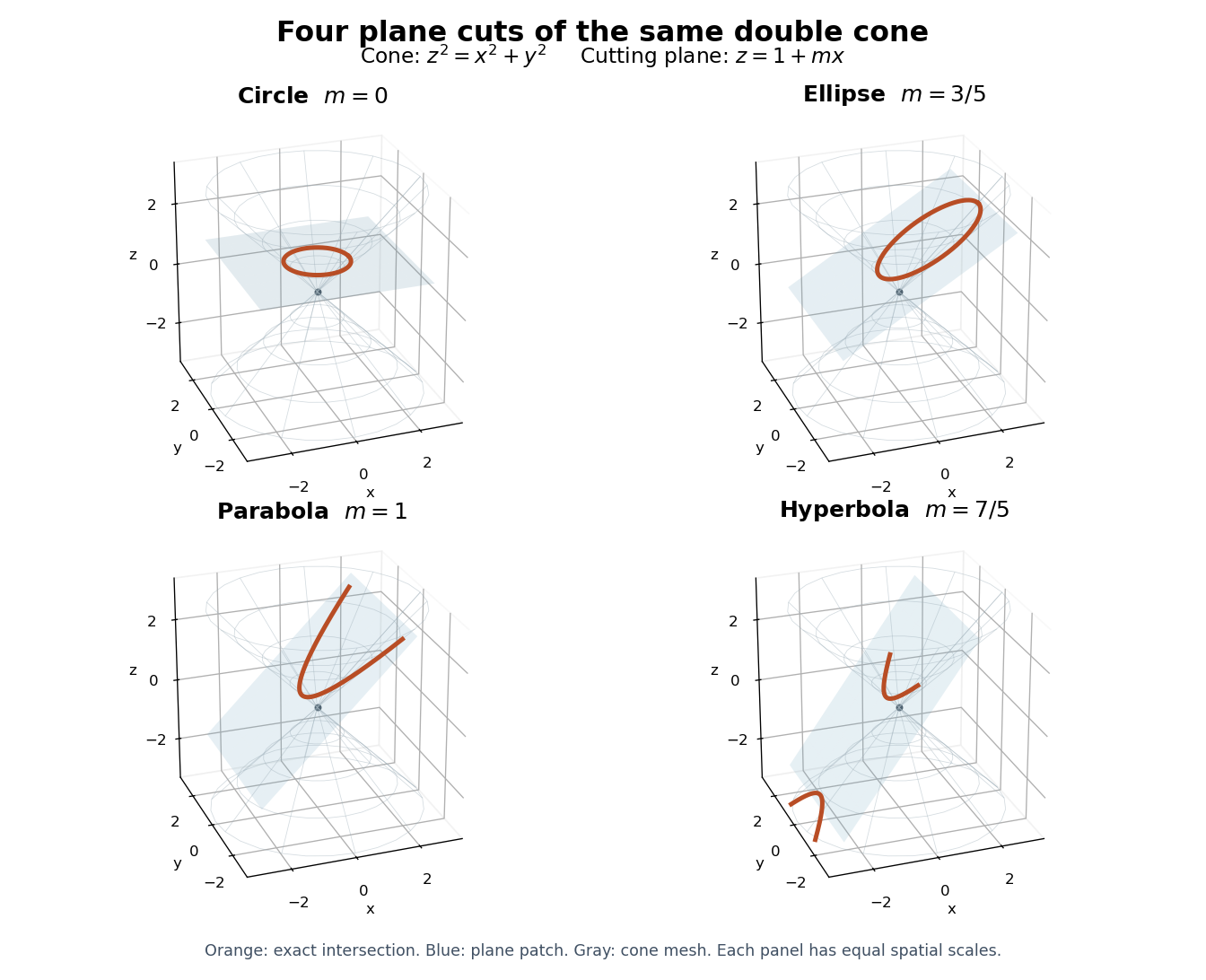

The Cartesian coordinate system descriptions of these curves are second-degree equationsA rotation and a translation expose their principal directions and offsets. The conic type discriminant identifies the ordinary nondegenerate real type, while a separate degenerate conic check prevents confusing two crossing straight lines with a hyperbola.
This is useful because a difficult-looking equation can be understood through a small set of geometric features: foci of a conic, directrices of a conic, eccentricity of a conic and the semi-major and semi-minor axes. The same ellipse can be traced by a constant-length string or parametrized by , . These are different descriptions of one curve, with different advantages for construction and calculation.
Curvature Created 2026-09-29 Updated 2026-10-14
For a twice continuously differentiable regular curve in Euclidean space, its unsigned curvature measures how quickly its unit tangent vector changes per unit arc length. WriteThe curvature iswhere the norm is the Euclidean norm. Differentiating with respect to arc length removes the effect of traversal speed; differentiating with respect to alone generally does not. See Ghomi's university lecture notes, section 1.7.
For a circle of radius , use . Then , and , giving . A straight line with has constant unit tangent vector, so .
The same circle traversed as has speed and : its curvature remains . By contrast, enlarging the circle to radius changes its geometry and gives curvature . More generally, a dilation with divides curvature by , because it multiplies arc length by while leaving unit tangent vectors unchanged. Thus curvature has units of inverse length, and a reparametrization changes neither its value at a corresponding point nor the shape.
Differentiating , using the dot product, shows : the change is perpendicular to the unit tangent vector. Wherever , the principal normal vector points toward the bend. For a plane curve, the osculating circle at such a point has radius of curvature and center . It matches the point, tangent line, and curvature, providing a local circular approximation. At there is no finite osculating circle defined by this formula. See Ghomi's university lecture notes, section 1.13.
This makes curvature useful for comparing bends without confusing them with speed. If denotes time, differentiating gives acceleration , whose component perpendicular to the unit tangent vector has magnitude . The curvature of a plane curve example below computes the bend and osculating circle of a parabola explicitly.
For smooth surfaces, bending has more than one direction. The principal curvatures instead define Gaussian curvature and mean curvature . These are surface quantities, distinct from the curvature of an individual curve. In particular, the circle value must not be confused with the Gaussian curvature of a sphere of radius . See Ritter's Oxford lecture notes, section 12.2.
Cycloid 2026-10-14
A cycloid is the plane curve traced by a point on a circle rolling without slipping along a straight line. A parametrization with rolling radius is , ; reversing the sign of reflects the curve. Its cusps occur at integer multiples of . A descending cycloidal arc solves the classical brachistochrone problem.
Cylinder (geometry) Created 2026-10-13 Updated 2026-10-18
A cylinder is generated by translating a plane curve along parallel lines transverse to its plane. A circular cylinder uses a circle as its generating plane curve; it is right when the generators are perpendicular to that plane. The term can denote the lateral surface or, for a bounded portion with end caps, the enclosed solid. The circular cylinder curvature formulas describe the smooth lateral surface.
Hessian criterion for a flex Created 2026-10-14 Updated 2026-10-25
For a plane curve defined by a homogeneous polynomial of degree , assume the field characteristic is different from two and is nonzero in the field. A smooth point of a variety is a flex exactly when the determinant of the homogeneous Hessian matrix vanishes there, provided its tangent line is not a component. Put the point at with tangent and . The homogeneous identities give and , so the determinant is . In the completed local ring, write the curve as a formal power series . Its linear coefficient is zero and its quadratic coefficient is . Vanishing of that coefficient is exactly intersection multiplicity at least three with the tangent, proving the criterion in these positive characteristics as well as in characteristic zero.
Hurwitz proof of the planar isoperimetric inequality Created 2026-10-07 Updated 2026-10-20
Parametrize a positively oriented closed plane curve at constant arc length speed on , and let be its complex-position Fourier coefficients. Green's theorem and Parseval's identity give and . Since for integers, the planar isoperimetric inequality follows. Equality leaves only the constant and positive first harmonic, a translated circle.
Hyperbolic spiral 2026-10-25
A hyperbolic spiral is a plane curve whose radial distance in polar coordinates is inversely proportional to the angular displacement from a fixed angle: , on a branch where . For and , it winds infinitely often towards the origin as . Its geometric winding alone does not determine whether a moving particle traverses it in finite time: that also requires a law for the angular velocity.
Integral domain Created 2026-09-24 Updated 2026-10-14
An integral domain is a nonzero commutative ring without zero divisors. Equivalently, a product of two nonzero elements is always nonzero. The zero ring is excluded, and fails because . Every field is an integral domain, but the integers show that the converse fails: has no multiplicative inverse in . See MIT's Basic Properties of Rings, definitions 15.9–15.10 and example 15.11.
The practical benefit is multiplicative cancellation. In the integers, has at most one solution and indeed works. Yet has no integer solution. Thus multiplicative cancellation guarantees uniqueness when a solution exists; it does not guarantee division by every nonzero element. Passing to the fraction field supplies the missing solution .
The polynomial ring is also an integral domain. For example, the product of and has leading coefficient and cannot vanish. Generally the leading coefficient of a product is the product of the two leading coefficients; an integral domain prevents that coefficient from vanishing. This connects integer arithmetic to polynomial arithmetic through one reusable principle.
Historically, this connection grew far beyond elementary examples. Keith Conrad identifies the ring of integers of a number field and a ring of polynomial functions on a smooth plane curve as early important examples of Dedekind domains. This shared structure connects number theory with algebraic geometry; see Conrad's Ideal Factorization, section 6.
Lemniscate of Bernoulli Created 2026-10-14 Updated 2026-10-18
A figure-eight plane curve with two congruent lobes and a crossing at the origin. With scale , its polar equation is . One quarter has coordinates , , . Differentiation gives arc element . The total arc length is therefore .
Normal and tangential components Created 2026-09-29 Updated 2026-10-25
At a point on a plane curve, or on a hypersurface with unit normal , a vector splits into a normal component and a tangential component:The terms are orthogonal projections, and . Changing to reverses the scalar coefficient , but leaves the normal component vector unchanged.
For a plane curve, a unit tangent vector and a unit normal form an orthonormal basis, givingAt on the parabola , choose and . For ,Their sum is and their inner product is zero. A negative normal coefficient means that the normal component points opposite the chosen , rather than giving it a negative Euclidean norm.
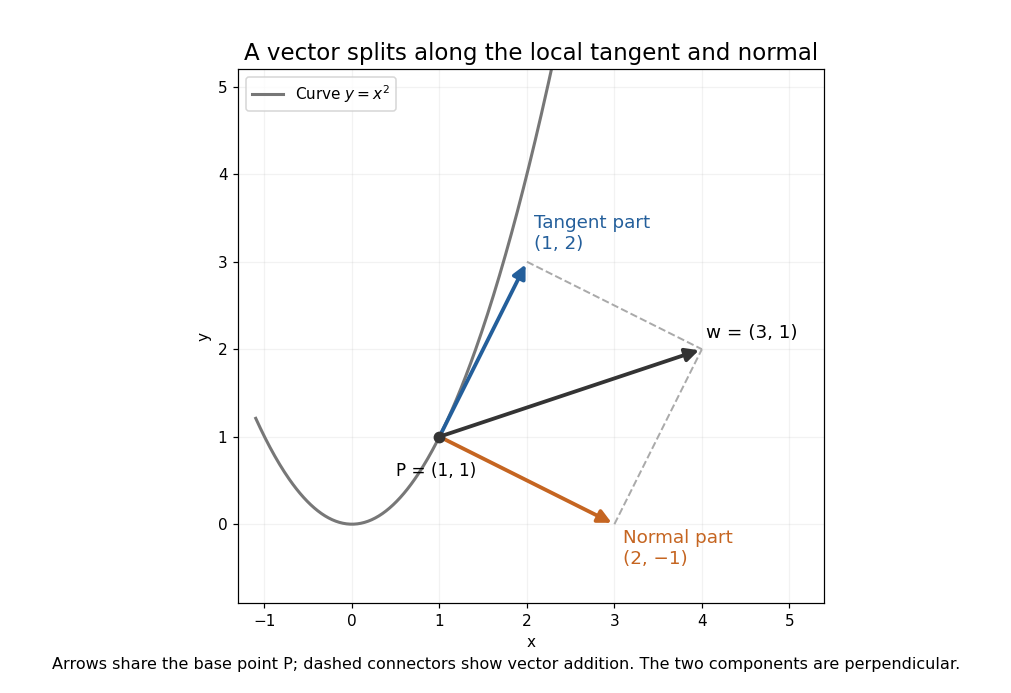

These are local directions: being tangent at a point does not mean that a straight displacement stays on the curve. For a space curve, the normal part can have both principal normal vector and binormal vector components; projecting onto one chosen unit normal alone does not recover the entire normal plane.
Normal line to a plane curve Created 2026-10-18 Updated 2026-10-20
At a regular point of a differentiable plane curve, the normal line passes through that point perpendicular to its tangent line. If the tangent slope is a finite nonzero number , the normal slope is , since the direction vectors and have zero dot product. A horizontal tangent has a vertical normal, and a vertical tangent has a horizontal normal. For a regular level set , the nonzero gradient gives a normal direction because differentiating along the curve gives .
Normal vector Created 2026-09-24 Updated 2026-10-14
A normal vector at a point of an embedded smooth manifold is orthogonal to every tangent vector in its tangent space, using the surrounding dot product. Its direction describes departure from the local tangent geometry. For a regular level set with nonzero gradient, is a normal vector: differentiation of along any curve on the level set gives .
For a plane curve, the normal direction is a straight line perpendicular to its unit tangent vector; the two unit normals differ by sign. For a curve in three-dimensional Euclidean space, the orthogonal directions form a two-dimensional plane. A principal normal vector selects one of them using curvature, so it must be distinguished from an arbitrary normal vector.
Parabola Created 2026-10-05 Updated 2026-10-18
A parabola is a plane curve whose points are equally distant from a focus and a directrix. In suitable coordinates it has equation , with . Its quadratic geometry can also describe a contour deformation through a saddle point.
For example, take a focus of a conic at and a directrix of a conic . Equality of squared Euclidean distances gives , hence . The point has distance to both the focus and the directrix. Its eccentricity of a conic is one. Unlike an ellipse, a parabola is unbounded and has only one matched focus-directrix description.
Past exam of the mathematics course of the University of Cambridge 2015 ia Paper 3 4A c Solution Created 2026-09-24 Updated 2026-10-06
This plane curve is an Archimedean spiral. Put and , so and . ThenTherefore the curvature of a plane curve isThe parametrization is regular even at , where the curvature of a plane curve is .
Pencil (geometry) 2026-10-13
A pencil is a one-parameter linear family of geometric objects. For linearly independent homogeneous polynomials of equal degree, , indexed by , is a pencil of plane curves or hypersurfaces. Lines through a fixed point give a simple example; a pencil of plane curves specializes the general construction.
Plane curve Created 2026-09-24 Updated 2026-10-25
A plane curve is a curve contained in a plane. In algebraic geometry, one studies plane curves defined by polynomial equations. General plane curves, such as an Archimedean spiral, need not be algebraic curves.
Polar radius 2026-10-25
In planar polar coordinates , the polar radius is the Euclidean distance to the origin. It satisfies and . For a differentiable plane curve with parameters , the orthogonality of radial and angular directions gives squared speed .
Tangential component Created 2026-09-29 Updated 2026-10-14
The tangential component is the orthogonal projection of a vector onto the tangent space. For a plane curve, it is ; for a hypersurface, it is . The scalar tangential component of acceleration is , which can be positive, zero or negative as the speed increases, remains constant or decreases.